


M&S Shakes Up Fashion Supply Chain to Spark Online Growth

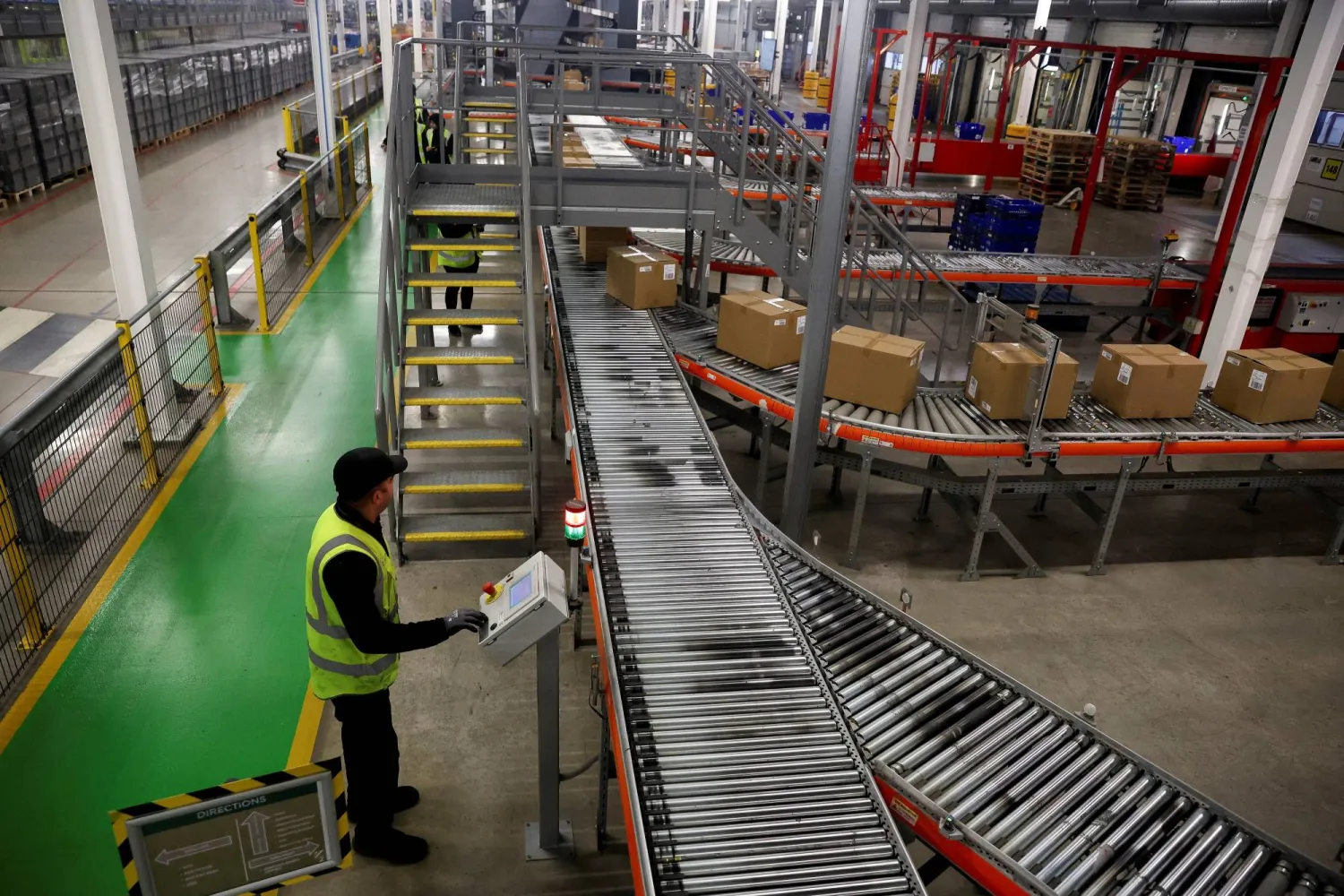
An employee oversees packages being transported on a conveyor belt through the automated sorting facility at a Marks & Spencer (M&S) distribution center in Castle Donington, Leicestershire, Britain, November 7, 2025. REUTERS/Temilade Adelaja
TT

M&S Shakes Up Fashion Supply Chain to Spark Online Growth

An employee oversees packages being transported on a conveyor belt through the automated sorting facility at a Marks & Spencer (M&S) distribution center in Castle Donington, Leicestershire, Britain, November 7, 2025. REUTERS/Temilade Adelaja

Marks & Spencer is revamping its supply chain from "factory to floor,” the retailer's new fashion boss told Reuters, as it looks to double annual online non-food sales to nearly 3 billion pounds ($4 billion).

John Lyttle, who joined M&S as managing director fashion, home and beauty (FH&B) in March, said the 141-year-old retailer has regained its footing after a cyberattack in April paralyzed online sales and cost about 300 million pounds in lost profit.

He said M&S had done a good job re-establishing its value, quality and style credentials, with FH&B sales up 9% over three years and market share rising to 10.5% in 2024/25, from 9.1% in 2021/22.

It now needs to focus on becoming a truly omnichannel retailer, said Lyttle, in his first interview since joining M&S.

"So from where we make our goods, to how we flow that all the way into our warehouses, how our warehouses operate, and then how we feed those products out to our customers - whether that's online, whether that's in our stores," he said.

Simplifying and cutting supply chain costs has been a priority for many companies after COVID-19, war in Ukraine, Red Sea shipping disruption and broader global trade upheavals, most recently due to US tariffs.

MORE LONG-TERM PARTNERSHIPS WITH SUPPLIERS
M&S, which mainly sources products from China, Bangladesh, India, Pakistan, Vietnam, Cambodia, Sri Lanka and Turkey, wants to create more long-term partnerships to reduce the risks to supplies.

While progress has been made in recent years through consolidating suppliers, M&S has "much more opportunity to go after through resetting how we buy, unlocking more margin from our scale, increasing cost discipline and reducing complexity," said Lyttle.

The cyber hack knocked what had been a strong turnaround under Stuart Machin, CEO since 2022, with M&S' 2024/25 profit its highest in over 15 years and its stock at near-decade highs.

Dominic Younger, fund manager at Columbia Threadneedle Investments, one of M&S' top 10 investors, said it had made huge and hard-won strides in fixing the FH&B front-end.

"But one of the most exciting aspects from an investment point of view is that, together with continuing to drive the food division, there is so much opportunity out there in terms of modernising the clothing supply chain," he said.

With a clothing customer base of 21 million, Lyttle said overhauling M&S' supply chain can double FH&B's online sales over the long term from about 1.4 billion pounds in 2024/25, while lifting its online operating margin to double digits.

M&S is also aiming to increase online's share of total FH&B sales from about 34% to 50% in the medium term, said Lyttle, a former Boohoo CEO who was also an executive at Primark.

"If you look at our online sales participation today versus the market, we're about 10 (percentage) points behind," said Lyttle, noting M&S was even further behind some top competitors, such as Next.

Next, an early adopter of warehouse and distribution automation, makes about 59% of its UK sales online.

M&S can increase online sales by optimising the breadth and depth of its product range, encouraging more customers to use its more than 1,000 stores for 'click and collect' and returns, and utilising more channels such as lockers, Lyttle said.

It will also introduce more payment methods and relaunch its 'Sparks' loyalty programme to drive more frequent purchases.

INVESTMENT IN AUTOMATION
Part of M&S' plan is a 120 million pound three-year investment in automation to increase capacity, reduce complexity and deliver cost savings worth "multi-millions" of pounds.

M&S is spending 600 million to 650 million pounds on capital investment in 2025/26 of which between 200 million and 250 million is being invested in technology infrastructure, store maintenance and upgrades to its logistics fleet.

In its vast Castle Donington warehouse in central England, M&S is investing in robotic technology that will speed up sorting 'click and collect' parcels and extend cut-off times for next-day delivery to nearly midnight.

Further investment at the 900,000-square foot site and another in Bradford, northern England, will increase boxed storage capacity by more than 30%.

M&S is also accelerating the implementation of a new planning platform, with a new merchandising capability already delivered, automating what was previously largely a manual task.

Cost savings will not need to come at the expense of the 63,000-strong M&S workforce, Lyttle said, adding: "Growing our business means we're moving more product, therefore we need more people to help us do that".

CYBER HACK LESSONS
While the cyber hack, which forced M&S to revert to manual processes, had not changed its strategy or longer-term plans, important lessons had been learned, Lyttle said.

"It's not just lessons of the actual incident. It's just general things that we could have done better, or we could have done faster," he said, without giving away any specifics.
"You don't want people who impacted us at the beginning to understand in any way," he added.



Fashion Commission Launches 1st Executive Master’s Program in Riyadh

Fashion Commission Launches 1st Executive Master’s Program in Riyadh
TT

Fashion Commission Launches 1st Executive Master’s Program in Riyadh

Fashion Commission Launches 1st Executive Master’s Program in Riyadh

The Fashion Commission announced the launch of the first Executive Master’s program to be delivered in Riyadh, developed in collaboration with the world-renowned Institut Français de la Mode (IFM).

The new program marks a significant leap in advancing fashion education and executive training within the Kingdom, according to SPA.

The Executive Master’s in Strategic Management of Fashion & Luxury represents a new milestone in fashion education, taking place in Riyadh for the first time. It is a 15-month hybrid executive master’s degree track designed for high-potential professionals seeking advanced executive training while continuing their careers. Delivered through a blend of in-person modules in Riyadh and Paris, alongside supervised online learning, the program equips participants with strategic, managerial, and analytical expertise tailored to the rapidly evolving fashion and luxury sector.

Designed with market needs in mind, the executive master’s curriculum covers creation and design, brand strategies, sustainability, new consumer behaviors, retail innovation, fashion media, collection management, and future industry perspectives. Participants will also complete a thesis that contributes new knowledge to the regional and global fashion landscape.

The program is taught by IFM’s internationally recognized faculty, experts in fashion history, sustainability, consumer behavior, design, and luxury management, alongside industry leaders from major global houses, fashion federations, media groups, and innovation-driven organizations.

This landmark program builds on the Fashion Commission’s ongoing partnership with IFM since June 2022. Within the first year, the collaboration introduced high-level educational initiatives, including the Advanced Management Program for Luxury Fashion and the Executive Master’s in Luxury Fashion, designed to elevate local talent and strengthen the Kingdom’s creative workforce.

These programs have contributed to developing the skills and knowledge required to support a world-class fashion ecosystem.

The launch of the Executive Master’s marks a pivotal step in establishing Riyadh as an education hub for the fashion and luxury sectors. By bringing a master’s qualification of this caliber directly to the Kingdom, the Fashion Commission reinforces its commitment to enabling professional growth, supporting innovation, and creating globally competitive talent pipelines.


Nike Shares Rise as Apple’s Cook Doubles His Bet on CEO Hill’s Overhaul Effort

A jogger wearing Nike shoes runs along the Charles River in Cambridge, Massachusetts, US, March 18, 2019. (Reuters)
TT

Nike Shares Rise as Apple’s Cook Doubles His Bet on CEO Hill’s Overhaul Effort

A jogger wearing Nike shoes runs along the Charles River in Cambridge, Massachusetts, US, March 18, 2019. (Reuters)

Nike shares rose 5% in early trading on Wednesday after Apple CEO Tim Cook doubled his personal stake in the sportswear maker, raising his bets on the margin-pinching turnaround efforts led by CEO Elliott Hill.

Cook, who has been on Nike's board since 2005, bought 50,000 shares at $58.97 ‌each, according to ‌a regulatory filing. As of December ‌22, ⁠he holds about ‌105,000 shares, which is now worth nearly $6 million.

It was the largest open market stock purchase for a Nike director or executive and possibly the largest in more than a decade, said Jonathan Komp, analyst at Baird Equity Research.

"(We see) Cook's move as a positive signal for the progress under CEO Elliott Hill and Nike's 'Win ⁠Now' actions," Komp said.

The purchase comes days after Nike reported weaker quarterly margins and weak ‌sales in China even as CEO ‍Hill tries to revive demand ‍through fresh marketing plans and innovation focused on running and sports, ‍while phasing out lagging lifestyle brands.

He has also attempted to mend Nike's ties with wholesalers such as Dicks Sporting Goods to increase visibility among shoppers amid stiff competition from newer brands.

However, the strategy has strained Nike's margins, which have been declining for over a year, while its efforts to win back its ⁠premier position in discount-friendly China appears to be faltering.

Nike's shares have slumped nearly 13% since it reported results on December 18 and are on track for the fourth straight year of declines. They were trading at $60.19 on Wednesday.

Cook has been a lead independent director of Nike since 2016 when co-founder Phil Knight stepped down as its chairman.

The Apple CEO "remains extremely close" with Knight, Komp said, adding that he has advised Nike through key strategic decisions including Hill's appointment last year.

Board director and former Intel CEO ‌Robert Swan also bought about 8,700 shares for about $500,000 this week.


Etro Founding Family Exits Group as New Investors Including Türkiye's RAMS Global Join

L Catterton, a private equity firm backed by French luxury giant LVMH, will remain Etro's majority owner. Reuters
TT

Etro Founding Family Exits Group as New Investors Including Türkiye's RAMS Global Join

L Catterton, a private equity firm backed by French luxury giant LVMH, will remain Etro's majority owner. Reuters

The founding family of Italian fashion house Etro has sold the minority stake it still owned in the brand to a group of investors including Turkish group RAMS Global, the company said on Friday.

L Catterton, a private equity firm backed by French luxury giant LVMH, will remain Etro's majority owner and "will continue to actively support the brand's long-term growth strategy," Etro added, according to Reuters.

The new investors comprise also Italian fashion group Swinger International and small private equity firm ⁠RSI.

In addition to buying the stake, they all subscribed to a capital increase that will lower L Catterton's holding in Etro to between 51% and 55% from around 65%.

When including both the acquisition and the capital increase, the deal is worth around 70 ⁠million euros ($82 million), two sources close to the matter said. Etro did not disclose financial details.

Chief Executive Fabrizio Cardinali will remain at the helm, while Faruk Bülbül, representing RAMS Global, will become chairman of the board.

L Catterton bought a 60% stake in the brand known for its paisley motif four years ago, and it slightly increased the holding over the years.

The company, founded by Gimmo Etro in 1968, has ⁠been struggling with its turnaround. Last year it posted a net loss of 23 million euros with net revenues declining to 245 million euros from 261 million euros, according to filings with the local chambers of commerce reviewed by Reuters.

Rothschild advised L Catterton and the Etro family on the deal.

Rothschild had been hired in 2024 to look for a new investor who could buy all or part of the Etro fashion group, sources had previously told Reuters.