


Washington Tightens Squeeze on Hezbollah From Battlefield to Economy

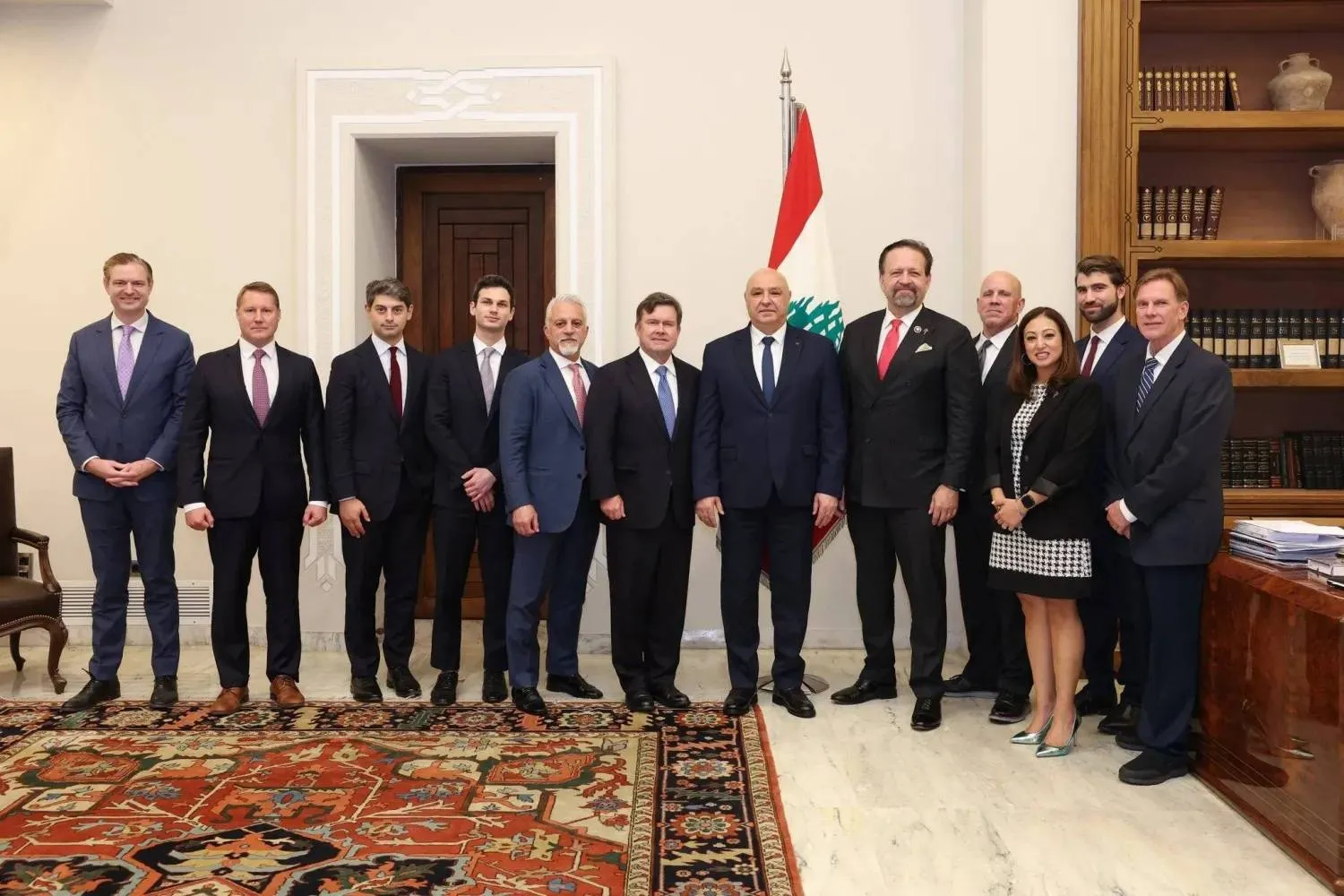
Lebanese President Joseph Aoun receives a US Treasury delegation at Baabda Palace (Lebanese Presidency)
TT

Washington Tightens Squeeze on Hezbollah From Battlefield to Economy

Lebanese President Joseph Aoun receives a US Treasury delegation at Baabda Palace (Lebanese Presidency)

The US strategy in Lebanon and Syria is moving on two parallel tracks: field and logistical pressure in the south to shrink Hezbollah’s area of operations, and a financial squeeze targeting its civilian funding network.

At the same time, Washington’s renewed security engagement with Damascus has become a new arm in its effort to contain the group by cutting off its supply routes.

Tighter financial chokehold

In Beirut, the visit of a US Treasury delegation signaled the start of a tougher phase in Washington’s financial crackdown.

The delegation, which included Treasury officials and White House counterterrorism experts, delivered a clear message to Lebanese officials: The issue is no longer only about weapons, but about the parallel economy that sustains Hezbollah.

The Americans called for the closure of Hezbollah-affiliated financial institutions, most notably Al-Qard Al-Hassan Association, and for tighter oversight of currency exchange offices and cash transfers through which Iranian funds flow.

They also urged Lebanon to reinforce banking compliance mechanisms ahead of the 2026 elections.

According to economic sources, the United States believes Lebanon’s “cash economy” has become an indirect lifeline for Hezbollah, with transfers from Tehran exceeding $1 billion since the beginning of the year.

The Treasury delegation reportedly gave Beirut a short deadline to enact financial reforms or face expanded sanctions on individuals and institutions accused of facilitating Hezbollah’s financing.

From battlefield pressure to financial warfare

Lebanese lawmaker Mark Daou told Asharq Al-Awsat that “Washington’s approach to Hezbollah has clearly shifted from military confrontation to financial and logistical strangulation.”

He said the latest US delegation’s visit to Beirut — which included Treasury officials and White House counterterrorism experts, “carries implications that go beyond financial monitoring.”

“The visit comes as part of broader efforts to target Hezbollah’s domestic financing network, especially after the group’s reduced military activity in recent months,” Daou said.

“The United States views the financial supply route as the main channel for rebuilding Hezbollah’s military capabilities, and that’s why it is tightening its oversight.”

Expanding to Syria

Daou added that “Washington’s efforts are not limited to Lebanon. They extend to Syria, where we are beginning to see a political and security opening toward Damascus aimed at tightening border control and preventing the use of Syria as a logistical corridor for Hezbollah.”

He said the United States believes “border cooperation with Damascus serves its core goal of containing Hezbollah and Iran, whom it views as direct adversaries in the region.”

Daou noted that “US focus now includes civilian institutions linked to the group, such as Al-Qard Al-Hassan and other social and educational associations,” adding that “the attention on Al-Qard Al-Hassan stems from its role in providing liquidity to Hezbollah through the liquidation of gold and guarantees after its access to traditional banking channels was restricted.”

He said some of these entities are already showing signs of financial strain. “Even Hezbollah-run schools are struggling to collect tuition and pay teachers’ salaries, reflecting the growing pressure on the parallel economy the group built over decades.”

A growing push to reclaim the south

According to sources familiar with meetings held by US envoy Morgan Ortagus during her recent visit to Beirut, “the American side spoke seriously about the need to prevent Hezbollah’s development and social institutions from dominating southern Lebanon.”

The sources said Washington stressed that Hezbollah’s civilian presence “is no less dangerous than its military one,” describing these institutions as “a permanent incubator and an alternative source of funding for its organizational structure.”

Civil network under pressure

Political analyst Marwan El-Amine told Asharq Al-Awsat that “certain groups in Syria are now collaborating with Hezbollah and the Iranians in smuggling weapons, not for ideological or political motives but for financial gain. Hezbollah pays these groups to move arms and storage facilities from Syria into Lebanon.”

He added that Syria’s formal participation in the international coalition against terrorism, coupled with international calls for Damascus to reassert state control over its entire territory, “is expected to curb this type of smuggling into Lebanon and, by extension, to Hezbollah.”

El-Amine noted that the US delegation’s recent visit to Beirut “was not merely consultative — it also addressed Hezbollah’s continued money smuggling through ports and crossings, with emphasis on tightening monitoring in this regard.”

He stressed that “pressure on Hezbollah is no longer just political or military, but directly financial, targeting the group’s funding structure and global networks.”

A choice ahead

El-Amine said the region has entered “a new phase defined by economic stability and cross-border development projects, where entities like Hezbollah or Hamas that threaten these initiatives will no longer be tolerated.”

“Drying up Hezbollah’s sources of funding,” he added, “will gradually weaken its social and educational institutions, leaving it with two options: either to become a political party operating within the law, or to remain a group pursued internationally.”


Assad Curses Ghouta, Mocks Syrian Troops in Leaked Videos

Bashar al-Assad was overthrown after 24 years in power. (EPA)
TT

Assad Curses Ghouta, Mocks Syrian Troops in Leaked Videos

Bashar al-Assad was overthrown after 24 years in power. (EPA)

As Syrians gear up to mark the one-year anniversary of the ouster of President Bashar al-Assad's regime on Monday, Al Arabiya television released videos of the toppled leader recorded a few years ago showing him cursing the region of al-Ghouta and mocking his own troops even amid the civil war.

The videos released on Saturday showed Assad as he was driving his car through Damascus with his late media advisor Luna al-Shibl. The videos are undated but suspected to have been recorded around 2018 after opposition fighters were forced out of Ghouta. They were filmed by a third person in the vehicle with Assad and Shibl.

In one video, Assad is heard cursing Ghouta, saying: “To hell with it.” Other shots showed him mocking his own soldiers when they would kiss the president’s hands in a show of loyalty.

At one point, Shibl asked Assad how he feels about seeing posters of himself on the streets of Syria, to which he replied that he feels “nothing” about them.

On the situation in war-torn Syria, Assad said he was “not only ashamed but disgusted.”

Assad at one point mocks even his family name, which translates to “lion” in Arabic, saying maybe he should change it to “some other animal.”

Assad and Shibl even mocked Lebanon's Hezbollah that had sent its fighters to Syria to prop up the regime.

Commenting on the leaks, Syrians dismissed them, while other said they were further evidence of his lack of loyalty to forces that had stood by him during the war.

Journalist Wael Youssef said he did not care about the leaks, saying Assad and Shibl were now part of the past.

He added that he was disturbed even hearing their voices. “Personally, I could never listen to Bashar when he was delivering an allegedly important speech. If it was really important, I would get a copy of it to read. Today they are now behind us, thank God.”

Assad's late media advisor Luna al-Shibl.

Radwan, a resident of Damascus’ Jobar neighborhood that was destroyed by regime forces during the war, described Assad as an “idiot, which is why we rose up against him”.

“When he would bomb us with planes, we would often wonder how he could possibly call himself Syrian because he has an unnatural animosity to Syria and its people,” he said. “The videos are evidence of this.”

Lawyer Nibal Hamdoun said she was not surprised by Assad’s comments in the leaks. “We had experienced his sentiments during 14 years of killing and destruction during the war,” she remarked.

“If he believes Syria is disgusting, then it is because of his corrupt rule and the corruption of his father (late President Hafez al-Assad),” she stressed, adding that he should be ashamed of himself.

Another Syrian, Badr Rahmeh said he was curious to learn how Assad feels in his Moscow exile as he watches Syria prepare to celebrate a year since his ouster.

“Will he watch as we trample posters of his image that he allegedly didn’t like to see on the streets where we were forced to hang them?” he wondered.

“I want to know how the supporters Shibl had called on to persevere during the war now feel as they watch these videos that mock their loyalty,” he went on to say.

Shibl had died in mysterious circumstance in 2024. The official story was that she died in a car accident, while skeptics say that the accident was deliberate and staged by the regime after she had fallen afoul of it.

She had worked for years as the director of the presidency media office before being promoted to Assad’s media advisor.


Abbas Calls on Hamas to Disarm, Israel to Withdraw from Gaza

Palestinian President Mahmoud Abbas. (dpa)
TT

Abbas Calls on Hamas to Disarm, Israel to Withdraw from Gaza

Palestinian President Mahmoud Abbas. (dpa)

Palestinian President Mahmoud Abbas said on Saturday that the second phase of US President Donald Trump’s ceasefire plan in Gaza demands Israel’s withdrawal from the enclave and for Hamas and other armed groups to turn over their weapons to his Palestinian Authority.

Speaking during a telephone call with German Chancellor Friedrich Merz, Abbas added that his priority now lies in implementing Trump’s plan to end the war, stop the bloodshed and ease the suffering of the Palestinian people in Gaza and prevent their displacement.

The implementation of the second phase will pave the way for the deployment of Palestinian police and the international stabilization force in Gaza and the launch of the reconstruction phase in an organized and effective manner, he explained.

Parallel steps must be carried out in the occupied West Bank to put an end to Israeli measures that are undermining the two-state solution, Abbas continued.

He demanded an end to Israeli settler violence against the Palestinian people, an end to settlement expansion and annexation policies, and an end to Israeli policies that are harming the Palestinian economy and government’s ability to meet its commitments to the people.

Abbas reiterated his condemnation of Hamas’ October 7, 2023 attack, saying the movement “must end its rule in Gaza and hand over its weapons.”

He renewed Palestine’s commitment to recognize Israel and the two-state solution, “so that an independent Palestinian state can coexist side by side by Israel in peace and security.”

Abbas and Merz held their call hours before the German leader arrived in Israel on an official visit.


Sudanese Paramilitary Drone Attack Kills 50, Including 33 Children in Kordofan

FILE - Sudanese soldiers from the Rapid Support Forces unit patrol during a rally for Dagalo, in Garawee town, north of Sudan, Saturday, June 15, 2019. (AP Photo)
TT

Sudanese Paramilitary Drone Attack Kills 50, Including 33 Children in Kordofan

FILE - Sudanese soldiers from the Rapid Support Forces unit patrol during a rally for Dagalo, in Garawee town, north of Sudan, Saturday, June 15, 2019. (AP Photo)

A drone attack by the Sudanese paramilitary forces hit a kindergarten in south-central Sudan, killing 50 people, including 33 children, a doctors’ group said.

Paramedics on the scene in the town of Kalogi in South Kordofan state were targeted in “a second unexpected attack," Sudan Doctors’ Network said in a statement late Friday.

Emergency Lawyers, a rights group tracking violence against civilians in Sudan reported in a statement Saturday the second strike on paramedics treating survivors in Kalogi and said “a third civilian site near the previous two” was also attacked, reported The Associated Press.

The group condemned the attack, blaming the paramilitary group, the Rapid Support Forces, or RSF, for the strikes, calling them “a flagrant violation of international humanitarian law, including the protection of civilians, especially children, and vital civilian infrastructure.”

The death toll is expected to be higher, but communication blackouts in the area have made it difficult to report casualties.

Thursday's attack is the latest in the fighting between the RSF, and the Sudanese military, who have been at war for over two years. It is now concentrating in the oil-rich Kordofan states.

“Killing children in their school is a horrific violation of children’s rights,” said UNICEF Representative for Sudan Sheldon Yett in a statement Friday.

“Children should never pay the price of conflict,” said Yett.

He said UNICEF urges all parties “to stop these attacks immediately and allow safe, unhindered access for humanitarian assistance to reach those in desperate need.”

Hundreds of civilians were killed throughout the Kordofan states in the last few weeks as intensified fighting shifted from Darfur after the RSF took over the besieged city of el-Fasher.

Sudanese military aerial strikes on Sunday killed at least 48 people, mostly civilians, in Kauda, South Kordofan.

UN Human Rights Chief Volker Türk warned that Kordofan could face new atrocities like those in el-Fasher.

Separately, the RSF condemned in a statement Friday a drone strike on the Chad-Sudan border, accusing the Sudanese military of being behind it and posted a video showing billowing black smoke. This couldn't be independently verified and it is unclear whether there were casualties in this strike. There was no immediate comment from the Sudanese military.

RSF’s violent takeover of el-Fasher was marked with executions of civilians, rapes and sexual assaults, and other atrocities. Thousands escaped and thousands more are feared killed or trapped in the city.

The RSF and the Sudanese military have been fighting for power over Sudan since 2023. More than 40,000 people were killed in the war, according to the World Health Organization, and 12 million displaced. However, aid groups say the true death toll could be way higher.
