


Lebanese President: Logic of Force No Longer Useful

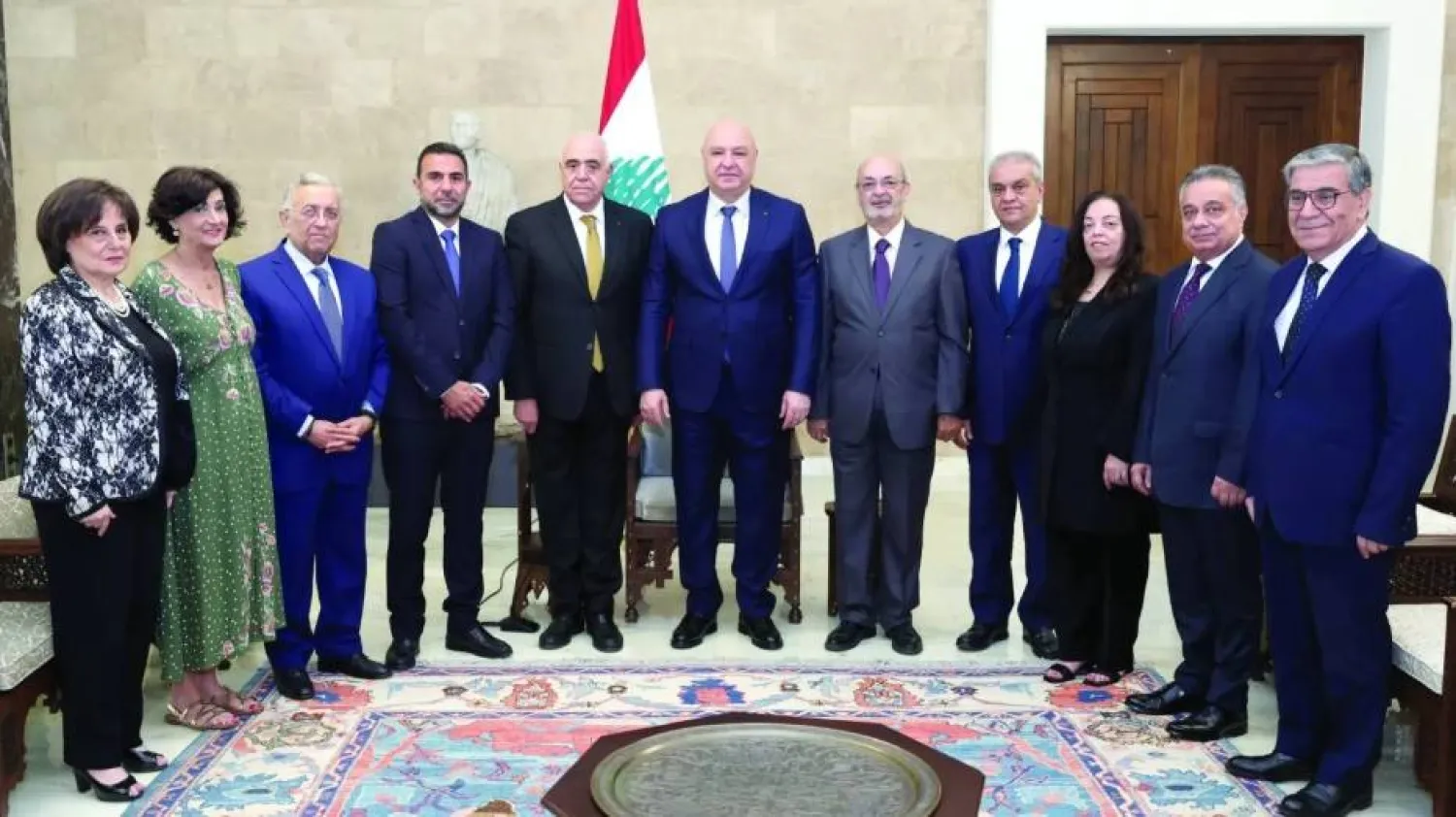
Lebanese President Joseph Aoun meets with the Council of the Order of Press Editors led by Joseph Kossaifi (Lebanese Presidency)
TT

Lebanese President: Logic of Force No Longer Useful

Lebanese President Joseph Aoun meets with the Council of the Order of Press Editors led by Joseph Kossaifi (Lebanese Presidency)

Lebanese President Joseph Aoun affirmed on Wednesday that the logic of force is no longer useful and that Lebanon must resort to the power of logic, indicating that the government has not received a response from Israel on his announcement of favoring negotiations.

Meanwhile, Speaker Nabih Berri urged on Wednesday the committee monitoring the ceasefire between Lebanon and Israel to stop the Israeli attacks and occupation, and called on the Lebanese to stay united in the face of the Israeli aggression.

Aoun and Berri’s positions came while the ceasefire committee held its 13th meeting in Al-Naqoura, headed by chairman, US General Joseph Clearfield, but in the absence of US envoy Morgan Ortagus, who attended the committee’s last meeting.

According to sources, the committee discussed the escalating Israeli violations, especially those recorded last week in the south, particularly an incident near a Lebanese army base, which Lebanon said constitutes a flagrant violation of the ceasefire agreement.

Accept Negotiations Before Setting Conditions
During a meeting with a delegation from the Council of the Order of Press Editors led by Joseph Kossaifi, Aoun said: “The war has only brought us tragedies. While the region moves toward settlements, then what choice do we have?”

Aoun noted that Lebanon has not yet received feedback from Washington regarding its proposal for negotiations with Israel.

He expressed cautious optimism, saying he expects progress once the new US ambassador to Lebanon (Michel Issa) arrives, potentially carrying a response from Israel.

“We have mentioned the principle of negotiation and we are yet to discuss the details, but we have not received an (Israeli) answer to our proposal. When we get an approval, we would talk about our conditions,” the President said.

Aoun then asked “are we capable of entering a war and can the rhetoric of war solve the problem? Let someone answer these two questions.”

Asked whether he had addressed these points directly with Hezbollah, Aoun confirmed that he had. “Yes, I told them openly,” he said. “The approach of force is no longer of use- we must rely on the power of logic instead. After 15 years of war in Vietnam, the United States was obliged to go to negotiations, and Hamas has also been obliged to go to negotiations.”

Virtual Investigation
Discussing the Beirut port explosion, Aoun said he had “contacted senior Bulgarian officials, and obtained approval to conduct a virtual investigation with the owner of the vessel MV Rhosus, which carried the ammonium nitrate that caused the 2020 Beirut explosion in the Lebanese capital.

He said Lebanese Justice Minister Adel Nassar will raise soon an official request to his Bulgarian counterpart in this regard.

Elections and National Dialogue
Aoun explained that calls for a national dialogue before the upcoming parliamentary elections would amount to a “dialogue of the deaf.”

He said there is firm determination from himself, Speaker Nabih Berri, and Prime Minister Nawaf Salam to hold next year’s parliamentary elections on time despite “some (officials) not wishing elections to take place.”

No Handing Lebanon Over to Syria
Aoun dismissed talk of “handing Lebanon over to Syria” as unjustified and unnecessary.
He described as positive the last meeting between US President Donald Tramp and Syrian President Ahmad al-Sharaa in Washington this week, affirming that the lifting of US sanctions on Syria will have a positive impact on Lebanon.

Berri Calls for National Approach
Meanwhile, Berri on Wednesday said the Israeli threat facing south Lebanon constitutes a danger to all Lebanese, adding that such threats must be addressed “with a national approach.”

“The Israeli threats that have targeted and continue to target the south actually concern all Lebanese. [They] must understand these dangers, these challenges, and their consequences in a national context,” he said.

On the sidelines of a meeting with a delegation of religious leaders representing the governorate of Akkar, Berri urged the ceasefire monitoring committee and member states to stop Israel's attacks and occupation, and called on the Lebanese to stay united in the face of the Israeli aggression.


Senior Hamas Official to Asharq Al-Awsat: Committed to Handing Gaza Governance to Palestinian Body

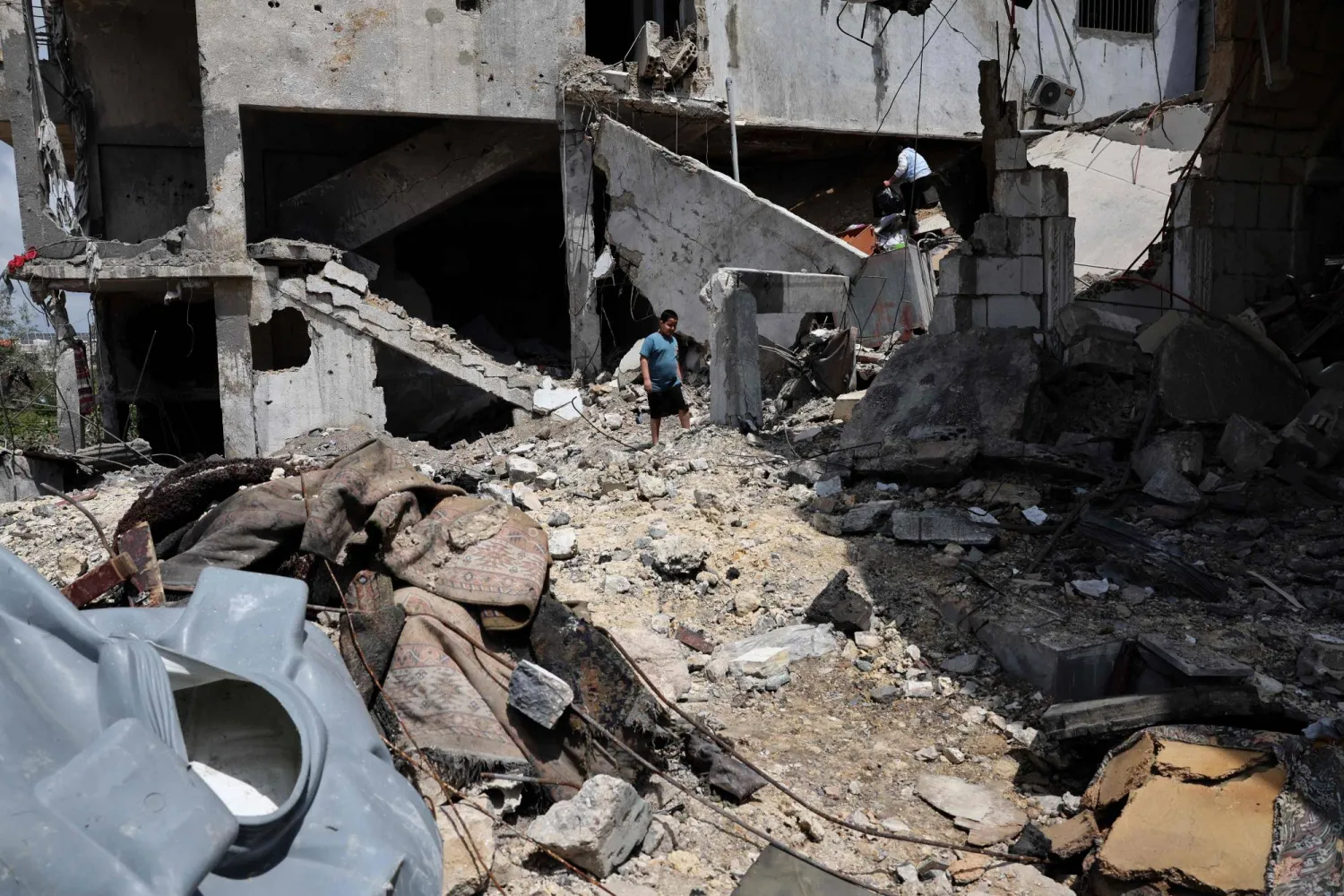
Palestinians walk past destroyed buildings in a neighborhood heavily damaged during the war, in Gaza City, January 5, 2026. (Reuters)
TT

Senior Hamas Official to Asharq Al-Awsat: Committed to Handing Gaza Governance to Palestinian Body

Palestinians walk past destroyed buildings in a neighborhood heavily damaged during the war, in Gaza City, January 5, 2026. (Reuters)

A senior source in Hamas cast doubt on Israel’s intentions to sustain the ceasefire in Gaza and move to its second phase, which provides for withdrawal from additional parts of the enclave and the reopening of the Rafah land crossing.

The source said, however, that the movement would abide by its obligations, including handing over Gaza’s governance to a Palestinian body and discussing a specific formula regarding the group's weapons, among other conditions.

The source, who is familiar with the details of contacts and negotiations, told Asharq Al-Awsat that Israel wants to keep Gaza in a state of instability by trying to impose new rules of engagement in the enclave, enforcing them by firepower as it has done since the start of this year.

About 21 Palestinians have been killed in a series of Israeli violations and three targeted strikes over eight days since the beginning of the year, hitting three Hamas members. This brings the death toll since the ceasefire took effect on Oct. 10, 2025, to about 431 people.

The latest assassination took place on Thursday evening after a suicide drone exploded in a tent belonging to a prominent member of the Qassam Brigades, Hamas’s armed wing, in Khan Younis, killing four people, including three children.

That followed another assassination on Wednesday evening of a field commander in the Qassam Brigades who led the Tuffah and Daraj battalion, after his family home was struck in the Tuffah neighborhood east of Gaza City.

The outcome of the operation remains unclear, with several wounded and others still missing under the rubble. The Israeli army claimed the strike was in response to gunfire toward its forces in the north of the enclave.

A Palestinian was killed on Thursday afternoon when a drone dropped a bomb on a group of Palestinians in the town of Bani Suheila east of Khan Younis, while a girl was killed by Israeli drone fire in Jabalia in northern Gaza.

The Israeli army said it detected a failed rocket launch from northern Gaza that fell inside the enclave, adding that its forces shelled the launch site. Field sources told Asharq Al-Awsat that the explosion occurred after children tampered with unexploded ordnance in an area northwest of Gaza City.

The senior source said Israel is seeking to impose security control over Gaza by continuing the same scenario it has followed for months, assassinating fighters from time to time on the pretext that its forces came under fire near the so-called yellow line, while it carries out daily killings of civilians along the same line, particularly to its west.

More than 200 Palestinians have been killed in those western areas without any real threat to the forces, while the number of cases of people crossing the line did not exceed 15.

Israel wants to kill Palestinians whenever and however it wishes and does not want security conditions to return to normal or the ceasefire to be maintained, the source said, adding that Israel wants to constantly remind residents that the war continues daily and will not end.

He said Israel is keen to keep Gaza in a state of war through various means, including a Lebanon-style scenario.

The Israeli war does not stop at killings, shelling and demolitions, which are daily operations, but extends to the humanitarian situation, the source said.

Israel regularly blocks the entry of aid and prevents many commercial goods from entering through the crossings, sometimes banning items it had previously allowed, such as dairy products that were permitted for 10 days before being stopped, a pattern that applies to other goods as well, it added.

Israel controls everything related to Gaza and works to squeeze the population by all means, including depriving them of their most basic rights, the source stressed, adding that it exploits unlimited US support to evade its obligations under the first phase of the ceasefire by using various flimsy pretexts.

Talks in Egypt

The source revealed that Hamas’s leadership is following up with mediators on all issues related to the violations, failure to adhere to the humanitarian protocol and the move to the second phase. He said efforts are underway to push in that direction, with meetings to be held in Cairo and other capitals in the coming days.

Cairo is set to host a Hamas leadership delegation next week to discuss these issues. Some of the movement’s leaders from Gaza have already arrived in Egypt in recent days and held a series of internal meetings and others with Palestinian factions, Asharq Al-Awsat learned.

Palestinian Vice President Hussein al-Sheikh and intelligence chief Majed Faraj recently visited Cairo and met senior officials to discuss the transition to the second phase, including the Palestinian Authority’s readiness to take part in operating the Rafah crossing and to form a technocratic committee to assume its duties, paving the way for the authority’s return to governing Gaza once the second phase is fully implemented.

Hamas outside administrative arrangements

Hamas spokesman Hazem Qassem said the movement is awaiting the formation of an independent committee to run Gaza across all sectors, a committee it agreed to establish alongside other factions.

He explained that Hamas would facilitate the handover and the committee’s work, adding that the movement had already decided it would not be part of administrative arrangements in the enclave.

According to Yedioth Ahronoth, Israel is preparing to open the Rafah crossing in both directions by January 15, the likely date for US President Donald Trump to announce the move to the second phase.

The paper said the crossing would open even if the last remaining body of an Israeli hostage in Gaza has not been recovered, which Hamas and Islamic Jihad are trying to locate under heavy pressure from mediators.

Israel is likely to allow the limited entry of a few dozen people a day under tight security supervision, it reported.


From ‘Jabal al-Sayyida’ to ‘Sheikh Maqsoud,’ Ashrafieh’s Syriac Roots

From the civil protest movement in Aleppo’s Ashrafieh district in 2013, which brought together Arabs and Kurds (Aqil Hussein archive)
TT

From ‘Jabal al-Sayyida’ to ‘Sheikh Maqsoud,’ Ashrafieh’s Syriac Roots

From the civil protest movement in Aleppo’s Ashrafieh district in 2013, which brought together Arabs and Kurds (Aqil Hussein archive)

Aqil Hussein, a Syrian activist and journalist from Aleppo, reflects on his ties to the neighborhoods of Sheikh Maqsoud and Ashrafieh, now the scene of fighting in and around them between the Syrian Democratic Forces and the Syrian government.

He was involved in the civil protest movement that erupted with the Syrian uprising in March 2011 and reported from the ground, particularly in the eastern districts of the city, which later came under intense bombardment and suffered widespread destruction at the hands of forces loyal to then president Bashar al-Assad.

This is the testimony of the young man who was recently elected to parliament for Aleppo province. Contrary to claims promoted by supporters of the Syrian Democratic Forces, Sheikh Maqsoud and Ashrafieh are home to an Arab majority, not a Kurdish one.

The two neighborhoods that have become known as Kurdish in recent years were, 50 years ago, little more than small residential clusters inhabited by a limited number of poor Christians, mainly Syriacs and Armenians.

Over time, people from the northern and eastern countryside of Aleppo, including residents of Afrin, Jandaris and Ain al-Arab (Kobani), moved there in search of better opportunities in the city, drawn by relatively affordable living costs and proximity to industrial zones.

What led many to label the neighborhoods as Kurdish was the rare and unprecedented concentration of Kurds in one area of Aleppo.

Until the 1970s, Aleppans knew Sheikh Maqsoud as Jabal al-Sayyida, named after the Virgin Mary. After a mosque bearing the name of a Kurdish Sufi sheikh, Sheikh Maqsoud, was built at the site where Kurds had begun to gather, the new name became widely used.

The neighboring Ashrafieh district emerged around the same time as an unplanned extension of the Syriac Christian quarter.

Aleppans did not view the two neighborhoods as Kurdish strongholds in a political sense until 2004, when Kurds in Syria’s Jazira region rose up in what became known as the Qamishli events.

Ashrafieh and Sheikh Maqsoud then witnessed clashes between cadres of Kurdish political parties and security forces.

Before that, the most visible Kurdish presence in the two districts appeared during Nowruz celebrations, which were previously banned in Syria and often accompanied by skirmishes with the authorities, especially involving elements of the Kurdistan Workers Party, which the Assad government had used since the 1980s to control any anti-government Kurdish political activity.

After the popular uprising against Assad began in 2011 and as the government sought to keep Kurds out of the protest movement, Syrian intelligence handed the two neighborhoods to the Kurdish self-administration in 2012.

They gradually slipped out of state control before authority settled in the hands of the Syrian Democratic Forces, through their security arm known as the Internal Security Forces, or Asayish, in the same manner applied in majority Kurdish cities in the country’s northeast.

Initially, Ashrafieh saw a civil protest movement led by local activists under the banner of the Brotherhood Coordination, which brought together prominent Arab and Kurdish figures and stood out as a peaceful revolutionary initiative.

Its members later found themselves pursued by the Kurdistan Workers Party’s Syrian branch, which cracked down on any activity linked to the uprising in areas it took over from the government, establishing security and police bodies as well as military recruitment centers that exercised full control. This further entrenched the perception of the neighborhoods as Kurdish.

The most severe blow to relations between the Kurdistan Workers Party and Syria’s opposition came at the end of 2016, when the Syrian Democratic Forces cooperated with Assad’s forces in taking control of eastern Aleppo. The operation resulted in the displacement of most residents and the destruction of large parts of the area.

Later, the Syrian Democratic Forces joined forces with Lebanon’s Hezbollah and Iran’s Revolutionary Guard Corps in seizing Sunni Arab towns and villages in the northern Aleppo countryside, especially the town of Tal Rifaat, whose residents were almost entirely displaced at the time.

Supporters of the Kurdish region in Syria then began describing it as a Kurdish area as well.

Today, as Aleppo faces renewed tension over the Syrian Democratic Forces’ refusal to hand over Sheikh Maqsoud and Ashrafieh to the Syrian government’s administration, supporters of the group are waging a fresh media campaign to assert the Kurdish identity of the two neighborhoods.

Tens of thousands of Arabs live there, particularly members of the Baggara tribe and the Batoush clan, alongside a significant Kurdish presence whose weight cannot be denied.


Somalia Probes Use of Its Airspace, Territory in Al-Zubaidi’s Escape

Aden Adde International Airport in Mogadishu. (SONNA)
TT

Somalia Probes Use of Its Airspace, Territory in Al-Zubaidi’s Escape

Aden Adde International Airport in Mogadishu. (SONNA)

Somalia opened an urgent investigation on Thursday into reports that its airspace and airports were used without authorization to facilitate the movement of Yemeni fugitive head of the Southern Transitional Council (STC) Aidrous al-Zubaidi in order to determine whether the alleged activity violated national law or established procedures and protocols.

A statement by Somalia’s Immigration and Citizenship Agency (ICA) emphasized that facilitating the entry of fugitives or undertaking unilateral actions on Somali territory without legal authorization is unacceptable.

It added that respect for sovereignty and adherence to national and international legal frameworks are principles that are not negotiable. Any such acts, if proven, would constitute a serious violation of national sovereignty and immigration laws, it said.

The statement said Somalia would take the necessary measures in line with the investigation’s findings to ensure full accountability for any confirmed violations, while reaffirming the country’s firm commitment to the rule of law, respect for international norms, and the protection of its sovereignty and territorial integrity.

It also confirmed Somalia’s support for Saudi Arabia’s call for southern dialogue in Riyadh as the appropriate political track to address the situation in Yemen, stating that any attempts to circumvent this process would directly undermine ongoing diplomatic efforts.

Earlier on Thursday, the Saudi-led coalition supporting Yemen’s legitimate government said al-Zubaidi and others had fled via a maritime vessel that departed the port of Aden toward Somaliland shortly after midnight on Wednesday, with its identification system switched off, arriving at the port of Berbera at around noon.

In a statement by its spokesman, Turki al-Maliki, the coalition stated, al-Zubaidi contacted Maj. Gen. Awad al-Ahbabi, commander of the UAE's joint operations, was to be informed of their arrival.

An Ilyushin Il-76 aircraft was waiting and took them on board under the supervision of Emirati officers, departing without specifying a destination before landing at Mogadishu airport at 3:15 p.m.

The statement said the aircraft waited at the airport for an hour before departing at 4:17 p.m. to travel via the Arabian Sea to the Arabian Gulf, without specifying a final destination.

The identification system was switched off over the Gulf of Oman and reactivated ten minutes before landing at Al Reef military airport in Abu Dhabi at 8:47 p.m. Saudi time.

The coalition said its forces were still tracking information on the fate of several individuals said to have been the last to meet al-Zubaidi before his escape from Aden, including Ahmed Lamlas, the former Aden governor, and Mohsen al-Wali, commander of the Security Belt Forces in the governorate, with whom contact has been lost.

On Wednesday, Yemen’s Presidential Leadership Council (PLC) Chairman Rashad al-Alimi issued a decree expelling al-Zubaidi from the council and referring him to the public prosecutor over accusations of crimes classified as high treason and acts undermining state security and unity.

The decree said investigations had established what it described as al-Zubaidi’s abuse of the southern cause and its exploitation to commit serious violations against civilians in southern governorates, in addition to harming the republic’s political and economic standing, attacking the constitution and constitutional authorities, and obstructing state efforts to confront the Houthi coup and rebellion.
