


Unexplained Drone Flights Fray Nerves in Belgium

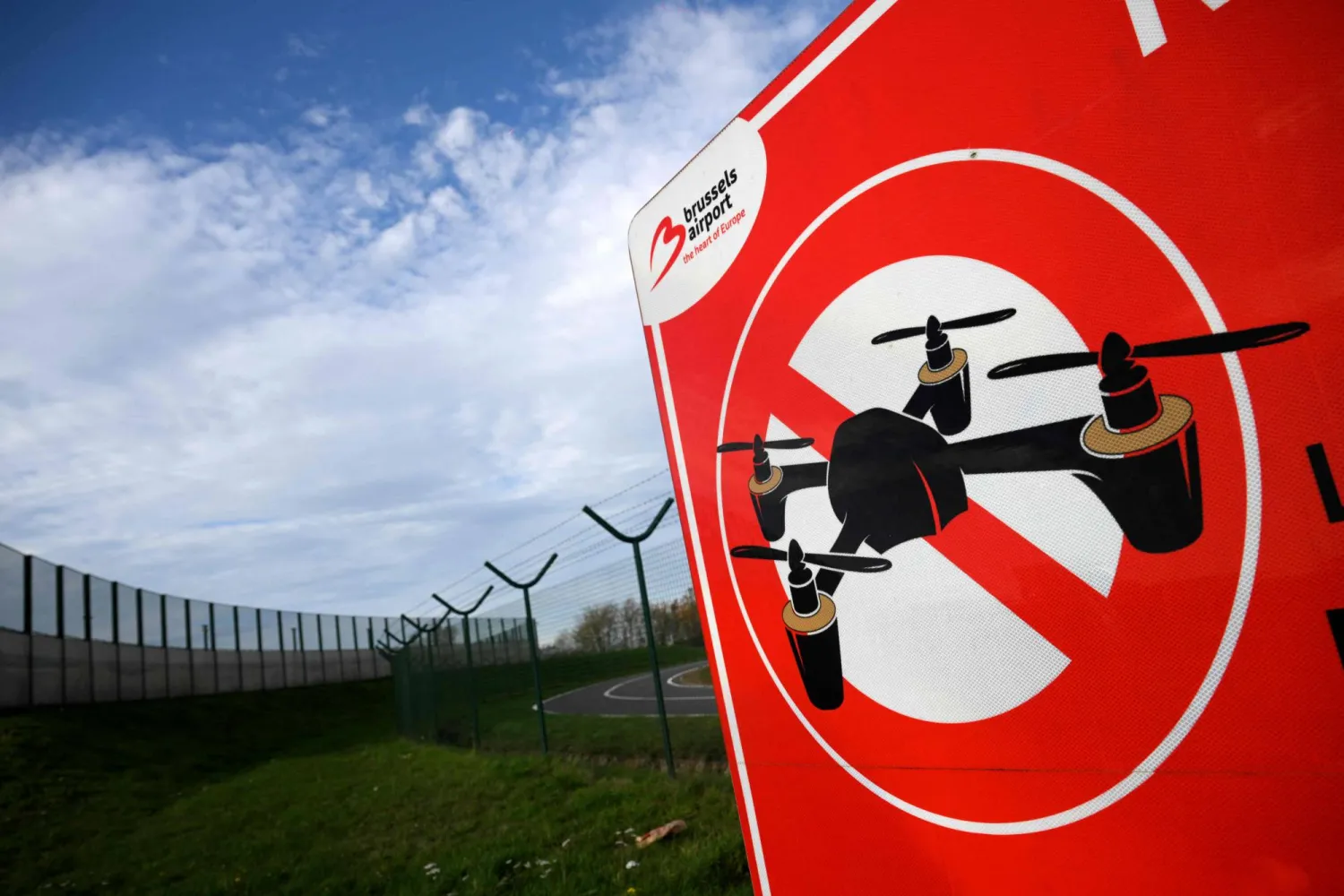
This photograph shows a sign reading "No drone zone" at Brussels Airport in Zaventem on November 5, 2025.  (Photo by Nicolas TUCAT / AFP)
This photograph shows a sign reading "No drone zone" at Brussels Airport in Zaventem on November 5, 2025. (Photo by Nicolas TUCAT / AFP)
TT

Unexplained Drone Flights Fray Nerves in Belgium

This photograph shows a sign reading "No drone zone" at Brussels Airport in Zaventem on November 5, 2025.  (Photo by Nicolas TUCAT / AFP)
This photograph shows a sign reading "No drone zone" at Brussels Airport in Zaventem on November 5, 2025. (Photo by Nicolas TUCAT / AFP)

Sightings at military bases, airports, a nuclear power station: a spate of unexplained drone flights has frayed nerves in Belgium and fueled fears the country could be being targeted by Russia.

Reports of drone activity at sensitive locations began to come out last month when suspected drones were spotted near a number of military bases in the country, said AFP.

Those sightings came as Europe was already on heightened alert after Russian drones were shot down over Poland and mysterious flights disrupted airports in Denmark and Germany.

Then last week the incidents appeared to gather pace, causing air traffic to be halted at Belgium's largest airport, the government to hold urgent talks and NATO allies to send in support.

So far, the Belgian authorities have refused -- or are unable to say -- who precisely is responsible.

Federal prosecutors have said they are probing 17 incidents.

"It is still often difficult to distinguish whether it is a local drone pilot breaking the rules or an attempt at destabilization by a state actor," the prosecutors said.

But the frequency of drone sightings have sparked strong suspicions professionals are involved -- and fingers have almost inevitably been pointed at Russia.

As tensions have surged over the Kremlin's invasion of Ukraine, Europe has accused Moscow of stepping up a "hybrid war" of sabotage, cyberattacks, and interference that float in a grey zone of deniability.

There are obvious reasons why it might be Belgium in the crosshairs right now.

At the moment, the European Union is debating unlocking a new 140-billion-euro ($162-billion) loan for Ukraine funded by frozen Russian central bank assets held in Belgium.

Even before the drone sightings, the Belgian government was warning that the move could draw Moscow's ire and put a target on the country's back.

And those worries have only been heightened by the latest activity.

"This is a measure designed to create uncertainty and fear in Belgium -- 'don't you dare touch the assets'. There's no other way to interpret it," Germany's Defense Minister Boris Pistorius said Friday.

"We can all see that, and the Belgians see it that way too."

Analysts say that drones are a low-cost and effective way to rattle a foe.

"Targeted drone overflights are almost always about unsettling the population and thereby destabilizing a country. Additionally, they are used to observe how well-prepared and equipped your opponent is," said Manuel Atug, a security expert who sits on a German working group on critical infrastructure.

"In this way, economic damage can indeed be caused, for example, through the disruption of air traffic."

Making drones even more of a problem are the difficulties facing authorities trying to identify and counter objects that can be launched at short notice from almost anywhere.

"For years, we have had drone sightings everywhere -- Germany alone has more than 100 drone sightings at its airports every year," said Ulrike Franke, an expert at the European Council on Foreign Relations.

"There is an effect where we read more about it in the press, and then the focus shifts more towards it. This plays into the hands of those who want to destabilize our countries," she said.

"Nevertheless, it is true that we currently have more sightings, especially of larger drones and over infrastructure."

Several of Belgium's NATO allies, including Germany and Britain, have sent teams and equipment to try to help, as was the case for Denmark.

Defense minister Theo Francken is now pushing for an initial 50 million euros to be spent on counter-drone defenses.

The EU for its part is working to establish a network of defenses but those will likely be more focused on its eastern border states and take years to complete.

"We cannot have 100 percent security," Franke said.

"However, there are key locations where systems should be installed: airports, nuclear power plants, liquefied natural gas terminals. This is not rocket science."

Starmer Says UK to Host Multi-nation Meeting on Hormuz Shipping

British Prime Minister Keir Starmer speaks during a press conference to update on the latest situation in the Middle East and how the government is supporting families at home at 10 Downing Street in London, on April 1, 2026. (Photo by Frank Augstein / POOL / AFP)
TT

Starmer Says UK to Host Multi-nation Meeting on Hormuz Shipping

British Prime Minister Keir Starmer speaks during a press conference to update on the latest situation in the Middle East and how the government is supporting families at home at 10 Downing Street in London, on April 1, 2026. (Photo by Frank Augstein / POOL / AFP)

Britain will this week hold a meeting of about 35 countries to discuss how to reopen the strategic Strait of Hormuz which has been crippled by the Middle East war, Prime Minister Keir Starmer announced Wednesday.

UK Foreign Secretary Yvette Cooper will host the discussions, Starmer told reporters during a Downing Street press conference, without specifying the day of the talks.

The meeting will "assess all viable diplomatic and political measures that we can take to restore freedom of navigation, guarantee the safety of trapped ships and seafarers and resume the movement of vital commodities", Starmer said.

"Following that meeting, we will also convene our military planners to look at how we can marshal our capabilities and make the strait accessible and safe after the fighting has stopped," he added.

The discussions will include countries who recently signed a statement saying they were ready "to contribute to appropriate efforts to ensure safe passage through the Strait of Hormuz", Starmer said.

Britain, France, Germany, Italy, Japan and the Netherlands are among those to have signed it.

Iran has virtually closed the vital strait since the US-Israeli strikes that started the war on February 28, causing global oil and gas prices to soar.

A fifth of the world's oil and liquefied natural gas passes through the strait in peacetime.

"I do have to level with people on this. This (reopening) will not be easy," Starmer said.

The UK leader also backed NATO following renewed criticism of the eight-decade-old alliance by US President Donald Trump.

"NATO is the single most effective military alliance the world has ever seen, and it has kept us safe for many decades, and we are fully committed to NATO," Starmer said.

Trump told Britain's Telegraph newspaper in an article published Wednesday that NATO was a "paper tiger".

Asked whether he would reconsider US membership, he replied: "Oh yes, I would say (it's) beyond reconsideration," the paper reported.

Last month, Trump told the Financial Times that it would be "very bad for the future of NATO" if members fail to help reopen the vital waterway.

On Tuesday, he said that countries which have not joined the war but are struggling with fuel shortages should "go get your own oil" in the Strait of Hormuz, adding that the US would not help them.


France: NATO is Not Designed to Carry Out Operations in Strait of Hormuz

France's junior Minister for Veterans affairs Alice Rufo delivers remarks during the Paris Defense Strategy Forum at the Ecole Militaire (military school) in Paris on March 24, 2026. (Photo by STEPHANE DE SAKUTIN / AFP)
TT

France: NATO is Not Designed to Carry Out Operations in Strait of Hormuz

France's junior Minister for Veterans affairs Alice Rufo delivers remarks during the Paris Defense Strategy Forum at the Ecole Militaire (military school) in Paris on March 24, 2026. (Photo by STEPHANE DE SAKUTIN / AFP)

NATO is a military alliance that ensures the security of the Euro-atlantic area and is not designed to carry out operations in the Strait of Hormuz that would breach international law, France's junior army minister said on Wednesday.

"Let me remind you what NATO is. It is a military alliance concerned with the security of the Euro-Atlantic region. It is not designed to carry out operations in the Strait of Hormuz, which would be a breach of international law," Alice Rufo said at the War & Peace conference in Paris, Reuters reported.

US President Donald Trump said he was strongly considering pulling the United States out of NATO after allies failed to back US military action against Iran, according to an interview with Britain's Daily Telegraph.


King Charles to Address US Congress on April 28

King Charles greets the public outside Clitheroe Station (AP)
TT

King Charles to Address US Congress on April 28

King Charles greets the public outside Clitheroe Station (AP)

Britain's King Charles will address the US Congress on April 28 during his visit to Washington, House Speaker Mike Johnson said in a statement on Wednesday.

Charles and his wife Queen Camilla will visit the US in a long-planned trip to mark the 250th anniversary of that country's independence from British rule, before the couple pay a visit to Bermuda, Buckingham Palace announced on Tuesday.

The high-profile trip comes as the British government hopes to repair relations with Donald Trump, which have been damaged by the Iran war, according to Reuters.

It will be the first state visit by a British monarch since 2007, when Charles' mother Queen Elizabeth made what was the fourth such US trip of her reign.

Trump said the king and queen's visit would begin on April 27 with a banquet dinner at the White House the next day.
