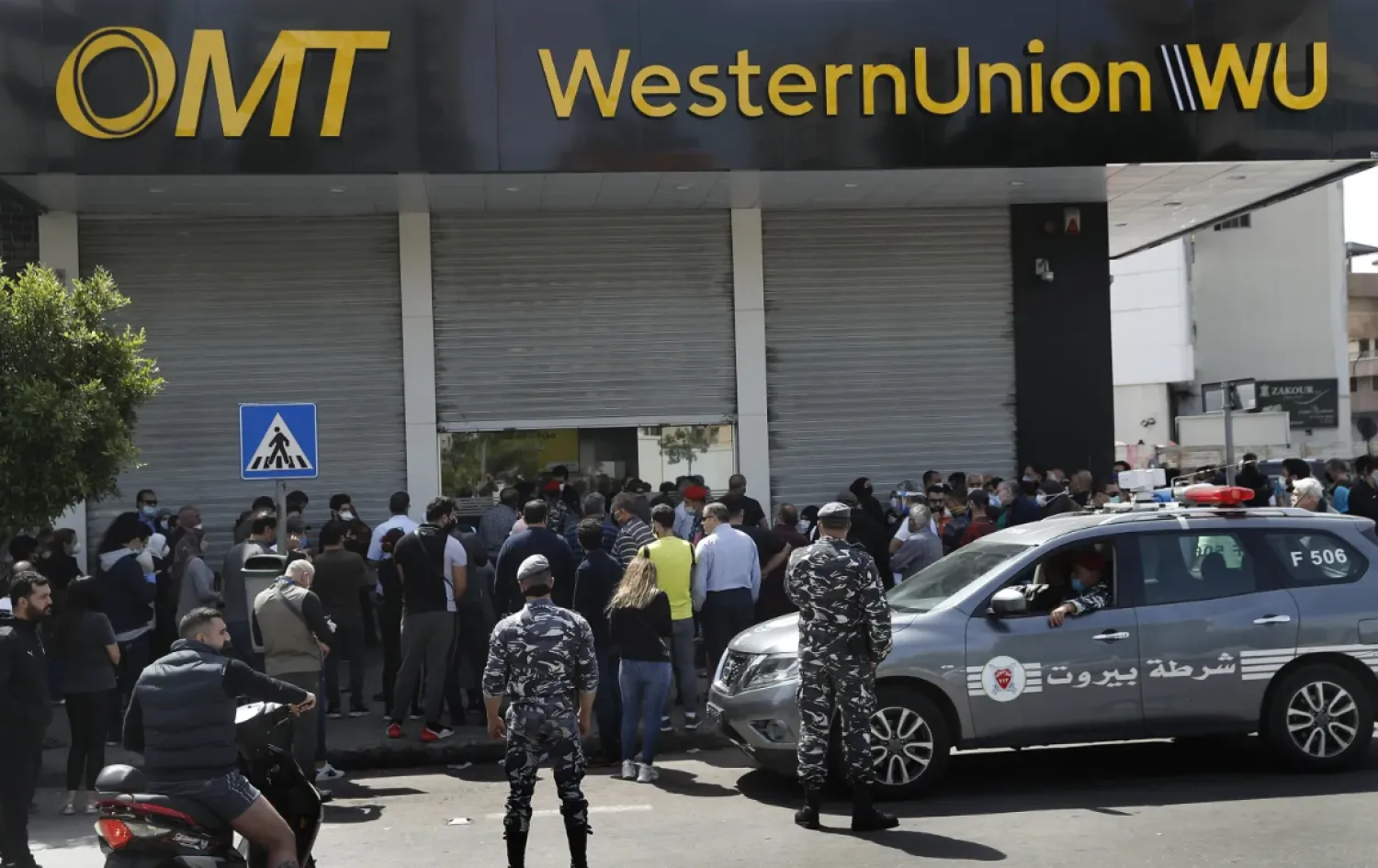
Under US Pressure, Lebanon Tightens Screws on Money Transfers

Lebanese citizens queue outside a Western Union shop to receive their money transfers. AP file photo
TT

Under US Pressure, Lebanon Tightens Screws on Money Transfers

Lebanese citizens queue outside a Western Union shop to receive their money transfers. AP file photo

Lebanon announced on Friday that money changers and transfer companies must comply with stricter rules as the country faces heavy US pressure to regulate its cash economy and cut off Hezbollah funding.

The move comes days after a visiting US official said his country was determined to cut off Tehran's funding to the group, and after the US Treasury said Iran's Revolutionary Guards had transferred over $1 billion to Hezbollah this year, mainly via money exchange companies.

Lebanese authorities are seeking to disarm Hezbollah, which was badly weakened in a recent war with Israel, and face heavy US pressure to do so more quickly as well as fears of expanded Israeli military action.

As part of efforts "to remove Lebanon from the Financial Action Task Force (FATF) grey list... the central bank of Lebanon today has taken the first step in a series of precautionary measures aiming to strengthen the compliance environment within the financial sector", a central bank statement said.

The FATF in October last year added Lebanon to its "grey list" of nations that are subject to increased monitoring of financial transactions.

The central bank said it was imposing measures "on all non-bank financial institutions licenced by the central bank of Lebanon, including money transfer companies, exchange bureaus" and other firms handling foreign currency transactions and transfers to and from the country.

According to a central bank circular, from December 1, all non-bank financial institutions must "collect information and data linked to their customers and operations" for transactions of $1,000 or more and report them to the central bank.

Institutions must confirm they have collected the required information before carrying out any transaction, the circular added.

The measures are consistent "with international standards on fighting money laundering and terrorist financing, and preventing the misuse of the authorized financial system for suspicious transactions."

Hezbollah has pushed back against moves to stifle the group.

On Thursday, its parliamentary bloc condemned "US efforts to tighten the financial siege on Lebanon" and rejected what it said was Washington's aim of imposing "financial guardianship" on the country.

Lebanon was once known as the "Switzerland of the Middle East" for its thriving banking sector before a crippling financial crisis in 2019.

Confidence in lenders tanked and the cash economy has since boomed, despite international institutions repeatedly warning of the risk of money laundering and terrorism financing.


Iran Military Says to Hit US, Israeli Economic Targets in Region

A photograph shows the damage in the aftermath of a drone strike in the Seef district of Manama on March 10, 2026. (Photo by AFP)
TT

Iran Military Says to Hit US, Israeli Economic Targets in Region

A photograph shows the damage in the aftermath of a drone strike in the Seef district of Manama on March 10, 2026. (Photo by AFP)

Iran's military vowed on Wednesday to launch strikes against US and Israeli economic targets in the region, including banks, after overnight attacks reportedly hit an Iranian bank.

"The enemy has given us free rein to target economic centers and banks belonging to the United States and the Zionist regime," said the military's central operational command, Khatam Al-Anbiya, in a statement carried by state TV.

It urged people across the region to refrain from going within one kilometer of banks.

Iranian media said US and Israeli strikes hit a bank in Tehran overnight, killing an unspecified number of employees.


Report: Drone Hits US Diplomatic Facility in Iraq, No Injuries Reported

The US embassy headquarters in Iraq is pictured in Baghdad's fortified Green Zone on March 8, 2026. (AFP)
TT

Report: Drone Hits US Diplomatic Facility in Iraq, No Injuries Reported

The US embassy headquarters in Iraq is pictured in Baghdad's fortified Green Zone on March 8, 2026. (AFP)

A drone struck a major US diplomatic facility in Iraq on Tuesday amid the US-Israeli air war on Iran, but there were no injuries and everyone was accounted for, according to a US official and an internal State Department alert seen by Reuters.

The drone hit the Baghdad Diplomatic Support Center, next to the Baghdad airport, impacting near a guard tower, the internal alert from the Department seen by Reuters said. Individuals at the facility were ordered to "duck and cover", it said. A separate alert said everyone was accounted for.

The White House and the State Department did not immediately respond to a request for comment.

The Washington Post ‌first reported the ‌incident and said a total of six drones were launched ‌toward ⁠the compound in ⁠Baghdad and that five were shot down. It also said the attack was likely carried out by the Islamic Resistance in Iraq, an umbrella group of Iran-backed armed factions.

Iraq condemned the attacks near the Iraqi bases but did not mention the damaged US facility, according to the Washington Post.

"The (Iraqi) Ministry of Defense stresses that it will not stand by as a spectator. Rather, it will firmly confront and pursue ... all parties involved," ⁠the ministry said in a statement cited by the newspaper.

The US ‌and Israel began attacks on Iran on ‌February 28. Iran has responded with its own strikes on Israel and Gulf countries with US ‌bases.

Raising the stakes for the global economy, Iran's Revolutionary Guard Corps said ‌it would block oil shipments from the Gulf unless US and Israeli attacks cease.

The United States and Israel pounded Iran on Tuesday with what the Pentagon and Iranians on the ground called the most intense airstrikes of the war, despite global markets betting that President Donald ‌Trump will seek to end the conflict soon.

Trump has said the strikes were aimed to eliminate what he called imminent threats from Iran, citing its nuclear and ballistic missile programs and its support for the Hamas and Hezbollah groups.

Iran, which denies seeking a nuclear weapon, has called the attacks an unlawful violation of its sovereignty. Iran does not have nuclear weapons. Israel is believed to be the only country in the region with nuclear weapons, while Washington is also nuclear-armed.

Israel says 11 civilians have been killed in Iranian attacks. Iran's UN ambassador said on Tuesday the US-Israeli strikes had killed more than 1,300 civilians.


Three Vessels Hit by Projectiles in Strait of Hormuz

The Callisto tanker sits anchored as the traffic is down in the Strait of Hormuz, amid the US-Israeli conflict with Iran, in Muscat, Oman, March 10, 2026. REUTERS/Benoit Tessier
TT

Three Vessels Hit by Projectiles in Strait of Hormuz

The Callisto tanker sits anchored as the traffic is down in the Strait of Hormuz, amid the US-Israeli conflict with Iran, in Muscat, Oman, March 10, 2026. REUTERS/Benoit Tessier

Three vessels have been hit by unknown projectiles in the Strait of Hormuz, maritime security agencies and sources said on Wednesday, as one of the strikes led to a fire onboard a ship and forced most of its crew to evacuate it.

The Thailand-flagged bulk carrier Mayuree Naree was targeted and damaged approximately 11 nautical miles north of Oman, two maritime security sources said.

The United Kingdom Maritime Trade Operations (UKMTO) said later, referring to the ⁠incident, that the ⁠fire had been extinguished and that there was no environmental impact. Necessary crew remained on the vessel.

Earlier, the Japan-flagged container ship One Majesty had sustained minor damage from an unknown projectile 25 nautical miles (46 km) northwest of Ras Al ⁠Khaimah in the United Arab Emirates, two maritime security sources said.

Its crew members are safe and the vessel is sailing towards a safe anchorage, the sources added.

A third vessel, a bulk carrier, was also hit by an unknown projectile approximately 50 miles northwest of Dubai, maritime security firms said.

The projectile had damaged the hull of the Marshall Islands-flagged Star Gwyneth, maritime risk management company Vanguard ⁠said, adding ⁠that the vessel's crew were safe.

US President Donald Trump said in social media posts there were no reports of Iran planting explosives in the Strait of Hormuz, through which 20% of the world’s oil is shipped.

The US said it took out more than a dozen minelaying Iranian vessels Tuesday to help prevent any attempt to close the waterway.

Iran's vow not to allow any oil through the strategic strait has led to market volatility and fears of shortages, especially in Asia, which is dependent on oil shipped from the region.

Some tankers, believed linked to Iran, are continuing to get through the Strait of Hormuz.

Some of the ships getting through are so-called “dark” transits, meaning they aren’t turning on their Automatic Identification System tracks, which show where vessels are.

Vessels carrying sanctioned Iranian crude often turn off their AIS trackers.

The security firm Neptune P2P Group said Wednesday that seven ships had passed through the strait since March 8. Of those, five were linked to Iranian-associated shipping, it said.

The commodity-tracking firm Kpler said Iran has restarted crude exports through its Jask oil terminal on the Gulf of Oman.

A tanker loaded roughly 2 million barrels at Jask on March 7, the firm said.