


Iran Warns US, E3 Against New IAEA Resolution

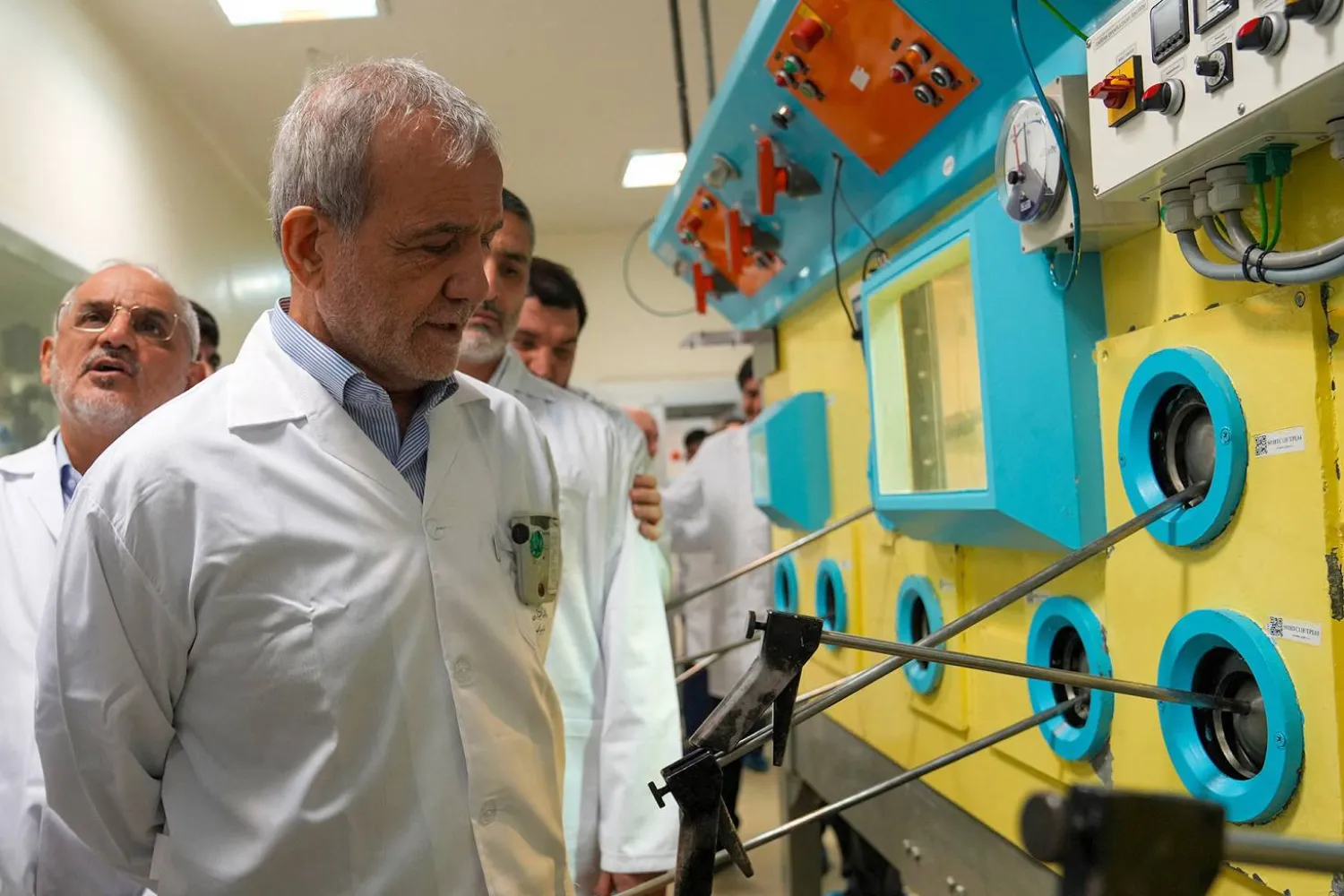
This handout picture made available by the Iranian Atomic Organization (IAEO) office on November 2, 2025, shows the Iranian President Masoud Pezeshkian during a visit to the Atomic Energy Organization of Iran, to meet with senior managers in the nuclear industry in Tehran. (Photo by Handout / Iranian Atomic Organization (IAEO) / AFP)
TT

Iran Warns US, E3 Against New IAEA Resolution

This handout picture made available by the Iranian Atomic Organization (IAEO) office on November 2, 2025, shows the Iranian President Masoud Pezeshkian during a visit to the Atomic Energy Organization of Iran, to meet with senior managers in the nuclear industry in Tehran. (Photo by Handout / Iranian Atomic Organization (IAEO) / AFP)

Iran’s permanent representative to the International Atomic Energy Agency (IAEA) has warned the United States and three European countries against submitting a new draft resolution to the IAEA Board of Governors, saying the move would only complicate the current situation without affecting Iran’s safeguards implementation.

Iran’s IRNA news agency said Tehran’s mission made the remark in a post on X late on Friday, ahead of the Board of Governors (BoG) meeting scheduled for November 19-21.

In a confidential report last Wednesday, the UN atomic watchdog said Iran still has not let inspectors into the nuclear sites Israel and the United States bombed in June, adding that accounting for Iran's enriched uranium stock is “long overdue.”

“It is critical that the Agency is able to verify the inventories of previously declared nuclear material in Iran as soon as possible in order to allay its concerns ... regarding the possible diversion of declared nuclear material from peaceful use,” the Agency said in the report to member states.

On Saturday, Iran’s representative to the IAEA, Reza Najafi, said: “Forcing the (IAEA) Director General to report on the basis of expired UN Security Council resolutions is not only entirely unlawful and unjustified, but in practice, will also add to the existing complexities and deliver yet another blow to diplomacy.”

The Mission accused the United States and Britain, France, and Germany, known as the E3, of intending to table a resolution against Iran at next week’s meeting of the IAEA BoG.

Najafi said that Washington and the E3 are once again attempting to “exploit international mechanisms to impose their illogical and coercive positions on the Iranian people.”

He affirmed that the push by the US and the E3 would not alter the current status of safeguards implementation in Iran, which the envoy said had been affected by the US-Israeli war of aggression against Iran in June this year.

The Iranian envoy called on all member states of the BoG to oppose what he described as destructive unilateral actions of the US and its European partners.
He also reaffirmed Iran’s right to take appropriate measures in response to any “illegal and unjustified” moves.

The IAEA Board of Governors will convene its regular November meeting at the Agency's headquarters in Vienna starting Wednesday to discuss a Western resolution against Iran.

The draft resolution against Iran cites a recent report by IAEA Director General Rafael Grossi, stressing the need for immediate verification of Iran’s declared nuclear material stocks under the Nuclear Non-Proliferation Treaty (NPT).

It requires Iran to suspend enrichment, reprocessing, and heavy water projects, including research and development activities, under UN non proliferation measures reinstated on Sept. 28, 2025.

The draft resolution also calls on Iran to fully implement the Additional Protocol and modified safeguards.

In its latest report, Grossi said the IAEA has now lost so-called continuity of knowledge of Iran’s enriched uranium stocks at the facilities that were damaged during the June airstrikes.

Diplomats said Iran is ignoring international calls to cooperate with the United Nations atomic watchdog and restart nuclear talks with the US, months into a tense stand-off following Israeli-led airstrikes on Iran.

Iran’s nuclear program, including the state and unknown location of its near-bomb-grade uranium stockpile, is the subject of a meeting next week at the International Atomic Energy Agency in Vienna.

Western nations represented there are due to draft new orders for IAEA inspectors to determine the status of Tehran’s nuclear inventory, according to three officials who asked not to be identified in return for discussing restricted information, Bloomberg said on Friday.

The IAEA is prepared to resume inspections of Iran's nuclear sites immediately, but Iran insists they're still too dangerous after airstrikes by Israel and the US five months ago, one senior western diplomat told Bloomberg.

Tehran may be gambling that an information blackout will deter any follow up strikes, the person said, while adding that those countries could equally call the bluff and bomb due to a lack of communication. IAEA Director General Rafael Mariano Grossi said in September that cooperation with his inspectors was crucial to diminish the threat of renewed military strikes.

Consensus is fraying over what to do next, with some western countries seeking to apply additional pressure on Iran by stripping scientists of access to IAEA technical cooperation in areas like nuclear medicine, the diplomats said.

Other nations caution that cutting all Iranian support could backfire and increase the chance of the country withdrawing from the Treaty on the Non-Proliferation of Nuclear weapons.

Iran’s nuclear work has concerned the West for decades and tensions over the nature of its atomic program, which dates back to the 1950s, have frequently shaken oil markets and spurred fits of both conciliation and conflict with the US.

Iran has always denied harboring intentions to develop a nuclear weapon and says it’s accelerated its uranium enrichment in response to US President Donald Trump’s first-term decision to quit the landmark 2015 nuclear deal and heavily sanction its economy.

Iran possessed sufficient highly-enriched uranium reserves to quickly craft about a dozen nuclear warheads before the June attacks. Since then, the IAEA has lost track of the material and Grossi says the lack of knowledge is a serious concern.

Recent satellite imagery shows Iranian activity around the bombed sites in Fordow, Natanz and Isfahan. Agency inspectors aren’t certain whether the activities are restricted to clean-up efforts or potentially include relocating uranium inventories.

A statement issued by Group of Seven nations earlier this week called on Iran to resume full cooperation with the IAEA and engage in direct talks with the Trump administration.

An Iranian foreign ministry spokesman rejected that call because it failed to condemn the Israeli and US attacks on its facilities, the state-backed Mehr News Agency reported.

“No new message has been conveyed to the US,” Iranian Security Council Secretary Ali Larijani said in a statement earlier this week. “The reason no new message has been sent is that previous negotiations had already taken place, and the other side showed no willingness to reach an agreement.”

Even if Iran immediately submitted to inspections and fully cooperated with the IAEA, it could take years to re-establish certainty over the fate of Iran’s nuclear stockpile, a second diplomat said.

Containment vessels where the material is stored may have been destroyed, releasing kilograms-worth of uranium into the environment. The June attacks didn’t end concerns over country’s nuclear program, they just opened a new chapter, the person said.



US Envoy Kellogg Says Ukraine Peace Deal Is Really Close

A Ukrainian serviceman walks near apartment buildings damaged by a Russian military strike, amid Russia's attack on Ukraine, in the frontline town of Kostiantynivka in Donetsk region, Ukraine November 15, 2025. (Oleg Petrasiuk/Press Service of the 24th King Danylo Separate Mechanized Brigade of the Ukrainian Armed Forces/Handout via Reuters)
TT

US Envoy Kellogg Says Ukraine Peace Deal Is Really Close

A Ukrainian serviceman walks near apartment buildings damaged by a Russian military strike, amid Russia's attack on Ukraine, in the frontline town of Kostiantynivka in Donetsk region, Ukraine November 15, 2025. (Oleg Petrasiuk/Press Service of the 24th King Danylo Separate Mechanized Brigade of the Ukrainian Armed Forces/Handout via Reuters)

US President Donald Trump's outgoing Ukraine envoy said a deal to end the Ukraine war was "really close" and now depended on resolving two main outstanding issues: the future of Ukraine's Donbas region and the Zaporizhzhia nuclear power plant.

Russia invaded Ukraine in February 2022 after eight years of fighting between Russian-backed separatists and Ukrainian troops in the Donbas, which is made up of the Donetsk and Luhansk regions.

The Ukraine war is the deadliest European conflict since World War Two and has triggered the biggest confrontation between Russia and the West since the depths of the Cold War.

US Special Envoy for Ukraine Keith Kellogg, who is due to step down in January, told the Reagan National Defense Forum that efforts to resolve the conflict were in "the last 10 meters" which he said was always the hardest.

The two main outstanding issues, Kellogg said, were on territory - primarily the future of the Donbas - and the future of Ukraine's Zaporizhzhia nuclear power plant, Europe's largest, which is under Russian control.

"If we get those two issues settled, I think the rest of the things will work out fairly well," Kellogg said on Saturday at the Ronald Reagan Presidential Library and Museum in Simi Valley, California. "We're almost there."

"We're really, really close," said Kellogg.

Kellogg, a retired lieutenant general who served in Vietnam, Panama and Iraq, said the scale of the death and injuries caused by the Ukraine war was "horrific" and unprecedented in terms of a regional war.

He said that, together, Russia and Ukraine have suffered more than 2 million casualties, including dead and wounded since the war began. Neither Russia nor Ukraine disclose credible estimates of their losses.

Moscow says Western and Ukrainian estimates inflate its losses. Kyiv says Moscow inflates estimates of Ukrainian losses.

Russia currently controls 19.2% of Ukraine, including Crimea, which it annexed in 2014, all of Luhansk, more than 80% of Donetsk, about 75% of Kherson and Zaporizhzhia, and slivers of the Kharkiv, Sumy, Mykolaiv and Dnipropetrovsk regions.

A leaked set of 28 US draft peace proposals emerged last month, alarming Ukrainian and European officials who said it bowed to Moscow's main demands on NATO, Russian control of a fifth of Ukraine and restrictions on Ukraine's army.

Those proposals, which Russia now says contain 27 points, have been split up into four different components, according to the Kremlin. The exact contents are not in the public domain.

Under the initial US proposals, the Zaporizhzhia nuclear plant, whose reactors are currently in cold shutdown, would be relaunched under the supervision of the International Atomic Energy Agency, and the electricity produced would be distributed equally between Russia and Ukraine.

Ukrainian President Volodymyr Zelenskiy said on Saturday that he had had a long and "substantive" phone call with Trump's special envoy Steve Witkoff and Trump's son-in-law Jared Kushner.

The Kremlin said on Friday it expected Kushner to be doing the main work on drafting a possible deal.


7.0 Earthquake Hits in Remote Wilderness Along Alaska-Canada Border

 Hubbard Glacier, located near Yakutat, Alaska, is seen on Aug. 1, 2024. (AP)
Hubbard Glacier, located near Yakutat, Alaska, is seen on Aug. 1, 2024. (AP)
TT

7.0 Earthquake Hits in Remote Wilderness Along Alaska-Canada Border

 Hubbard Glacier, located near Yakutat, Alaska, is seen on Aug. 1, 2024. (AP)
Hubbard Glacier, located near Yakutat, Alaska, is seen on Aug. 1, 2024. (AP)

A powerful, magnitude-7.0 earthquake struck in a remote area near the border between Alaska and the Canadian territory of Yukon on Saturday. There was no tsunami warning, and officials said there were no immediate reports of damage or injury.

The US Geological Survey said it struck about 230 miles (370 kilometers) northwest of Juneau, Alaska, and 155 miles (250 kilometers) west of Whitehorse, Yukon.

In Whitehorse, Royal Canadian Mounted Police Sgt. Calista MacLeod said the detachment received two 911 calls about the earthquake.

“It definitely was felt,” MacLeod said. “There are a lot of people on social media, people felt it.”

Alison Bird, a seismologist with Natural Resources Canada, said the part of Yukon most affected by the temblor is mountainous and has few people.

“Mostly people have reported things falling off shelves and walls,” Bird said. “It doesn’t seem like we’ve seen anything in terms of structural damage.”

The Canadian community nearest to the epicenter is Haines Junction, Bird said, about 80 miles (130 kilometers) away. The Yukon Bureau of Statistics lists its population count for 2022 as 1,018.

The quake was also about 56 miles (91 kilometers) from Yakutat, Alaska, which the USGS said has 662 residents.

It struck at a depth of about 6 miles (10 kilometers) and was followed by multiple smaller aftershocks.


Japan and Australia Urge Calm after Chinese Radar Locks on Japanese Jets

Printed Chinese and Japanese flags are seen in this illustration, July 21, 2022. REUTERS/Dado Ruvic/Illustration Purchase Licensing Rights
TT

Japan and Australia Urge Calm after Chinese Radar Locks on Japanese Jets

Printed Chinese and Japanese flags are seen in this illustration, July 21, 2022. REUTERS/Dado Ruvic/Illustration Purchase Licensing Rights

Japan and Australia urged calm on Sunday after Chinese military aircraft locked radar on Japanese fighter jets, a month after the Japanese leader’s recent remarks on Taiwan that stirred tensions between Tokyo and Beijing.

Defense Minister Shinjiro Koizumi said Japan formally protested the incident, calling it “an extremely regrettable” act and “a dangerous" one that "exceeded the scope necessary for safe aircraft operations.”

“We have lodged a strong protest with the Chinese side and demanded strict preventive measures,” Koizumi said.

Japan’s Defense Ministry said China’s military aircraft J-15 took off from the Chinese carrier Liaoning near the southern island of Okinawa on Saturday and “intermittently” latched its radar on Japanese F-15 fighter jets on two occasions Saturday, for about three minutes in the late afternoon and for about 30 minutes in the evening. It was not made clear whether the radar lock incident involved the same Chinese J-15 both times.

Japanese fighter jets that had been scrambled to pursue Chinese jets that were conducting aircraft takeoff and landing exercises in the Pacific. They were pursuing the Chinese aircraft at a safe distance and did not take actions that could be interpreted as provocation, Kyodo News agency said, quoting defense officials, when the radar lock happened. There was no breach of Japanese airspace, and no injury or damage was reported from the incident.

Senior Colonel Wang Xuemeng, spokesperson for the Chinese navy, defended China’s flight training near the Miyako island Saturday, saying Beijing announced the exercises beforehand and accused Japanese aircraft of “harassment.”

“We solemnly asked the Japanese side to immediately stop slandering and smearing, and strictly restrain its frontline actions. The Chinese Navy will take necessary measures in accordance with the law to resolutely safeguard its own security and legitimate rights and interests,” Wang said in a statement posted Sunday on the Chinese Ministry of Defense website.

Relations between Japan and China have worsened after Japan’s Prime Minister Sanae Takaichi said in early November its military could get involved if China were to take action against Taiwan, the self-governing island that Beijing claims as its own.

Japan and Australia, whose defense ministers held their scheduled talks in Tokyo on Sunday, expressed worry over the development.

“We are deeply concerned by the actions of China in the last 24 hours,” Australian Defense Minister Richard Marles told a joint news conference Sunday after holding talks with Koizumi. “We expect those interactions to be safe and professional."

Australia does “not want to see any change to the status quo across the Taiwan Straits,” Marles said, adding that China is his country's largest trade partner and he wants to have productive relations with Beijing.

“We continue to advocate to China about these issues again, in a very calm, sensible and moderate way,” he said.

Japan and Australia, during Sunday talks, agreed to bolster military ties to lead the region’s multilateral defense cooperation. The two ministers agreed to form a comprehensive “framework for strategic defense coordination” and discuss further details.

Tokyo has been accelerating its military buildup while expanding its defense ties beyond its only treaty ally, the United States. It now considers Australia to be a semi-ally.

Marles also visited a Mitsubishi Heavy Industries shipyard in Nagasaki on Saturday to observe production of the upgraded Mogami-class frigate that his country chose in September as a replacement for its aging fleet.

Saturday's radar lock is believed to be the first involving Japanese and Chinese military aircraft. In 2013, a Chinese warship targeted a radar on a Japanese destroyer, Kyodo said.

Fighter jets use radars for search operations or fire control ahead of a missile launch.

Elsewhere in the Pacific, the Philippine coast guard said China fired three flares toward a fisheries bureau plane on patrol in the South China Sea on Saturday. Chinese forces fire flares to warn planes to move away from what they consider their airspace over the disputed waters.