UK Threatens Visa Bans Ahead of Asylum Overhaul

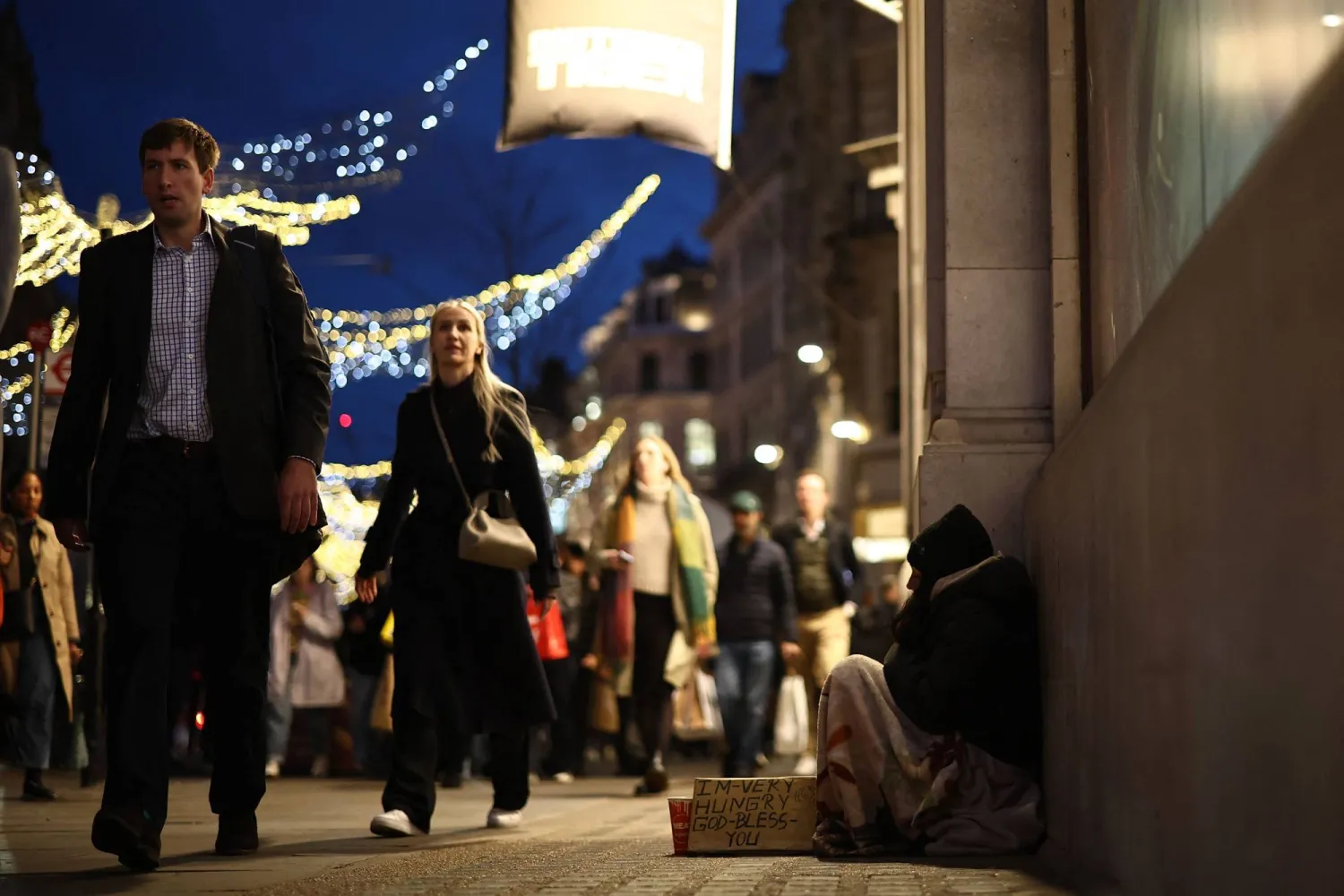
A beggar sits on the pavement on Regent Street as shoppers pass by on November 11, 2025 in London. (Photo by HENRY NICHOLLS / AFP)
TT

UK Threatens Visa Bans Ahead of Asylum Overhaul

A beggar sits on the pavement on Regent Street as shoppers pass by on November 11, 2025 in London. (Photo by HENRY NICHOLLS / AFP)

The UK government on Monday threatened visa bans on three African countries unless they accept the returns of irregular migrants, as the interior minister was set to announce sweeping changes to the asylum system.

Britain said it would stop granting visas to nationals from Angola, Namibia and the Democratic Republic of Congo unless the countries accepted the returns of "their criminals and illegal immigrants,” the interior ministry said in a statement.

Home Secretary Shabana Mahmood was expected later on Monday to announce what has been touted by the government as the "most sweeping reforms to tackle illegal migration in modern times.”

Immigration has become a bitterly divisive issue in Britain in recent years, fueling support for the hard-right Reform UK party.

Mahmood's hardline rhetoric and measures is aimed at curbing asylum seekers crossing the Channel from France to Britain on small boats -- but they are widely seen as an attempt to claw back public support from Reform, which has surged past the governing Labour Party in popularity polls.

Echoing US President Donald Trump's travel bans, the Home Office said the "three countries face penalties for their unacceptably low cooperation and obstructive returns processes,” Reuters reported.

Home Office minister Alex Norris told Sky News the countries had "one month to get this in order.”

The government also said it would consider similar measures against other countries.
These include an "emergency brake" on visas for people from countries with high rates of asylum claims, who travel to the UK by legal routes.

Despite an increase in asylum claims being submitted, the number of initial positive decisions the UK authorities have granted fell from 2023 to 2024, according to the latest government figures.

Thousands of visas have been granted under humanitarian schemes for Ukrainians, Afghans and Hong Kong residents in recent years.

Other planned measures, modelled on Denmark's strict asylum system, will include ending automatic benefits for asylum seekers and drastically reducing protections for refugees.

One of the most contentious proposals -- which has been condemned by charities as well as Labour lawmakers -- will see the length of refugee status cut from five years to 30 months.

Refugees will have their protection "regularly reviewed" and will be forced to return to their home countries once those are deemed safe.

They will also need to wait for 20 years, instead of the current five, before they can apply for permanent residency.

"We should be welcoming and integrating and not creating this situation of kind of perpetual limbo and alienation, which doesn’t help the refugees and it doesn't help society," Labour MP Tony Vaughan told the BBC's Today program.


Pope Leo XIV Makes a Rare 1-day Visit to Glitzy Monaco

Pope Leo XIV speaks during his pastoral visit to the Parish of the Parish of 'Sacred Heart of Jesus' in Rome, Italy, 15 March 2026. EPA/ANGELO CARCONI
TT

Pope Leo XIV Makes a Rare 1-day Visit to Glitzy Monaco

Pope Leo XIV speaks during his pastoral visit to the Parish of the Parish of 'Sacred Heart of Jesus' in Rome, Italy, 15 March 2026. EPA/ANGELO CARCONI

Pope Leo XIV travels Saturday to the principality of Monaco, becoming the first pope in nearly five centuries to visit the glitzy Mediterranean enclave and highlighting how small states can punch above their weight on the global stage.

Vatican spokesperson Matteo Bruni said the visit would provide the American pope with his first real chance to speak to all of Europe.

“In the Bible, it is precisely the small ones who play a significant role,” Bruni said.

Monaco is also one of the few European countries where Catholicism is the official state religion. And Prince Albert recently refused a proposal to legalize abortion, citing the important role Catholicism plays in Monaco society.

The decision was largely symbolic, since abortion is a constitutional right in France, which surrounds the coastal principality of 2.2 square kilometers (about 1 square mile).

In refusing to allow it in Monaco, Albert joined other European Catholic royals who have taken a similar stand over the years to uphold Catholic doctrine on an increasingly secular continent. When Pope Francis visited Belgium in 2024, he announced he was putting the late King Baudouin on the path to possible sainthood because he abdicated for a day in 1990 rather than approve legislation to legalize abortion.

Bruni said the “defense of life” would be one of the themes of Leo’s one-day visit Saturday. But he stressed that Leo’s vision would be in the larger context of defending all life, including in wars and conflicts.

An unexpected destination

The visit includes a private meeting with Albert and Princess Charlene at the palace, a meeting with Monaco’s Catholic community in the cathedral and Mass in the sports stadium.

A coastal playground for the rich and famous, Monaco is renowned as much for its tax-friendly incentives and Formula 1 Grand Prix as its glamorous royal family. The son of the late American actress Grace Kelly, Albert spoke in perfect, unaccented English when he visited the Chicago-born Leo at the Vatican on Jan. 17 and invited him to visit.

The trip came together quickly after that, and raised eyebrows about why Leo had chosen Monaco, a hereditary and constitutional monarchy, as his first foreign trip in Europe. Pope Francis also liked to travel to small countries, but Monaco’s glitz factor likely would have turned him off.

“It does raise questions,” conceded Abbe Christian Venard, spokesperson for the diocese of Monaco. “Is it really the place for a pope to go to a principality better known — somewhat caricatured — as a haven for billionaires, even if that is part of Monaco’s reality? I think it reflects some inner freedom from the pope,” he told The Associated Press.

In fact, there are good reasons for Leo to visit, not least because there hasn’t been a pope who visited in 488 years, since Pope Paul III in 1538.

Monaco's population of 38,000 is heavily Catholic and also multinational, with only a fifth of the population actually citizens of the principality.

Short but symbolic trip Leo will be in Monaco for just under nine hours, and the principality is so close to home that he can get there and back to the Vatican by helicopter. But the visit is rich in symbolic significance, since it represents the leaders of the world’s two smallest states coming together to talk about some of the world’s biggest problems.

With Russia’s war in Ukraine raging and the US-Israeli war in Iran spreading, Leo will likely want to repeat his appeal for peace and dialogue to prevail.

"Much like the principality’s role in fostering dialogue and mediation, serving as a laboratory for peace, social friendship, and the responsible use of influence and wealth,” Bruni said.

That is a reference to Monaco's financial support of initiatives to help Christians in the Middle East, including its participation in the Aliph Foundation, which works in particular to rebuild and restore churches and other sites of cultural importance that get damaged or destroyed by conflict.

The government has also been a longtime supporter of church projects in Lebanon organized by l’Œuvre d’Orient, a French-based group that supports bishops, priests and religious orders working in 23 countries.

Albert is also a well-known environmental campaigner, and Monaco hosts regular international conferences, especially on the plight of the Mediterranean. Leo has strongly carried on Francis’ legacy of ecological stewardship, and the environment is expected to be a topic of discussion.

“The fact that Monaco hosts environmental forums, scientific conferences, and thematic summits makes sense and effectively counterbalances the somewhat ‘glitzy’ image that the event might initially convey,” noted François Mabille, director of the Geopolitical Observatory of Religion at the French Institute for International and Strategic Affairs.

Mabille said it is precisely on issues such as the environment where two small states with similar values can work together on the global stage, especially when the Holy See has a tradition of diplomatic neutrality and only enjoys observer status at the United Nations and other international organizations.

“What’s interesting is to realize that there is indeed a Monaco foreign policy that can, in a way, enable or allow the Vatican to go further,’’ Mabille said. “And here, the Vatican’s soft power can find ... a sort of continuity and, in any case, a convergence with another small state — one that, this time, votes and participates."


Japan to Boost Coal-Fired Power as Middle East War Causes Energy Turmoil

This photo taken on March 13, 2026 shows Noshiro Thermal Power Station, a coal-fired thermal power station operated by Tohoku Electric Power in the city of Noshiro, Akita Prefecture. (Jiji Press/AFP)
TT

Japan to Boost Coal-Fired Power as Middle East War Causes Energy Turmoil

This photo taken on March 13, 2026 shows Noshiro Thermal Power Station, a coal-fired thermal power station operated by Tohoku Electric Power in the city of Noshiro, Akita Prefecture. (Jiji Press/AFP)

Japan's government plans to temporarily lift restrictions on coal-fired power plants as it seeks to ease an energy crunch caused by the Middle East war, officials said on Friday.

Officials presented the plan at a meeting of a panel of experts, who approved the proposal, the industry ministry said on its website.

"Given the current situation in the Middle East affecting fuel prices, we believe that uncertainty regarding future LNG procurement is increasing," an industry ministry official said at the meeting, which was broadcast online.

"We think it will be necessary, by increasing the operation of coal-fired power plants, to...ensure the reliability of stable supply," he said.

Power suppliers have previously been required to keep the operating rate of coal-fired thermal power stations that emit large amounts of carbon dioxide at or below 50 percent.

But the government now intends to allow the full operation of older, less efficient coal-fired plants, for a year from the new fiscal year starting April, according to the plan presented at the meeting.

Japan relies on thermal power plants to generate around 70 percent of its electricity needs, with coal constituting 30 percent of their fuel.

Liquified natural gas (LNG) accounts for another 30 percent, and oil comprises seven percent.

The emergency measure to boost reliance on coal is estimated to "result in an LNG savings effect of approximately 500,000 tons," the official added.

The initiative follows many Asian nations' pivot towards coal to power their economies since the Middle East war that began late last month prompted Iran to partially close the crucial Strait of Hormuz trade route and target energy facilities in the Gulf.

South Korea plans to lift a cap on coal-powered generation capacity, while also increasing nuclear plant operations.

The Philippines also intended to boost the output of its coal-fired power plants to keep electricity costs down as the war wreaks havoc with gas shipments.

Japan is the fifth-biggest importer of oil with more than 90 percent of it coming from the Middle East.

Around 10 percent of its LNG imports are also from the region.

Tokyo purchases nearly 80 percent of its coal imports from Australia and Indonesia, according to the Agency for Natural Resources and Energy.

Japan on Thursday said it had also started to release another part of its strategic oil reserves, as it faced supply challenges to its oil imports.


Israel Launches New Wave of Strikes on Iran with No Sign of Diplomatic Breakthrough

FILE PHOTO: A view of a residential building damaged by a strike, amid the US-Israeli conflict with Iran, in Tehran, Iran, March 23, 2026. Majid Asgaripour/WANA (West Asia News Agency) via REUTERS
TT

Israel Launches New Wave of Strikes on Iran with No Sign of Diplomatic Breakthrough

FILE PHOTO: A view of a residential building damaged by a strike, amid the US-Israeli conflict with Iran, in Tehran, Iran, March 23, 2026. Majid Asgaripour/WANA (West Asia News Agency) via REUTERS

Israel launched a new wave of strikes on Iran on Friday after US President Donald Trump claimed talks on ending the war were going well and gave Tehran more time to open the Strait of Hormuz, though there have been no signs of Iran backing down.

With stock markets reeling and economic fallout from the war extending far beyond the Middle East, Trump is under growing pressure to end Iran's chokehold on the strait, a strategic waterway through which a fifth of the world's oil is usually shipped, said The Associated Press.

The US has offered Iran a 15-point proposal for a ceasefire that includes it relinquishing control of the strait, but at the same time has ordered thousands more troops to the region, possibly in preparation for a military attempt to wrest the waterway from Iran’s tight grip.

With time running out on a deadline set by Trump for Iran to open the strait, after which he had threatened to destroy Iran’s energy plants, he pushed his self-imposed deadline back to April 6 on Thursday, saying that talks on ending the conflict were going “very well.” Iran, however, maintains it is not engaged in any negotiations.

Israel’s attack Friday on targets “in the heart of Tehran” targeted sites used by Iran to produce ballistic missiles and other weapons, the Israeli military said. It also hit missile launchers and storage sites in western Iran.

Smoke also rose over Beirut, although Israel did not immediately report hitting the Lebanese capital, while air raid sirens sounded in Israel as the military said it was working to intercept Iranian missiles. Iran kept firing missiles and drones at its Gulf Arab neighbors, with sirens warning of attacks in Bahrain, Qatar and the United Arab Emirates.

Kuwait said its Shuwaikh Port in Kuwait City had sustained “material damage” in attack but that nobody was hurt.

After Wall Street's worst day since the war began, Asian shares mostly fell Friday over growing doubts about the chances of de-escalation. Oil prices rose again, the Brent crude, the international standard, at $107 a barrel in morning trading, up more than 45% since Israel and the US attacked Iran on Feb. 28 to start the war.

US pushing diplomatic solution but sending more troops to the region Iran's stranglehold on shipping through the Strait of Hormuz, has caused growing concerns of a global energy crisis, and appears part of a strategy to get the US to back down by roiling the world economy. A Gulf Arab bloc said Thursday that Iran is now exacting tolls from ships to ensure their safe passage through the waterway.

Trump envoy Steve Witkoff said Washington has delivered a 15-point “action list" to Iran for a possible ceasefire, using Pakistan as an intermediary. The list includes restrictions on Iran’s nuclear program and re-opening the Strait of Hormuz.

Iran has rejected the US offer and put forth its own five-point proposal, which includes reparations and recognition of its sovereignty over the Strait of Hormuz.

Diplomats from several countries have been trying to organize a direct meeting between envoys from the US and Iran, possibly in Pakistan.

Egypt's Foreign Ministry said in a statement Friday that the country's Foreign Minster Badr Abdelatty held phone calls the day before with his Turkish and Pakistani counterparts as part of their "intensive efforts" to organize the talks.

Abdelatty said he hoped the tri-country effort would result in "gradual de-escalation efforts that would ultimately lead to the end of the war."

As the diplomatic efforts went on, a group of US ships drew closer to the region with some 2,500 Marines. Also, at least 1,000 paratroopers from the 82nd Airborne — trained to land in hostile territory to secure key territory and airfields — have been ordered to the region.

As American and Israeli attacks on Iran continued, the UN Security Council scheduled closed consultation on Iran for Friday in New York, according to two UN diplomats who spoke on condition of anonymity because the meeting is not public.

They added that Russia had asked for the meeting on US-Israeli attacks on civilian infrastructure in the country, that the United States, which holds the Security Council presidency, had scheduled it.

Jan Egeland, secretary general of the Norwegian Refugee Council, said the humanitarian organization's teams in Iran have reported that “countless homes, hospitals and schools have been damaged or destroyed,” and that nearly every neighborhood in Tehran has sustained damage.

“Civilians are paying the highest price for this war — it must end” he said in a statement.

The International Organization for Migration said Friday that 82,000 civilian buildings, including hospitals and the homes of 180,000 people have been damaged in Iran so far.

“If this war continues, we risk a far wider humanitarian disaster,” Egeland said. “Millions could be forced to flee across borders, placing immense pressure on an already overstretched region.”

Deaths continue to climb, primarily in Iran and Lebanon Since the war began, more than 1,900 people have been killed in Iran, according to the Health Ministry.

Eighteen people have died in Israel, while at least three Israeli soldiers have also been killed in Lebanon. At least 13 American troops have been killed. Four people in the occupied West Bank and 20 in Gulf Arab states have also died.

Authorities said more than 1,100 people have died in Lebanon. In Iraq, where Iranian-supported militia groups have entered the conflict, 80 members of the security forces have been killed.