


Bangladesh Tribunal Sentences Ousted Leader Sheikh Hasina to Death for Crimes Against Humanity 

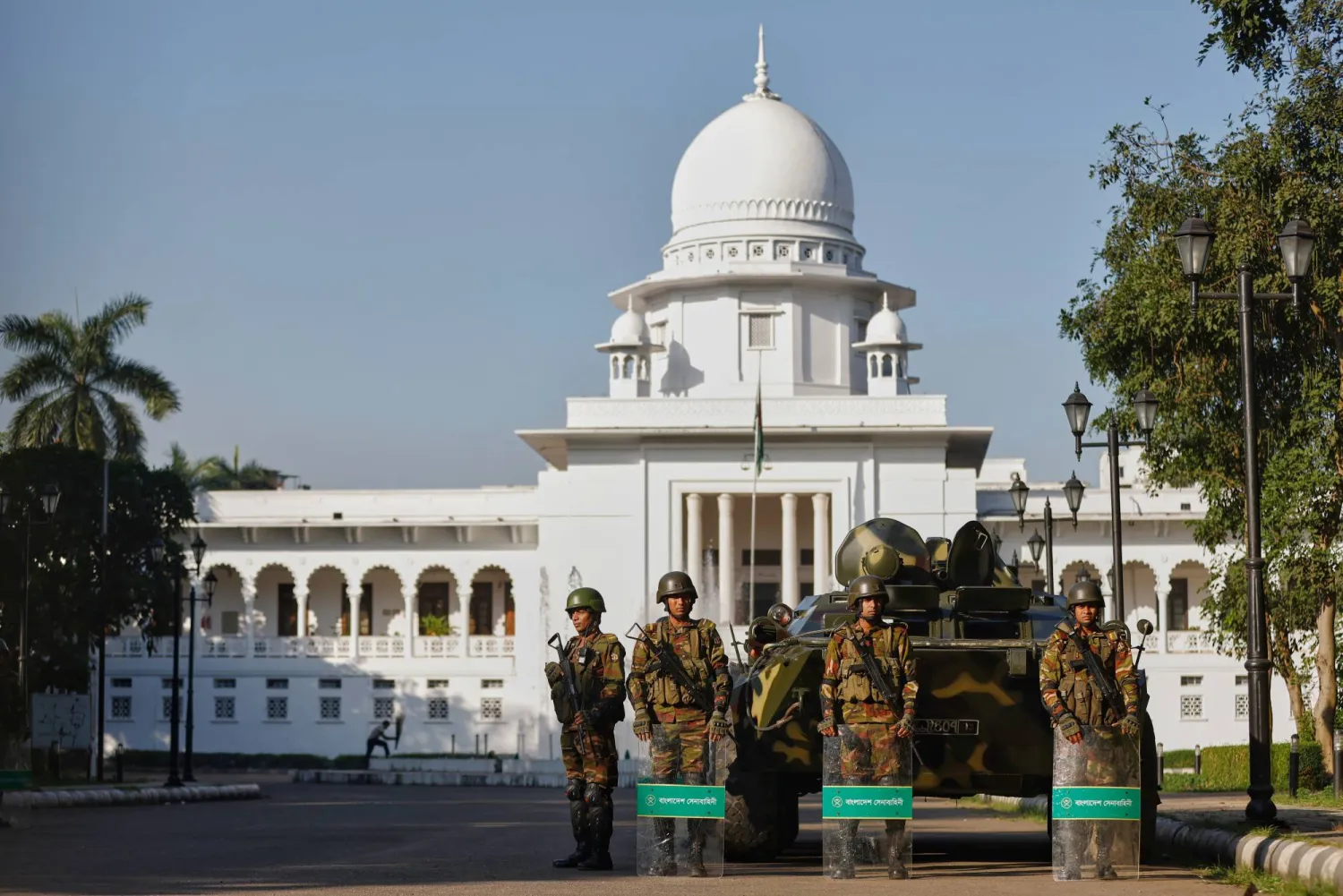
Bangladeshi Army soldiers stand guard outside the Supreme Court after security have been beefed up across the country ahead of an expected verdict against ousted Prime Minister Sheikh Hasina, in Dhaka, Bangladesh, Monday, Nov. 17, 2025. (AP)
TT

Bangladesh Tribunal Sentences Ousted Leader Sheikh Hasina to Death for Crimes Against Humanity 

Bangladeshi Army soldiers stand guard outside the Supreme Court after security have been beefed up across the country ahead of an expected verdict against ousted Prime Minister Sheikh Hasina, in Dhaka, Bangladesh, Monday, Nov. 17, 2025. (AP)

A special tribunal sentenced Bangladesh’s ousted Prime Minister Sheikh Hasina to death on charges of crimes against humanity for her crackdown on a student uprising last year that killed hundreds of people and led to the toppling of her 15-year rule.

The Dhaka-based International Crimes Tribunal also sentenced former Home Minister Asaduzzaman Khan to death for his involvement in the use of deadly force against protesters.

Both Hasina and Khan fled to India last year and were sentenced in absentia.

A third suspect, a former police chief, was sentenced to five years in prison after becoming a state witness against Hasina and pleading guilty.

Hasina and Khan were accused of crimes against humanity over the killing of hundreds of people during a student-led uprising in July and August of 2024. The country’s health adviser under the country’s current interim government said more than 800 people were killed and about 14,000 were injured. However, the United Nations in a February report said up to 1,400 may have been killed.

Hasina says the charges are unjustified, arguing that she and Khan “acted in good faith and were trying to minimize the loss of life.”

“We lost control of the situation, but to characterize what happened as a premeditated assault on citizens is simply to misread the facts,” she said Monday.

The verdict comes as the country still grapples with instability after Hasina was ousted on Aug. 5, 2024. Bangladeshi Nobel Peace Prize laureate Muhammad Yunus took over as the head of an interim government three days after her fall. Yunus has vowed to punish Hasina and banned the activities of her Awami League party.

A three-member tribunal, headed by Justice Golam Mortuza Mozumder, announced the tribunal's ruling in the capital, Dhaka. Tensions in the country were high and the tribunal was broadcast live.

Some of those in the packed courtroom cheered when Mazumder announced the death penalty for Hasina. He admonished them, telling them to express their feelings outside the courtroom.

Many families of the killed and the injured during last year's uprising gathered outside the tribunal premises, where they had waited hours to hear the verdict.

It appeared unlikely that Hasina would return to Bangladesh to face her sentence. India had not responded to requests by Bangladesh to extradite her to face the trial.

Hasina can’t also appeal.

The interim government beefed up security ahead of the verdict, with paramilitary border guards and police deployed in Dhaka and many other parts of the country.

Hasina’s Awami League party called for a nationwide shutdown to protest the verdict on Monday.

Hasina denounced Monday’s ruling, calling it “biased and politically motivated” in a statement. She also denounced the tribunal as “rigged” and alleged that it was “established and presided over by an unelected government with no democratic mandate.”

“In their distasteful call for the death penalty, they reveal the brazen and murderous intent of extremist figures within the interim government to remove Bangladesh’s last elected prime minister, and to nullify the Awami League as a political force,” she said.

Hasina cannot appeal the verdict unless she surrenders or is arrested within 30 days of the judgment.

Tensions and disruptions grew in the country in the days leading up to the expected verdict.

Nearly 50 arson attacks, mostly targeting vehicles, and dozens of crude bombs explosions were reported nationwide over the past week. Two people were killed in the arson attacks, local media reported.

Authorities at the Supreme Court, in a letter to army headquarters on Sunday, requested the deployment of soldiers around the tribunal premises ahead of the verdict.

Yunus said his interim government would hold the country's next elections in February, and that Hasina’s party would not get a chance to contest the race.

Bangladesh's politics under Yunus has remained at a crossroads with limited signs of stability.



Running App Reveals Location of France Aircraft Carrier in Mediterranean

French President Emmanuel Macron (C) visits the French aircraft carrier Charles de Gaulle, deployed to the Mediterranean following Iranian drone strikes on Cyprus on the Mediterranean Sea, on March 9, 2026, on the sidelines of his trip to Cyprus to discuss regional security. (Photo by Gonzalo Fuentes / POOL / AFP)
TT

Running App Reveals Location of France Aircraft Carrier in Mediterranean

French President Emmanuel Macron (C) visits the French aircraft carrier Charles de Gaulle, deployed to the Mediterranean following Iranian drone strikes on Cyprus on the Mediterranean Sea, on March 9, 2026, on the sidelines of his trip to Cyprus to discuss regional security. (Photo by Gonzalo Fuentes / POOL / AFP)

A member of the French navy using an app to track his jogging performance broadcast the exact position of his country's flagship aircraft carrier, a newspaper has reported.

France deployed the Charles de Gaulle -- and accompanying frigates -- to the Mediterranean in early March shortly after US-Israeli strikes on Iran sparked war in the Middle East.

It has been in the eastern Mediterranean since March 9 as part of what Emmanuel Macron has called a "purely defensive" posture in support of France's allies in the conflict.

Le Monde newspaper reported on Thursday that the runner jogged in circles on a ship in movement on March 13 in the middle of the sea northwest of Cyprus, according to his public profile on the Strava fitness tracking app, while satellite images showed the aircraft carrier was in the immediate vicinity at the time.

The same person had also been running in Copenhagen, Denmark, in late February, across a bridge from Malmo, Sweden, where the Charles de Gaulle was anchored at the time, Strava data showed.

The French armed forces told AFP appropriate measures would be taken if the report was true, as members of the navy were regularly reminded about the risk of security breaches using such apps.

"The reported case -- if confirmed -- does not comply with the current instructions," it said.

Running app profiles have given away sensitive information before.


Israeli Reservist Arrested on Suspicion of Spying for Iran

A long exposure showing the interception of a ballistic missile in the skies above Tel Aviv, as sirens sounds across central Israel, 20 March  2026. EPA/ABIR SULTAN
A long exposure showing the interception of a ballistic missile in the skies above Tel Aviv, as sirens sounds across central Israel, 20 March 2026. EPA/ABIR SULTAN
TT

Israeli Reservist Arrested on Suspicion of Spying for Iran

A long exposure showing the interception of a ballistic missile in the skies above Tel Aviv, as sirens sounds across central Israel, 20 March  2026. EPA/ABIR SULTAN
A long exposure showing the interception of a ballistic missile in the skies above Tel Aviv, as sirens sounds across central Israel, 20 March 2026. EPA/ABIR SULTAN

Israeli police said on Friday they had arrested an army reservist who served on the Iron Dome air defense system on suspicion of passing secrets to Iran.

The arrest comes as Israel and the United States are locked in a war with Iran that has spread across the Middle East.

"Raz Cohen, a 26-year-old resident of Jerusalem who served in the reserves in the Iron Dome system, was recently arrested on suspicion of committing security offenses involving contact with Iranian intelligence," Israeli police said.

"Over the course of several months, the citizen maintained contact with Iranian intelligence operatives and, under their instructions, was asked to carry out various security missions, including passing on sensitive security information."

Iran has been firing barrages of missiles at Israel in retaliation for a US-Israeli bombing campaign that began on February 28 with the killing of supreme leader Ali Khamenei.

Israel's state-of-the-art air defenses have managed to intercept many of the missiles fired by Tehran, but there have been deaths and damage to some strategic sites.

According to Israeli rescue services and authorities, Iranian missile fire toward Israel has killed 15 civilians in the country since the start of the war.

Four Palestinian women also died after Iranian missile fire in the occupied West Bank, the Ramallah-based health ministry said.


Italy, Germany and France Offer Help with Hormuz Only after Ceasefire

Britain, France, Germany, Italy, Japan and the Netherlands say they are ready "to contribute to appropriate efforts to ensure safe passage through the Strait of Hormuz" post-ceasefire. Giuseppe CACACE / AFP/File
TT

Italy, Germany and France Offer Help with Hormuz Only after Ceasefire

Britain, France, Germany, Italy, Japan and the Netherlands say they are ready "to contribute to appropriate efforts to ensure safe passage through the Strait of Hormuz" post-ceasefire. Giuseppe CACACE / AFP/File

Six major international powers said Thursday they were ready "to contribute to" ensuring safe passage through the Strait of Hormuz, though three stressed that any initiative would take place post-ceasefire.

Britain, France, Germany, Italy, Japan and the Netherlands said Thursday they were ready "to contribute to appropriate efforts to ensure safe passage through the Strait of Hormuz".

The grouping said they "welcome the commitment of nations who are engaging in preparatory planning", as they condemned "in the strongest terms recent attacks by Iran on unarmed commercial vessels in the Gulf".

But Italy, Germany and France made clear later Thursday that they were not talking about any immediate military help, but rather a potential multilateral initiative after a ceasefire.

The declaration came as an effective Iranian blockade of the strait has paralyzed commercial shipping through the crucial maritime chokepoint, which in peacetime sees a fifth of global crude oil and liquefied natural gas pass through it.

The war, which erupted on February 28 when the United States and Israel began bombing Iran, has led Tehran to retaliate with strikes across the Gulf region.

Twenty-three commercial vessels, including 10 tankers, have reported incidents or having been attacked.

The situation has left around 20,000 seafarers stranded on approximately 3,200 vessels west of the strait, according to the International Maritime Organization.

"We express our deep concern about the escalating conflict," the allies' joint statement said.

"We call on Iran to cease immediately its threats, laying of mines, drone and missile attacks and other attempts to block the Strait to commercial shipping," it added.

"Freedom of navigation is a fundamental principle of international law, including under the United Nations Convention on the Law of the Sea.

"The effects of Iran's actions will be felt by people in all parts of the world, especially the most vulnerable."

- Not a 'war mission' -

US President Donald Trump has urged other world powers, and NATO, to help reopen the Hormuz Strait to commercial shipping.

But they have rebuffed his call in the short term while insisting they were open to discussions and planning.

Italy's Defense Minister Guido Crosetto said the statement by the six countries should not be seen as a "war mission".

"No entry into Hormuz without a truce and a comprehensive multilateral initiative", for which "it is right and appropriate for the United Nations to provide the legal framework", he said in a statement.

And in Berlin, Defense Minister Boris Pistorius said that any German military involvement "would depend on the situation after a ceasefire... and whether we could participate within the framework of an international mandate".

Military involvement would also require approval by the German parliament, he added.

French President Emmanuel Macron told reporters his country planned to sound out permanent members of the UN Security Council on the possibility of establishing a UN framework for future plans -- once the ongoing exchange of fire had ended -- to secure navigation in the Strait of Hormuz.

"We have initiated an exploratory process, and we will see in the coming days whether it stands a chance of succeeding," he said in Brussels following a European summit that took place on Thursday.

A UK defense official told reporters at a briefing Wednesday that "the level of threat is such that I don't see many nations being willing to put warships into the middle of that threat right now".

The defense official noted London has sent a "small number" of additional military "planners" to US Central Command to "help with the planning and option development for... whatever comes next in the Strait of Hormuz might look like".