

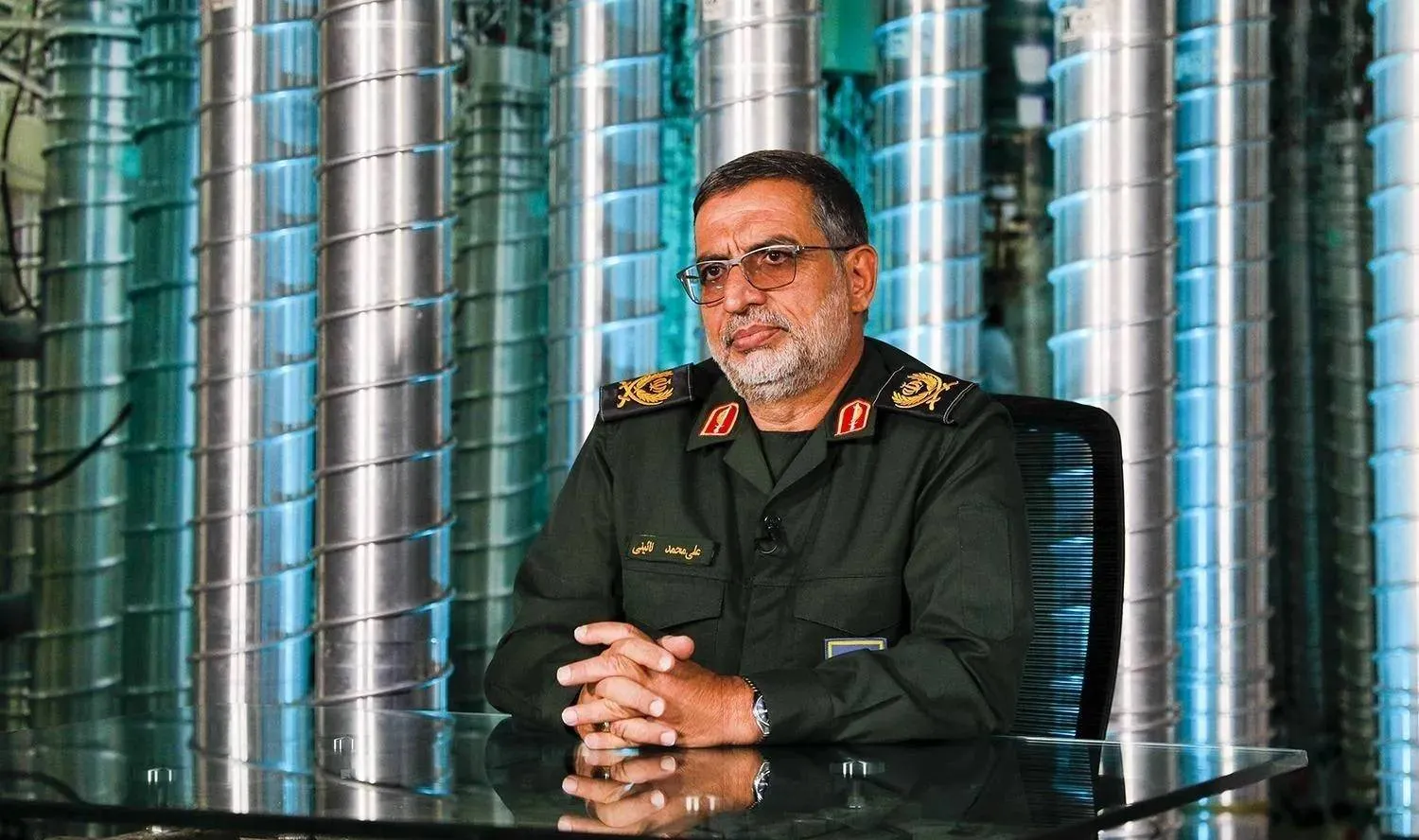

IRGC: Iran Ready for More Complex War with Israel

Brigadier General Ali Mohammad Naini, spokesman for the Iranian Revolutionary Guards Corps, in September. (defapress)
TT

IRGC: Iran Ready for More Complex War with Israel

Brigadier General Ali Mohammad Naini, spokesman for the Iranian Revolutionary Guards Corps, in September. (defapress)

Iran is prepared for a more complex confrontation than the 12-day war with Israel last June, said Brigadier General Ali Mohammad Naini, spokesman for the Iranian Revolutionary Guards Corps (IRGC), downplaying the possibility of renewed hostilities between the two sides.

Highlighting Iran's missile power and the level of preparedness, Naini told the semi-official Mehr news agency that “the enemy is not ready for a new war” with Iran.

He offered a new account of the shocking early moments of the conflict with Israel and the death of several of Iran’s most distinguished military commanders.

“The enemy is nowhere near having the capacity for war anytime soon,” he said, stressing that talk about renewed conflict is more psychological warfare than a real threat.

“The enemy’s strategy is to construct a narrative of victory from the previous war and to produce fear of a new war.”

Moreover, Naini denied that the Israeli attack in June was not foreseen by the country’s leaders.

He said since February 2024, Tehran had assumed that war was “inevitable” and that senior commanders were constantly assessing and overseeing combat readiness in all aspects - from weapons and equipment to tactics and technology.

“Immediately after the enemy’s surprise attack, which resulted in the killing of several of our commanders at operational bases and headquarters, the command cycle was swiftly restored, and our forces were fully mobilized to respond in less than an hour,” he asserted.

“The 12‑day war was a full‑scale technological, missile‑driven, and aerial confrontation - a genuinely hybrid war,” he said.

Immediately after the Israeli attack, he said the command was swiftly restored, and Iran’s forces were fully mobilized to respond in less than an hour.

“For example, the Aerospace operational units, despite a 12-hour delay due to new appointments, were fully prepared and carried out their historic missile operation. This level of readiness was the result of years of struggle and force-building by these commanders,” Naini said.

About possible renewed conflict with Israel, the spokesperson said: “We have no concerns about threats.”

He said Iran’s armed forces are continuously building strength and innovating.

“We are focused on nothing else. Every branch of the armed forces is striving to deliver a response that is fully innovative in tactics, technology, and methods, surpassing even what was demonstrated during the 12-Day War.”

“If the enemy commits another act of folly, it will face a far more decisive and regret‑inducing response. We are prepared even for a more complex war,” he declared.

He warned internal parties against internal divisions that will only serve the enemy.


Governor of Russia’s Belgorod Region Says 600,000 without Power, Heat, or Water After Ukrainian Strike

 A residential building and cars during a power blackout, that according to local authorities was caused by a recent Ukrainian missile attack targeting the regional energy system, amid the Russia-Ukraine military conflict in Belgorod, Russia, January 9, 2026. (Reuters)
A residential building and cars during a power blackout, that according to local authorities was caused by a recent Ukrainian missile attack targeting the regional energy system, amid the Russia-Ukraine military conflict in Belgorod, Russia, January 9, 2026. (Reuters)
TT

Governor of Russia’s Belgorod Region Says 600,000 without Power, Heat, or Water After Ukrainian Strike

 A residential building and cars during a power blackout, that according to local authorities was caused by a recent Ukrainian missile attack targeting the regional energy system, amid the Russia-Ukraine military conflict in Belgorod, Russia, January 9, 2026. (Reuters)
A residential building and cars during a power blackout, that according to local authorities was caused by a recent Ukrainian missile attack targeting the regional energy system, amid the Russia-Ukraine military conflict in Belgorod, Russia, January 9, 2026. (Reuters)

The governor of Russia's Belgorod region, which borders Ukraine, said on Saturday that 600,000 residents were without electricity, heating and water after a Ukrainian missile strike.

In a statement posted on Telegram, Vyacheslav Gladkov said that work was ‌underway to ‌restore supplies, ‌but ⁠that the situation ‌was "extremely challenging".

Footage filmed by Reuters in Belgorod city showed streetlights extinguished and locals finding their way using hand-held torches and car headlights.

Belgorod region, ⁠which adjoins Ukraine's Kharkiv region ‌and had a pre-war ‍population of ‍1.5 million, has come ‍under regular attack from Kyiv's forces since Russia ordered tens of thousands of troops into Ukraine in February 2022.

Russia has frequently bombarded Ukraine's power infrastructure, causing ⁠rolling daily blackouts, and has also targeted heating systems this winter. An overnight strike on Thursday left about half of Kyiv's apartment blocks without heat.

Temperatures in most of Russia and Ukraine have been well below freezing in ‌recent days.


Venezuela Says in Talks with US to Restore Diplomatic Ties

The city of Caracas, days after the US launched a strike on Venezuela and captured President Nicolas Maduro and his wife Cilia Flores, Venezuela January 7, 2026. (Reuters)
TT

Venezuela Says in Talks with US to Restore Diplomatic Ties

The city of Caracas, days after the US launched a strike on Venezuela and captured President Nicolas Maduro and his wife Cilia Flores, Venezuela January 7, 2026. (Reuters)

Venezuela was set to hold talks on Saturday with US envoys in Caracas on restoring diplomatic ties, days after US forces deposed Nicolas Maduro as its president.

Venezuela said Friday it had launched discussions with US diplomats in the capital, the latest sign of cooperation following the leftist leader's capture and US President Donald Trump's claim to be "in charge" of the South American country.

Officials said the US envoys were in Caracas to discuss reopening the country's embassy, while in Washington Trump met with oil companies over his plans to access Venezuela's huge crude reserves.

The government of interim President Delcy Rodriguez "has decided to initiate an exploratory diplomatic process with the government of the United States of America, aimed at re-establishing diplomatic missions in both countries," Foreign Minister Yvan Gil said in a statement.

John McNamara, the top US diplomat in neighboring Colombia, and other personnel "traveled to Caracas to conduct an initial assessment for a potential phased resumption of operations," a US official said on customary condition of anonymity.

Venezuela said it would be reciprocating by sending a delegation to Washington.

Rodriguez in a statement condemned "the serious, criminal, illegal and illegitimate attack" by the United States and vowed: "Venezuela will continue to confront this aggression through the diplomatic route."

- Prisoners' release -

Anxious relatives waited outside Venezuelan jails for a glimpse of their loved ones as the authorities began releasing political prisoners -- a move Washington claimed credit for.

"When I heard the news, I broke down," said Dilsia Caro, 50, waiting for the release of her husband Noel Flores, who was jailed for criticizing Maduro.

Venezuela began releasing prisoners on Thursday in the first such gesture since US forces removed and detained Maduro in the deadly January 3 raid.

Some relatives still gathered outside the prison had waited more than 36 hours to see their family members.

"We've been living with this uncertainty for several days now... We are worried, we are very distressed, filled with anxiety," said one woman, awaiting the release of her brother.

In Nicaragua, meanwhile, authorities have arrested at least 60 people for reportedly expressing support for Maduro's capture, according to a local human rights group.

Trump told Fox News he would meet next week with Venezuelan opposition leader Maria Corina Machado, whom he earlier brushed aside as lacking the "respect" to lead Venezuela.

Exiled Venezuelan opposition figurehead Edmundo Gonzalez Urrutia said that any democratic transition in the country must recognize his claim to victory in 2024 presidential elections.

Maduro was proclaimed the winner of the vote, but his re-election was widely seen as fraudulent.

Gonzalez was hoping Friday for the release of his son-in-law, who was detained a year ago in Caracas.

- Protests in Caracas -

Maduro was seized in a US special forces raid accompanied by airstrikes, operations that left 100 people dead, according to Caracas.

US forces took Maduro and his wife Cilia Flores to New York to face trial on drug-trafficking and other charges.

Rodriguez insisted Thursday her country was "not subordinate or subjugated" despite her pledge to cooperate with Trump.

Angry protesters rallied in the streets of Caracas on Friday demanding Maduro's release in the latest of a daily series of demonstrations.

"We don't have to give one little drop of oil to Trump after all that he has done to us," said one protester, Josefina Castro, 70, a member of a civil activists' group.

"Our Venezuelan brothers died (in the attack), and that hurts."


Son of Ousted Iran Shah Urges Protesters to 'Prepare to Seize' City Centers

FILE - Reza Pahlavi, the son of Iran's toppled Shah Mohammad Reza Pahlavi, speaks during a news conference, June 23, 2025 in Paris. (AP Photo/Thomas Padilla, File)
TT

Son of Ousted Iran Shah Urges Protesters to 'Prepare to Seize' City Centers

FILE - Reza Pahlavi, the son of Iran's toppled Shah Mohammad Reza Pahlavi, speaks during a news conference, June 23, 2025 in Paris. (AP Photo/Thomas Padilla, File)

The US-based son of Iran's ousted shah urged Iranians on Saturday to stage more targeted protests with the aim of taking and then holding city centers.

"Our goal is no longer just to take to the streets. The goal is to prepare to seize and hold city centers," Reza Pahlavi said in a video message on social media, urging more protests on Saturday and Sunday and adding he was also "preparing to return to my homeland" in a day he believed was "very near".
Iran was largely cut off from the outside world on Friday after authorities blacked out the internet to curb growing unrest, as video showed buildings aflame in anti-government protests raging in cities across the country.

Rights groups have already documented dozens of deaths of protesters in nearly two weeks and, with Iranian state TV showing clashes and fires, the semi-official Tasnim news agency reported that several police officers had been killed overnight.

In a televised address, Supreme Leader Ali Khamenei vowed not to back down, accusing demonstrators of acting on behalf of émigré opposition groups and the United States, and a public prosecutor threatened death sentences.
