


Trump Says Will Talk to Venezuela’s Maduro, ‘Ok’ with US Strikes on Mexico 

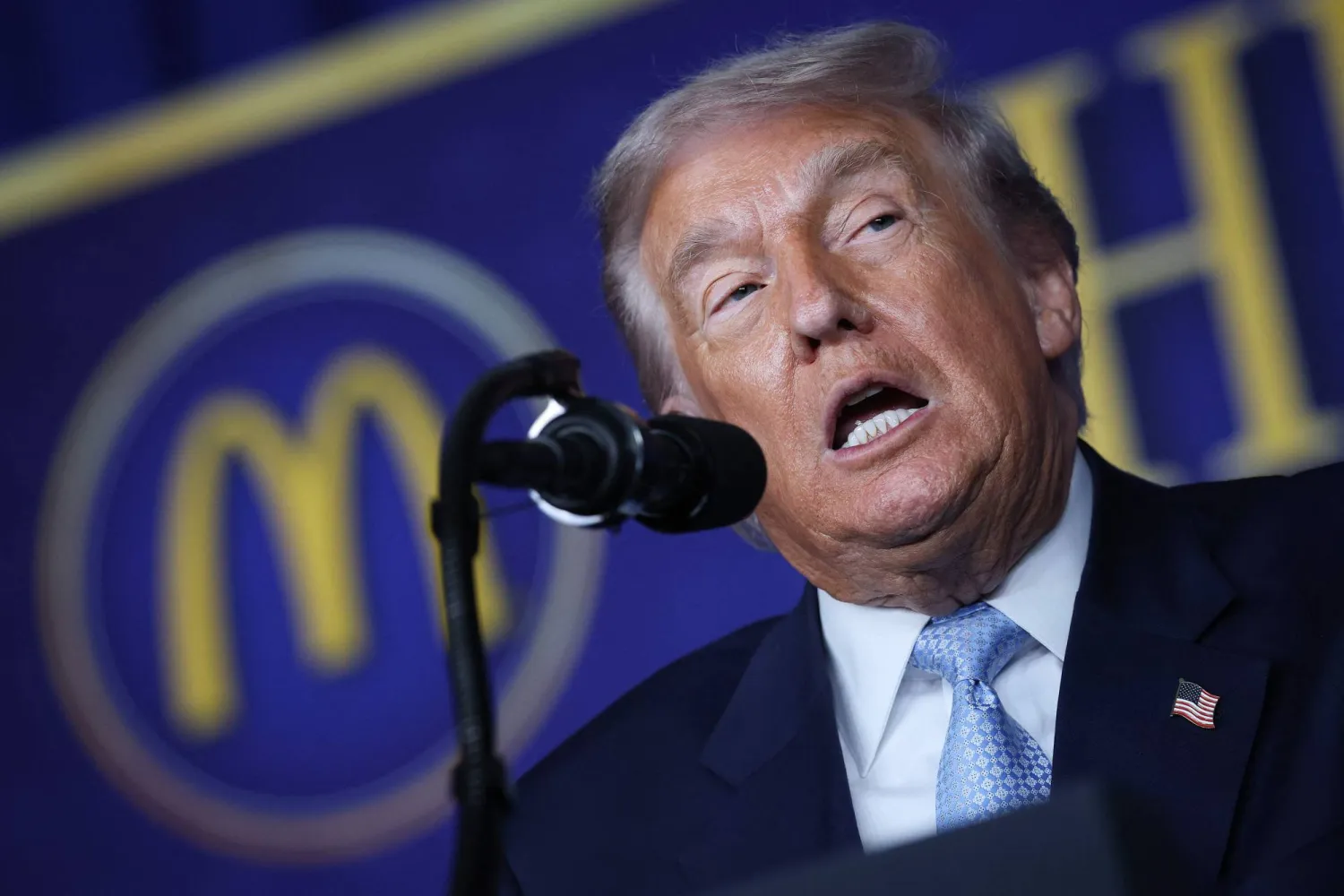
US President Donald Trump delivers remarks at the McDonald's Impact Summit at the Westin DC Downtown on November 17, 2025 in Washington, DC. (Getty Images via AFP)
TT

Trump Says Will Talk to Venezuela’s Maduro, ‘Ok’ with US Strikes on Mexico 

US President Donald Trump delivers remarks at the McDonald's Impact Summit at the Westin DC Downtown on November 17, 2025 in Washington, DC. (Getty Images via AFP)

US President Donald Trump said Monday he will talk to Venezuela's Nicolas Maduro, as Washington's military buildup stokes tensions, and added that he would be "OK" with US anti-drug strikes inside Mexico.

Trump has dramatically increased the number of US forces in the Caribbean region to tackle what he calls drug traffickers based in a number of Latin American countries including Venezuela and Mexico.

"At a certain period of time, I'll be talking to him," Trump told reporters in the Oval Office when asked if he would speak to Maduro, while adding that the Venezuelan president "has not been good to the United States."

Asked if he would rule out US troops on the ground in Venezuela, Trump replied: "No, I don't rule out that, I don't rule out anything.

"We just have to take care of Venezuela," he added. "They dumped hundreds of thousands of people into our country from prisons."

Hours later, Maduro said on his weekly television show that he was ready to talk "face to face" with anyone in the United States "who wants to talk to Venezuela."

A contingent of US Marines is currently conducting military exercises in Trinidad and Tobago, the second such maneuvers in less than a month between Washington and the small English-speaking archipelago located about 10 kilometers (six miles) from the Venezuelan coast.

But Trinidad and Tobago's leader said Monday that the small island nation would not allow its territory to be used to attack Venezuela, nor was it ever asked to.

"The US has NEVER requested use of our territory to launch any attacks against the people of Venezuela," said Prime Minister Kamla Persad-Bissessar, a close Trump ally, in a WhatsApp message to AFP.

"Trinidad and Tobago will not participate in any act that could harm the Venezuelan people," she added, emphasizing that Washington and Caracas should resolve their differences through dialogue.

Venezuela has accused Washington of seeking regime change in Caracas with its military build-up including an aircraft carrier group, warships and several stealth jets.

Washington accuses Maduro of leading a "terrorist" drug cartel, a charge he denies.

Since September, US forces have killed at least 83 people via air strikes on boats accused of ferrying drugs in international waters, according to an AFP tally of publicly released figures.

The United States has released no details to back up its claims that the people targeted in both the Caribbean and eastern Pacific in the more than 20 strikes were actually traffickers.

- 'OK with me' -

Trump has also accused Mexico of failing to tackle drug trafficking groups, and stepped up his rhetoric towards the United States's southern neighbor.

"Would I launch strikes in Mexico to stop drugs? It's OK with me. Whatever we have to do to stop drugs," Trump said when asked by reporters at the White House whether he would sanction a US counter-drug operation in Mexico.

"I didn't say I'm doing it, but I'd be proud to do it. Because we're going to save millions of lives by doing it."

Since August, Washington has maintained a significant military presence in the Caribbean, including half a dozen warships, officially to combat drug trafficking destined for the United States.



Strong Quake Causes Small Tsunami Waves Off Northeastern Japan

People stroll along Marunouchi Naka-dori Street illuminated with winter lights Wednesday, Dec. 10, 2025, in Tokyo. (AP Photo/Eugene Hoshiko)
TT

Strong Quake Causes Small Tsunami Waves Off Northeastern Japan

People stroll along Marunouchi Naka-dori Street illuminated with winter lights Wednesday, Dec. 10, 2025, in Tokyo. (AP Photo/Eugene Hoshiko)

A 6.7 magnitude earthquake shook northeastern Japan and caused small tsunami waves but no apparent damage Friday, days after a stronger quake in the same region.

Friday's quake occurred off the east coast of Aomori prefecture, in the north of Honshu, the main Japanese island, at a depth of 20 kilometers (12.4 miles) at 11:44 a.m., according to the Japan Meteorological Agency, which issued a tsunami advisory that was lifted about two hours later.

Small waves were reported in Hokkaido and Aomori prefectures, but no serious damage or injuries were reported, according to The Associated Press.

The quake followed a 7.5 magnitude earthquake Monday that caused injuries, light damage and a small tsunami on Japan's Pacific coast.

At least 34 people were injured in that quake, power was knocked out temporarily in places, and tsunami waves more than 2 feet (0.6 meters) above tide levels were measured in Kuji port in Iwate prefecture.

Authorities had warned of possible aftershocks.

Officials said after Monday's quake there was also a slight increase in the risk of a megaquake, at magnitude 8 or stronger, and a possible tsunami occurring along Japan’s northeastern coast from Chiba, just east of Tokyo, to the northernmost main island of Hokkaido.

The agency urged residents in the area to monitor their emergency preparedness, reminding them that the caution is not a prediction of such a strong earthquake.


US Slaps Sanctions on Maduro Relatives as Venezuela War Fears Build

(COMBO) This combination of pictures created on August 7, 2025 shows US President Donald Trump (L) in Washington, DC, on July 9, 2025, and Venezuelan President Nicolas Maduro (R) in Caracas on July 31, 2024.  (Photo by Jim WATSON and Federico PARRA / AFP)
(COMBO) This combination of pictures created on August 7, 2025 shows US President Donald Trump (L) in Washington, DC, on July 9, 2025, and Venezuelan President Nicolas Maduro (R) in Caracas on July 31, 2024. (Photo by Jim WATSON and Federico PARRA / AFP)
TT

US Slaps Sanctions on Maduro Relatives as Venezuela War Fears Build

(COMBO) This combination of pictures created on August 7, 2025 shows US President Donald Trump (L) in Washington, DC, on July 9, 2025, and Venezuelan President Nicolas Maduro (R) in Caracas on July 31, 2024.  (Photo by Jim WATSON and Federico PARRA / AFP)
(COMBO) This combination of pictures created on August 7, 2025 shows US President Donald Trump (L) in Washington, DC, on July 9, 2025, and Venezuelan President Nicolas Maduro (R) in Caracas on July 31, 2024. (Photo by Jim WATSON and Federico PARRA / AFP)

The US Treasury imposed new sanctions Thursday against three of Venezuelan leader Nicolas Maduro's relatives as well as six companies shipping the South American country's oil.

The move came as the White House said it will bring an oil tanker seized by American forces off the Venezuelan coast to a port in the United States, adding to growing fears of open conflict between the two countries, reported AFP6.

Washington took control of the tanker in a dramatic raid that saw US forces rope down from a helicopter onto the vessel in an operation that Homeland Security Secretary Kristi Noem said was aimed at Maduro's "regime."

Treasury officials said three nephews of Maduro's wife, Cilia Flores, were being slapped with sanctions, labeling two of the men "narco-traffickers operating in Venezuela."

"Nicolas Maduro and his criminal associates in Venezuela are flooding the United States with drugs that are poisoning the American people," Treasury Secretary Scott Bessent said in a statement.

President Donald Trump's administration has been piling pressure on Venezuela for months with a major naval buildup in the region that has been accompanied by strikes on alleged drug-trafficking boats that have killed close to 90 people.

Russian leader Vladimir Putin on Thursday expressed support during a phone call with his ally Maduro, but with Moscow's forces tied down in a grinding war in Ukraine, its capacity to provide aid is limited.

"The vessel will go to a US port and the United States does intend to seize the oil," White House Press Secretary Karoline Leavitt told journalists of the tanker.

"We're not going to stand by and watch sanctioned vessels sail the seas with black-market oil, the proceeds of which will fuel narco-terrorism of rogue and illegitimate regimes around the world."

Earlier on Thursday, Noem told a congressional hearing that the tanker operation was "pushing back on a regime that is systematically covering and flooding our country with deadly drugs" -- a reference to US allegations of narcotics smuggling by Maduro's government.

A video released Wednesday by US Attorney General Pam Bondi showed American forces descending from a helicopter onto the tanker's deck, then entering the ship's bridge with weapons raised.

Bondi said the ship was part of an "illicit oil shipping network" that was used to carry sanctioned oil.

- 'Blatant theft' -

Venezuela's foreign ministry said it "strongly denounces and condemns what constitutes blatant theft and an act of international piracy."

"They kidnapped the crew, stole the ship and have inaugurated a new era, the era of criminal naval piracy in the Caribbean," Maduro said at a presidential event on Thursday, adding: "Venezuela will secure all ships to guarantee the free trade of its oil around the world."

UN Secretary-General Antonio Guterres on Thursday expressed concern over the escalating tensions and urged restraint.

"We are calling on all actors to refrain from action that could further escalate bilateral tensions and destabilize Venezuela and the region," his spokesperson said.

US media reported that the tanker had been heading for Cuba -- another American rival -- and that the ship was stopped by the US Coast Guard.

Dick Durbin, the top Democrat on the Senate Judiciary Committee, said Thursday he questioned the legality of the tanker seizure and that "any president, before he engages in an act of war, has to have the authorization of the American people through Congress."

"This president is preparing for an invasion of Venezuela, simply said. And if the American people are in favor of that, I'd be surprised," Durbin told CNN.

Washington has accused Maduro of leading the alleged "Cartel of the Suns," which it declared a "narco-terrorist" organization last month, and has offered a $50 million reward for information leading to his capture.

Trump told Politico on Monday that Maduro's "days are numbered" and declined to rule out a US ground invasion of Venezuela.

The Trump administration alleges that Maduro's hold on power is illegitimate and that he stole Venezuela's July 2024 election.

Maduro -- the political heir to leftist leader Hugo Chavez -- says the United States is bent on regime change and wants to seize Venezuela's oil reserves.


Russia, Türkiye, Iran Presidents in Turkmenistan for Rare Summit

(R-L) Tajik President Emomali Rahmon, Iranian President Masoud Pezeshkian, Russian President Vladimir Putin, Turkmen President Serdar Berdimuhamedov, Turkish President Recep Tayyip Erdogan, Kazakh President Kassym-Jomart Tokayev, and Kyrgyz President Sadyr Japarov attend a wreath-laying ceremony at the Turkmenistan Neutrality Monument in Ashgabat, Turkmenistan, 12 December 2025. EPA/ALEXANDER SHCHERBAK / SPUTNIK / KREMLIN POOL MANDATORY CREDIT
TT

Russia, Türkiye, Iran Presidents in Turkmenistan for Rare Summit

(R-L) Tajik President Emomali Rahmon, Iranian President Masoud Pezeshkian, Russian President Vladimir Putin, Turkmen President Serdar Berdimuhamedov, Turkish President Recep Tayyip Erdogan, Kazakh President Kassym-Jomart Tokayev, and Kyrgyz President Sadyr Japarov attend a wreath-laying ceremony at the Turkmenistan Neutrality Monument in Ashgabat, Turkmenistan, 12 December 2025. EPA/ALEXANDER SHCHERBAK / SPUTNIK / KREMLIN POOL MANDATORY CREDIT

The leaders of Russia, Türkiye and Iran meet Friday in Turkmenistan, an isolated Central Asian state which is marking 30 years of official neutrality with a rare international summit.

The principle of "permanent neutrality" is at the heart of the former Soviet republic's foreign policy -- a doctrine that has contributed to making Turkmenistan one of the world's most isolated countries.

On the guest list are Russian President Vladimir Putin, Turkish President Recep Tayyip Erdogan, and Iranian President Masoud Pezeshkian, along with other regional leaders, AFP said.

Here's five things to know about the desert nation and its position on the world stage:

- Presidential dynasty -

Turkmenistan, which borders Iran, Afghanistan, and the Caspian Sea, has only had three presidents since gaining independence when the Soviet Union collapsed in 1991.

The first was Saparmurat Niyazov, who proclaimed himself both "president for life" and the "father of the Turkmen" (Turkmenbashi), and ruled for 15 years.

The Berdymukhamedov family took over in 2006, with father Gurbanguly becoming president before handing the job to his son Serdar in 2022.

In reality, the pair rule in tandem. Gurbanguly retains immense power and is the subject of an intense personality cult.

Officially proclaimed "leader of the Turkmen nation" and Arkadag, which means hero-protector, he built a vast city named after himself, Arkadag, at a cost of at least $5 billion. He also erected gigantic golden statues of himself, while Serdar is regularly praised in the state-run media.

- Neutrality and isolation -

Turkmenistan is one of the world's most secretive countries, often compared to North Korea for its inaccessibility.

Since the United Nations supported Turkmenistan's "permanent neutrality" status in 1995, it has become a foreign policy cornerstone. An almost 100-meter (300-feet) tall Neutrality Monument, resembling a rocket and featuring a golden statue of the first president, stands in the capital Ashgabat.

The status prohibits Turkmenistan from fully joining any union or military alliance, and is used by the government to implement its isolationist policies.

Ahead of the summit, Serdar Berdymukhamedov published yet another book -- presented as a "precious gift for the Turkmen people" -- extolling the virtues of neutrality.

Turkmenistan's closest relations are with China, Russia, Iran, and Türkiye thanks to gas contracts. Cooperation with the West remains limited.

According to Amnesty International, Turkmenistan is "effectively closed to international human rights NGOs, UN special mechanisms and independent media".

Information on the country is fragmented, tightly controlled and generally unverifiable, "aimed solely at praising the regime", according to Reporters Without Borders.

- Lots of gas, little water -

While Turkmenistan is estimated to have the world's fourth-largest natural gas reserves, water supplies are scarce -- and the situation is expected to worsen due to climate change, scientists warn.

Three-quarters of the country is covered by the vast Karakum desert.

Cotton is another important industry for the Turkmen economy, but the high use of water has contributed to water shortages across the region.

- Methane 'Gateway to Hell' -

A massive five-decade-old fire raging in a natural gas crater is the country's top tourist attraction. The fire has been burning in the Karakum desert since 1971, when Soviet scientists accidentally ignited it.

Turkmen authorities have repeatedly stated their intentions to close the Darvaza crater, dubbed the "Gateway to Hell", but so far without success.

Emissions are a huge problem. Turkmenistan is the world's top methane leaker, according to the International Energy Agency.

- Sacred animals -

Local breeds of horse and dog are sacred and have been elevated to the status of national symbols.

On the orders of Gurbanguly, numerous statues honoring the Alabai -- or Central Asian shepherd-dog -- and the Akhal-Teke horse have been erected and the animals are celebrated on public holidays.

Gurbanguly has even composed a song in honor of his favorite horse.

The father-and-son duo regularly give and receive dogs and horses as gifts, including to other world leaders. They are often filmed cuddling the animals in public.