


Tennessee State Judge Blocks National Guard Deployment to Memphis

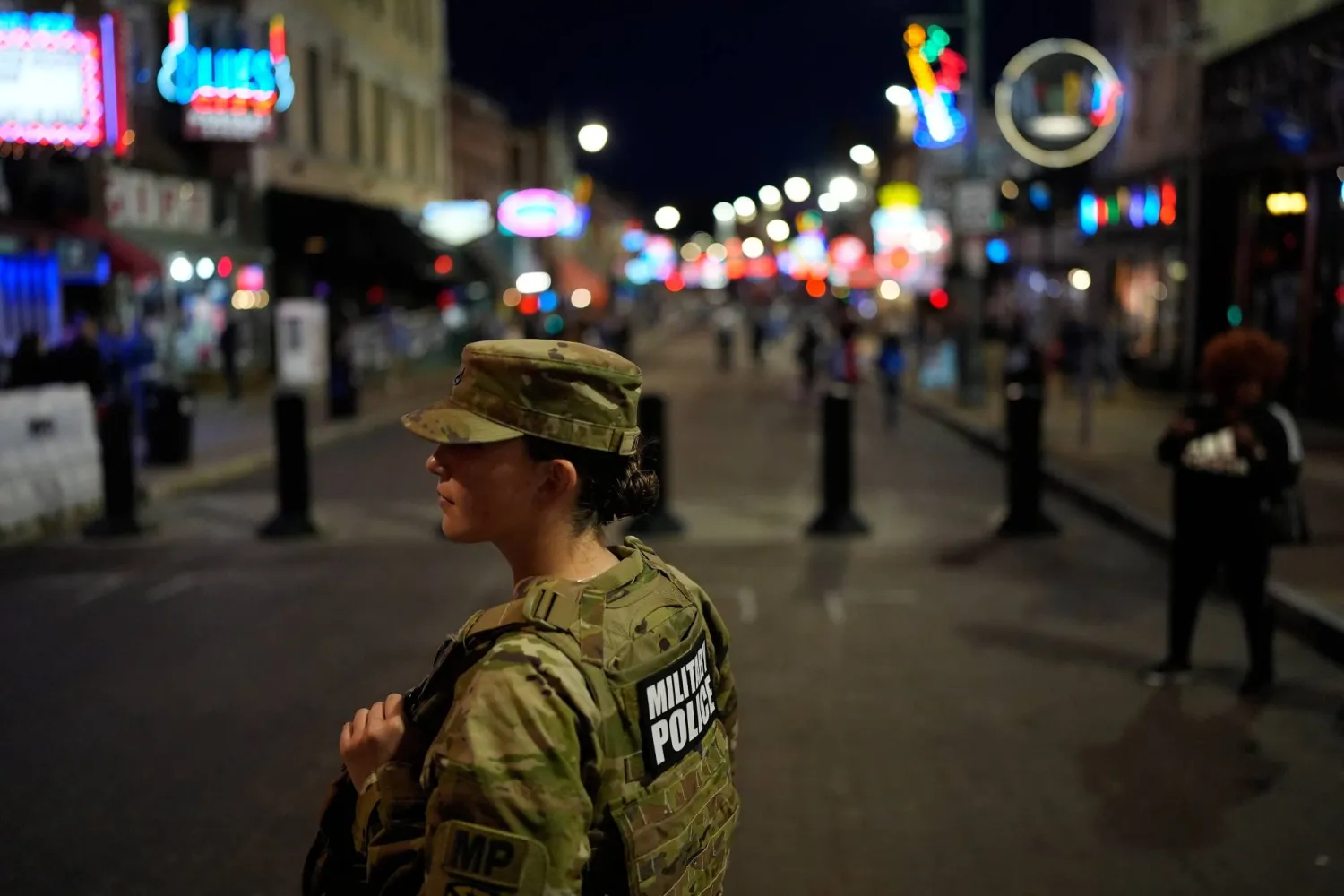
FILE - A member of the National Guard stands watch on Beale Street Oct. 24, 2025, in Memphis, Tenn. (AP Photo/George Walker IV, File)
TT

Tennessee State Judge Blocks National Guard Deployment to Memphis

FILE - A member of the National Guard stands watch on Beale Street Oct. 24, 2025, in Memphis, Tenn. (AP Photo/George Walker IV, File)

A Tennessee state court judge temporarily blocked on Monday Republican Governor Bill Lee's deployment of National Guard troops to the city of Memphis, ruling that the use of troops was likely not legal under the state's militia law.

Chancellor Patricia Head Moskal of the Davidson County Chancery Court in Nashville said the militia law required Tennessee's General Assembly to call in the National Guard for public safety.

She ruled that crime rates in Memphis were not a "grave emergency" or "disaster" that would authorize Lee to send troops in his role as commander-in-chief of the state’s military forces.

Her order blocks the governor from "continuing the activation and deployment of Tennessee National Guard personnel" pending further court proceedings. But it will not take effect for five days, to give Lee time to appeal.

National Guard troops began patrolling Memphis as part of a federal task force to combat crime after Republican President Donald Trump requested the deployment in September.

State lawmakers and Shelby County mayor Lee Harris sued the governor to block the deployment, saying the use of the troops for law enforcement violates the Tennessee constitution and state laws.

"This is a positive step toward ensuring the rule of law applies to everyone, including everyday Tennesseans and even the governor," Harris said in a Facebook post on Monday.

Memphis is one of several US cities to which Trump has sent the National Guard, departing from norms against deploying troops on US soil.

Trump has said they are needed to suppress civil unrest, support immigration enforcement and fight crime. Democrats have accused the Republican president of abusing military powers meant for grave emergencies such as an invasion.

LEGAL CHALLENGES MOUNT

National Guard deployments to the Democratic-led cities of Los Angeles, Portland, Chicago and Washington, D.C. also face legal challenges.

Three district court judges have ruled against Trump's use of troops in preliminary rulings, saying the president cannot summon the military to respond to routine protests or engage in law enforcement.

Two appeals courts have split on the issue, which is likely to ultimately go to the US Supreme Court.

The situation in Memphis differs from others, as the troops are being deployed by the Republican state governor and remain under the state's control.

Elsewhere, the troops deployed by Trump have faced opposition from Democratic governors and local officials to their use, leading him to place those states' National Guard under control of the federal government.

The Memphis lawsuit seeks to stop the troop deployment based on Tennessee state law, unlike the rest, which are based on federal law and the US Constitution.

Memphis, a city of 611,000 along the Mississippi River, has one of the highest violent crime rates in the United States, FBI figures show. About 24% of residents live in poverty, more than double the national average, the US Census Bureau says.



US Suspends Flights at El Paso Airport for 'Special Security Reasons'

FILE - A Federal Aviation Administration sign hangs in the tower at John F. Kennedy International Airport in New York, March 16, 2017. (AP Photo/Seth Wenig, File)
TT

US Suspends Flights at El Paso Airport for 'Special Security Reasons'

FILE - A Federal Aviation Administration sign hangs in the tower at John F. Kennedy International Airport in New York, March 16, 2017. (AP Photo/Seth Wenig, File)

The top US aviation agency said Tuesday it is stopping all flights to and from El Paso International Airport in Texas for 10 days over unspecified "security reasons."

The flight restrictions are in effect from 11:30 pm on Tuesday (0630 GMT Wednesday) until February 20 for the airspace over El Paso and an area in neighboring New Mexico's south, according to the Federal Aviation Administration (FAA).

"No pilots may operate an aircraft in the areas" covered by the restrictions, the FAA said in a notice, citing "special security reasons" without elaborating.

El Paso International Airport in a social media post said all flights, "including commercial, cargo and general aviation," would be impacted by the move.

The airport, which is served by major US airlines like Delta, American and United, encouraged travelers to "contact their airlines to get most up-to-date flight status information."

In a separate statement to the New York Times, it said that the restrictions had been issued "on short notice" and that it was waiting for guidance from the FAA.


Russia Says It Won’t Breach Limits of Expired Nuclear Treaty if US Does the Same 

Russian Foreign Minister Sergei Lavrov reacts during a meeting with Tanzanian Minister of Foreign Affairs and East African Cooperation Mahmoud Thabit Kombo (not pictured), in Moscow, Russia, 09 February 2026. (EPA)
TT

Russia Says It Won’t Breach Limits of Expired Nuclear Treaty if US Does the Same 

Russian Foreign Minister Sergei Lavrov reacts during a meeting with Tanzanian Minister of Foreign Affairs and East African Cooperation Mahmoud Thabit Kombo (not pictured), in Moscow, Russia, 09 February 2026. (EPA)

Russia will keep observing the missile and warhead limits in the New START nuclear treaty with the United States, which expired last week, as long as Washington continues to do the same, Foreign Minister Sergei Lavrov said on Wednesday.

The 2010 treaty ran out on February 5, leaving the world's two biggest ‌nuclear-armed powers ‌with no binding constraints on their ‌strategic ⁠nuclear arsenals for ⁠the first time in more than half a century.

US President Donald Trump declined a formal proposal from Russian President Vladimir Putin to voluntarily abide by the New START limits for another year. ⁠Lavrov said Moscow would stick ‌to the limits ‌itself for now anyway.

"Our position is that this ‌moratorium on our side that ‌was declared by the president is still in place, but only as long as the United States doesn't exceed the said limits," ‌Lavrov told parliament's lower house, the State Duma.

The treaty's expiry has ⁠spurred ⁠fears of a three-way arms race involving Russia, the US and China, which has far fewer warheads than the other two countries but is arming rapidly.

Some analysts say, however, that Russia is keen to avoid the cost of such a contest at a time when its state budget is feeling the strain from its four-year-old war in Ukraine.


After Vance Visit, the Kremlin Says Russia Will Develop Ties with Armenia and Azerbaijan 

A handout photo made available by the Press Service of the President of the Republic of Azerbaijan shows Azerbaijan's President Ilham Aliyev (R) and US Vice President JD Vance (L) during a meeting in Baku, Azerbaijan, 10 February 2026. (EPA/Azerbaijan Presidential Press Service Handout)
TT

After Vance Visit, the Kremlin Says Russia Will Develop Ties with Armenia and Azerbaijan 

A handout photo made available by the Press Service of the President of the Republic of Azerbaijan shows Azerbaijan's President Ilham Aliyev (R) and US Vice President JD Vance (L) during a meeting in Baku, Azerbaijan, 10 February 2026. (EPA/Azerbaijan Presidential Press Service Handout)

Russia intends to further develop its relations with both Armenia and Azerbaijan, the Kremlin said on Wednesday, after US Vice President JD Vance visited the two South Caucasus nations.

The United States and Azerbaijan signed a strategic partnership, and Vance signed a nuclear deal with Armenia which operates an ageing ‌Soviet-era nuclear ‌power plant and is ‌looking to ⁠commission a new ⁠one.

Kremlin spokesman Dmitry Peskov said Azerbaijan and Armenia were sovereign countries who had the right to develop their own foreign policies and that Moscow had deep mutually-beneficial ties with both nations.

"We have ⁠a huge range of bilateral ‌relations with both Baku ‌and Yerevan, covering all possible areas. These ‌include mutually beneficial trade and economic cooperation, ‌mutual investments, cultural relations, and so on.

"And, of course, we intend to further develop our relations with our partners so that they ‌are beneficial not only for us, but also for them."

Peskov said ⁠Russia ⁠was well placed to tender for any new nuclear power plant in Armenia.

"As the most advanced country in the world in this field, Russia is capable of withstanding the highest level of international competition," said Peskov. "If such competition is demanded by partners, Russia is capable of providing better quality for many years to come at a lower cost."