


Japan Warns Citizens in China about Safety as Diplomatic Crisis Deepens 

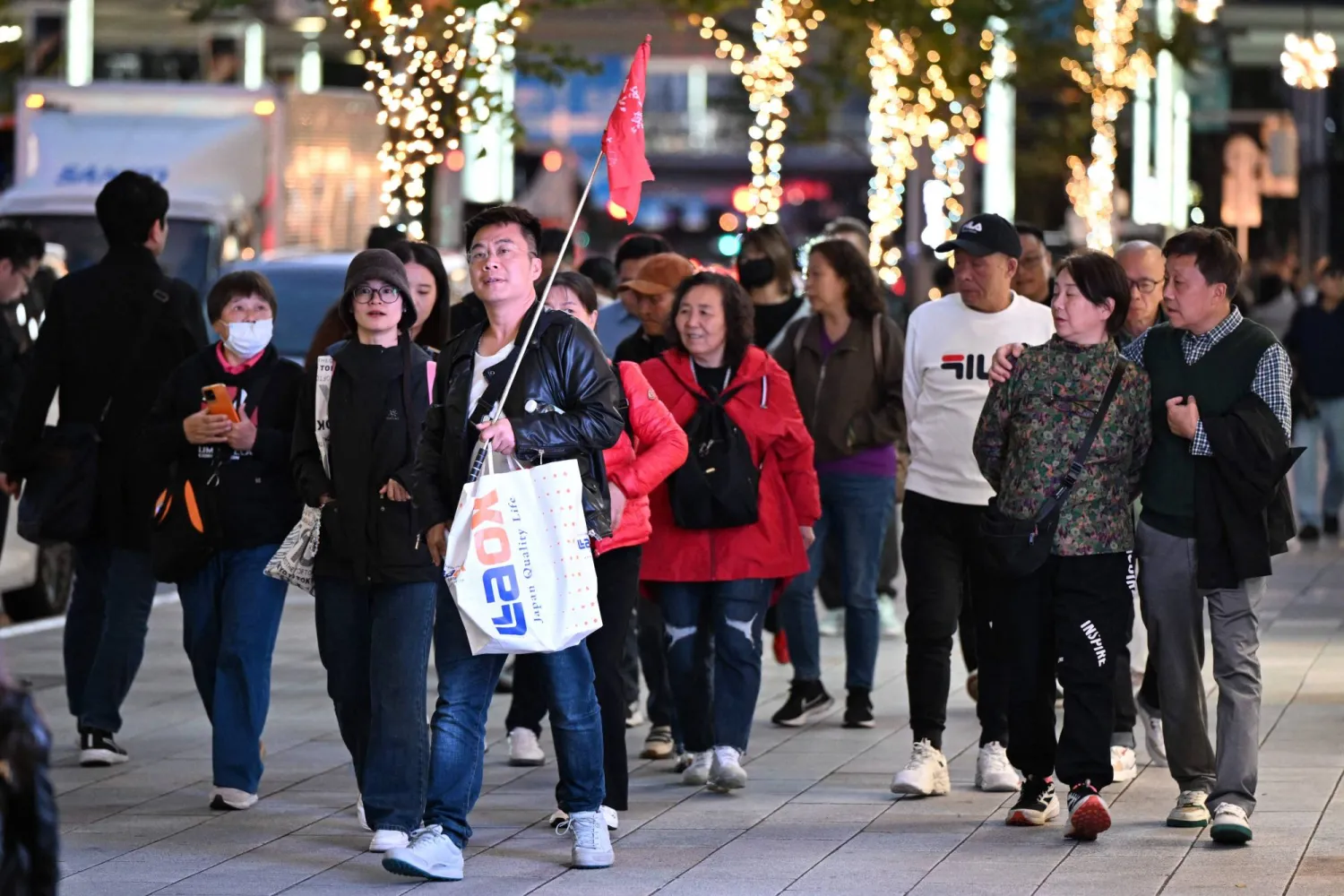
A Chinese tour group walks in the Ginza shopping district in Tokyo on November 17, 2025. (AFP)
TT

Japan Warns Citizens in China about Safety as Diplomatic Crisis Deepens 

A Chinese tour group walks in the Ginza shopping district in Tokyo on November 17, 2025. (AFP)

Japan has warned its citizens in China to step up safety precautions and avoid crowded places, amid a deepening dispute between Asia's two largest economies over Japanese Prime Minister Sanae Takaichi's comments on Taiwan.

Takaichi sparked the most serious diplomatic clash in years when she told Japanese lawmakers this month that a Chinese attack on Taiwan threatening Japan's survival could trigger a military response.

Tuesday's advisory came as a senior Japanese envoy arrived in Beijing for a meeting to try and tamp down the tension, although no breakthrough appeared imminent.

China's foreign ministry said it had pressed at the meeting for Takaichi to retract her remarks, but Japan's top government spokesperson suggested Tokyo was in no mood to do so, as they were in line with its longstanding view.

"Regarding Prime Minister Takaichi's response ... it does not alter the government's existing position," Minoru Kihara told a press conference, when asked if Japan planned to retract the comments.

The government hoped that issues concerning Taiwan would be resolved peacefully through dialogue, he added.

BEIJING CLAIMS TAIWAN AS ITS OWN

Beijing claims democratically governed Taiwan as its own and has not ruled out using force to take control of the island. Taiwan's government rejects Beijing's claims.

A Chinese diplomat in Japan responded to Takaichi's remarks by posting a threatening comment aimed at her on social media. That drew a strong rebuke from Tokyo, though it failed to stem vitriolic commentary against her in Chinese state media.

Takaichi was summoning Japan's "militarist demons", the official news agency Xinhua said in the latest such attack on Tuesday.

In view of the media coverage in China, Japan's embassy there reminded citizens on Monday to respect local customs and take care in interactions with Chinese people.

It asked citizens to be aware of their surroundings when outdoors, telling them to not travel alone and urging extra caution when accompanying children.

"If you see a person or group that looks even slightly suspicious, do not approach them and leave the area immediately," the embassy said in its notice.

CHINA URGES AGAINST TRAVEL TO JAPAN

The dispute could deal a blow to Japan's economy, as Beijing has urged its citizens not to travel there.

Chinese form the largest number of all tourists to Japan, accounting for nearly a quarter, official figures show. Tourism-related stocks in Japan plunged on the news.

Film distributors have also suspended the screening of at least two Japanese films in China, a step state broadcaster CCTV hailed on Monday as a "prudent decision" reflecting souring domestic sentiment.

Screening of some Japanese films originally set for release in coming weeks, such as the animated "Crayon Shin-chan the Movie: Super Hot! Scorching Kasukabe Dancers" and manga-turned-movie "Cells at Work!" will not begin in mainland China as scheduled, it added, citing industry checks.

Apart from tourism, Japan is heavily dependent on China for supply of critical minerals used in items from electronics to cars.

"If we rely too heavily on a country that resorts to economic coercion the moment something displeases it, that creates risks not only for supply chains but also for tourism," Japan's economic security minister, Kimi Onoda, told a press conference on Tuesday.

"We need to recognize that it’s dangerous to be economically dependent on somewhere that poses such risks," she added, responding to a question about China's calls for its citizens to avoid travel to Japan.

Japan's Trade Minister Ryosei Akazawa said there had been no particular changes yet in China's export control measures on rare earths and other materials.

The heads of Japan's three business federations met Takaichi late on Monday and urged dialogue to resolve the diplomatic tension.

"Political stability is a prerequisite for economic exchange," Yoshinobu Tsutsui, chairman of Japan's biggest business lobby Keidanren, told reporters after the meeting, media said.

'ON A KNIFE'S EDGE'

Taiwan is located just over 110 km (68 miles) from Japanese territory and the waters around it offer a vital sea route for Tokyo's trade. Japan also hosts the largest contingent of US military overseas.

On Sunday, Chinese coast guard ships sailed through waters around a group of East China Sea islands controlled by Japan but claimed by China. Japan's coast guard said it drove the Chinese ships away.

The United States does not formally recognize the islands, known as Senkaku in Tokyo and the Diaoyu in Beijing, as Japanese sovereign territory.

Since 2014 it has said it would be obliged by the Japan-US security treaty to defend them if they were attacked, however.

"In case anyone was in doubt, the United States is fully committed to the defense of Japan, which includes the Senkaku Islands, the US ambassador to Japan, George Glass, said on X. "And formations of Chinese coast guard ships won’t change that."

Chinese foreign ministry spokesperson Mao Ning told a press conference on Tuesday that Glass's remarks were a "political show with ulterior motives".

This week's G20 summit in South Africa offered a possible forum to help ease tension but China said its premier had no plans to meet Takaichi on the sidelines.

Kihara said nothing has been decided about two-way meetings during G20, but Japan remains open to holding "various dialogues" with China.

Japan's refusal to retract its statements meant its de-escalatory efforts had failed to mollify Beijing, said Allen Carlson, an expert on China's foreign policy at Cornell University.

"As a result, the two countries now stand on a knife’s edge."


Ukrainian Drone Kills One in Russia-Annexed Crimea, Moscow-Installed Governor Says

A drone crater at the site of a Russian strike on a residential area in Odesa, Ukraine, 01 June 2026, amid the Russian invasion. (EPA)
TT

Ukrainian Drone Kills One in Russia-Annexed Crimea, Moscow-Installed Governor Says

A drone crater at the site of a Russian strike on a residential area in Odesa, Ukraine, 01 June 2026, amid the Russian invasion. (EPA)

A Ukrainian drone struck a train in Crimea, killing its assistant driver and injuring the driver, the peninsula's Russian-installed governor Sergei Aksyonov said in a Telegram post early on Monday.

Passengers on the train, commuting between Moscow and Simferopol, the main city of the Russia-annexed Black Sea Crimea peninsula, were not harmed, Aksyonov added. The train connection in Crimea was ‌suspended, Interfax ‌news agency reported.

Russia seized and ‌annexed ⁠Crimea in 2014 - ⁠long before its 2022 full-scale invasion of Ukraine - after public protests in Kyiv prompted a Moscow-friendly president to flee Ukraine. Crimea is a popular destination for Russian tourists.

Drone raid sirens were sounded in the early hours of Monday in the Black ⁠Sea port of Novorossiysk, a ‌major export hub for oil ‌and grains in Russia's Krasnodar region about a ‌two-hour drive from the bridge Moscow built to ‌connect to Crimea, local authorities said on Telegram.

The most recent Ukrainian drone strikes, attacking fuel infrastructure, have forced the Russian-controlled Crimea to tighten its rationing of fuel ‌supplies.

In the Crimean port of Sevastopol, the peninsula's second-largest city where the Russian ⁠Black ⁠Sea fleet is stationed, the local Russian-installed governor, Mikhail Razvozhayev, said on Telegram that fuel rationing would continue.

"The number of (electronic) codes issued for (fuel refill at) the gas stations for tomorrow was bigger than yesterday. Those were gone in just a few dozen seconds," he said on Monday.

"Those who received a code today will not be able to get the new one for the next seven days."

Reuters could not independently verify all the reports.


Pentagon Sees Growing Espionage Threat from Israel

President Donald Trump and Israeli Prime Minister Benjamin Netanyahu last December. (The New York Times)
TT

Pentagon Sees Growing Espionage Threat from Israel

President Donald Trump and Israeli Prime Minister Benjamin Netanyahu last December. (The New York Times)

Washington: Julian E Barnes, Eric Schmitt

Recent US intelligence reports have raised concerns about Israeli spy agencies eavesdropping on American negotiators working on a peace deal with Iran, amid rising concern over a more general counterintelligence threat by Israel.

Israel and the United States have long known, and tolerated, that each was spying on the other. But an intensified Israeli effort to learn about US positions in talks with Iran has crossed a line, according to some American officials.

The reports include concerns that Israel has stepped up its efforts to eavesdrop on senior American officials, including Steve Witkoff, President Trump’s top negotiator, Elbridge A Colby, the Pentagon’s top policy official, and one of his main deputies, Michael P DiMino IV.

Another report, written by the Defense Intelligence Agency and other military intelligence offices and focused on earlier events going back several years, said that the counterintelligence threat level posed by Israel had been increased in recent weeks to the top level, from high to critical.

The report, to which the Defense Counterintelligence and Security Agency contributed, outlines various efforts by Israel to spy on American military personnel and government officials.

The reports and the intensified concern about Israeli spying come at an especially sensitive time.

Israel and the US have been fighting the war against Iran together, and have never had such close military coordination as they do now, with Israeli military officers working side-by-side with their American counterparts at US Central Command.

The US military is sharing huge amounts of tactical and operational information with its Israeli counterparts. But senior American officials said that Israel is looking for insights into Trump’s strategy and shifting stances on the peace talks.

The new warning could potentially complicate efforts to further integrate military war planning between US Central Command and Israel, especially if the Pentagon makes a decision to place new restrictions on information shared with Israeli officers.

There has already been tension between the two nations as Trump pursues a peace deal even as Prime Minister Benjamin Netanyahu of Israel seeks to further degrade Iran’s capabilities, weaken or topple its regime and assault Tehran’s proxy in Lebanon, Hezbollah.

The Defense Intelligence Agency (DIA) report was drafted after incidents in which American defense personnel in Israel detected that software to tap their communications had been surreptitiously installed on their phones.

The existence of the Defense Intelligence Agency report and the increased threat level were reported earlier by NBC News.

The Defense Department declined to comment. A White House official, speaking on the condition their name not be used, said the account was false.

A spokesperson for the Israeli embassy in Washington also disputed claims that Israel poses a counterintelligence threat, saying that Israel does not spy on American officials or entities.

The developments were described by several current and former US officials, speaking on the condition of anonymity to discuss sensitive intelligence matters.

They said that in some respects the counterintelligence warning is no surprise. Israel has long engaged in aggressive intelligence collection operations against both its enemies and its allies, as does the United States.

Still, Israel’s counterintelligence threat level is now higher than any other ally and higher than some adversarial countries. Of American allies, only South Korea, which is rated at high in certain situations, approaches the concern with Israel’s espionage efforts, the officials said.

The aggressiveness of the Israeli intelligence collection on top US officials during the second Trump administration has been “unhinged,” one senior official said.

Two senior US military officials said that American personnel, particularly those serving in Israel or with Israeli counterparts, were well aware of the counterintelligence risks before the new report.

The officials, who spoke on the condition of anonymity to discuss internal assessments, said US personnel employ a range of security procedures and protocols to help counter the threat and to protect their cellphones and other electronic devices, especially while traveling in Israel, but declined to describe those measures in detail for security reasons.

Cooperation between the two militaries is very close, but each side also needs to keep its most sensitive information secret.

At the US-led Civil-Military Coordination Center in Kiryat Gat, Israel, for instance, American and Israeli military and diplomatic personnel work side-by-side to enforce the Gaza cease-fire and facilitate humanitarian efforts. But the building also has a US-only floor and an Israeli-only floor where personnel from each country can discuss the most sensitive topics.

The report says counterintelligence incidents began increasing in late 2024, as the Biden administration pressed Israel to curb its attacks on Gaza, and continued into 2025, as the Trump administration weighed options to attack Iran.

The report, which incorporated contributions from a number of military intelligence agencies, also details several episodes in recent years. In 2021, Israeli military intelligence officers were caught planting listening devices at DIA headquarters. Last year, officers from Shin Bet, Israel’s domestic intelligence agency, were discovered to have tried to plant a listening device in a Secret Service vehicle.

While the DIA document does not explicitly discuss the peace negotiations, other recent intelligence reports have raised concern about Israelis’ listening to Witkoff and other top negotiators as they try to reach a long-term agreement for a peace deal between the US and Iran.

The tendency of some senior Trump administration officials to fly on private aircraft, to conduct national security business on their personal phones and to reject staffing from US embassies abroad made them especially vulnerable targets for the spy services of allies and adversaries alike, said a former senior US official who has dealt extensively with Israel.

Other current officials also acknowledged the use of personal cellphones by top American officials has made them easy targets for eavesdropping.

US and Israel were largely aligned at the beginning of the Iran war, with Trump endorsing Netanyahu’s long-sought goal to push the theocratic government from power.

But the war aims quickly diverged, as the United States focused more on trying to erode Iran’s military capabilities to force concessions at the bargaining table, while Israel hoped the Iranian hard-line government would lose its grip on power.

It is not entirely clear why Colby, who is in charge of Pentagon policy, would be a target. But he is one of the most prominent proponents inside the US government of a restrained foreign policy. DiMino is in charge of Pentagon policy for the Middle East, making him a person of natural interest to Israel.

The New York Times


China’s Xi Lands in North Korea for Rare Visit

The national flags of North Korea and China are displayed on a street in Pyongyang on June 8, 2026. (AFP)
TT

China’s Xi Lands in North Korea for Rare Visit

The national flags of North Korea and China are displayed on a street in Pyongyang on June 8, 2026. (AFP)

China's President Xi Jinping hailed an "invincible friendship" with Pyongyang as he arrived in North Korea Monday, his first trip abroad this year after hosting back-to-back summits in Beijing.

China, Washington's chief geopolitical rival, has been North Korea's main trading partner by far for decades and a key source of diplomatic and economic support for the country hit by multiple international sanctions.

Military officers lined a red carpet as an Air China plane carrying Xi arrived for his first visit since 2019, video from Xinhua showed.

A banner that read "We warmly welcome Comrade Xi Jinping" and hailing the two countries' "unbreakable friendship" hung below Chinese and North Korean flags at the airport.

Xi made the trip after hosting US President Donald Trump and Russia's Vladimir Putin separately in Beijing, and as North Korea's nuclear talks with Washington remain deadlocked.

The White House said last month that Xi and Trump "confirmed their shared goal to denuclearize North Korea" during their summit in Beijing.

However, leader Kim Jong Un's powerful sister said on the eve of Xi's arrival that North Korea's nuclear weapons program was "the line of no retreat".

Minseon Ku, a diplomacy professor at DePaul University, told AFP that "Beijing probably has accepted North Korea as a nuclear state" but Xi "will probably tell Kim that China wants stability more than anything".

China has "always prioritized stability and is currently having to manage its relations and differences with the US", Ku said.

Seong-Hyon Lee, a visiting scholar at the Harvard University Asia Center, also said Beijing is shifting towards "underwriting regime durability" rather than seeking to coerce North Korea into denuclearisation.

"China's broader regional strategy benefits from a stable, heavily armed, and aligned buffer state that absorbs US and allied military bandwidth," he told AFP.

- Elevated status -

North Korea has repeatedly declared itself an "irreversible" nuclear state since Kim and Trump's 2019 summit collapsed over the scope of denuclearisation and sanctions relief.

Kim has also been emboldened by the war in Ukraine, securing critical support from Moscow after sending troops to fight alongside Russian forces.

Some analysts say the summit could be Xi's way of countering Russia's growing influence over North Korea, but DePaul's Ku stressed that "overall, Moscow is not a major power like China".

"Moscow-Pyongyang power relations are more equal than Beijing-Pyongyang; Moscow needs Kim for their war in Ukraine as much as Kim needs technology sharing and food from Russia," she said.

In an article published on the front page of North Korea's Rodong Sinmun, Xi pledged closer cooperation.

"No matter how the times change or how the international situation evolves, the traditional friendship between China and North Korea is always invincible," Xi wrote.

Xi last met Kim in September, when he invited the North Korean leader and Putin to a military parade in Beijing marking the 80th anniversary of the end of World War II.

- Taiwan counterweight -

Trump has made little progress on North Korea, especially on the nuclear front, despite his earlier high-profile summits with Kim.

North Korea is also the only country with an official, binding military alliance with China.

"America is currently engaged in offensive warfare potentially harmful to China's key interests, such as energy supplies," Vladimir Tikhonov, Korean Studies professor at the University of Oslo, told AFP.

"It appears Xi is trying to consolidate the alliance" with North Korea partly for that reason, he said.

Beijing claims self-ruled Taiwan as part of its territory, and North Korea could also serve as a useful counterweight to US partners in the region, including South Korea and Japan, analysts said.

Long-frosty China-Japan ties have deteriorated since Prime Minister Sanae Takaichi, a security hawk, suggested last year that Tokyo might intervene militarily in any Chinese attempt to take Taiwan.

"As China's international standing rises, Beijing is likely seeking to draw Pyongyang more actively into its diplomatic orbit," said Lim Eul-chul, a North Korea expert at Kyungnam University.
