
Saudi Crown Prince’s Visit to US Launches New Chapter in Relations 

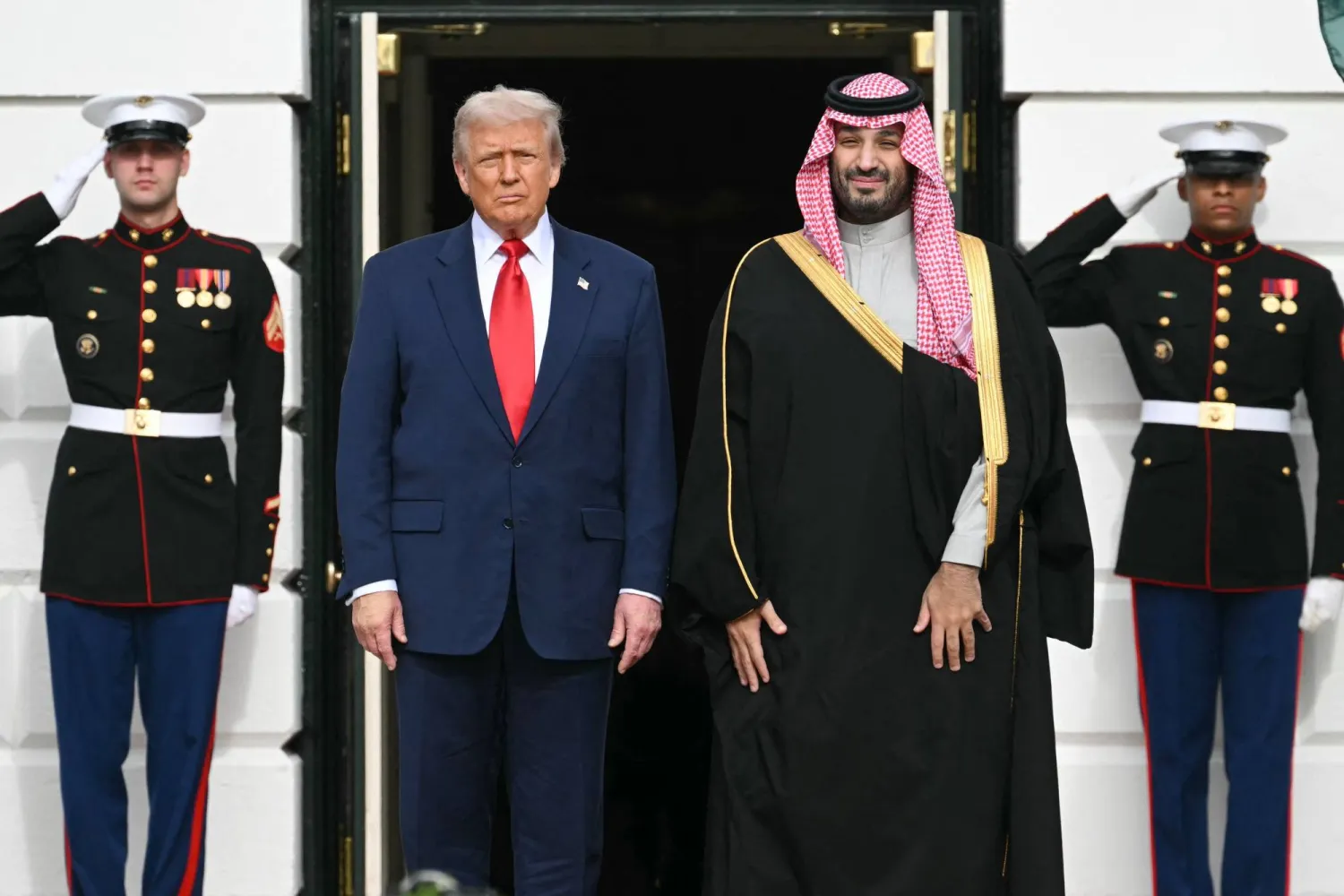
US President Donald Trump greets Prince Mohammed bin Salman, Saudi Crown Prince and Prime Minister, on the South Lawn at the White House in Washington, DC on November 18, 2025. (AFP)
TT

Saudi Crown Prince’s Visit to US Launches New Chapter in Relations 

US President Donald Trump greets Prince Mohammed bin Salman, Saudi Crown Prince and Prime Minister, on the South Lawn at the White House in Washington, DC on November 18, 2025. (AFP)

The visit by Prince Mohammed bin Salman bin Abdulaziz Al Saud, Crown Prince and Prime Minister, to the United States on Tuesday paved the way for a new "great" chapter in relations between the two allies and consolidated the "unlimited" partnership between them. 

US President Donald Trump received Crown Prince Mohammed bin Salman at the White House. An official reception ceremony was held for the Crown Prince, whose motorcade was escorted by cavalry upon arrival followed by a review of the honor guard while the military band performed, and 19 artillery rounds were fired in welcome. 

The Crown Prince and Trump witnessed an aerial military display in which a formation of fighter jets flew over Washington in welcome of his arrival. 

Following the reception ceremony, Trump escorted the Crown Prince on a tour of the White House. 

During remarks at the Oval Office, Crown Prince Mohammed revealed that Saudi Arabia will invest up to $1 trillion in the US.  

"I believe, Mr. President, in today and tomorrow, we can announce that we are going to increase that $600 billion to almost $1 trillion for investment, real investment, and real opportunity," he said.  

"Now, you're saying to me now that the $600 billion will be $1 trillion?" Trump said, to which Crown Prince Mohammed replied: "Definitely."  

The Kingdom was not "creating fake opportunities to please America or please Trump," he added. Saudi Arabia has a high demand for computing power and desires US chips. 

Afterwards, the Crown Prince and Trump chaired the Saudi-US summit. 

They reviewed aspects of bilateral relations, discussed joint efforts to boost the Saudi-US strategic partnership across various fields, examined regional and international developments, explored ways to strengthen security and stability regionally and globally, and addressed several other issues of mutual interest. 

Crown Prince Mohammed and Trump signed a strategic defense agreement at the conclusion of the summit. They also signed bilateral agreements and memoranda on strategic partnership for artificial intelligence; a joint statement on completing the negotiations regarding cooperation in civil nuclear energy; a strategic framework for partnership in securing supply chains for uranium, permanent magnets, and critical minerals; and agreement to facilitate procedures for accelerating Saudi investments. 

They also signed financial and economic partnership arrangements for economic prosperity; arrangements related to cooperation in the financial markets; a memorandum of understanding (MoU) in the field of education and training; and letters concerning vehicle safety standards. 

Attending the summit from the Saudi side were Minister of Energy and Chairman of the Saudi side of the Saudi-US Strategic Economic Partnership Committee Prince Abdulaziz bin Salman bin Abdulaziz; Saudi Ambassador to the US Princess Reema bint Bandar bin Sultan bin Abdulaziz; Minister of Foreign Affairs Prince Faisal bin Farhan bin Abdullah; Minister of State, Member of the Cabinet, and National Security Adviser Dr. Musaed bin Mohammed Al-Aiban; Minister of Commerce Majid Al-Kassabi; Minister of Finance Mohammed Aljadaan; and Governor of the Public Investment Fund (PIF) Yasir Alrumayyan. 

From the American side, officials included Vice President JD Vance; Secretary of State Marco Rubio; Secretary of Defense Pete Hegseth; Secretary of the Treasury Scott Bessent; Secretary of Energy Chris Wright; White House chief of staff Susie Wiles; and special envoy for the Middle East Steve Witkoff. 


Iran Attacks on Gulf States Surpass 7,000

Smoke rises from a building in Kuwait following an Iranian attack. (AFP file)
TT

Iran Attacks on Gulf States Surpass 7,000

Smoke rises from a building in Kuwait following an Iranian attack. (AFP file)

Iranian attacks on Gulf states have reached new levels since the war began, with Kuwait emerging as one of the countries most heavily targeted in recent weeks.

The attacks have continued despite a ceasefire between Iran and the United States, mediated by Pakistan, that has been in place since last April.

According to a tally by Asharq Al-Awsat following the two latest attacks on Kuwait, on May 28 and again on Monday, and based on official data and statements issued by Gulf Cooperation Council states, Iranian attacks on Gulf countries from the start of the war in February through early June 2026 totaled about 7,028. They included around 1,716 missiles and 5,311 drones.

The figures show that drones accounted for the bulk of Iran’s attacks with more than 5,000 launched, compared with over 1,700 missiles. The pattern points to Tehran’s growing reliance in recent months on low-cost, high-volume attacks.

The attacks have persisted despite the truce. More than 215 Iranian attacks have been recorded since the ceasefire was announced on April 8, underscoring continued security tensions in the region. Gulf air defenses have intercepted and destroyed most of the attacks.

According to the tally, the United Arab Emirates recorded the highest number of attacks, with 2,846, followed by Saudi Arabia with 1,234. Kuwait was third with 1,194 attacks, reflecting the recent surge in strikes targeting the country.

Qatar was fourth with 737 attacks, followed by Bahrain with 700, while Oman recorded the fewest with 26.

The figures come after Kuwait was hit by fresh attacks in recent days, prompting several Gulf states to condemn the strikes and declare their solidarity with Kuwait.

The continued attacks have also raised warnings that they threaten regional stability and undermine efforts to consolidate the ceasefire.

Kuwait said on Monday that its air defenses had repelled missile and drone attacks targeting the country, activated emergency procedures, and sounded sirens in several areas.

The Kuwaiti Foreign Ministry held Iran fully responsible and said Kuwait reserved the right to take all necessary measures to defend its security and sovereignty.

The Kuwait News Agency, KUNA, said Kuwaiti air defenses had intercepted hostile missiles and drones, as sirens sounded across the country. It did not immediately provide further details on the targets or the extent of any possible damage.

After the attacks, the Kuwaiti Foreign Ministry issued a strongly worded statement condemning what it called “sinful and repeated Iranian attacks.”

It said the attacks represented “a dangerous escalation and a direct assault on the security and stability of the State of Kuwait,” as well as a direct threat to civilians and vital facilities.

The ministry said the attacks violated international law, the United Nations Charter, and UN Security Council resolutions, adding that their continuation undermined efforts to reduce tensions and contain the fallout from the escalating regional crisis.

Saudi Arabia also strongly condemned the repeated Iranian attacks on Kuwait. In a statement, it said, “the Kingdom stresses its categorical rejection of these attacks, which violate the sovereignty of Kuwait in a clear breach of international law and the United Nations Charter.”

It said the violations undermined international efforts to restore security and stability in the region. Saudi Arabia expressed solidarity with Kuwait’s government and people and renewed its full support for all measures Kuwait takes to preserve its sovereignty, security, and stability.

GCC Secretary-General Jassem Albudaiwi condemned the continued “hostile Iranian attacks” targeting Kuwait, describing them as a dangerous and irresponsible escalation, a blatant violation of Kuwait’s sovereignty and international laws and norms, and a direct threat to regional security and stability.

Albudaiwi said the continued attacks reflected an unacceptable Iranian approach that undermined efforts to preserve security and stability.

He called on the international community and the UN Security Council to assume their responsibilities and take a firm, deterrent stance against violations that threaten regional and international peace and security.

The GCC secretary-general stressed that Kuwait’s security was an integral part of the security of all GCC states.

The United Arab Emirates strongly condemned the Iranian “terrorist attacks” that targeted Kuwait with missiles and drones. In a statement, the UAE Foreign Ministry said the attacks were a flagrant violation of its sovereignty and a threat to its security and stability.

Abu Dhabi expressed its full solidarity with Kuwait and its support for all measures aimed at preserving Kuwait’s security and stability.


Saudi, Qatari FMs Discuss Regional Developments

Saudi Minister of Foreign Affairs Prince Faisal bin Farhan bin Abdullah and his Qatari counterpart Sheikh Mohammed bin Abdulrahman Al Thani (Asharq Al-Awsat)
TT

Saudi, Qatari FMs Discuss Regional Developments

Saudi Minister of Foreign Affairs Prince Faisal bin Farhan bin Abdullah and his Qatari counterpart Sheikh Mohammed bin Abdulrahman Al Thani (Asharq Al-Awsat)

Saudi Minister of Foreign Affairs Prince Faisal bin Farhan bin Abdullah received a phone call from Qatari Prime Minister and Minister of Foreign Affairs Sheikh Mohammed bin Abdulrahman Al Thani, the Saudi Press Agency (SPA) reported Wednesday.

During the call, they reviewed the latest developments and current situation in the region, in light of the ongoing coordination and consultation between the two countries, SPA said.


One Killed in ‘Criminal’ Iranian Attack on Kuwait, Airport Partially Resumes Flights

Planes are seen at Kuwait International Airport. (KUNA)
TT

One Killed in ‘Criminal’ Iranian Attack on Kuwait, Airport Partially Resumes Flights

Planes are seen at Kuwait International Airport. (KUNA)

One person was killed in an Iranian attack targeting civilian facilities in Kuwait, including the international airport and diplomatic missions, the foreign ministry said on Wednesday. 

The statement did not specify which diplomatic missions were damaged. 

Ministry of defense spokesman Brigadier General Saud Abdulaziz Al-Atwan described the attack as "criminal Iranian aggression which resulted in significant material damage to the building and injuries." 

The strike marks an escalation for the country, which had seen relative calm since a ‌ceasefire in ‌the Iran war was announced on ‌April ⁠8. Iran had ⁠launched a salvo of missiles and drones at Kuwait as well as at other Gulf states. 

The early morning attack on Kuwait International Airport injured several people and forced authorities to divert flights, the state news ⁠agency reported. The attack caused "severe damage" to ‌the airport's Terminal ‌1 building, it said, citing the General Civil Aviation ‌Authority. 

Kuwait Airways said it would reschedule its ‌Wednesday flights. Shortly afterwards, the civil aviation authority said the country's flagship carrier had resumed flights from Terminal 4, after evaluating damage and taking safety measures. 

Earlier, ‌the US military said two Iranian missiles fired at Kuwait fell short or ⁠broke ⁠apart mid-flight, while three missiles launched at Bahrain were intercepted by US and Bahraini forces. 

A further wave of Iranian drones targeting US forces in Kuwait failed to hit their intended targets, Central Command said in a post on X, adding that Iranian ballistic missiles fired toward regional neighbors did not strike their targets. 

In response, US forces carried out strikes on Qeshm Island and intercepted multiple Iranian ballistic missiles and drones.