


Saudi Vision 2030, ‘America First’ Shape Saudi, US Talks

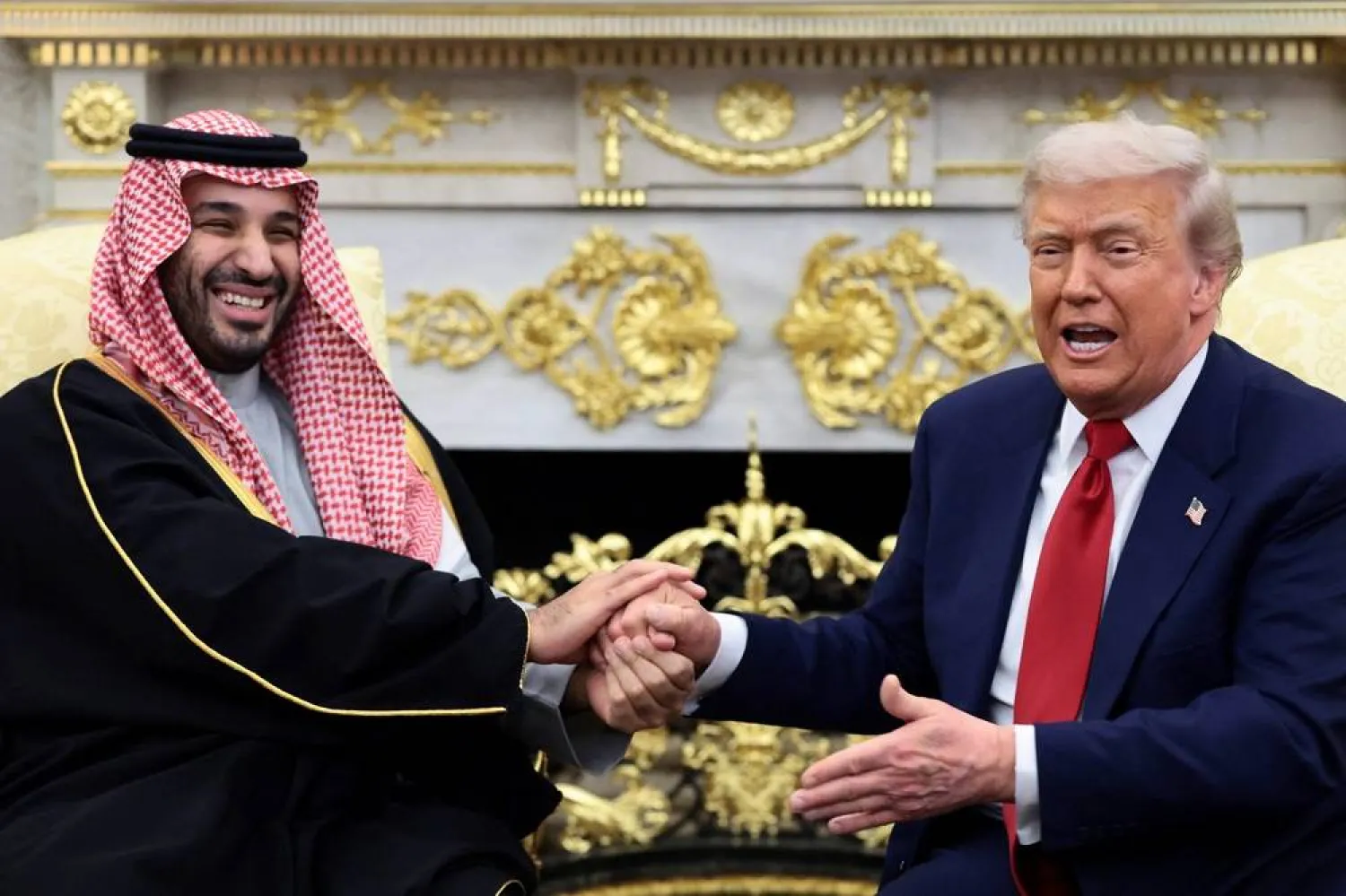
Prince Mohammed bin Salman, Saudi Crown Prince and Prime Minister laughs as US President Donald Trump speaks while shaking hands during a meeting in the Oval Office at the White House in Washington, DC, US, November 18, 2025. (Reuters)
TT

Saudi Vision 2030, ‘America First’ Shape Saudi, US Talks

Prince Mohammed bin Salman, Saudi Crown Prince and Prime Minister laughs as US President Donald Trump speaks while shaking hands during a meeting in the Oval Office at the White House in Washington, DC, US, November 18, 2025. (Reuters)

US President Donald Trump chose Saudi Arabia as his first foreign stop in both his first and second terms, while Prince Mohammed bin Salman, Saudi Crown Prince and Prime Minister, began a second official visit to the United States that is expected to push the relationship, forged in the mid-1940s, toward new horizons and a “strategic partnership.”

According to two senior experts on Saudi-US relations, the visit serves shared interests under both Trump’s “America First” agenda and Saudi Arabia’s Vision 2030, and supports efforts to anchor regional and international stability and peace.

Bernard Haykel, professor of Near Eastern Studies and director of the Institute for the Transregional Study of the Contemporary Middle East, North Africa and Central Asia at Princeton University, told Asharq Al-Awsat the trip is “extremely important,” marking the culmination of years of negotiations on a series of agreements between Saudi Arabia and the United States covering mutual security and collective defense, civilian nuclear energy production, mining and rare minerals, artificial intelligence, and streamlined military sales.

Haykel said the agreements show that Saudi Arabia and the United States are strategic allies, formalizing a partnership that also closes an important chapter of the tensions that weighed on the relationship in recent years.

Beyond oil and security

Gregory Gause, professor and head of the International Affairs Department at Texas A&M University, told Asharq Al-Awsat the visit signals Crown Prince Mohammed’s strong leadership role at home, in the region, and even on the global stage. But he stressed the issues under discussion have been on the table for a long time.

Gause was not referring to the historical relationship born of the landmark 1945 meeting between King Abdulaziz, the Kingdom’s founder, and President Franklin D. Roosevelt, but rather to the durability of the partnership despite periodic ups and downs, saying it endures because both sides have many interests intertwined with each other.

That is why, he said, the Saudi-US relationship will continue, far beyond a simplistic oil-for-security formula.

Haykel also rejected the notion that the relationship was ever based on a security for oil trade-off, calling it an “illusion.”

He said ties deepened over time on the basis of shared interests and a common vision of the world.

Both countries have long sought a stable Middle East with free-flowing trade, he added, noting that Riyadh and Washington share strikingly similar views of the international order. That allowed the relationship to mature into a broad alliance encompassing security, counterterrorism, and other files.

Haykel said Saudi leaders want a more formal relationship, similar to the US approach to Japan or South Korea. He added that as long as oil remains a key global commodity, the United States wants a good relationship with the world’s largest oil exporter.

He recalled the tense early period of President Joe Biden’s term, when Washington later recognized Saudi Arabia’s strategic weight after the Ukraine war broke out and oil prices surged.

Reducing ties to a security-for-oil swap is a mistake, he said, though security and oil remain essential pillars that hold the relationship together.

‘America First’ and Vision 2030

Haykel said both countries are undergoing strategic shifts under “America First” and Vision 2030, but their thinking aligns in viewing reciprocal interests as the basis of international relations.

He argued that Saudi and US interests have long converged around principles such as stability, order, prosperity, countering extremism and revolutionary ideologies, free trade, and preserving a global economic system anchored by the US dollar.

The relationship has brought prosperity and development to Saudi Arabia, and that every US president realizes that if we want a stable global economic system, we need Saudi Arabia as a partner. Trump, he added, understands this very well.

Saudi commitment to a Palestinian state

Haykel stressed Saudi Arabia has always cared deeply about the Palestinian cause, saying the Kingdom has pushed for a two-state solution for decades, not just recently.

Gause said Trump definitely wants more Arab states, especially Saudi Arabia, to join the Abraham Accords. He added that the Crown Prince envisions a more stable Middle East and a Saudi Arabia that serves as a global economic bridge in sectors beyond energy, including trade, transport, and tourism.

Haykel said Trump has a clear vision for the Middle East, shaped in large part by Saudi thinking. Trump is eager to win a Nobel Peace Prize for resolving the Israeli-Palestinian conflict, and that Saudi leaders would be very pleased to see that happen, but they have very clear conditions and cannot imagine stability without a Palestinian state.

Containing Iran

Despite the heavy blows Iran suffered at the hands of Israel and the United States during June’s 12-day war, Gause argued it would be an exaggeration to say the Iranians have been defeated in their regional ambitions.

Iran is not out of the game, he said, and will be on the agenda, though the Trump administration and Saudi Arabia have somewhat different views of Tehran.

Haykel agreed, saying Saudi Arabia views Iran as a large, capable neighboring state that should be peaceful and prosperous and a part of the new Middle East the kingdom is trying to build.

But he said Iran is likely to face containment and constraint, which is why a strong security alliance with Washington is critical, both as deterrence and as a signal that any attack on Saudi Arabia would be very costly for Iran.

Sudan and Yemen

On the war in Sudan, where tens of thousands have been killed, Gause said the country is not at the top of the Trump administration’s agenda, even if Washington wants a peaceful Sudan.

Trump does not seem willing to expend political capital on bringing together Sudan’s warring parties or their external backers to secure stability, he noted.

Haykel offered a different view, saying the conflicts in Yemen and Sudan are extremely important because they pose strategic and security threats to Saudi Arabia. He said Riyadh is determined to end both conflicts.



President of Sudan's Transitional Sovereignty Council Arrives in Riyadh

President of Sudan's Transitional Sovereignty Council arrives in Riyadh. (SPA)
TT

President of Sudan's Transitional Sovereignty Council Arrives in Riyadh

President of Sudan's Transitional Sovereignty Council arrives in Riyadh. (SPA)

President of the Transitional Sovereignty Council of the Republic of the Sudan Abdel Fattah Al-Burhan and his accompanying delegation arrived in Riyadh on Monday, the Saudi Press Agency said.

He was received at King Khalid International Airport by Deputy Governor of Riyadh Region Prince Mohammed bin Abdulrahman bin Abdulaziz and several other officials.


Saudi Crown Prince Receives Written Message from Chinese President 

The message was received by Saudi Minister of Foreign Affairs Prince Faisal bin Farhan bin Abdullah in Riyadh during a meeting with his Chinese counterpart Wang Yi. (SPA)
TT

Saudi Crown Prince Receives Written Message from Chinese President 

The message was received by Saudi Minister of Foreign Affairs Prince Faisal bin Farhan bin Abdullah in Riyadh during a meeting with his Chinese counterpart Wang Yi. (SPA)

Prince Mohammed bin Salman bin Abdulaziz Al Saud, Saudi Crown Prince and Prime Minister, received on Sunday a written message from China’s President Xi Jinping on bilateral relations between their two countries.

The message was received by Saudi Minister of Foreign Affairs Prince Faisal bin Farhan bin Abdullah in Riyadh during a meeting with his Chinese counterpart Wang Yi.

The meeting was attended by Saudi Ambassador to China Abdulrahman Al-Harbi and Director General of the General Department for Asian Affairs Nasser Al-Ghannoum.


Fifth Session of Political Committee under Saudi-Chinese Joint High-Level Committee Held in Riyadh 

The ministers held the fifth session of the Political Committee under the Saudi-Chinese High-Level Joint Committee to discuss ways to bolster cooperation across all sectors. (SPA)
TT

Fifth Session of Political Committee under Saudi-Chinese Joint High-Level Committee Held in Riyadh 

The ministers held the fifth session of the Political Committee under the Saudi-Chinese High-Level Joint Committee to discuss ways to bolster cooperation across all sectors. (SPA)

Saudi Foreign Affairs Prince Faisal bin Farhan bin Abdullah and his Chinese counterpart Wang Yi met in Riyadh on Sunday for talks on the comprehensive strategic partnership between their countries.

They praised the level of relations across all fields, including the economic, trade, investment, and energy sectors.

They underscored that the visit coincides with the 35th anniversary of the establishment of diplomatic relations between Saudi Arabia and China, which have witnessed significant development and alignment of vision.

The ministers held the fifth session of the Political Committee under the Saudi-Chinese High-Level Joint Committee to discuss ways to bolster cooperation across all sectors.

They stressed their keenness to provide mutual support on matters related to the vital interests of both countries. They underlined their support for measures that achieve security, stability, development, and prosperity in both nations, in a manner that meets the aspirations of the leadership of both countries.

The Saudi side reaffirmed its adherence to the One-China policy, recognizing the Chinese government as the sole legitimate government representing all of China, stressing that Taiwan is an inseparable part of Chinese territory.

The Chinese side expressed its support for the development and strengthening of Saudi-Iranian relations and praised the Kingdom’s leadership role and efforts to achieve regional and international security and stability.

It lauded the economic developments taking place in the Kingdom under Saudi Vision 2030. It commended the outcomes of the Arab-China Riyadh Summit for Cooperation and Development hosted by the Kingdom in December 2022.

Saudi officials expressed their support for China hosting the second China-Arab Summit and the second China-GCC Summit in 2026.

Chinese officials also expressed Beijing's readiness to participate in the World Expo 2030 Riyadh.

The two parties exchanged views on regional and international issues of common interest, expressing their readiness to boost communication and coordination on these matters.

They underscored their support for efforts to achieve a comprehensive and just solution to the Palestinian-Israeli conflict, establishing an independent Palestinian state on the 1967 borders with East Jerusalem as its capital, in accordance with the two-state solution, international resolutions, and the Arab Peace Initiative.

Both sides also signed an agreement on the mutual waiver of visas for holders of diplomatic, private, and service passports.