


Lebanon’s Army Commander Postpones US Visit amid American, Israeli Pressure 

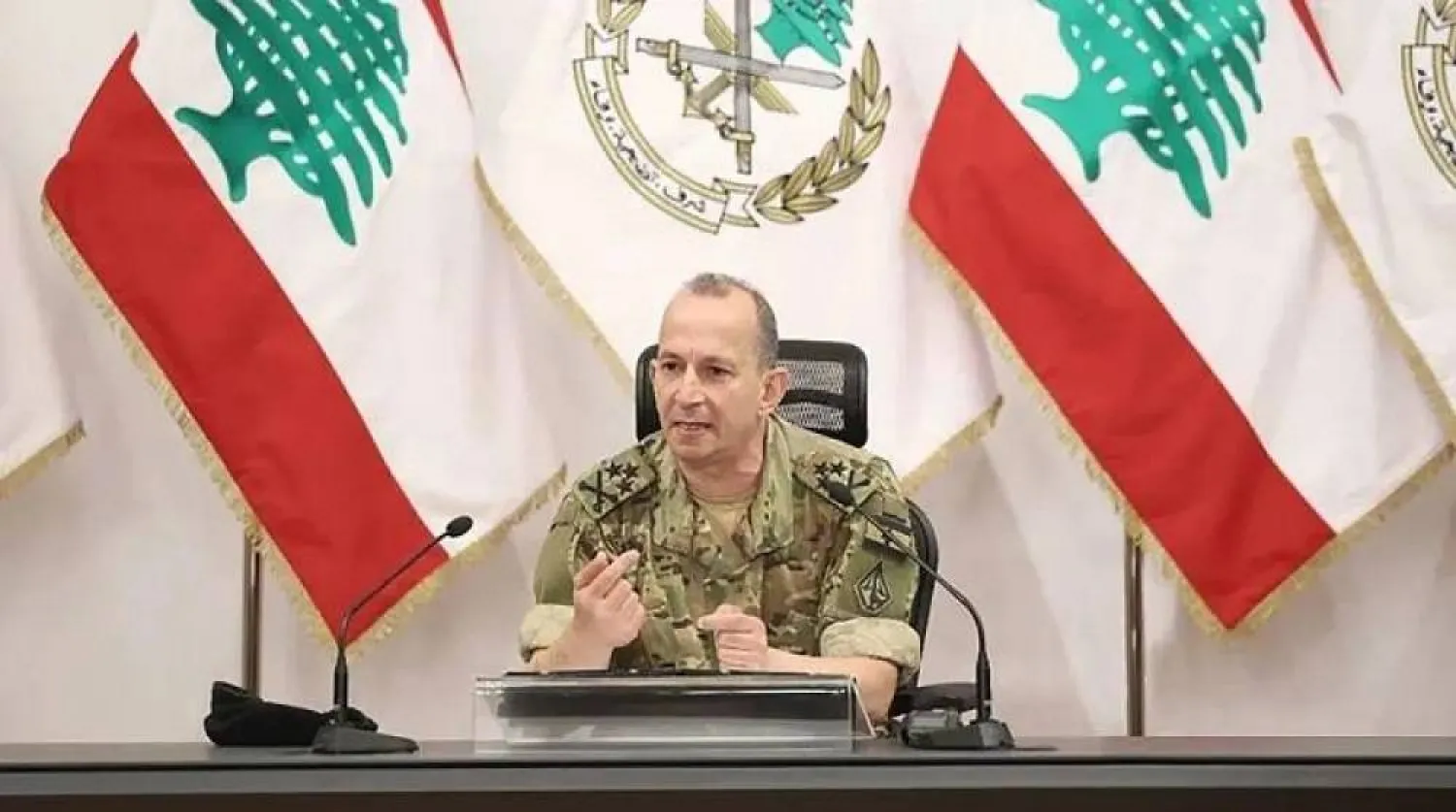
Lebanon’s Army Commander General Rodolphe Haykal. (Lebanese army)
TT

Lebanon’s Army Commander Postpones US Visit amid American, Israeli Pressure 

Lebanon’s Army Commander General Rodolphe Haykal. (Lebanese army)

Lebanon’s Army Commander General Rodolphe Haykal postponed his visit to the United States after Israel and members of Congress criticized the military for not doing enough to implement the ceasefire with Israel.

The US cancelled meetings in Washington with Haykal after objecting to a statement the army issued on Sunday about border tensions with Israel, Lebanese officials familiar with the matter said, according to Reuters.

Haykal chose to postpone the visit to ensure that the "trip is not a failure," military sources told Asharq Al-Awsat.

Haykal was supposed to arrive in Washington on Tuesday to meet several American officials at the White House, as well as members of Congress and military leaders.

The military sources told Asharq Al-Awsat that the military command "had noted in the past two weeks Israeli criticism against the army and its national role." This was coupled with a "sudden" campaign by US Senators Lindsey Graham and Joni Ernst.

The campaign led to pressure in Washington, culminating in the cancellation of several meetings on Haykal’s agenda for his visit.

"Given the circumstances, the army commander decided to postpone the trip until the situation becomes clearer," the sources added.

Sunday’s statement

In Sunday’s statement, the army accused Israel of "insisting on violating Lebanese sovereignty, causing instability and obstructing the army's deployment in the south".

It condemned the "latest attack" on a UNIFIL peacekeeping patrol and said Israeli actions required "immediate action" from friendly states as they amounted to "a dangerous escalation".

The Israeli military occupies five posts within Lebanon and frequently carries out airstrikes in the country's south that it says are targeting Hezbollah fighters.

Israel and Lebanon agreed to a ceasefire a year ago that required the Lebanese group not to have any weapons in the south and for Israeli forces to fully withdraw from Lebanon.

Washington is a key backer of Lebanon's army, providing support of more than $3 billion over the last two decades in a policy aimed at supporting state institutions in a country where the Iran-backed group Hezbollah has long held sway.

Under the terms of the truce brokered by the US and France, Lebanon's armed forces were to confiscate "all unauthorized arms", beginning in the area south of the Litani River - the zone closest to Israel.

Israeli campaign

For around two weeks, Israel has heavily criticized the Lebanese army. Israeli media reported that the Israeli military has accused the Lebanese army of "not exerting enough efforts to curb Hezbollah’s activities and armament in the South."

It said the military was "lax" in dealing with Hezbollah, allowing the party to bolster its capabilities near the border.

Tel Aviv has also been pressuring the army to intensify its operations in the South and carry out raids on private properties in search of Hezbollah weapons.

Israel had relayed this request during a ceasefire committee meeting, known as the mechanism. The Lebanese army refused, explaining that entering private properties needs legal authorization.

American criticism

Meanwhile, Senator Graham took to the X platform to criticize Haykal, saying: "It is clear that the Lebanese Chief Head of Defense -- because of a reference to Israel as the enemy and his weak almost non-existent effort to disarm Hezbollah -- is a giant setback for efforts to move Lebanon forward."

"This combination makes the Lebanese Armed Forces not a very good investment for America," he added.

Senator Ernst echoed his remarks, expressing her "disappointment" with the army.

The army is a "strategic partner, and — as I discussed with the CHOD in August — Israel has given Lebanon a real opportunity to free itself from Iran-backed Hezbollah terrorists," she said on X, referring to Haykal.

"Instead of seizing that opportunity and working together to disarm Hezbollah, the CHOD is shamefully directing blame at Israel," she stated.

Amid the tensions, Lebanon’s LBCI television quoted American sources as saying they were hoping that Haykal’s visit would be rescheduled and that matters would return to the right path should "necessary reforms" be implemented and efforts to impose state monopoly over arms are accelerated.

Continuing its duties

Meanwhile, the army continues "to carry out its duties in full despite its limited and modest means", including imposing state monopoly over arms, military sources told Asharq Al-Awsat.

It is implementing the ceasefire according to the timeframe that was approved by the political authorities, they added. "The military will not be affected by the campaigns against it."

The army has deployed 9,000 soldiers south of the Litani and is working on dismantling Hezbollah facilities and seizing its weapons, they went on to say.



Aidrous Al-Zubaidi Removed from Yemen's PLC for Committing 'High Treason'

Head of the Southern Transitional Council (STC) Aidrous Al-Zubaidi. (AP)
TT

Aidrous Al-Zubaidi Removed from Yemen's PLC for Committing 'High Treason'

Head of the Southern Transitional Council (STC) Aidrous Al-Zubaidi. (AP)

Head of the Southern Transitional Council (STC) Aidrous Al-Zubaidi has been removed from Yemen's Presidential Leadership Council (PLC) for high treason, announced PLC Chairman Dr. Rashad Al-Alimi on Wednesday.

In a decree, Al-Alimi referred Al-Zubaidi to the general prosecutor for committing high treason and harming the unity and security of the state.

The move stems from keenness on the security of all civilians and sovereignty of the republic, said the decree.

Moreover, it accused Al-Zubaidi of "harming the just southern cause and exploiting it to commit grave violations against civilians in southern governorates."

He was also accused of "harming the republic's political and economic interests, violating the constitution and obstructing state efforts to confront the Houthi coup."

Other charges include forming an armed gang and killing officers and members of the armed forces.

Earlier on Wednesday, Official Spokesperson of the Coalition to Restore Legitimacy in Yemen Major General Turki Al-Malki said that Al-Zubaidi had fled to an unknown location after distributing weapons to dozens of elements inside Aden, led by Mu'min Al-Saqqaf and Mukhtar Al-Nubi, with the aim of stoking unrest in Aden in the coming hours.


Arab Coalition: Aidrous Al-Zubaidi Flees to Unknown Location Amid Yemen Escalation

Coalition spokesman Major General Turki al-Malki. (SPA)
TT

Arab Coalition: Aidrous Al-Zubaidi Flees to Unknown Location Amid Yemen Escalation

Coalition spokesman Major General Turki al-Malki. (SPA)

Official Spokesperson of the Coalition to Restore Legitimacy in Yemen Major General Turki Al-Malki said on Wednesday that the head of the Southern Transitional Council (STC) Aidrous Al-Zubaidi has fled to an unknown location.

On January 4, the Joint Forces Command of the Coalition informed Al-Zubaidi that he must travel to Saudi Arabia within 48 hours to meet with Chairman of Yemen's Presidential Leadership Council (PLC) Dr. Rashad Al-Alimi, and the Coalition Forces Command to address the reasons behind the escalation and attacks by forces affiliated with the STC on the governorates of Hadhramaut and Al-Mahra.

On January 5, the Presidency of the STC reiterated its appreciation for the efforts led by Saudi Arabia in preparing for a comprehensive southern conference to discuss ways to resolve the southern issue, and confirmed its participation in ensuring the conference's success.

Al-Zubaidi informed the Kingdom of his intention to attend on January 6, and the delegation proceeded to the airport.

However, the departure of Yemenia Airways flight IYE 532, scheduled for 10:10 PM and carrying the delegation, was delayed for more than three hours. The legitimate government and the coalition received intelligence indicating that Al-Zubaidi had moved a large force, including armored vehicles, combat vehicles, heavy and light weapons, and ammunition, from the Jabal Hadid and Al-Solban camps towards Al-Dhaleh around midnight.

The aforementioned flight was allowed to depart, carrying a large number of STC leaders but excluding Al-Zubaidi, who fled to an unknown location.

He left the members and leaders of the STC without any details regarding his whereabouts. This occurred after he distributed weapons and ammunition to dozens of elements inside Aden, led by Mu'min Al-Saqqaf and Mukhtar Al-Nubi, with the aim of stoking unrest in Aden in the coming hours.

This prompted the National Shield Forces and the coalition to request Vice President of the Presidential Leadership Council Abdul Rahman Al-Mahrami, also known as Abu Zaraa, to impose security, prevent any clashes within Aden, spare its residents any disturbances, protect lives and property, and cooperate with the National Shield Forces.

The coalition forces monitored the movement of the military units as they emerged from the camps and took up positions in a building near Al-Zand camp in Al-Dhaleh Governorate. At 4:00 AM, coalition forces, in coordination with legitimate government forces and the National Shield Forces, launched limited preemptive strikes to disrupt these forces and thwart Al-Zubaidi's attempts to escalate the conflict and extend it into Al-Dhaleh.

The Joint Forces Command of the Coalition to Restore Legitimacy in Yemen stress that it is working with the Yemeni government and the local authority in Aden to support and maintain security efforts and confront any military forces targeting cities and civilians.

The command urges all residents to stay away from camps in Aden and Al-Dhaleh, avoid any gatherings of military vehicles for their own safety, and provide information to security agencies regarding any suspicious military movements.


Israel Clears Final Hurdle to Start Settlement Construction That Would Cut West Bank in Two

Construction cranes tower above a construction site in Givat HaMatos, an Israeli settlement suburb of Israeli-annexed east Jerusalem on January 2, 2026. (AFP)
TT

Israel Clears Final Hurdle to Start Settlement Construction That Would Cut West Bank in Two

Construction cranes tower above a construction site in Givat HaMatos, an Israeli settlement suburb of Israeli-annexed east Jerusalem on January 2, 2026. (AFP)

Israel has cleared the final hurdle before starting construction on a controversial settlement project near Jerusalem that would effectively cut the West Bank into two, according to a government tender. 

The tender, seeking bids from developers, would clear the way to begin construction of the E1 project. 

The anti-settlement monitoring group Peace Now first reported the tender. Yoni Mizrahi, who runs the group’s settlement watch division, said initial work could begin within the month. 

Settlement development in E1, an open tract of land east of Jerusalem, has been under consideration for more than two decades, but was frozen due to US pressure during previous administrations. 

The international community overwhelmingly considers Israeli settlement construction in the West Bank to be illegal and an obstacle to peace. 

The E1 project is especially contentious because it runs from the outskirts of Jerusalem deep into the occupied West Bank. Critics say it would prevent the establishment of a contiguous Palestinian state in the territory. 

Israeli Finance Minister Bezalel Smotrich, a far-right politician who oversees settlement policy, has long pushed for the plan to become a reality. 

“The Palestinian state is being erased from the table not with slogans but with actions,” he said in August, when Israel gave final approval to the plan. “Every settlement, every neighborhood, every housing unit is another nail in the coffin of this dangerous idea.” 

The tender, publicly accessible on the website for Israel’s Land Authority, calls for proposals to develop 3,401 housing units. Peace Now says the publication of the tender “reflects an accelerated effort to advance construction in E1.”