

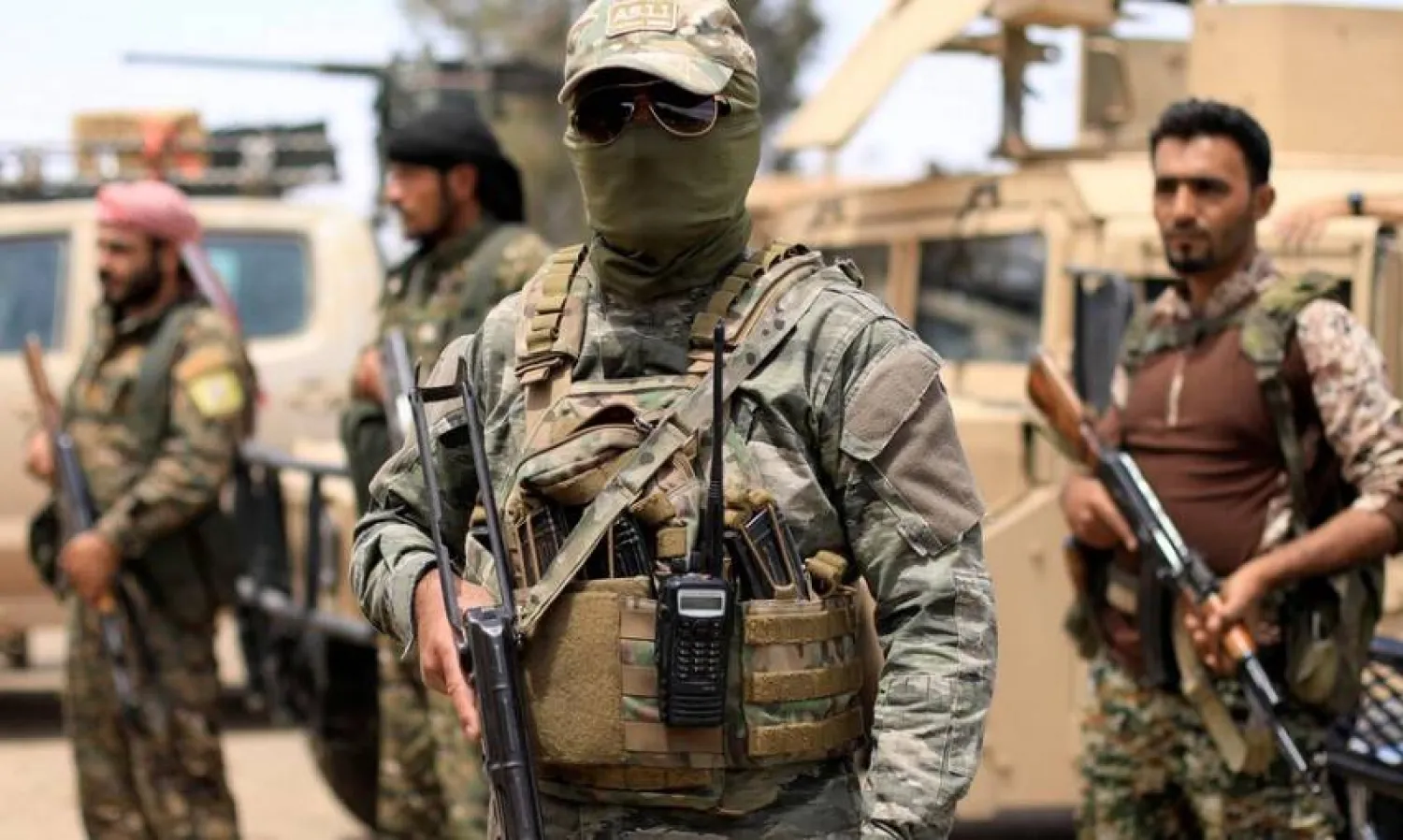

Two Syrian Soldiers Killed During Clashes with SDF

 Members of the SDF in Deir Ezzor. (Reuters)
Members of the SDF in Deir Ezzor. (Reuters)
TT

Two Syrian Soldiers Killed During Clashes with SDF

 Members of the SDF in Deir Ezzor. (Reuters)
Members of the SDF in Deir Ezzor. (Reuters)

Two Syrian soldiers were killed in overnight clashes with the Syrian Democratic Forces in the country's northeast, the defense ministry said Thursday, with the SDF saying they were targeting positions used by the ISIS group.

The ministry said in a statement carried by SANA state news agency that clashes took place after the US-backed Syrian Democratic Forces (SDF) attacked army positions in Raqa province.

The SDF is the de facto army of the semi-autonomous Kurdish administration that controls swathes of the oil-rich north and northeast.

The Kurdish-led fighters took control of several locations "resulting in the death of two army soldiers and the wounding of others", the ministry said.

Soldiers then returned fire and retook the positions, it said, adding Damascus held the SDF responsible for the attack.

But the SDF said in a statement its forces were "engaging with several positions that members of the Daesh (ISIS) terrorist organization have used directly to launch drones towards positions where our troops are stationed".

The forces played a key role in the fight against ISIS in Syria, ultimately leading to the extremists’ territorial defeat in the country in 2019.

"The region has been subjected to a series of attacks this week by factions affiliated with the Damascus government, in parallel with the activity of ISIS members who have actually used those positions to carry out their terrorist attacks," the SDF statement said.

It alleged "direct coordination between several Damascus government factions and ISIS terrorists in targeting our military positions".

The Syrian Observatory for Human Rights monitor gave a higher toll of six government personnel dead.

In March, the SDF signed an agreement with Syria's new authorities to integrate Kurdish military and civilian institutions into the central government.

However differences between the two sides have held up the deal's implementation.

The Kurds have called for decentralization, which Damascus has rejected.


EU Condemns Israel's West Bank Control Measures

The Israeli settlement of Har Homa, seen from the West Bank city of Bethlehem, Tuesday, Dec. 17, 2024. (AP)
TT

EU Condemns Israel's West Bank Control Measures

The Israeli settlement of Har Homa, seen from the West Bank city of Bethlehem, Tuesday, Dec. 17, 2024. (AP)

The European Union on Monday condemned new Israeli measures to tighten control of the West Bank and pave the way for more settlements in the occupied Palestinian territory, AFP reported.

"The European Union condemns recent decisions by Israel's security cabinet to expand Israeli control in the West Bank. This move is another step in the wrong direction," EU spokesman Anouar El Anouni told journalists.


Atrocities in Sudan's El-Fasher Were 'Preventable Human Rights Catastrophe'

Sudanese displaced people who left El Fasher after its fall, sit in the shade in Tawila at the Rwanda camp reception point on December 17, 2025. (Photo by AFP)
TT

Atrocities in Sudan's El-Fasher Were 'Preventable Human Rights Catastrophe'

Sudanese displaced people who left El Fasher after its fall, sit in the shade in Tawila at the Rwanda camp reception point on December 17, 2025. (Photo by AFP)

The atrocities unleashed on El-Fasher in Sudan's Darfur region last October were a "preventable human rights catastrophe", the United Nations said Monday, warning they now risked being repeated in the neighbouring Kordofan region.


"My office sounded the alarm about the risk of mass atrocities in the besieged city of El-Fasher for more than a year ... but our warnings were ignored," UN rights chief Volker Turk told the Human Rights Council in Geneva.


He added that he was now "extremely concerned that these violations and abuses may be repeated in the Kordofan region".


Arab League Condemns Israel's Decisions to Alter Legal, Administrative Status of West Bank

A general view shows the opening session of the meeting of Arab foreign ministers at the Arab League Headquarters (Reuters)
TT

Arab League Condemns Israel's Decisions to Alter Legal, Administrative Status of West Bank

A general view shows the opening session of the meeting of Arab foreign ministers at the Arab League Headquarters (Reuters)

The General Secretariat of the Arab League strongly condemned decisions by Israeli occupation authorities to impose fundamental changes on the legal and administrative status of the occupied Palestinian territories, particularly in the West Bank, describing them as a dangerous escalation and a flagrant violation of international law, international legitimacy resolutions, and signed agreements, SPA reported.

In a statement, the Arab League said the measures include facilitating the confiscation of private Palestinian property and transferring planning and licensing authorities in the city of Hebron and the area surrounding the Ibrahimi Mosque to occupation authorities.

It warned of the serious repercussions of these actions on the rights of the Palestinian people and on Islamic and Christian holy sites.

The statement reaffirmed the Arab League’s firm support for the legitimate rights of the Palestinian people, foremost among them the establishment of their independent state on the June 4, 1967 borders, with East Jerusalem as its capital.
