2 Robbers Overpower Guard, Steal Dozens of Ancient Gold Coins from Swiss Museum

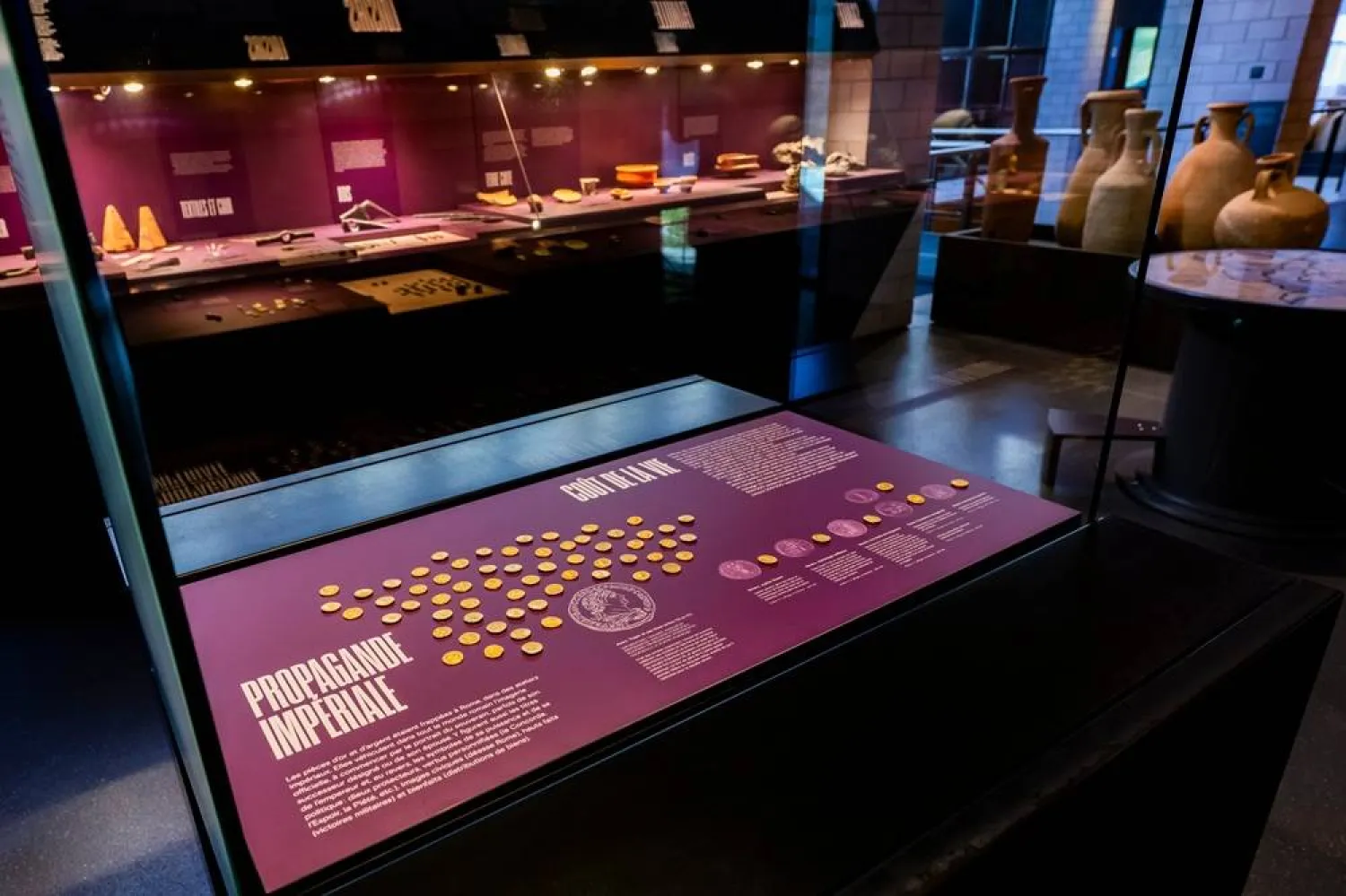
 A view of the permanent exposition at the Musee Romain (Roman museum) in Lausanne, Switzerland, Tuesday Nov. 4, 2025. (Jean-Christophe Bott/Keystone via AP)
A view of the permanent exposition at the Musee Romain (Roman museum) in Lausanne, Switzerland, Tuesday Nov. 4, 2025. (Jean-Christophe Bott/Keystone via AP)
TT

2 Robbers Overpower Guard, Steal Dozens of Ancient Gold Coins from Swiss Museum

 A view of the permanent exposition at the Musee Romain (Roman museum) in Lausanne, Switzerland, Tuesday Nov. 4, 2025. (Jean-Christophe Bott/Keystone via AP)
A view of the permanent exposition at the Musee Romain (Roman museum) in Lausanne, Switzerland, Tuesday Nov. 4, 2025. (Jean-Christophe Bott/Keystone via AP)

Swiss authorities were searching Friday for two robbers who overpowered a security guard at an ancient Rome-themed museum in Lausanne, smashed a display case and made off with dozens of gold coins that had been displayed inside.

City police said the suspects had purchased tickets and waited until other visitors had left shortly before closing time on Thursday, before assaulting and restraining the guard, and then breaking the display case.

The monetary value of the loot was not immediately revealed, but police said the coins had “archaeological value.”

The theft comes at a time when gold prices have soared in global markets this year — even if they have dropped off their highs lately — and a high-profile robbery at the Louvre in Paris exposed vulnerabilities and security lapses at museums.

Officials said the Lausanne museum employee, a 64-year-old Swiss national, was interviewed by investigators and that he was not injured in the incident. No other people — staff or visitors — were on hand at the time.

State prosecutors have opened an investigation. Lausanne city officials filed a legal complaint for damage to the museum, and the regional government — the owner of the gold coins — announced plans to file a criminal complaint.


Culture Ministry Signs Partnership with Guildhall School of Music & Drama for Riyadh University of Arts

Culture Ministry Signs Partnership with Guildhall School of Music & Drama for Riyadh University of Arts
TT

Culture Ministry Signs Partnership with Guildhall School of Music & Drama for Riyadh University of Arts

Culture Ministry Signs Partnership with Guildhall School of Music & Drama for Riyadh University of Arts

The Ministry of Culture today signed a partnership with Guildhall School of Music & Drama for Riyadh University of Arts (RUA)’s College of Music. The partnership aims to further develop cultural and artistic talent and drive cultural exchange.

Under the terms of the partnership, Guildhall School will work with RUA to co-design undergraduate, postgraduate and research programs spanning music performance, production and education, in addition to training and capability development opportunities for RUA’s faculty body.

The programs will help cultivate and support Saudi talent across a wide range of musical disciplines, as well as provide students with a firm understanding of creative processes, research pathways and professional skills.

Founded in 1880, Guildhall School is a vibrant, international community of musicians, actors and production artists. Ranked as number one in Arts, Drama and Music by the Complete University Guide 2025, and in the top three in the world for Music by the QS World University Rankings 2025, Guildhall delivers world-class professional training in partnership with distinguished artists, companies and ensembles, SPA reported.

The partnership with Guildhall School sits within a series of partnerships for the Riyadh University of Arts and its colleges with leading international institutions to co-design academic programs, collaborate in research, and offer enriching programs in cultural education and development.

In December 2025, RUA announced partnerships between their College of Film and the University of Southern California’s (USC) School of Cinematic Arts (SCA); between SOAS University of London and their College of Heritage and Civilization Studies; AMDA College of the Performing Art and RUA’s College of Theater and Performing Art; and between ESSEC Business School and RUA’s College of Cultural Management. A further agreement was signed with the Royal College of Art (RCA) and RUA’s College of Architecture and Design and College of Visual Arts and Photography in January 2026.

Riyadh University of Arts was established by royal decree and is headquartered in Riyadh. Its Board of Trustees is chaired by Minister of Culture Prince Bader bin Abdullah bin Farhan. The university is dedicated to advancing education in the fields of culture and the arts, serving as a cornerstone for creative learning and cultural innovation. It aims to empower students with the knowledge, skills, and vision needed to shape the future of Saudi Arabia’s creative economy.

The university will launch its programs in phases, gradually expanding to cover a wide range of fields and specialized disciplines. It will offer a comprehensive academic portfolio that supports continuous education across the arts and culture sectors, including short courses, diplomas, bachelor’s degrees, higher diplomas, master’s degrees, and PhDs.


Czech ‘Arks’ Help Preserve Ukraine’s Cultural Heritage

A photo taken in Prague's National Museum shows a 3D scanner in the Archa III (Ark Project) truck on March 24, 2026 in Prague, Czech Republic. (AFP)
TT

Czech ‘Arks’ Help Preserve Ukraine’s Cultural Heritage

A photo taken in Prague's National Museum shows a 3D scanner in the Archa III (Ark Project) truck on March 24, 2026 in Prague, Czech Republic. (AFP)

The National Museum in Prague on Tuesday unveiled a van containing a 3D scanning device that will soon travel to war-ravaged Ukraine to help preserve its cultural artifacts.

The Archa (Ark) III is a Volkswagen van comprising a studio equipped with a robot and three cameras to create precise models of endangered historic items in Ukraine, which has been battling a full-scale Russian invasion since 2022.

"Archa III is a unique mobile digitization device enabling us to create high-quality 3D images of endangered artifacts and collection items out in the field," National Museum director Michal Lukes told reporters.

He added the scanners could handle both tiny objects and more sizeable items even inside museums.

"In this way, we can create precise digital copies of items that can then serve for documentation and research purposes, but also for restoration, potential reconstruction, or the production of copies," he added.

Museum staff will drive the van to Kyiv in early April and hand it over to Ukrainian partners under the project carried out in cooperation with the foundation of Czech billionaire Karel Komarek.

It follows an Archa I container equipped to conserve and restore books and an Archa II van digitizing two-dimensional items, which Prague sent to Ukraine earlier.

The foundation, which worked on the first two "Arks" with other institutions, said they have so far handled almost 40,000 pages of documents, such as historic newspapers retrieved from the Regional Scientific Library in Kherson.

"The van comprises an autonomous robotic system designed for photogrammetry and 3D output," said the museum's IT director Martin Soucek.

Speed is crucial, and the robot moving along three axes can generate thousands of high-quality photographs within minutes.

"It then uses the photographs to create a hyper-realistic model with high detail, a so-called digital twin," Soucek added.

The project also involves expert training and a website on which the scanned artifacts will be exhibited.

Vitalii Usatyi, the charge d'affaires at the Ukrainian embassy in Prague, hailed the van for being able to work across Ukraine, "including regions exposed to risks related to the Russian aggression".

"This is crucial for preserving cultural heritage," he added.

A recent UNESCO report said that 523 cultural sites had been verified as damaged as of March 11, including 153 religious sites, 273 buildings of historical or artistic interest, 39 museums, 33 monuments, 20 libraries, four archaeological sites and one archive.


In Lebanon’s Tyre, Ancient Site Threatened by Israeli Bombs

This photograph taken on March 23, 2026, shows smoke as it rises from the site of an Israeli air strike at the background of the archaeological site of the ruins of the Phoenician Port in the southern Lebanese city of Tyre. (AFP)
TT

In Lebanon’s Tyre, Ancient Site Threatened by Israeli Bombs

This photograph taken on March 23, 2026, shows smoke as it rises from the site of an Israeli air strike at the background of the archaeological site of the ruins of the Phoenician Port in the southern Lebanese city of Tyre. (AFP)

At an archaeological site in southern Lebanon's Tyre, small signs bearing a blue and white emblem provide a symbolic shield, meant to protect the ancient ruins from bombardment.

One of the oldest cities on the Mediterranean coast, Tyre is located around 20 kilometers (12 miles) from the Israeli border, and has been the target of several strikes since Lebanon was drawn into the Middle East war by Hezbollah's March 2 rocket attack on Israel.

The Al-Bass site is centered on a necropolis that dates back three millennia to Tyre's time as a major Phoenician city and was still in use until the Arab conquests of the 7h Century.

An organization linked to UNESCO, the United Nations' cultural heritage agency, launched the signs initiative near the site, part of a push that covers more than 30 locations across the country.

It is a reminder that the 1954 Hague Convention obliges warring parties to protect cultural property.

On March 6, an Israeli strike hit just a few meters away, killing eight people according to Lebanon's health ministry.

The target, a family home, is now a pile of rubble.

"They were our neighbors... They thought that being close to an archaeological site protected them, that because this is a World Heritage site it would not be struck," said Nader Saqlawi, director of archaeological excavations in the south for Lebanon's culture ministry.

Museum employees place Enhanced Protection Emblems, a special symbol used under international humanitarian law to protect critical sites during armed conflict, at the archaeological site of the Roman hippodrome in the southern Lebanese city of Tyre, on March 23, 2026. (AFP)

- Human remains -

The team from the ministry that came to inspect possible damage to the monuments found human remains -- "a hand and pieces of flesh" -- on the roof of the site's museum, which is still under construction, he said.

The museum suffered damage, its windows were blown out, but the explosion did not reach the necropolis nor the Roman-era triumphal arch, aqueducts and hippodrome that are also part of the site.

In antiquity, the city of Tyre was at various times Phoenician, Persian, Hellenistic, Roman and Byzantine.

While many of its inhabitants have fled the latest war, others remain alongside the city's precious relics.

Lebanese Culture Minister Ghassan Salame condemned what he called Israel's aggression.

"The archaeological sites do not contain any military or security presence. Therefore, this argument cannot be used to justify their bombing," he said.

There was no immediate comment in response to AFP's request from the Israeli army, which usually says it is targeting Hezbollah sites or operatives with its attacks.

"Lebanon is full of archaeological riches... and the Beirut depots do not have the capacity to accommodate all these threatened objects," said David Sassine, an expert at the International Alliance for the Protection of Heritage.

This photograph taken on March 23, 2026, shows boxes filled with fragments of ancient pottery collected after an Israeli strike near the archaeological site of the Roman hippodrome in the southern Lebanese city of Tyre. (AFP)

- 'No one cares' -

There is also no guarantee that the objects would be safer in the capital, which is itself regularly bombed by Israel, and transporting the items from the south of the country, even under military escort, "remains risky", Sassine said.

During the previous Israel-Hezbollah conflict in 2024, gold coins, millennia-old amphorae and valuable sarcophagi were transferred to Beirut, where they have remained.

Tyre was heavily damaged by Israeli strikes during that war, while much of the population evacuated at the time.

Closer to the border, the citadel in the village of Shamaa was also partly destroyed by the Israeli military.

Saqlawi of the culture ministry said he believed attacks on historic sites were intentional.

"The Israelis know everything. They know your shoe size... and they know very well this is an archaeological site," he said.

Mustapha Najdi, a guard at the archaeological sites, was at the Al-Bass site when the March 6 strike hit.

"I heard a very violent impact. I fled and alerted the authorities," he said.

"No one cares about us," Najdi lamented, calling on "everyone who can to exert pressure to stop this barbarity".

"This civilization represents history, represents us all, Lebanese and non-Lebanese."