


Egypt’s PM from South Africa: Strengthening Partnership and Coordination on African Issues

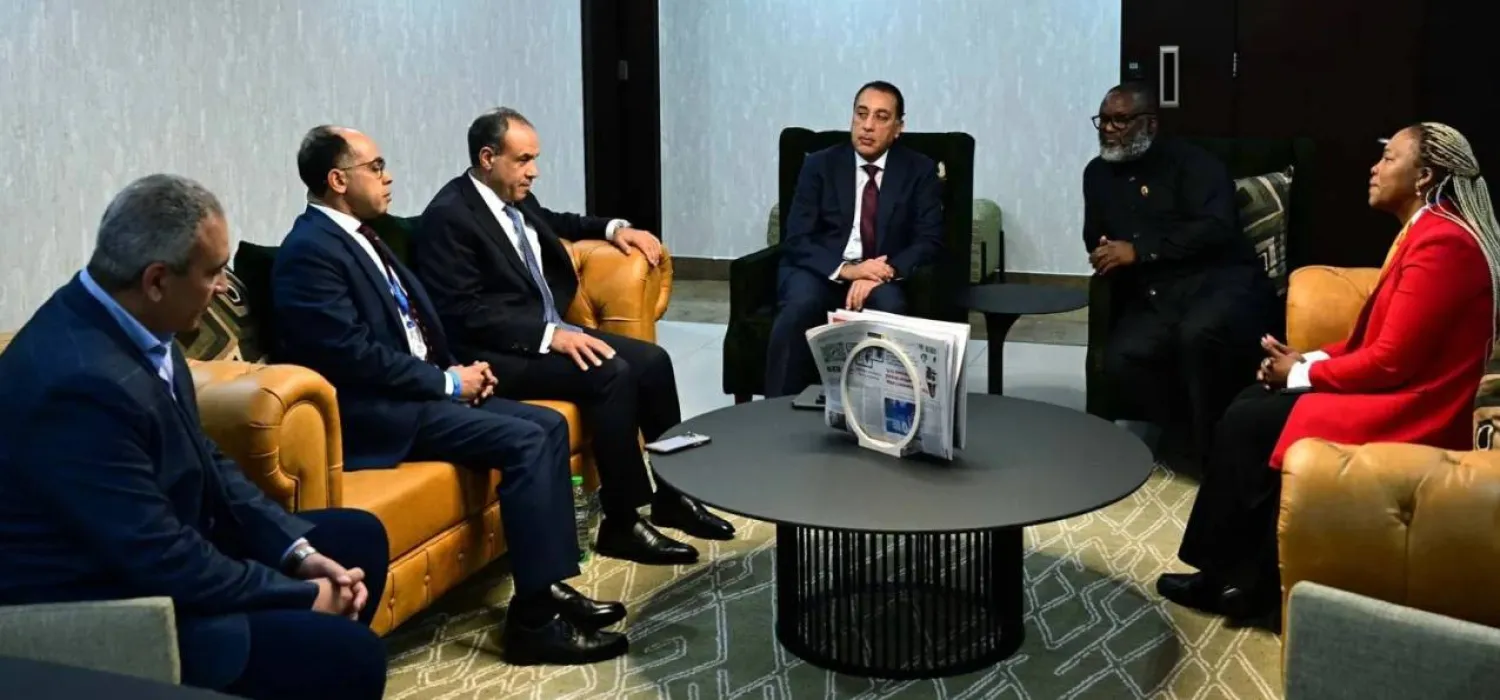
Egyptian Prime Minister Mostafa Madbouly on Friday held talks with senior South African officials on the sidelines of the G20 Summit 2025 (Egyptian cabinet)
TT

Egypt’s PM from South Africa: Strengthening Partnership and Coordination on African Issues

Egyptian Prime Minister Mostafa Madbouly on Friday held talks with senior South African officials on the sidelines of the G20 Summit 2025 (Egyptian cabinet)

Egyptian Prime Minister Mostafa Madbouly held on Friday talks with senior South African officials on the sidelines of the G20 Summit in Johannesburg aimed at “strengthening the partnership between the two countries and coordination on African issues.”

Madbouly is attending the high-profile global event on behalf of President Abdel Fattah El-Sisi. The G20 Summit is scheduled to take place on Saturday and Sunday.

On Friday, the Egyptian PM held talks with representatives from around 40 major companies and leading research centers in South Africa to enhance economic partnership and fostering mutual investment between the two countries.

He said Egypt views cooperation with South Africa and other major countries on the continent, such as Nigeria, as a means to achieve continental integration, adding that his country also seeks cooperation and integration, not competition, with any other countries.

The PM also underlined Cairo’s interest in establishing a joint business council with South Africa and hosting its first meeting in Egypt, asserting the importance of greater connection and cooperation between Egyptian companies and their South African peers.

Egyptian economic expert, Dr. Rashad Abdo, said both Egypt and South Africa possess the necessary elements to forge an economic partnership.

He told Asharq Al-Awsat that such cooperation supports economic development in both countries, and enhances the opportunities for economic integration in African countries.

During his meeting with South African business representatives, the PM emphasized Egypt's desire to bolster economic, trade, and investment partnerships between Cairo and Cape Town.

He also underscored Egypt's readiness to overcome any existing challenges and provide necessary incentives that could contribute to increasing flow of investments from South Africa to Egypt.

Madbouly also reviewed investment opportunities in various sectors in Egypt, including the Suez Canal Economic Zone (SCZONE).

He stressed that the Zone represents one of the most promising opportunities for companies seeking a stable and cost-competitive business environment to enhance their access to regional and international markets.

Positioned at the intersection of three continents (Africa, Asia, and Europe), the Zone provides convenient logistics services, and duty-free access for goods to a number of markets, including the Middle East and Europe, the PM noted.

“Madbouly’s meetings in South Africa are of great political and economic importance,” said Ambassador Rakha Ahmed Hassan, a member of the Egyptian Council for Foreign Affairs.

He told Asharq Al-Awsat that in addition to their economic and trade relations, Egypt and South Africa hold discussions and coordinate on many regional and African issues.

“Egypt has promising investment and trade opportunities, and has good relations with most of the G20 countries,” Ahmed Hassan said. Therefore, he noted, “the development of trade and economic cooperation between Egypt and South Africa will have direct practical benefits through the BRICS and G20.”

On Friday, Egyptian Foreign Minister Badr Abdelatty affirmed Egypt’s keenness to strengthen cooperation, expand joint investments, and advance economic integration with South Africa.

He announced that he will lead a delegation of Egyptian business leaders on an official visit to South Africa next year.




Russia Says it is Discussing 'Reformatting' of Military Facilities in Syria

People rest outside the Kremlin on a warm summer day in downtown Moscow, Russia, 05 June 2026. EPA/MAXIM SHIPENKOV
TT

Russia Says it is Discussing 'Reformatting' of Military Facilities in Syria

People rest outside the Kremlin on a warm summer day in downtown Moscow, Russia, 05 June 2026. EPA/MAXIM SHIPENKOV

Russia's foreign ministry said on Wednesday that cooperation with Syria was developing very actively and that Moscow was discussing with Damascus a "possible reformatting" of its military facilities in Syria.

The December 2024 ousting of Syrian president Bashar al-Assad, a close Russian ally, raised questions about the future of Russia's Hmeimim airbase in Latakia and its naval facility at Tartous. But Moscow has since built relations with Ahmed al-Sharaa, who is now Syria's president.

"Russian-Syrian ⁠cooperation is developing ⁠very actively," Foreign Ministry spokeswoman Maria Zakharova said when asked about reported plans for the creation of a logistics hub in Tartous to distribute goods imported from Russia across Syria.

"Within the framework of contacts with Syrian partners, the issue of ⁠Russia's military presence in Syria is also being discussed, including in the context of a possible reformatting of the functionality of Russian military facilities,” Reuters quoted her as saying.

The bases in Syria are an integral part of Russia's global military presence: The Tartous naval base is Russia's only Mediterranean repair and resupply hub, while Hmeimim is a major staging post for military and mercenary activity in Africa.

Russia intervened militarily in Syria in ⁠2015 ⁠to back Assad in a civil war. Reuters reported in 2024 that Russia was pulling back forces from front lines in northern Syria and from posts in mountains dominated by Assad's Alawite community, but was not leaving its Mediterranean bases in Hmeimim and Tartous.


Amnesty Accuses Israel of ‘Ethnic Cleansing’ of West Bank Bedouins

An aerial view shows the Bedouin hamlet of Khan al-Ahmar in the West Bank, Jan. 24, 2023. (AP)
TT

Amnesty Accuses Israel of ‘Ethnic Cleansing’ of West Bank Bedouins

An aerial view shows the Bedouin hamlet of Khan al-Ahmar in the West Bank, Jan. 24, 2023. (AP)

Amnesty International accused Israel on Wednesday of conducting an "ethnic cleansing" campaign against Bedouin and herding communities in the occupied West Bank, saying the measures were designed to accelerate the annexation of the Palestinian territory.

A new report by the rights group found that these rural Palestinian communities are bearing the brunt of Israeli settler violence and forced displacement.

"Israeli authorities are accelerating annexation through a state-driven campaign of ethnic cleansing targeting Palestinian Bedouin and herding communities" of the West Bank, said the report released on Wednesday.

Amnesty said its research showed that 27 Bedouin and herding communities comprising hundreds of Palestinians were forcibly displaced between 2023 and 2025 or were at risk of displacement in the West Bank's Area C, which encompasses 60 percent of the territory and is under Israeli control under the 1990s Oslo agreements.

In the report titled "Erasing anything Palestinian: Israel's ethnic cleansing of West Bank Bedouin and herding communities", Amnesty accused Prime Minister Benjamin Netanyahu's government, one of Israel's most right-wing to date, of catering to the settler movement's religious nationalist agenda.

"It has accelerated settlement expansion and land grabs, increased financial and logistical support to settlements, and it has armed settlers, thereby enabling a brutal state-sanctioned campaign of settler violence," the report said.

In an apparent effort to counter arguments by Israeli officials that settler violence is caused by bad actors in that community, Amnesty pointed to "explicit calls by Israeli officials for settlement expansion" and "measures aimed at minimizing Palestinian presence in Area C".

The "ethnic cleansing campaign is state-led, and state-sponsored, not driven by rogue settlers or so-called extremist ministers", the report concluded.

- 'Unlawful deportation' -

Far-right Finance Minister Bezalel Smotrich, who himself lives in a settlement, is a vocal proponent of West Bank's annexation and on Tuesday was banned from France for actively promoting it.

In May 2026, the UN rights office had also decried indications of "ethnic cleansing" in Gaza and the West Bank.

Amnesty pointed to Israel's legal responsibilities as an occupying power in the West Bank, and its violations of international humanitarian law.

"These violations include the war crime of unlawful deportation and transfer and the crime against humanity of deportation or forcible transfer of population," the report said.

Bedouin and herders' communities, often isolated and without security services, are particularly vulnerable to the threat of violence or displacement.

Since 2023, AFP reporters have witnessed the departure of several Bedouin communities of the West Bank under pressure from settler groups, including the community of Ras Ein al-Auja in early 2026.

"What is happening today is the complete collapse of the community as a result of the settlers' continuous and repeated attacks," Farhan Jahaleen, a Bedouin from the village, told AFP in January.

Since Netanyahu's government came to power in late 2022, it has greenlighted the creation of 102 settlements in the West Bank, according to settlement watchdog Peace Now.

Excluding east Jerusalem, more than 500,000 Israelis live in settlements in the West Bank, which Israel has occupied since 1967, among some three million Palestinians.

All Israeli settlements are considered illegal under international law.

Some settlers have engaged in arson, vandalism, theft of private property in Palestinian communities, as well as physical assaults and sometimes murder, according to rights groups.

The number of such incidents steadily increased after the start of the war in Gaza in 2023, reaching an average of six per day in the West Bank in 2026, according to the UN humanitarian agency OCHA.


Israeli Concerns over Egypt’s Jabbar 150 Drone

The Egyptian-made Jabbar 150 drone, produced by Amstone International Group, on display at the EDEX defense exhibition on Dec. 3, 2025 (Reuters)
TT

Israeli Concerns over Egypt’s Jabbar 150 Drone

The Egyptian-made Jabbar 150 drone, produced by Amstone International Group, on display at the EDEX defense exhibition on Dec. 3, 2025 (Reuters)

Israeli media has recently raised concern over the Jabbar 150 drone, the latest Egyptian weapons system, despite having been unveiled nearly six months ago.

Israeli news platform Natziv Net reported Tuesday that the unveiling of the domestically produced drone at the Egypt Defense Expo (EDEX) in Cairo in December 2025 has become a growing source of concern within Israel’s security establishment.

According to the report, Israeli concerns center on the drone’s operational capabilities rather than the origins of its technology.

The Jabbar 150 reportedly has a range of up to 1,500 kilometers, can carry a warhead weighing about 50 kilograms, and may be powered by either a piston or jet engine, giving Egypt a long-range strike capability.

The platform also highlighted the integration of real-time targeting systems in some variants through onboard cameras, allowing operators to identify and engage targets during flight rather than relying solely on satellite navigation.

Egyptian authorities have not officially commented on the reports. Egyptian media, however, previously described the Jabbar 150 as a high-performance attack drone capable of flying at speeds of up to 200 kilometers per hour and remaining airborne for nearly 10 hours. The aircraft is also said to be the first in a family of drones that will include the Jabbar 200 and Jabbar 250.

Retired Maj. Gen. Samir Farag, an Egyptian military and strategic affairs expert, said Egypt has every right to develop its armed forces and that its advanced military capabilities are intended to protect national security.

Ahmed Fouad Anwar, a member of the Egyptian Council for Foreign Affairs and an expert in Israeli affairs, said Egypt’s military strength has steadily grown since President Abdel Fattah el-Sisi has taken office in 2014.

“That is what concerns Israel,” Anwar said. “Egypt’s priority is its own security, and it will continue to maintain credible deterrent capabilities.”

Israeli scrutiny of Egypt’s military modernization has intensified since the outbreak of the Gaza war. Israeli newspaper Maariv recently claimed that US intelligence had detected signs of expanding military cooperation between Egypt and Türkiye that could affect regional power balances.

Farag expects such rhetoric to increase ahead of Israeli elections, arguing that some political figures, including Prime Minister Benjamin Netanyahu, may seek to portray Egypt as a potential threat for domestic political gain.

Anwar believes Israeli pressure campaigns will continue, particularly as Egypt hosts Gaza ceasefire negotiations, warning that such reports risk unnecessarily heightening tensions between the two countries.