


China Says Japan Sent ‘Shocking’ Wrong Signal on Taiwan

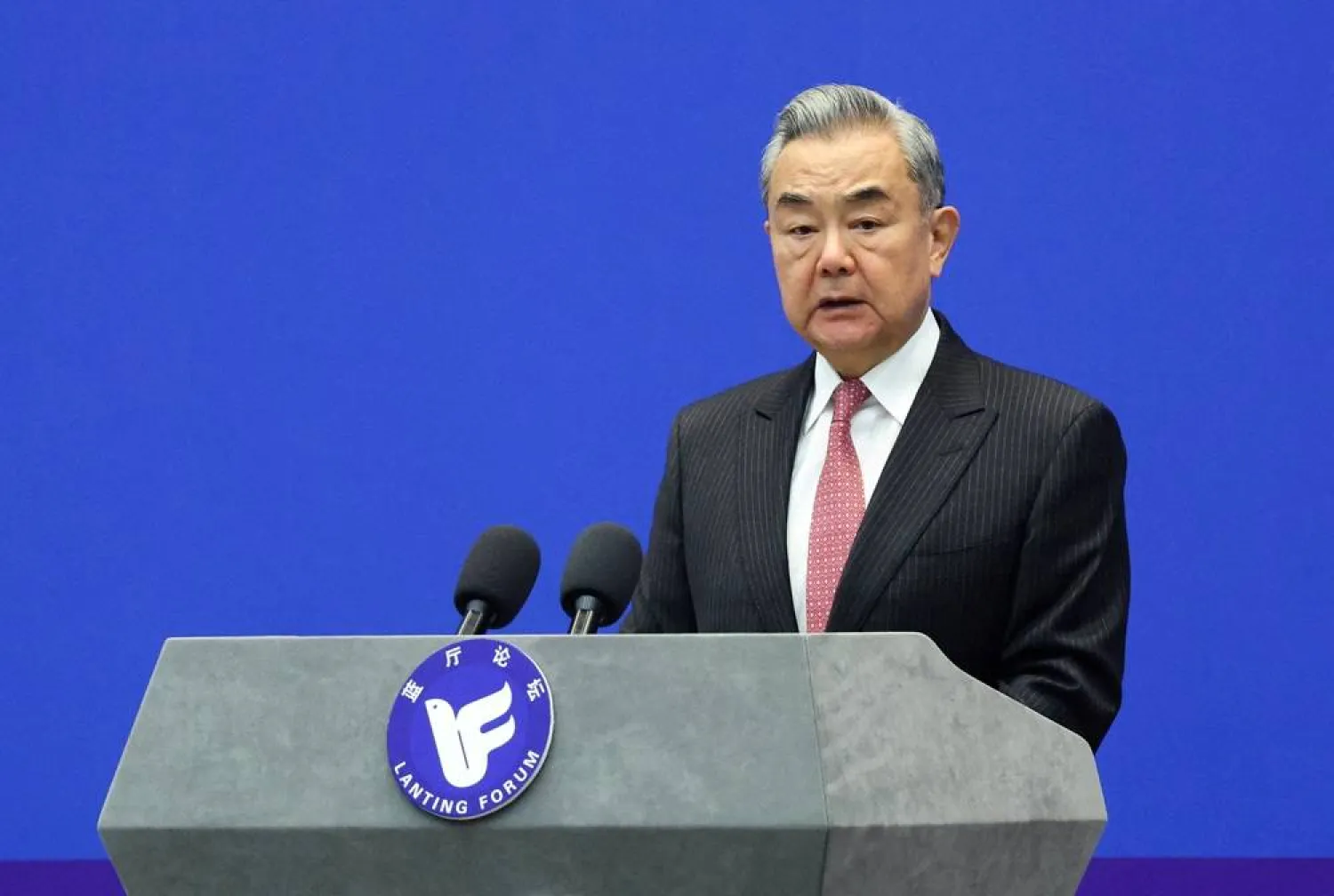
Chinese Foreign Minister Wang Yi delivers his speech at the opening ceremony of the Lanting Forum in Beijing, China, October 27, 2025. (Reuters)
TT

China Says Japan Sent ‘Shocking’ Wrong Signal on Taiwan

Chinese Foreign Minister Wang Yi delivers his speech at the opening ceremony of the Lanting Forum in Beijing, China, October 27, 2025. (Reuters)

China's Foreign Minister Wang Yi said it was "shocking" for Japan's leader to openly send a wrong signal concerning Taiwan, according to an official statement on Sunday, the latest remarks in a row that has shaken relations for more than two weeks.

Wang, the most senior Chinese official to have commented publicly on the issue, said Japan was crossing a red line that must not be touched, according to the statement posted on the Chinese Ministry of Foreign Affairs' website.

He accused Japanese Prime Minister Sanae Takaichi of attempting to intervene militarily over Taiwan. Wang was referring to comments on November 7 in which she told a questioner in parliament that a hypothetical Chinese attack on democratically governed Taiwan could trigger a military response from Tokyo.

The ensuing row, the biggest China-Japan crisis in years, has spread to trade and cultural relations. On Friday China raised the issue with UN Secretary-General Antonio Guterres, vowing to defend itself.

Beijing views democratically governed Taiwan as its own territory and has not ruled out the use of force to take control of the island. Taiwan's government rejects Beijing's claims and says only the island's people can decide their future.

Japan's Foreign Ministry did not immediately respond on Sunday to a request for comment on Wang's remarks. In response to the letter to the UN, the ministry on Saturday dismissed China's claims as "entirely unacceptable" and said Japan's commitment to peace was unchanged.

Taiwan’s Foreign Ministry on Sunday condemned the letter to the UN.

"The letter not only contains rude and unreasonable content but also maliciously distorts historical facts," the ministry said in a statement. "Furthermore, it violates Article 2(4) of the UN Charter, which prohibits the threat or use of force in international relations."

Wang said that in responding to Japan's move, "China must resolutely hit back - not only to safeguard its sovereignty and territorial integrity, but also to defend the hard-won postwar achievements secured with blood and sacrifice."

If Japan "persists in its wrong course and continues down this path," all countries and people have the right to "re-examine Japan's historical crimes" and "resolutely prevent the resurgence of Japanese militarism", he said.

China is Japan's largest export market after the United States, buying about $125 billion of Japanese goods in 2024, mainly industrial equipment, semiconductors and automobiles, according to UN COMTRADE data.



Iranians to Receive Monthly Payment Amid Economic Woes, Protests

A customer shops at a supermarket at a shopping mall in northern Tehran, on Sept. 28, 2025. (AP)
TT

Iranians to Receive Monthly Payment Amid Economic Woes, Protests

A customer shops at a supermarket at a shopping mall in northern Tehran, on Sept. 28, 2025. (AP)

Iranian authorities on Sunday announced they will give a monthly allowance to every citizen in the country to alleviate economic pressure, after a week of protests.

"Individuals can receive an amount equivalent to one million Tomans (approximately $7) per person per month, which is credited to their accounts for four months," government spokeswoman Fatemeh Mohajerani told state TV.

She said the amount will be given to every Iranian for four months in the form of credit that can be used to purchase certain goods and is intended to "reduce the economic pressure on the people."

In Iran, which has a population of more than 85 million people, the minimum wage is roughly $100 (85 euros) and average monthly salaries are around $200.

Iranians mostly use mobile phones and debit cards for their daily purchases instead of cash.

Iran's economy has been grappling with biting US and international sanctions over Tehran's nuclear program for years, and December saw a 52 percent year-on-year inflation rate.

The national currency has lost more than a third of its value against the US dollar over the past year, causing a sharp decrease in people's purchasing power and broad discontent in the country.

Sunday marked the eighth day of sporadic protests in the country over economic uncertainty in the wake of the depreciation.

The protests have touched, to varying degrees, at least 40 different cities, mostly medium-sized and in the country's west, according to an AFP tally based on official announcements and media reports.

At least 12 people have been killed, including members of the security forces, according to a toll based on official reports.


Rubio Says US Won’t Govern Venezuela but Will Press for Changes Through Oil Blockade

US Secretary of State Marco Rubio (C) speaks during a news conference at the Mar-a-Lago Club in Palm Beach, Florida, USA, 03 January 2026. (EPA)
TT

Rubio Says US Won’t Govern Venezuela but Will Press for Changes Through Oil Blockade

US Secretary of State Marco Rubio (C) speaks during a news conference at the Mar-a-Lago Club in Palm Beach, Florida, USA, 03 January 2026. (EPA)

Secretary of State Marco Rubio suggested Sunday that the United States would not take a day-to-day role in governing Venezuela other than enforcing an existing "oil quarantine" on the country, a turnaround after President Donald Trump announced a day earlier that the US would be running Venezuela following its ouster of leader Nicolas Maduro.

Rubio's statements on TV talk shows seemed designed to temper concerns about whether the assertive American action to achieve regime change might again produce a prolonged foreign intervention or failed attempt at nation-building. They stood in contrast to Trump’s broad but vague claims that the US would at least temporarily "run" the oil-rich nation, comments that suggested some sort of governing structure under which Caracas would be controlled by Washington.

But Rubio offered a more nuanced take, saying the US would continue to enforce an oil quarantine that was already in place on sanctioned tankers before Maduro was removed from power early Saturday and using that leverage as a means to press policy changes in Venezuela.

"And so that’s the sort of control the president is pointing to when he says that," Rubio said on CBS’ "Face the Nation.We continue with that quarantine, and we expect to see that there will be changes, not just in the way the oil industry is run for the benefit of the people, but also so that they stop the drug trafficking."

The blockade on sanctioned oil tankers — some of which have been seized by the US — "remains in place, and that’s a tremendous amount of leverage that will continue to be in place until we see changes that not just further the national interest of the United States, which is number one, but also that lead to a better future for the people of Venezuela," he added.

Trump repeated vow US would ‘run’ Venezuela

Trump's vow to "run" Venezuela, repeated more than half a dozen times at a news conference in Florida on Saturday, sparked concerns among some Democrats. It also drew unease from parts of his own Republican coalition, including an "America First" base that is opposed to foreign interventions, and also from observers who recalled past nation-building efforts in Iraq and Afghanistan.

Rubio dismissed such criticism, saying that Trump’s intent had been misunderstood by a "foreign policy establishment" that was fixated on the Middle East.

"The whole foreign policy apparatus thinks everything is Libya, everything is Iraq, everything is Afghanistan," Rubio said. "This is not the Middle East. And our mission here is very different. This is the Western Hemisphere."

Rubio also suggested that the US would give Maduro’s subordinates who are now in charge time to govern, saying, "We’re going to judge everything by what they do, and we’re going to see what they do." And though he did not rule out a US military presence in Venezuela, Rubio said the current US "force posture" was capable of stopping drug boats and sanctioned tankers.

A day earlier, Trump told reporters, "We’re going to run the country until such time as we can do a safe, proper and judicious transition." He later pointed to his national security team with him, including Rubio and Defense Secretary Pete Hegseth, and said it would be done for a period of time by "the people that are standing right behind me. We’re gonna be running it we’re gonna be bringing it back."

The White House declined to comment beyond what Trump said Saturday.

Maduro's arrival

Maduro landed late Saturday afternoon at a small airport in New York City's northern suburbs following the middle-of-the-night operation that extracted him and his wife, Cilia Flores, from their home in a military base in the capital, Caracas — an act that Maduro’s government called "imperialist." The couple faces US charges of participating in a narco-terrorism conspiracy.

The dramatic seizure of the Maduros capped an intensive Trump administration pressure campaign on Venezuela’s autocratic leader and months of secret planning, resulting in the most assertive American action to achieve regime change since the 2003 invasion of Iraq. Legal experts raised questions about the lawfulness of the operation, which was done without congressional approval.

Venezuela’s vice president, Delcy Rodriguez, meanwhile, demanded that the US free Maduro and called him the country’s rightful leader as her nation’s high court named her interim president.

After arriving at the airport, Maduro was flown by helicopter to Manhattan, where a convoy of law enforcement vehicles, including an armored car, was waiting to whisk him to a nearby US Drug Enforcement Administration office. A video posted on social media by a White House account showed Maduro, smiling, as he was escorted through that office by two DEA agents grasping his arms.

He is due to make his first appearance Monday in Manhattan's federal court.

Maduro and other Venezuelan officials were indicted in 2020 on narco-terrorism conspiracy charges, and the Justice Department released a new indictment Saturday of Maduro and his wife that painted his administration as a "corrupt, illegitimate government" fueled by a drug-trafficking operation that flooded the US with cocaine. The US government does not recognize Maduro as the country’s leader.

The Trump administration spent months building up American forces in the region and carrying out attacks on boats in the Caribbean Sea and eastern Pacific Ocean for allegedly ferrying drugs. Last week, the CIA was behind a drone strike at a docking area believed to have been used by Venezuelan drug cartels — the first known direct operation on Venezuelan soil since the US campaign began in September.

Quiet falls in Venezuela after US operation

Venezuela’s capital remained unusually quiet Sunday with few vehicles moving around and convenience stores, gas stations and other businesses closed. A road typically filled with runners, cyclists and other fitness enthusiasts on Sundays only had a handful of people working out the day after Maduro was deposed.

The presidential palace was guarded by armed civilians and members of the military. At a nearby plaza, only a street sweeper and a soldier stood, and across the street, a church remained close for a second day in a row.

Caracas resident David Leal arrived to the lot where he parks vehicles for a living only to quickly realize that he would likely not see any clients for a second day.

"People are still shaken," said Leal, 77.


Venezuela Military Recognizes Maduro’s VP as Acting President

Venezuela's Vice-President and Oil Minister Delcy Rodriguez addresses the media in Caracas, Venezuela, March 10, 2025. (Reuters)
TT

Venezuela Military Recognizes Maduro’s VP as Acting President

Venezuela's Vice-President and Oil Minister Delcy Rodriguez addresses the media in Caracas, Venezuela, March 10, 2025. (Reuters)

Venezuela's military on Sunday recognized Delcy Rodriguez, deputy to ousted President Nicolas Maduro, as the country's acting leader, after US forces extracted the former head of state to face trial.

Amid uncertainty following the leftist president's dramatic capture, Defense Minister Vladimir Padrino Lopez appeared to throw his weight behind Rodriguez, who US President Donald Trump had earlier indicated was a figure Washington could work with.

Padrino read out a statement on television endorsing a Supreme Court ruling that appointed Rodriguez as acting president for 90 days.

He also called on Venezuelans to get back to their daily life, speaking less than two days after the US strikes shook the capital Caracas and special forces seized Maduro and his wife.

Padrino denounced it as a "cowardly kidnapping" and said that some of Maduro's bodyguards were killed "in cold blood," as well as military personnel and civilians on the Venezuelan side.

Venezuelan authorities have not yet given an official toll for people hurt or killed in the US operations.

The streets of Caracas were deserted and quiet on Sunday, with many businesses closed and moderate queues at some markets and pharmacies.

"I call on the people of Venezuela to resume their activities of all kinds, economic, work and education, in the coming days," Padrino said.

"The homeland must follow its constitutional course."