

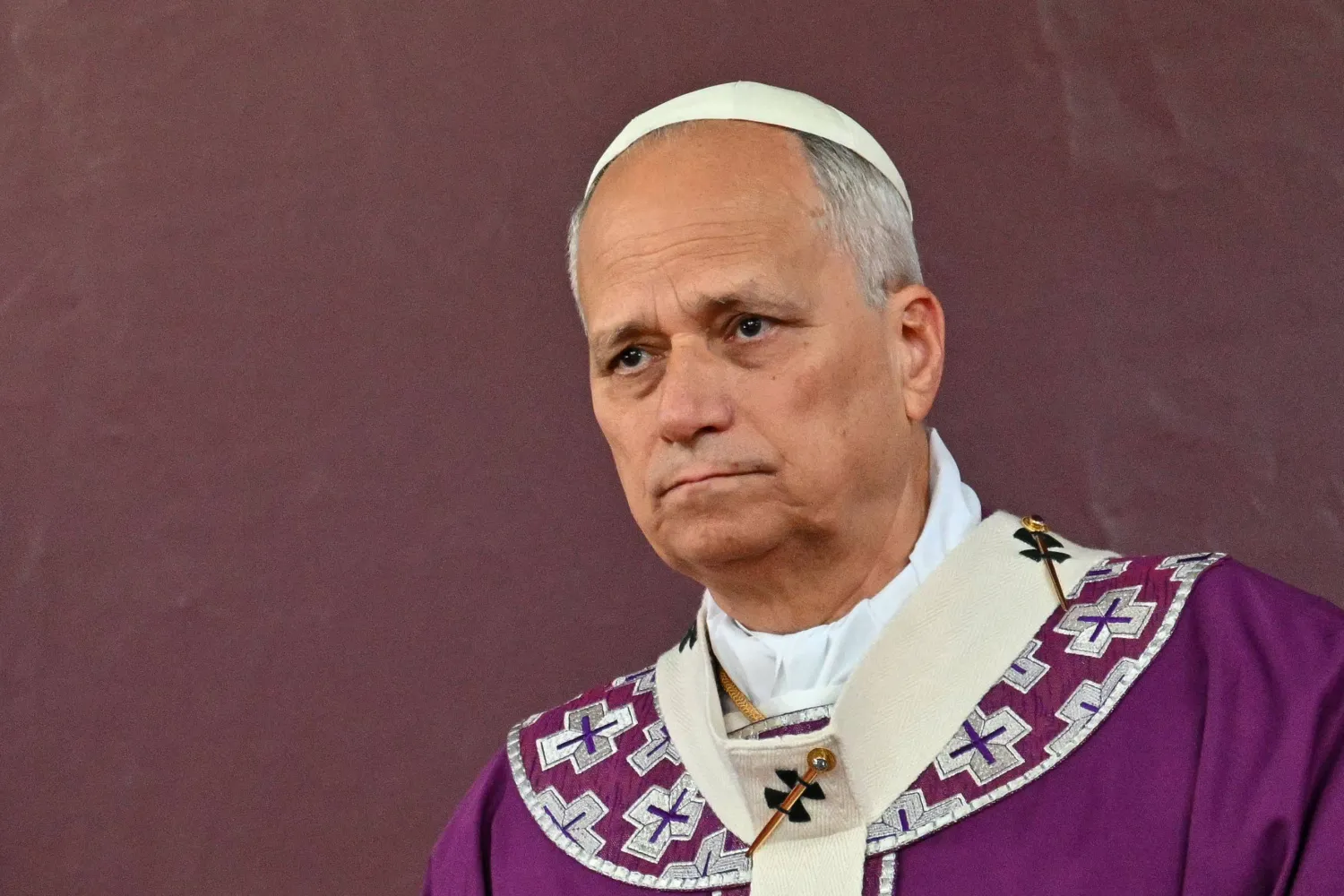

Pope Heads to Türkiye, Lebanon in First Overseas Trip

Pope Leo XIV leads the All Souls' Day holy mass as part of the commemoration of all the faithful departed at the Verano Monumental Cemetery, in Rome on November 2, 2025. (Photo by Andreas SOLARO / AFP)
TT

Pope Heads to Türkiye, Lebanon in First Overseas Trip

Pope Leo XIV leads the All Souls' Day holy mass as part of the commemoration of all the faithful departed at the Verano Monumental Cemetery, in Rome on November 2, 2025. (Photo by Andreas SOLARO / AFP)

Pope Leo XIV embarks on his debut overseas trip Thursday, travelling to Türkiye and Lebanon to promote Christian unity and urge peace efforts amid heightened tensions in the Middle East.

The six-day trip is the first major international test for the US pope, who was elected head of the Catholic Church in May.

In Türkiye, Leo will celebrate the 1,700th anniversary of the Council of Nicaea, where the Creed -- a foundational declaration of the Christian faith -- was written.

The Chicago-born pontiff's upcoming visit is eagerly awaited in Lebanon where Christians represent only 0.2 percent of the 86 million inhabitants.

Lebanon has long been held up as a model of religious coexistence.

But since 2019, it has been ravaged by crises, including economic collapse which has caused widespread poverty, a devastating blast at Beirut port in 2020, and the recent war with Israel.

"The Lebanese are tired," said Vincent Gelot, director of the Lebanon and Syria office for l'Oeuvre d'Orient, a Catholic organization that supports Christians in the Middle East.

"They expect a frank word to the Lebanese elite, as well as strong and concrete actions," he told AFP.

Preparations are in full swing at the sites the pope will visit, with signs bearing his image and reading "Lebanon wants peace" hung along newly-restored roads.

Lebanon's ambassador to the Holy See, Fadi Assaf, said it was an "exceptional" visit which would "highlight the difficulties facing Lebanon", which is hoping for a "political and economic breakthrough".

Gelot said the Lebanese are caught in "a vicious cycle of wars and suffering", "dashed hopes" and "uncertainty about the future", and they "know full well that (this visit) will not solve all their problems".

It is an opportunity however to highlight the role of private, often religious, organizations in ensuring access to healthcare and education -- like the psychiatric hospital run by Franciscan nuns that Leo is set to visit, he said.

Trip highlights include a meeting with the country's youth, an open-air mass expected to draw 100,000 people, and a prayer at the site of the port explosion that killed over 220 people and caused vast damage to the Lebanese capital.

Abdo Abou Kassem, the church's media coordinator for the visit, said the pope also wishes to "reaffirm Lebanon's role as... a model for both East and West" through an interreligious meeting in downtown Beirut.

The visit to Türkiye, a strategic crossroad between East and West, is also aimed at promoting the Church's dialogue with Islam.

Leo will meet President Recep Tayyip Erdogan in Ankara on Thursday and visit the Blue Mosque in Istanbul on Saturday.

But at the heart of the trip is the anniversary of the Council of Nicaea, which Leo was invited to attend by Patriarch Bartholomew I, the spiritual head of Orthodox Christianity.

Catholics recognize the universal authority of the pope as head of the Church, while Orthodox Christians are organized into churches that appoint their own heads.

The 325 A.D. meeting in Nicaea predated the schisms that divided Christianity between East and West and the commemoration is an important moment to promote Christian unity.

On the shores of Lake Iznik, the current name for Nicaea, the 70-year-old will join dignitaries from various Orthodox churches on Friday for a prayer which his predecessor, who died in April, had originally been set to attend.



Israel Approves Closing of Military Radio

Israeli soldiers from Galei Tzahal, the Israeli army radio station, are seen through a window while producing a show at the station's studio in Jaffa, south of central Tel Aviv November 10, 2013. REUTERS/Nir Elias
TT

Israel Approves Closing of Military Radio

Israeli soldiers from Galei Tzahal, the Israeli army radio station, are seen through a window while producing a show at the station's studio in Jaffa, south of central Tel Aviv November 10, 2013. REUTERS/Nir Elias

Israel's government approved on Monday the closure of the country's military radio station, dismissing objections from the attorney general, who warned that the move threatened media freedom.

According to a government survey of audiences, it is Israel's third most listened-to station, with a market share of 17.7 percent.

"The government unanimously approved the proposal put forward by Defense Minister Israel Katz to shut down the military radio station Galei Tsahal," Katz's office said in a statement, adding that the closure would take effect before March 1, 2026, AFP reported.

Prime Minister Benjamin Netanyahu had urged his ministers to back Katz's proposal, according to the statement.

"There have long been recurring proposals to remove Galei Tsahal from the military framework, abolish it, or privatize it," the statement quoted Netanyahu as saying.

Attorney General Gali Baharav-Miara, who also serves as the government's legal adviser is currently facing dismissal proceedings initiated by the premier, said the decision "raises concerns about possible political interference in public broadcasting".

She added that it "poses questions regarding an infringement on freedom of expression and of the press".

Her office stated that closing the station would require a vote in parliament.

The government's decision "does not meet the required legal criteria and cannot be advanced in its current form", according to a 34-page document prepared by her office and seen by AFP.

Some of the programs broadcast on the radio station have been critical of the government's policies.

Katz justified the decision by arguing that Galei Tsahal "broadcasts political and divisive content that does not align with the values" of the military.

"A situation in which a radio station intended for all citizens of the State of Israel is operated by the military is an anomaly that does not exist in democratic countries," Katz said.

Opposition leader Yair Lapid condemned the shutdown on X, saying it "is part of the government's effort to suppress freedom of expression in Israel during an election period."

"They cannot control reality, so they try to control minds," Lapid added.

Israel will hold a parliamentary election in 2026 and Netanyahu has announced that he would seek a new term in the office of prime minister.


Iran Holds Missile Drills in Various Cities, State Media Say

The Iranian flag waves in front of the International Atomic Energy Agency (IAEA) headquarters, before the beginning of a board of governors meeting, amid the coronavirus disease (COVID-19) outbreak in Vienna, Austria, March 1, 2021. (Reuters)
TT

Iran Holds Missile Drills in Various Cities, State Media Say

The Iranian flag waves in front of the International Atomic Energy Agency (IAEA) headquarters, before the beginning of a board of governors meeting, amid the coronavirus disease (COVID-19) outbreak in Vienna, Austria, March 1, 2021. (Reuters)

Iran held missile ​drills in various cities on Monday, state media reported, citing unnamed sources and witnesses, in what was the second such reported exercise in a month.

NBC News reported on Saturday that US President Donald Trump was to be briefed by Israeli Prime Minister Benjamin Netanyahu ‌that any ‌expansion of Iran's ballistic ‌missile program ⁠poses ​a threat ‌that could necessitate swift action.

Western powers regard Iran's ballistic missile arsenal both as a conventional military threat to Middle East stability and a possible delivery mechanism for nuclear weapons should Tehran develop them. It denies any intent to build ⁠atomic bombs.

The Telegram channel of Iran's public broadcaster and semi-official ‌Nournews published videos of what ‍appeared to be missile launches, ‍without specifying the whereabouts, Reuters reported.

However, the outlets ‍said launches took place from the capital Tehran and the cities of Isfahan and Mashhad. Reuters could not independently verify the authenticity of the videos.

State media ​later on Monday cited "informed sources" as denying that missiles were tested and saying the ⁠circulated images were of "high-altitude aircraft". No clarification regarding the conflicting reports was provided.

NBC reported that Israeli officials are concerned that Iran is reconstituting nuclear enrichment sites the US bombed in June, and were preparing to brief Trump for options on attacking the missile program again.

Earlier this month, the navy of Iran's elite Revolutionary Guards held a two-day exercise aimed at countering foreign threats, firing ‌ballistic and cruise missiles at simulated targets in the Gulf.


Germany Charges Suspected Former Syrian Intelligence Agent with Murder

German Police - May 24, 2017. REUTERS/Fabian Bimmer
TT

Germany Charges Suspected Former Syrian Intelligence Agent with Murder

German Police - May 24, 2017. REUTERS/Fabian Bimmer

German prosecutors have charged a suspected former member of Syrian intelligence with crimes against humanity and the torture and murder of dozens of prisoners held in a Damascus prison under Bashar al-Assad, a statement said on Monday.

The accused, who was arrested in May and identified only as Fahad A. under German privacy rules, was suspected of working as a guard ⁠in a prison in the Syrian capital between the end of April 2011 and mid-April 2012, Reuters quoted it as saying.

"There, he participated in well over 100 interrogations during which prisoners were subjected to severe physical abuse, such ⁠as electric shocks or beatings with cables," it said.

"On the orders of his superiors, the accused also abused inmates at night, for example by hanging them from the ceiling, dousing them with cold water, or forcing them to remain in uncomfortable positions. As a result of such mistreatment and the catastrophic prison conditions, at ⁠least 70 prisoners died."

German prosecutors have used universal jurisdiction laws that allow them to seek trials for suspects in crimes against humanity committed anywhere in the world.

Based on these laws, several people suspected of war crimes during the Syrian conflict have been arrested in the last few years in Germany, which is home to around one million Syrians.