


Saudi Arabia Opens One of Its Longest Marine Bridges to Boost Logistics, Economic Growth

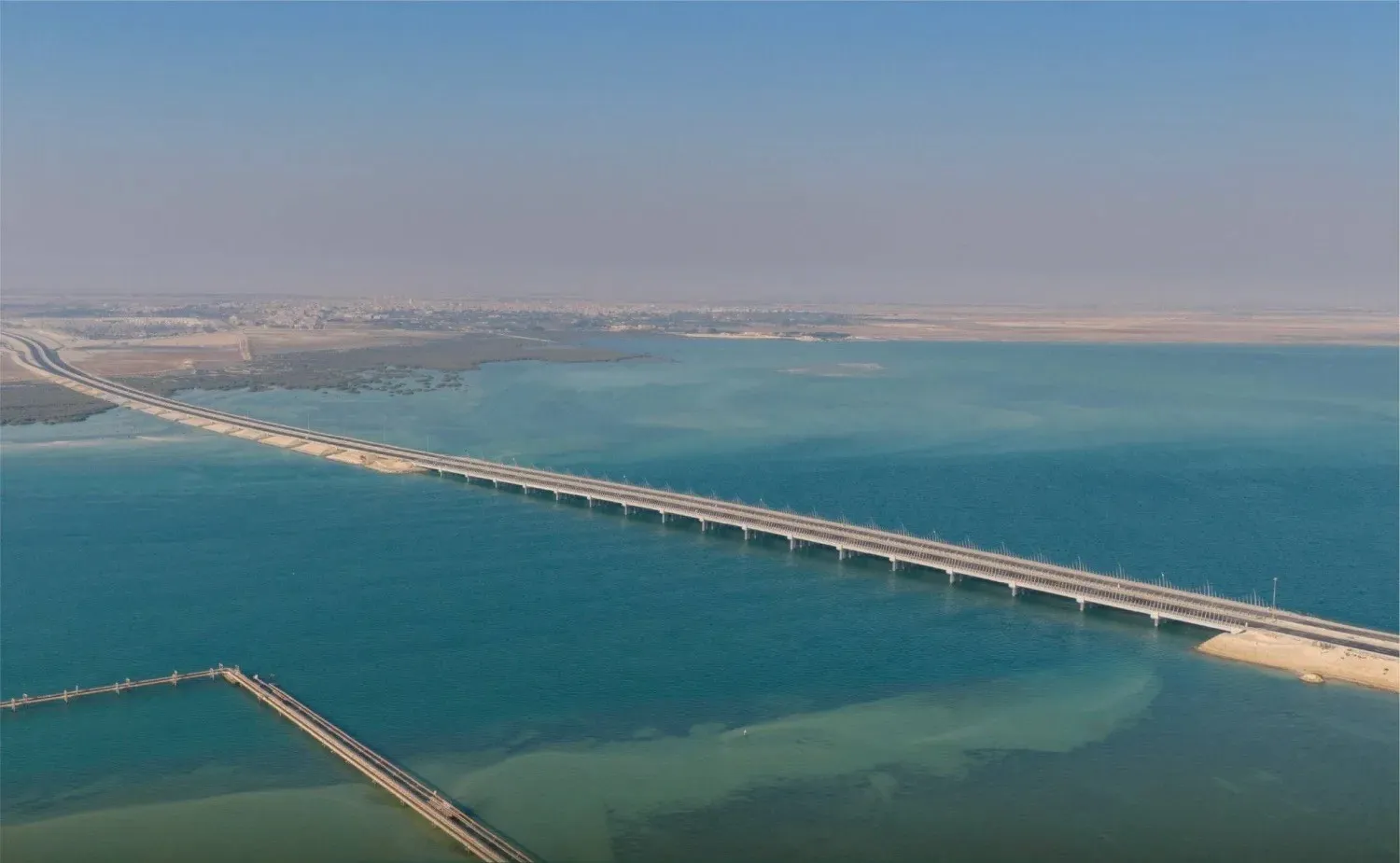
The 15-km marine bridge linking Safwa in Qatif Governorate with Ras Tanura (Saudi Projects). 
TT

Saudi Arabia Opens One of Its Longest Marine Bridges to Boost Logistics, Economic Growth

The 15-km marine bridge linking Safwa in Qatif Governorate with Ras Tanura (Saudi Projects). 

Saudi Arabia’s Ministry of Transport has inaugurated a major new marine bridge in the Eastern Province, described as one of the longest in the Kingdom and the second-largest dual marine bridge in the country.

The project is expected to significantly enhance mobility, logistics, and economic activity in an area central to Saudi Arabia’s energy industry.

The bridge will serve thousands of employees at the Ras Tanura Oil Refinery, operated by Saudi Aramco. Ras Tanura is the Kingdom’s first refinery and remains one of the largest oil processing facilities in the world.

The structure forms part of the newly inaugurated Safwa–Rahima Road, opened by Prince Saud bin Nayef bin Abdulaziz, Governor of the Eastern Province. The 15-kilometer route links Safwa in Qatif Governorate to Ras Tanura via a 3.2-kilometer dual marine bridge.

Officials say the project will reduce travel time, ease congestion, and improve connectivity between two densely populated and industrial zones.

Alongside the bridge opening, the government also launched upgrades to the Dhahran–Buqayq–Abu Hadriyah Road. The works include the construction of five new bridges, expanded lighting systems, and improved rainwater drainage.

Minister of Transport and Logistics Services, Engineer Saleh bin Nasser Al-Jasser, stated that the new bridge adds a direct access route that strengthens supply chains and facilitates the flow of goods and services from Ras Tanura Port. He described it as an integral part of a modern transport network linking Safwa and Ras Tanura to major highways such as the Dammam–Jubail Expressway.

Al-Jasser emphasized the bridge’s dual value: boosting the energy sector while increasing social and economic integration between neighboring communities. He noted that the project will enhance logistics services supporting the oil industry, reduce travel distances, and raise transport efficiency in one of Saudi Arabia’s busiest industrial hubs.

According to the General Authority for Roads, the new bridge creates an additional entry and exit point for Ras Tanura, cuts travel distance to Dammam and Qatif, and provides a direct link to King Fahd International Airport.

The project also includes new drainage channels, road paving, and extensive safety measures, including signage, ground markings, vibration strips, and concrete barriers to improve traffic flow and road safety across the region.


Venture Capital Records Two Historic Milestones, Reinforces Saudi Arabia’s Regional Leadership

Venture Capital Records Two Historic Milestones, Reinforces Saudi Arabia’s Regional Leadership
TT

Venture Capital Records Two Historic Milestones, Reinforces Saudi Arabia’s Regional Leadership

Venture Capital Records Two Historic Milestones, Reinforces Saudi Arabia’s Regional Leadership

The Saudi Venture Capital Company (SVC) announced on Sunday that Saudi Arabia’s venture capital ecosystem achieved two historic leaps in 2025, in terms of total investment value and number of transactions, further reinforcing the Kingdom’s position as the leading venture capital market in the Middle East for the third consecutive year.

This performance reflects the tangible impact of Saudi Vision 2030 and the structural economic transformation taking place across the Kingdom.

In a statement, the SVC said that the Saudi market recorded its highest-ever number of venture capital transactions, reaching 254 deals in 2025, alongside a record investment value of $1.66 billion during the year.

This compares to approximately $60 million in 2018, representing a 25-fold increase in venture capital investment since the establishment of SVC and the emergence of its role as a market maker within the ecosystem.

CEO and Board Member of SVC Dr. Nabeel Koshak said: “What we are witnessing today in Saudi Arabia’s venture capital sector is the direct result of the unlimited support provided by the Kingdom’s wise leadership across all sectors.”

“This support has been translated into a deliberate and well-calibrated economic transformation, moving private capital into a more mature and impactful phase. These figures reflect the strength of the Saudi economy, the clarity of national vision, and the growing confidence of investors, confirming that venture capital has become a core pillar of growth and economic diversification,” he added.

He stressed that the 25-fold growth in investment since 2018, together with the record-breaking figures for both investment value and deal volume, underscores the maturity of the Saudi venture capital market.

“Venture capital today is enabling the creation of scalable companies, generating high-quality jobs, and transforming innovation into sustainable economic value, fully aligned with the objectives of Saudi Vision 2030,” he said.


Türkiye to Ink 33 bcm Natural Gas Import Deal with Azerbaijan, Minister Says

Türkiye's Energy Minister Alparslan Bayraktar talks during a meeting in Ankara, Türkiye, September 14, 2023. (Turkish Energy Ministry Press Office/PPO/Handout via Reuters)
TT

Türkiye to Ink 33 bcm Natural Gas Import Deal with Azerbaijan, Minister Says

Türkiye's Energy Minister Alparslan Bayraktar talks during a meeting in Ankara, Türkiye, September 14, 2023. (Turkish Energy Ministry Press Office/PPO/Handout via Reuters)

Türkiye has reached a new long-term agreement to import a total of 33 bcm natural gas from Azerbaijan, Energy ‌Minister Alparslan ‌Bayraktar ‌said ⁠on Sunday in ‌a televised interview.

Under the deal, Türkiye will receive 2.25 billion cubic meters of ⁠gas per year ‌for 15 ‍years ‍from Azerbaijan's Absheron field, ‍totaling 33 billion cubic meters, Bayraktar said. Deliveries via pipeline are set to begin in ⁠2029.

He added that final negotiations were concluded on Friday and that the agreement was expected to be signed shortly.


Saudi Arabia Approves Annual Borrowing Plan with $58 Billion Financing Needs

The logo of Saudi Arabia’s Ministry of Finance (Asharq Al-Awsat)
TT

Saudi Arabia Approves Annual Borrowing Plan with $58 Billion Financing Needs

The logo of Saudi Arabia’s Ministry of Finance (Asharq Al-Awsat)

Saudi Arabia has approved its annual borrowing plan for the 2026 fiscal year, setting projected financing needs at about $58 billion as the Kingdom seeks to fund its budget deficit while maintaining long-term debt sustainability.

The plan was endorsed by Finance Minister Mohammed Al-Jadaan, who also chairs the board of the National Debt Management Center, following approval by the center’s board. It outlines key developments in public debt during 2025, initiatives to deepen the domestic debt market, and the financing strategy and guiding principles for 2026. It also includes the issuance calendar for the kingdom’s local riyal-denominated sukuk program for 2026.

According to the plan, total financing requirements for 2026 are estimated at around SAR 217 billion ($57.9 billion). These will be used to cover the projected budget deficit of about SAR 165 billion ($44 billion), as set out in the Ministry of Finance’s budget statement for the year, as well as the repayment of maturing debt principal amounting to roughly SAR 52 billion ($13.9 billion).

In a statement, the National Debt Management Center said the strategy prioritizes preserving public debt sustainability, expanding the investor base, and diversifying funding sources at home and abroad. This will be pursued through a combination of public and private channels, including the issuance of bonds and sukuk and the use of loans at competitive and reasonable costs.

The plan also points to an expanded use of alternative government financing tools, including project and infrastructure financing, and greater reliance on export credit agencies in 2026 and over the medium term. These measures will be implemented within carefully structured risk-management frameworks to support the Kingdom’s broader economic and fiscal objectives.
