


Bitcoin Mining in China Rebounds, Defying 2021 Ban

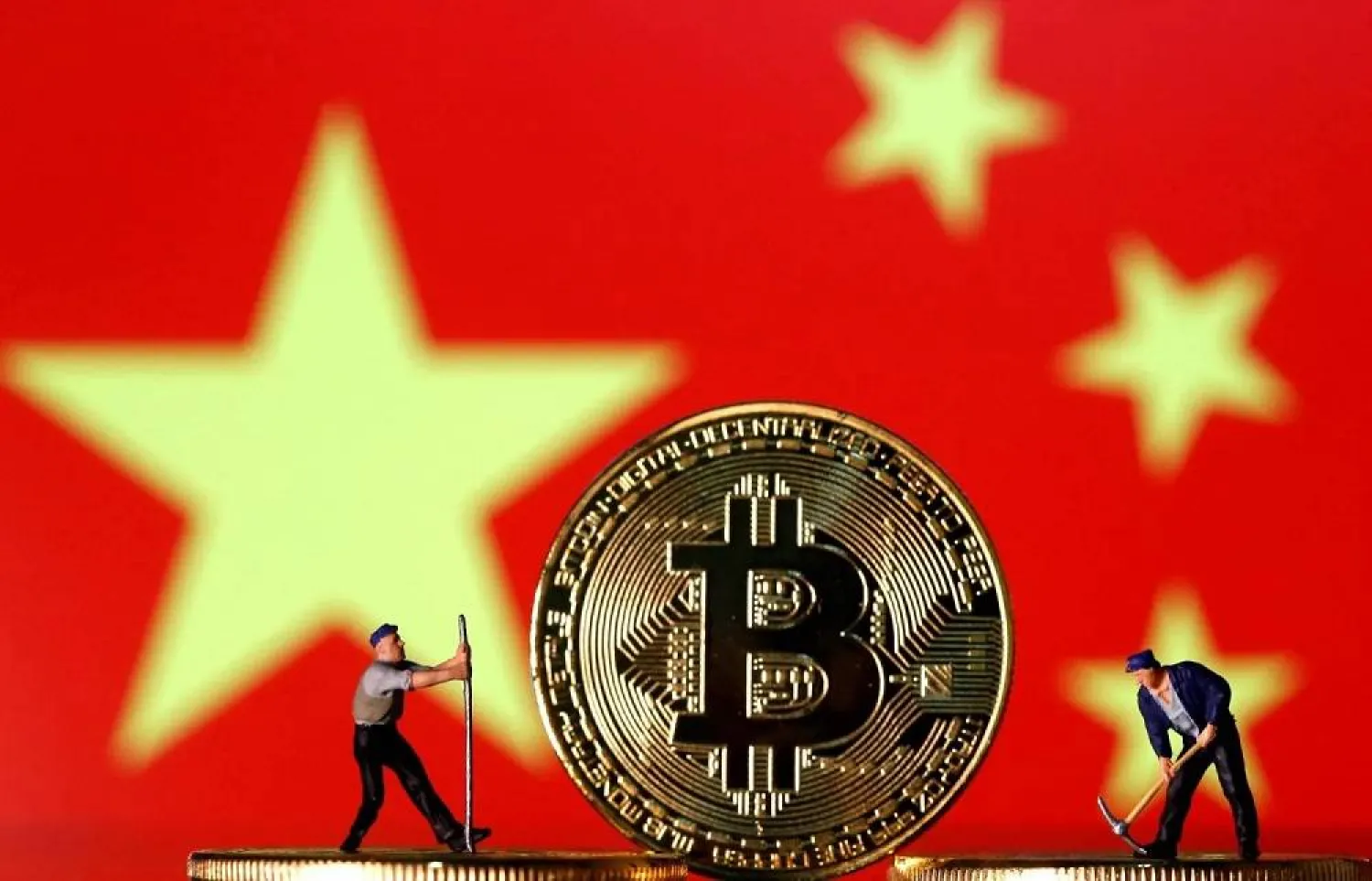
Small toy figurines are seen on representations of the Bitcoin virtual currency displayed in front of an image of China's flag in this illustration picture, April 9, 2019. (Reuters)
TT

Bitcoin Mining in China Rebounds, Defying 2021 Ban

Small toy figurines are seen on representations of the Bitcoin virtual currency displayed in front of an image of China's flag in this illustration picture, April 9, 2019. (Reuters)

Bitcoin mining is quietly staging a comeback in China despite being banned four years ago, as individual and corporate miners exploit cheap electricity and a data center boom in some energy-rich provinces, according to miners and industry data. 

China had been the world's biggest crypto mining country until Beijing banned all cryptocurrency trading and mining in 2021, citing threats to the country's financial stability and energy conservation, according to Reuters. 

After having seen its global bitcoin mining market share slump to zero as a result of the ban, China crept back to third place with a 14% share at the end of October, according to Hashrate Index, which tracks bitcoin mining activities. 

The resurgence in bitcoin mining, which has also been corroborated by rig maker Canaan Inc’s fast-rebounding sales in China, could act as a demand and price support for the world’s largest cryptocurrency. 

Wang, a private miner in Xinjiang, said he started mining late last year in the energy-abundant province. 

“A lot of energy cannot be transmitted out of Xinjiang, so you consume it in the form of crypto mining,” Wang said, asking to be identified by just his last name. “New mining projects are under construction. What I can say is that people mine where electricity is cheap.” 

Mining Resurgence 

Beijing's crackdown on the sector in 2021 led to miners shutting down local operations and fleeing to overseas markets such as North America and Central Asia. 

The rebound in bitcoin mining coincides with the digital asset hitting record highs in October on the back of US President Donald Trump’s pro-crypto policies, and growing distrust toward the dollar, making crypto mining more rewarding. 

The cryptocurrency, however, is down roughly a third from its October peak as global risk appetite wanes. 

“Chinese policy flexibility emerges when economic incentives are strong in specific regions,” said Patrick Gruhn, CEO of Perpetuals.com, a provider of crypto market infrastructure. “The resurgence of mining activity in China is one of the most important signals the market has seen in years.” 

China has not officially relaxed bitcoin mining curbs, but “even hints of China's policy easing could act as a tailwind for bitcoin's narrative as a global, state-resilient asset,” he said, pointing to industry data signaling renewed activity. 

Bitcoin mining - the energy-intensive process of using specialized computers to solve complex puzzles to win bitcoins - is especially active in power-abundant hinterlands such as Xinjiang, according to miners and rig makers. 

Sichuan-based Duke Huang, who quit bitcoin mining a few years ago due to the Chinese regulatory ban, said some of his friends have come back to the business recently. “It's a sensitive area ... But people who get cheap electricity are still mining.” 

Besides higher bitcoin prices, a glut of electricity and computing power following over-investment in data centers by some cash-strapped Chinese local governments fueled the rebound, said a source at a bitcoin mining rig maker, who did not want to be identified due to the sensitivity involved. 

Crypto Policy   

The trend is also captured by sales data from mining rig makers.  

Canaan, the world's second-biggest bitcoin mining machine maker, generated 30.3% of its global revenues in China last year, compared with 2.8% in 2022 in the aftermath of the crackdown, according to company filings. 

China's contribution to Canaan's sales jumped further to more than 50% during the second quarter this year, according to a source with direct knowledge, who declined to be named as he is not authorized to speak to the media. 

Canaan, which did not confirm the second-quarter sales breakdown, attributed its growing sales in China to this year’s US tariff uncertainty that disrupted US sales, rising bitcoin prices that make mining more profitable, and a subtle shift in China’s digital asset posture. 

In an emailed statement, the Singapore-based company said its activities remain fully compliant with Chinese regulations but refused to comment on mining policies in China. 

“In China, the R&D, manufacturing, and sale of mining machines are permitted,” Canaan said. 

The pickup in bitcoin mining in China comes amid signs that Beijing has softened its attitude toward digital coins. These were once seen as a challenge to China's fiat currencies and abetting capital flight. 

Hong Kong's stablecoin bill, for example, took effect in August, enabling the Chinese city to compete with the US in fostering a regulated market for fiat-currency-backed cryptocurrencies. 

China was also considering allowing the use of yuan-backed stablecoins to boost the wider adoption of its currency globally and catch up with a US push on stablecoins, Reuters reported in August, citing sources familiar with the matter. 

“Bitcoin mining is still officially banned in China. However, there continues to be significant capacity operating,” said Julio Moreno, head of research at CryptoQuant, a blockchain data & analytics firm.  

CryptoQuant estimated that 15%-20% of global bitcoin mining capacity currently operates in China. 

Liu Honglin, founder of Man Kun Law Firm, said it is hard to wipe out a profitable business. 

“I personally think government policies against mining will be gradually loosened, because you simply cannot stop such activities completely.” 


Turkmenistan, China Launch Expansion of World’s Second-largest Gas Field

Former Turkmen president Gurbanguly Berdymukhamedov and Chinese Vice Premier Ding Xuexiang applaud during a ceremony launching the fourth of seven planned development phases at Galkynysh gas field, the world's second-largest gas field in the Karakum desert about 400 kilometres (250 miles) east of the capital Ashgabat, on April 17, 2026. (Photo by AFP)
TT

Turkmenistan, China Launch Expansion of World’s Second-largest Gas Field

Former Turkmen president Gurbanguly Berdymukhamedov and Chinese Vice Premier Ding Xuexiang applaud during a ceremony launching the fourth of seven planned development phases at Galkynysh gas field, the world's second-largest gas field in the Karakum desert about 400 kilometres (250 miles) east of the capital Ashgabat, on April 17, 2026. (Photo by AFP)

Turkmenistan and China broke ground Friday on works to expand production at the giant Galkynysh gas field, strengthening Beijing's already dominant position in the secretive Central Asian nation's energy sector.

The former Soviet republic, which holds the world's fourth-largest gas reserves, has exported nearly all its production to China since 2009, when the Central Asia-China pipeline opened.

In the middle of the desert, former president Gurbanguly Berdymukhamedov -- who effectively runs the country alongside his son, President Serdar Berdymukhamedov -- formally inaugurated the launch of the fourth of seven planned development phases at Galkynysh.

The ceremony was attended by Chinese Vice Premier Ding Xuexiang, an AFP correspondent saw.

"Turkmen gas is a symbol of happiness -- it is present in every Chinese household," Ding said.

The event featured songs and dances celebrating Turkmen-Chinese friendship, staged with the lavish pomp typical of Turkmenistan's state-sponsored events.

Gurbanguly Berdymukhamedov, officially titled "Hero-Protector" and vested with sweeping powers, presided over the gathering.

Galkynysh, in the Karakum desert about 400 kilometers (250 miles) east of the capital Ashgabat, has been producing gas since 2013 and is the world's second-largest gas field, according to the British consulting firm GaffneyCline.

Expansion works are being carried out by the state-owned China National Petroleum Corporation (CNPC).

On a visit to Ashgabat the day before the ceremony, CNPC chairman Dai Houliang said "the friendship between China and Turkmenistan is as deep as the roots of a tree."


$27 Billion City to be Built East of Cairo

The project covers approximately 2.4 million square meters of land. Asharq Al-Awsat
TT

$27 Billion City to be Built East of Cairo

The project covers approximately 2.4 million square meters of land. Asharq Al-Awsat

Egypt's Talaat Moustafa Group (TMG) will build a new 1.4 trillion Egyptian pound ($27 billion) mixed-use city east of Cairo, CEO and Managing Director Hisham Talaat Moustafa said at a press conference on Saturday.

The project, called The Spine, is to be developed in partnership with ⁠the National Bank ⁠of Egypt, with a paid-up capital of 69 billion Egyptian pounds ($1.3 billion).

The project, to be built as a Special Investment ⁠Zone with TMG's Madinaty, covers approximately 2.4 million square meters of land, combining residential, commercial, hospitality, retail, entertainment, and public green space within a single continuous urban environment.

The investment is equivalent to roughly 1% of Egypt's GDP, according to Moustafa, and is ⁠projected ⁠to generate approximately 818 billion Egyptian pounds in tax revenues for the state budget over time.

The project is expected to create more than 55,000 direct jobs and hundreds of thousands of indirect positions.


Türkiye Says Iran Gas Pipeline Contract Nearing Expiry, No Talks Yet on Extension

Türkiye's Minister of Energy and Natural Resources Alparslan Bayraktar -  REUTERS/Umit Bektas
Türkiye's Minister of Energy and Natural Resources Alparslan Bayraktar - REUTERS/Umit Bektas
TT

Türkiye Says Iran Gas Pipeline Contract Nearing Expiry, No Talks Yet on Extension

Türkiye's Minister of Energy and Natural Resources Alparslan Bayraktar -  REUTERS/Umit Bektas
Türkiye's Minister of Energy and Natural Resources Alparslan Bayraktar - REUTERS/Umit Bektas

Türkiye's long-term contract for importing natural gas from Iran is due to expire in the coming months, and the two countries could hold talks on a possible extension, though no negotiations are under way yet, Türkiye's energy minister said on Saturday.

The agreement, due to expire in July, provides for delivery of 9.6 billion cubic metres of gas a year, but actual flows have often fallen short, Reuters reported.

Türkiye imported 7.6 bcm from Iran last year, accounting for 13% of total gas imports. Regulator data show the pipeline last hit the contracted volume in 2022.

"According to our forecast, we might need this gas pipeline or the gas flow from Iran for the security of supply of Türkiye. There is no negotiation right now ongoing. I think they are busy with so many other things. But we might sit and discuss a potential extension," Alparslan Bayraktar told reporters on the sidelines of a diplomacy forum in the southern Turkish province of Antalya.

"But we haven't started a negotiation during the current circumstances in the region," Bayraktar said, referring to the Iran war.

Bayraktar also said Türkiye was seeking to diversify natural gas supplies, including through Russian liquefied natural gas.
