


Pope Leo to Take Peace Message to Türkiye, Lebanon on First Overseas Trip

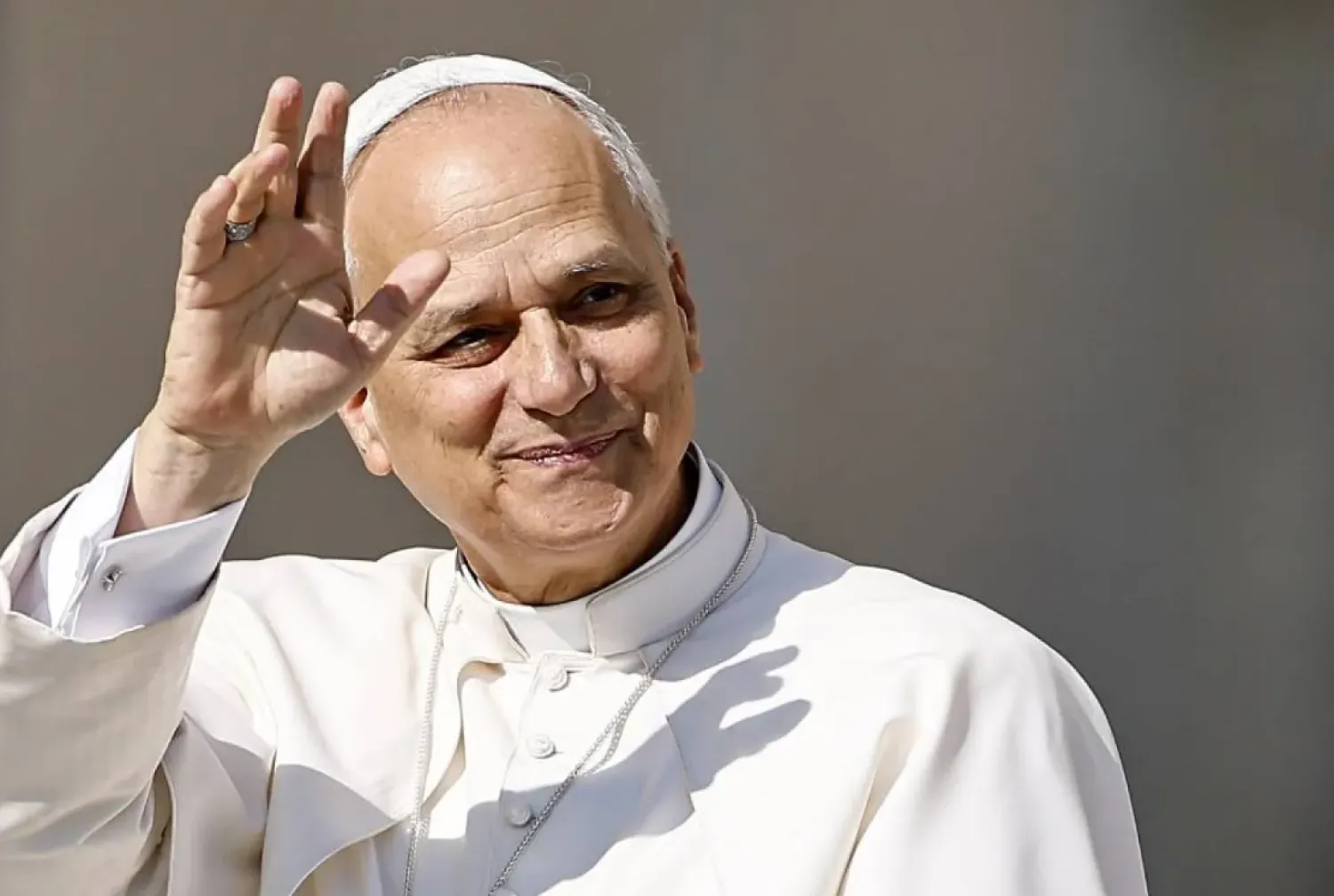
Pope Leo XIV greets the faithful during his weekly General Audience in St. Peter's Square, in Vatican City, 06 August 2025. (EPA)
TT

Pope Leo to Take Peace Message to Türkiye, Lebanon on First Overseas Trip

Pope Leo XIV greets the faithful during his weekly General Audience in St. Peter's Square, in Vatican City, 06 August 2025. (EPA)

Pope Leo will embark on his first trip outside Italy as the leader of the Catholic Church on Thursday, travelling to Türkiye and Lebanon, where he is expected to make appeals for peace in the region and urge unity among long-divided Christian churches.

Leo, the first US pope, will give his first speeches to foreign governments and visit some sensitive cultural sites as part of a crowded itinerary during the November 27 to December 2 trip, Reuters reported.

His predecessor Pope Francis had planned to visit both countries but was unable to because of his worsening health. Francis died on April 21 and Leo, originally from Chicago, was elected pope on May 8 by the world's cardinals.

"A pope's first foreign trip is an opportunity to capture and hold the world's attention," said John Thavis, a retired Vatican correspondent who covered three papacies.

"What's at stake for Pope Leo is his ability to connect with a wider audience, in a region where war and peace, humanitarian needs and interfaith dialogue are crucial issues," said Thavis.

PAPAL VISITS DRAW WORLD ATTENTION

Leo goes first to Türkiye, from November 27 to 30, where he has several joint events with Patriarch Bartholomew, spiritual leader of the world's 260 million Orthodox Christians, who is based in Istanbul.

Peace is expected to be a key theme of Leo's visit to Lebanon, which has the largest percentage of Christians in the Middle East.

On Sunday, Israel killed the Iran-backed militant group Hezbollah's top military official in an airstrike on a southern suburb of Beirut, despite a US-brokered truce a year ago.

Leaders in Lebanon, which is also host to one million Syrian and Palestinian refugees and is struggling to recover after years of economic crisis, hope the papal visit might bring global attention to the country.

An off-the-cuff moment in October raised possible security concerns about Leo's visit in Lebanon. Queen Rania of Jordan, visiting Leo at the Vatican, asked the pope if he thought it was safe to go to the country. "Well, we're going," Leo responded.

Travelling abroad has become a major part of the modern papacy, with popes attracting international attention as they lead events with crowds sometimes in the millions, give foreign policy speeches and conduct international diplomacy.

Francis, who made 47 foreign visits over his 12-year tenure, often grabbed headlines during his trips with surprise comments.

The late pope was also known for giving unusually frank answers during traditional in-flight press conferences with his travelling press corps, one of the few times the leader of the Church interacts at length with journalists.

Leo has a more reserved style and tends to speak from prepared texts. He has only given one exclusive interview in his six months as pope.

"What we've seen so far is a pope who's very careful when he speaks," Rev. Thomas Reese, a Jesuit priest and commentator, said. "But every trip is a risk. There can always be mistakes or fumbles."

In Türkiye, Leo and Bartholomew will celebrate the 1,700th anniversary of a major early Church council, which took place in Nicaea, now Iznik, and created a creed that most of the world's 2.6 billion Christians still pray today.

Orthodox and Catholic Christians split in the East-West Schism of 1054, but have generally strengthened their ties in recent decades.

Rev. John Chryssavgis, an adviser to Bartholomew, said the event is "especially meaningful as a sign and pledge of unity in an otherwise fragmented and conflicted world".

Several other Orthodox Christian leaders are expected to attend the anniversary, but the Vatican has not said which.

The Moscow Patriarchate, an Orthodox community closely allied with Russian President Vladimir Putin that severed ties with Bartholomew in 2018, is not expected to take part.

POPE TO COMMEMORATE BEIRUT PORT EXPLOSION

Leo will also visit Istanbul's Blue Mosque, his first visit as pope to a Muslim place of worship, and will celebrate a Catholic Mass at Istanbul's Volkswagen Arena.

Rev. Nicola Masedu, pastor of Istanbul's Catholic Cathedral of the Holy Spirit, said interest in the new pope's visit led organizers to move the Mass from the cathedral to the arena, which can hold around 5,000 people.

Leo's schedule in Lebanon includes a prayer at the site of the 2020 chemical explosion at the Beirut port that killed 200 people and caused billions of dollars' worth of damage.

The pope will also host an inter-religious meeting and lead an outdoor Mass on the Beirut waterfront. But Leo, visiting five towns and cities in the country, will not travel to the south, the target of Israeli strikes.

Rev. Michel Abboud, who leads the Catholic Church's charity network in Lebanon, told the Vatican's media outlet the pope's visit was one of "solidarity."

"The people will know that, despite all the difficult situations they have gone through, they must not feel abandoned," he said.



6.5-magnitude Quake Shakes Mexico City

People wait outside their homes and buildings after an earthquake in Mexico City, Mexico, January 2, 2026. REUTERS/Henry Romero
TT

6.5-magnitude Quake Shakes Mexico City

People wait outside their homes and buildings after an earthquake in Mexico City, Mexico, January 2, 2026. REUTERS/Henry Romero

A 6.5-magnitude earthquake shook Mexico City and southwestern Guerrero state on Friday, sending people rushing into the streets but causing no serious damage, according to preliminary reports.

President Claudia Sheinbaum was forced to evacuate the presidential palace during her regular morning press conference, along with the journalists in attendance, when the earthquake alert sounded.

The Seismological Service said that the earthquake's epicenter was situated 14 kilometers (nine miles) southwest of San Marcos, in the southern state of Guerrero, about 400 kilometers from Mexico City.

The US Geological Survey said the quake struck around 8:00 am east of Acapulco, a major port and beach resort.

Sheinbaum said there were no immediate reports of major damage in either Mexico City or Guerrero.

Mexico, which is situated between five tectonic plates, is one of the world's most seismically active countries.

Karen Gomez, a 47-year-old office worker living on the 13th floor of an apartment building in Mexico City, told AFP she was roused from her sleep by a street siren.

"I woke up in terror. My cellphone alert said it was a powerful earthquake."

Norma Ortega, a 57-year-old kindergarten director, living in a 10th-floor apartment, said she could feel her building shake.

"I got a terrible fright."

The center of Mexico City is built on the muddy subsoil of what was once the bed of a lake, making it particularly vulnerable to earthquakes.

Those most strongly felt usually originate off Guerrero state on the Pacific coast.

On September 19, 1985, an 8.1-magnitude earthquake devastated a vast swathe of Mexico City, leaving nearly 13,000 dead, mostly in the city, according to official figures.

In 2017, also on September 19, a 7.1-magnitude quake killed 369 people, also mostly in Mexico City.

Early warning systems, including smartphone apps, have been developed to warn Mexico City residents of strong quakes and urge them to reach safety.

The city has also installed loudspeakers on lampposts to broadcast the alerts.


Zelenskyy Names Ukraine's Head of Military Intelligence as his New Chief of Staff

Kyrylo Budanov, Chief of the Main Intelligence Directorate of the Ministry of Defense of Ukraine, attends the press conference 'Ukraine, Year 2025' in Kyiv, Ukraine, 23 February 2025 (reissued 02 January 2026), amid the Russian invasion. EPA/SERGEY DOLZHENKO
TT

Zelenskyy Names Ukraine's Head of Military Intelligence as his New Chief of Staff

Kyrylo Budanov, Chief of the Main Intelligence Directorate of the Ministry of Defense of Ukraine, attends the press conference 'Ukraine, Year 2025' in Kyiv, Ukraine, 23 February 2025 (reissued 02 January 2026), amid the Russian invasion. EPA/SERGEY DOLZHENKO

President Volodymyr Zelenskyy on Friday appointed the head of Ukraine's military intelligence as his new chief of staff, a move that comes as the US leads a diplomatic push to end Russia's nearly 4-year-old invasion.

In announcing the appointment of Gen. Kyrylo Budanov, Zelenskyy said Ukraine needs to focus on security issues, developing its defense and security forces, and peace talks -- areas that are overseen by the office of the president, The Associated Press reported.

Zelenskyy had dismissed his previous chief of staff, Andrii Yermak, after anti-corruption officials began investigating alleged graft in the energy sector.

Budanov, 39, is one of the country’s most recognizable and popular wartime figures. He has led Ukraine’s military intelligence agency, known by its acronym GUR, since 2020.

A career military intelligence officer, he rose through the defense establishment after Russia’s illegal annexation of Crimea in 2014. He also took part in special operations and intelligence missions linked to the fighting with Moscow-backed separatist forces in eastern Ukraine before the full-scale invasion of February 2022. He reportedly was wounded during one such operation.

Since the full-scale invasion. Budanov has become a prominent face of Kyiv’s intelligence effort, regularly appearing in interviews and briefings that mix strategic signaling with psychological pressure on Moscow. He has frequently warned of Russia’s long-term intentions toward Ukraine and the region, while portraying the war as an existential struggle for the country's statehood.

Under Budanov, the GUR expanded its operational footprint, coordinating intelligence, sabotage and special operations aimed at degrading Russian military capabilities far beyond the front lines. Ukrainian officials have credited military intelligence with operations targeting Russian command structures, logistics hubs, energy infrastructure and naval assets, including strikes deep inside Russian territory and occupied areas.

His appointment to lead the office of the president marks an unusual shift, placing a serving intelligence chief at the center of Ukraine’s political and diplomatic coordination. Zelenskyy has framed the move as part of a broader effort to sharpen the focus on security, defense development and diplomacy.
“Kyrylo has specialized experience in these areas and sufficient strength to achieve results,” Zelenskyy said.

Budanov said on Telegram his new position is "both an honor and a responsibility — at a historic time for Ukraine — to focus on the critically important issues of the state’s strategic security.”

Russian authorities said Friday the death toll from what they called a Ukrainian drone strike on a cafe and hotel in a Russian-occupied village in Ukraine’s Kherson region rose to 27. Kyiv strongly denied attacking civilian targets.

Svetlana Petrenko, spokeswoman of Russia's main criminal investigation agency, the Investigative Committee, said those killed in the village of Khorly, where at least 100 civilians were celebrating New Year's Eve, included two minors, while 31 people were hospitalized.

A spokesman for Ukraine’s General Staff, Dmytro Lykhovii, denied attacking civilians. He told Ukraine's public broadcaster Suspilne on Thursday that Ukrainian forces “adhere to the norms of international humanitarian law” and "carry out strikes exclusively against Russian military targets, facilities of the Russian fuel and energy sector, and other lawful targets.”

He noted that Russia has repeatedly used disinformation and false statements to disrupt the ongoing peace negotiations.

The Associated Press could not independently verify claims made about the attack.

US President Donald Trump’s special envoy Steve Witkoff said Wednesday that he, Secretary of State Marco Rubio and Trump’s son-in-law and adviser Jared Kushner had a “productive call” with the national security advisers of Britain, France, Germany and Ukraine “to discuss advancing the next steps in the European peace process.”

The US efforts has faced a new obstacle earlier this week, when Moscow said it would toughen its negotiating stand after what it said was a long-range drone attack against a residence of Russian President Vladimir Putin in northwestern Russia early Monday.

Kyiv has denied attacking Putin’s residence, saying the Russian claim was a ruse to derail the negotiations.

In his New Year’s address, Zelenskyy said a peace deal was “90% ready” but warned that the remaining 10% — believed to include key sticking points such as territory — would “determine the fate of peace, the fate of Ukraine and Europe, how people will live.”

New overnight attacks Elsewhere in Ukraine, Russia struck a residential area of Kharkiv with two missiles Friday, Zelenskyy wrote on his Telegram page, adding that Moscow's forces "continue the killings, despite all the efforts of the world, and above all the United States, in the diplomatic process.”

At least 15 people in the eastern city were injured, according to regional administration head Oleh Syniehubov.

Earlier Friday, Russia conducted what local authorities called “one of the most massive” drone attacks at Zaporizhzhia. At least nine drones struck the city, damaging dozens of residential buildings and other civilian infrastructure but causing no casualties, according to Ivan Fedorov, head of the regional administration.

Overall, Russia fired 116 long-range drones at Ukraine, according to Ukraine’s air force, with 86 intercepted and 27 striking their targets.

The Russian Defense Ministry said its air defenses intercepted 64 Ukrainian drones overnight in multiple Russian regions.

The Russian city of Belgorod was hit by a Ukrainian missile, according to regional Gov. Vyacheslav Gladkov. Two women were hospitalized after the strike, which shattered windows and damaged an unspecified commercial facility and a number of cars in the region that borders Ukraine, he said.


A Building Under Construction Collapses in Nairobi, Leaving an Unknown Number of People Trapped

Members of The Disaster Response Battalion (DRB) of the Kenya Defense Forces (KDF) gather at the site of a 16-storey building under construction that collapsed, as search and rescue operations begin with possible casualties still unconfirmed, in the South C neighborhood of Nairobi, on January 2, 2026. (AFP)
TT

A Building Under Construction Collapses in Nairobi, Leaving an Unknown Number of People Trapped

Members of The Disaster Response Battalion (DRB) of the Kenya Defense Forces (KDF) gather at the site of a 16-storey building under construction that collapsed, as search and rescue operations begin with possible casualties still unconfirmed, in the South C neighborhood of Nairobi, on January 2, 2026. (AFP)

A multi-story building under construction in the Kenyan capital, Nairobi, collapsed Friday, leaving an unknown number of people trapped.

Rescue workers are digging through the rubble. The building was in an area of Nairobi known as South C, according to the Kenya Red Cross, and local media say it was a 16-story structure.

“A multi-agency response team is on site managing the situation,” the Kenya Red Cross said in a statement.

There was no immediate comment from authorities on the likely cause of the collapse or the number of victims. The toll is not expected to be high, The Associated Press said.

Building collapses are common in Nairobi, where housing is in high demand and unscrupulous developers often bypass regulations or simply violate building codes.

After eight buildings collapsed and killed 15 people in Kenya in 2015, the presidency ordered an audit of buildings across the country to see if they were up to code. The National Construction Authority found that 58% of the buildings in Nairobi were unfit for habitation.