

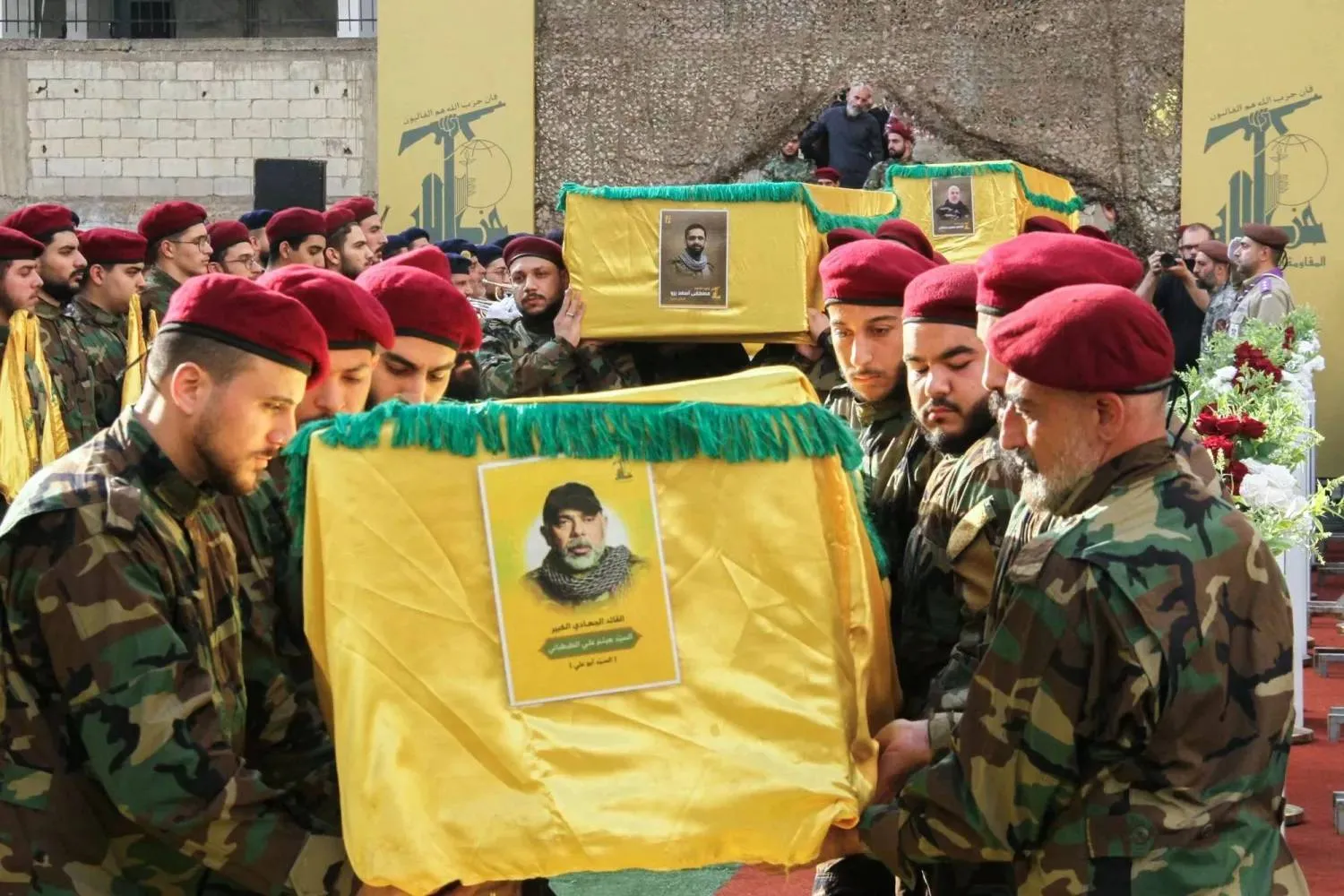

Tabtabai Killing Shakes Hezbollah’s Leadership Structure

Hezbollah members carry the coffin of Chief of Staff Haitham Tabtabai during his funeral on Monday in Beirut’s southern suburbs (AFP)
TT

Tabtabai Killing Shakes Hezbollah’s Leadership Structure

Hezbollah members carry the coffin of Chief of Staff Haitham Tabtabai during his funeral on Monday in Beirut’s southern suburbs (AFP)

The assassination of Haitham Ali Tabtabai, Hezbollah’s top military commander, deep inside Beirut’s southern suburbs has dramatically reshaped Lebanon’s internal security scene.

Hours after the strike, Israel’s Alma Center published an updated chart of Hezbollah’s command structure that included senior political figures such as Mohammad Raad, head of Hezbollah’s parliamentary bloc, Ibrahim Amin Al-Sayyed, head of the party’s political council, and Mohammad Yazbek, head of Hezbollah’s Sharia (Religious) Council, alongside military and security commanders.

Experts in Beirut viewed the move as a clear attempt to expand the “target map” and reinforce the image of Hezbollah as a single, unified system with no separation between its political and military wings.

A new trajectory

Although not officially announced, the inclusion appeared to mark a shift in Israel’s messaging.

After years of focusing its operations on Hezbollah’s Jihad Council, Israel is now presenting the political leadership as part of the military decision making circle.

Analysts say this opens the door to a new phase of confrontation that reaches beyond the battlefield into Hezbollah’s top organisational hierarchy.

A historic moment of vulnerability

Political writer and analyst Ali al-Amin said the images published by Alma carry security implications that go far beyond media messaging during an open war.

He said they reflect an unprecedented level of exposure for Hezbollah after the assassination of its highest ranking military commander in the heart of the southern suburbs.

“Any image or signal at this moment cannot be separated from a wartime environment. We are facing direct targeting of the first tier, and with Tabtabai’s assassination, the possibility of strikes against others, whether security or political leaders, becomes plausible,” al-Amin told Asharq Al-Awsat.

“The breach that led to the killing of someone at this level shows Israel’s ability to reach anyone inside Hezbollah’s structure.”

He added: “In an entire year, no contemporary group has been subjected to daily strikes and assassinations without being able to respond. This is not a normal scene, it is an indicator of profound weakness and exposure inside the party.”

Al Amin said the latest assassination was notable because Israel targeted Tabtabai and four people around him with precision and without killing civilians.

“This reveals the level of Israeli intelligence and its effort to keep the confrontation confined to Hezbollah’s ranks,” he said.

“This tactic embarrasses the party’s leadership because it proves day after day that Israel can eliminate its members and commanders at little cost.”

A deal or a final card

Al-Amin placed current developments within two possible trajectories: “Either this is part of a gradual sell off of Hezbollah’s security and military infrastructure on an American table, or Tehran wants a disaster in Lebanon to use as a delaying card against any potential threat to Iran.”

He warned that a possible Israeli war on Lebanon could, in some ways, serve Iran at a moment of weakness.

“There is no point in talking about a military recovery for Hezbollah today,” he said. “Its security and military structure has been severely damaged. Missiles and stockpiles do not make power when the leadership is exposed and Israel can penetrate every circle.”

He argued that the period after Tabtabai’s killing will not resemble what came before it, saying all scenarios are now open, from new assassinations to wider escalation amid what he described as a complete strategic vacuum inside Hezbollah.

Historic fragility

Tabtabai’s killing does not appear to be an isolated military episode, but a turning point that has reopened the file of Hezbollah’s decision making circle.

If Tabtabai represented the most sensitive node in the group’s operational system, the inclusion of political leaders suggests an Israeli desire to move the confrontation from the front line to the level where decisions are made and wars are managed.

According to analysts, this shift places Hezbollah in one of the most complicated moments of its history: security fragility, leadership exposure, international pressure and internal division between a public political facade and a concealed military cadre.

A deceptive sense of safety

Retired Brig.Gen. Naji Malaeb offered a complementary reading.

He said Hezbollah has effectively split into two groups after the ceasefire: a public group of politicians, lawmakers and ministers who serve as the public voice, and another that has disappeared from view, abandoned all forms of technology and communication, and continues quietly working to rebuild the party’s military structure.

He said Israeli strikes over the past year had largely failed to reach first and second tier commanders.

“Most of those killed were school directors, municipal employees or lower level members who were not decision makers,” he said, arguing that Hezbollah had maintained some internal security discipline but “misjudged its safety inside the southern suburbs, which allowed the latest breach.”

Success after failure

He said Israel possesses enough technical capabilities, from satellites to drones, to track any target that remains within surveillance range.

The exceptional level of political and military celebration in Israel after the operation, he added, signals a domestic need in Tel Aviv to showcase a major success after a long period of setbacks.

Malaeb said Alma’s publication of names and photos of Hezbollah officials is not an official position, but a form of psychological and military pressure by hinting that political leaders could also be targeted.

“The problem for Hezbollah is that it has not acknowledged defeat and continues to resist doing so. The longer this denial lasts, the higher the level of Israeli escalation.”

He warned that upcoming pressure will not be military only.

According to Malaeb, a United States Treasury delegation preparing to visit Beirut indicates a new phase aimed at drying up Hezbollah’s funding sources.

He described the phase of blocking funds as a threat more serious for the group than the weapons issue itself.



Libya Says UK to Analyze Black Box from Crash That Killed General

Military personnel carry portraits of the Libyan chief of staff, General Mohamed al-Haddad (2-R), and his four advisers, who were killed in a plane crash in Türkiye, during an official repatriation ceremony at the Ministry of Defense headquarters in Tripoli, Libya, 27 December 2025. (EPA)
TT

Libya Says UK to Analyze Black Box from Crash That Killed General

Military personnel carry portraits of the Libyan chief of staff, General Mohamed al-Haddad (2-R), and his four advisers, who were killed in a plane crash in Türkiye, during an official repatriation ceremony at the Ministry of Defense headquarters in Tripoli, Libya, 27 December 2025. (EPA)

Libya said on Thursday that Britain had agreed to analyze the black box from a plane crash in Türkiye on December 23 that killed a Libyan military delegation, including the head of its army.

General Mohammed al-Haddad and four aides died after a visit to Ankara, with Turkish officials saying an electrical failure caused their Falcon 50 jet to crash shortly after takeoff.

Three crew members, two of them French, were also killed.

The aircraft's black box flight recorder was found on farmland near the crash site.

"We coordinated directly with Britain for the analysis" of the black box, Mohamed al-Chahoubi, transport minister in the Government of National Unity (GNU), said at a press conference in Tripoli.

Haddad was very popular in Libya despite deep divisions between west and east.

Haddad was chief of staff for the Tripoli-based GNU.

Chahoubi told AFP a request for the analysis was "made to Germany, which demanded France's assistance" to examine the aircraft's flight recorders.

"However, the Chicago Convention stipulates that the country analyzing the black box must be neutral," he said.

"Since France is a manufacturer of the aircraft and the crew was French, it is not qualified to participate. The United Kingdom, on the other hand, was accepted by Libya and Turkey."

After meeting the British ambassador to Tripoli on Tuesday, Foreign Minister Taher al-Baour said a joint request had been submitted by Libya and Türkiye to Britain "to obtain technical and legal support for the analysis of the black box".

Chahoubi told Thursday's press briefing that Britain "announced its agreement, in coordination with the Libyan Ministry of Transport and the Turkish authorities".

He said it was not yet possible to say how long it would take to retrieve the flight data, as this depended on the state of the black box.

"The findings will be made public once they are known," Chahoubi said, warning against "false information" and urging the public not to pay attention to rumors.


STC Says Handing over Positions to National Shield Forces in Yemen's Hadhramaut, Mahra

National Shield forces in Hadhramaut. (National Shield forces)
TT

STC Says Handing over Positions to National Shield Forces in Yemen's Hadhramaut, Mahra

National Shield forces in Hadhramaut. (National Shield forces)

Southern Transitional Council (STC) forces in Yemen began on Thursday handing over military positions to the government’s National Shield forces in the Hadhramaut and al-Mahra provinces in eastern Yemen.

Local sources in Hadhramaut confirmed to Asharq Al-Awsat that the handover kicked off after meetings were held between the two sides.

Speaking on condition of anonymity, the sources said the National Shield commanders met with STC leaderships to discuss future arrangements. The sourced did not elaborate, but they confirmed that Emirati armored vehicles, which had entered Balhaf port in Shabwah were seen departing on a UAE vessel, in line with a Yemeni government request.

The National Shield is overseen by Presidential Leadership Council (PLC) Chairman Dr. Rashad al-Alimi.

A Yemeni official described Thursday’s developments as “positive” step towards uniting ranks and legitimacy against a common enemy – the Houthi groups.

The official, also speaking on condition of anonymity, underscored to Asharq Al-Awsat the importance of “partnership between components of the legitimacy and of dialogue to resolve any future differences.”

Meanwhile, on the ground, Yemeni military sources revealed that some STC forces had refused to quit their positions, prompting the forces to dispatch an official to Hadhramaut’s Seiyun city to negotiate the situation.


One Dead as Israeli Forces Open Fire on West Bank Stone-Throwers

Israeli troops during a military operation in the Palestinian village of Qabatiya, near the West Bank city of Jenin, 27 December 2025. (EPA)
TT

One Dead as Israeli Forces Open Fire on West Bank Stone-Throwers

Israeli troops during a military operation in the Palestinian village of Qabatiya, near the West Bank city of Jenin, 27 December 2025. (EPA)

The Israeli military said its forces killed a Palestinian in the occupied West Bank in the early hours on Thursday as they opened fire on people who were throwing stones at soldiers.

Two other people were hit on a main ‌road near the ‌village of Luban ‌al-Sharqiya ⁠in Nablus, ‌the military statement added. It described the people as militants and said the stone-throwing was part of an ambush.

Palestinian authorities in the West Bank said ⁠a 26-year-old man they named as ‌Khattab Al Sarhan was ‍killed and ‍another person wounded.

Israeli forces had ‍closed the main entrance to the village of Luban al-Sharqiya, in Nablus, and blocked several secondary roads on Wednesday, the Palestinian Authority's official news agency WAFA reported.

More ⁠than a thousand Palestinians were killed in the West Bank between October 2023 and October 2025, mostly in operations by security forces and some by settler violence, the UN has said.

Over the same period, 57 Israelis were killed ‌in Palestinian attacks.