
Israeli Army Announces New Operation in Northern West Bank 

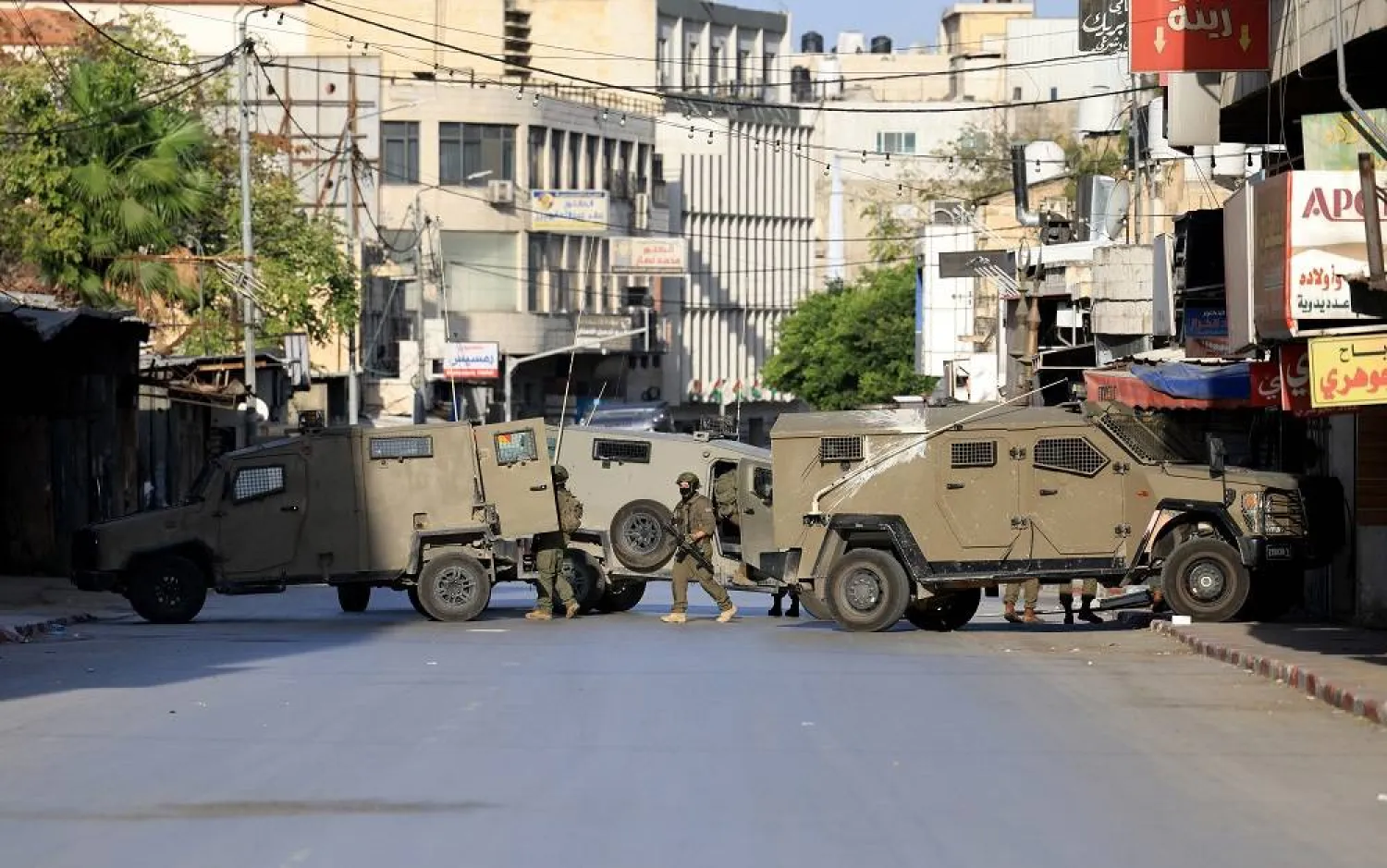
Israeli troops take positions during an Israeli military operation in the West Bank city of Nablus, 20 November 2025. (EPA)
TT

Israeli Army Announces New Operation in Northern West Bank 

Israeli troops take positions during an Israeli military operation in the West Bank city of Nablus, 20 November 2025. (EPA)

Israeli security forces on Wednesday launched what the military described as a counter-terrorism operation in the northern West Bank, which Palestinians said was targeting the city of Tubas. 

Tubas Governor Ahmed Al-Asaad told Reuters Israeli forces, backed by a helicopter that had opened fire, were encircling the city and establishing positions across several neighborhoods. 

"The incursion looks to be a long one; occupation (Israeli) forces have driven people from their houses, commandeered rooftops of buildings, and are conducting arrests," he said. 

Al-Asaad said Israeli forces ordered those whom they forced to leave their homes not to return until the operation ends, which he anticipated could be several days. 

The Israeli military said in an earlier statement that the operation, carried out with police and intelligence forces, began early on Wednesday morning. 

ISRAELI OPERATIONS IN NORTHERN WEST BANK BEGAN IN JANUARY 

Asked about the operation, a military spokesperson declined to comment, saying more details would be released soon. 

Israel has said its security forces have been targeting Palestinian militancy in the West Bank, where hundreds of thousands of Israeli settlers live among 2.7 million Palestinians, granted limited self-rule under Israeli military occupation. 

Hamas, which agreed to a ceasefire with Israel in Gaza last month, condemned the latest West Bank operation and called on the international community to intervene to stop it.  

The assault on Tubas appeared to be an extension of a military operation launched by security forces in the northern West Bank city of Jenin in January, days after US President Donald Trump returned to the White House.  

That operation has since expanded to other Palestinian cities in the north of the West Bank, forcing thousands from their homes, with Israeli forces maintaining their longest presence in some West Bank cities for decades. 

Israeli forces have cleared out refugee camps across the northern West Bank, with deadly raids destroying roads and homes.  

Human Rights Watch this month accused Israel of war crimes and crimes against humanity over what it said were forced expulsions. Israel denies committing such crimes. 

Violence in the West Bank has escalated in recent months, with Israeli settlers carrying out attacks on Palestinian communities. Settlers are rarely arrested or prosecuted, although the wave of attacks has drawn criticism from Prime Minister Benjamin Netanyahu and others in his government.  

Since Hamas carried out the October 7 attack on Israel from Gaza two years ago, Israel has sharply curtailed movement in the West Bank, with new checkpoints erected and some Palestinian communities effectively sealed off by gates and roadblocks. 


Report: Iran’s Ambassador Won’t Leave Lebanon Despite Expulsion

Iranian Ambassador to Syria Mohammad Reza Sheibani, shows his ink-stained finger as he votes in the first round of the Iranian presidential election on June 14, 2013 at the Iranian embassy in the Syrian capital, Damascus. (AFP)
TT

Report: Iran’s Ambassador Won’t Leave Lebanon Despite Expulsion

Iranian Ambassador to Syria Mohammad Reza Sheibani, shows his ink-stained finger as he votes in the first round of the Iranian presidential election on June 14, 2013 at the Iranian embassy in the Syrian capital, Damascus. (AFP)

Iran's ambassador will not leave Lebanon despite being declared persona non grata and ordered to leave the country by Sunday, an Iranian diplomatic source told AFP.

"The ambassador will not leave Lebanon, in accordance with the wishes of the speaker of parliament Nabih Berri and of Hezbollah," the source said, speaking on condition of anonymity.

Hezbollah has denounced the decision while Berri's Amal party joined Hezbollah ministers in boycotting a cabinet session this week in protest at the order to expel Mohammad Reza Sheibani.

The foreign ministry this week gave Tehran's envoy until Sunday to leave in the latest unprecedented step by Lebanese authorities since a new war erupted on March 2 between Israel and Hezbollah.

The ministry accused him of making statements "interfering in Lebanon's internal politics".

French Foreign Minister Jean-Noel Barrot called the expulsion "a courageous decision".

The Lebanese authorities have banned Hezbollah's military and security activities. It is the only armed non-state group in the country and a close ally of Iran.

It has also banned the presence and operations of Iran's Revolutionary Guards whom Prime Minister Nawaf Salam accused of directing Hezbollah operations against Israel.


Netanyahu Says Israel Will Widen Its Invasion of Southern Lebanon

Israeli army soldiers walk next to a self-propelled Howitzer artillery gun positioned in the upper Galilee in northern Israel near the border with southern Lebanon on March 29, 2026. (AFP)
TT

Netanyahu Says Israel Will Widen Its Invasion of Southern Lebanon

Israeli army soldiers walk next to a self-propelled Howitzer artillery gun positioned in the upper Galilee in northern Israel near the border with southern Lebanon on March 29, 2026. (AFP)

Prime Minister Benjamin Netanyahu announced Sunday that Israel will widen its invasion of southern Lebanon.

Netanyahu said Israel would expand what he called the “existing security strip” in Lebanon as Israeli forces continue to target the Iranian-backed Hezbollah militant group.

“We are determined to fundamentally change the situation in the north,” he said on a visit to northern Israel.

Netanyahu said Hezbollah still retained "residual capabilities" to fire rockets at Israel, but the group had been severely hit by Israeli forces.

"Iran is no longer the same Iran, Hezbollah is no longer the same Hezbollah, and Hamas is no longer the same Hamas," he added.

"These are no longer terrorist armies threatening our existence -- they are defeated enemies, fighting for their own survival."

"We are determined, we are fighting, and with God's help -- we are winning," Netanyahu said.

There were no immediate details.

In Lebanon, officials say more than 1,100 people have been killed and more than one million displaced since the Iran war began.


France Condemns Houthis for Entering Middle East War

A satellite image shows Bab el-Mandab Strait off the coast of Yemen, February 27, 2026. (2026 Planet Labs PBC/Handout via Reuters)
TT

France Condemns Houthis for Entering Middle East War

A satellite image shows Bab el-Mandab Strait off the coast of Yemen, February 27, 2026. (2026 Planet Labs PBC/Handout via Reuters)

France condemned on Sunday two attacks by Yemen's Houthi militants on Israeli targets, accusing them of escalating tension in the Middle East by entering the regional war.

A Houthi spokesman said on Saturday the Iranian-backed group had fired missiles and drones towards "several vital and military sites" in Israel, the same day that Israel said it had intensified attacks on Iran's military industry.

The escalation came after more than a month of Israeli and US bombardment of Iran, to which Iran has responded by attacking US-linked interests in wealthy Gulf states.

"The Houthis should abstain from all attacks," French foreign ministry spokesman Pascal Confavreux said. He accused them of being "irresponsible".

He said everything should be done "to avoid an even greater escalation of the conflict", which has killed thousands across the region and sent energy markets into a tailspin.

The war has disrupted global maritime traffic through the Strait of Hormuz, a key waterway in the Gulf through which a fifth of the world's crude supplies pass, along with substantial shipments of gas and fertilizers.

The only alternative routes are to sail through the Red Sea on the other side of the Arabian peninsula or make the much lengthier journey around the tip of southern Africa.

From Yemen, the Houthis could potentially disrupt shipping through the Red Sea, as they did at the height of Israel's war on Gaza.

The European Union said on March 16 it would not extend the bloc's existing naval mission in the Red Sea to help re-open the Strait of Hormuz.

US President Donald Trump had lashed out at EU and NATO countries for not agreeing to escort ships through the strait.