


Israel Watches Katz-Zamir Feud as Netanyahu Gains Ground

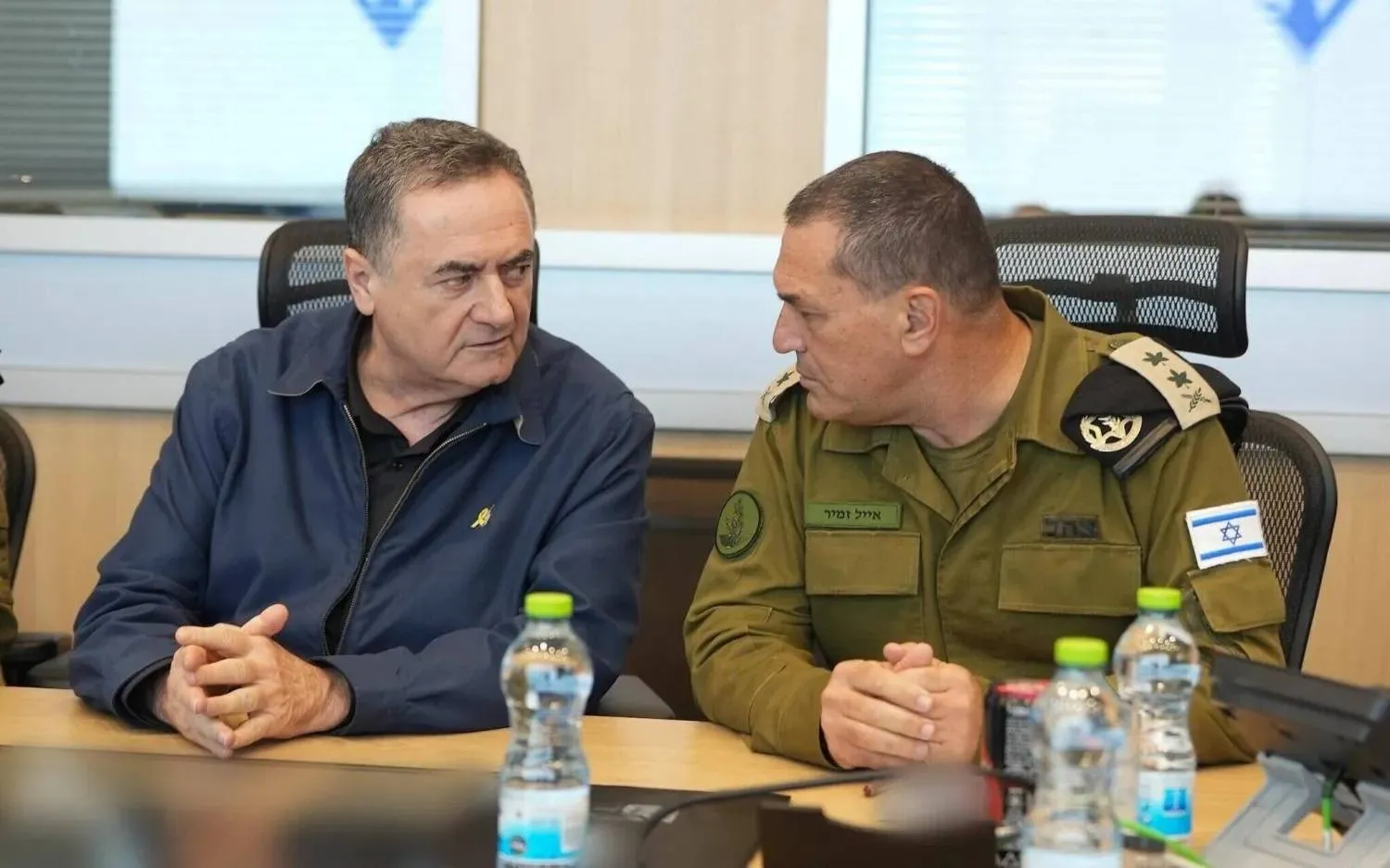
 Israeli Defense Minister Israel Katz, Army Chief Eyal Zamir (Israeli Defense Ministry
Israeli Defense Minister Israel Katz, Army Chief Eyal Zamir (Israeli Defense Ministry
TT

Israel Watches Katz-Zamir Feud as Netanyahu Gains Ground

 Israeli Defense Minister Israel Katz, Army Chief Eyal Zamir (Israeli Defense Ministry
Israeli Defense Minister Israel Katz, Army Chief Eyal Zamir (Israeli Defense Ministry

Despite a reconciliation meeting between Defense Minister Israel Katz and military chief of staff Eyal Zamir in the office of Prime Minister Benjamin Netanyahu, their feud has not subsided.

The rift continues to fuel public outrage in Israel and has led commentators to describe Netanyahu’s government as "a kindergarten."

The dispute erupted after Zamir imposed disciplinary measures on senior army officers over what he called the “major failure” to counter the Hamas assault of October 7, 2023.

Katz rejected the move, saying the decisions were announced without his knowledge.

Some warn the standoff undermines national security. Many agree it has become an arm wrestling match and a show of force, not only between the two men but between the government and the entire military and security establishment.

It also appeared that Netanyahu sought to exploit the dispute by threatening Katz’s standing inside the Likud party ahead of internal primaries and casting doubt on Zamir’s position inside the military, presenting himself as the only strong figure in the arena, one whose presence leaves no room for any other.

The latest episode unfolded on Thursday night when Netanyahu summoned both men for a reconciliation meeting.

Katz did not show up on time and told Netanyahu’s office he preferred to meet each of them separately. Netanyahu agreed, not to avoid confrontation but to stretch the political advantage for as long as possible.

Sending messages to both sides

Netanyahu has repeatedly signaled to both sides. Leaks to the media suggested he might dismiss Katz for picking fights with the army chief and treating him with roughness and arrogance bordering on humiliation.

Other leaks suggested Netanyahu believed Zamir’s appointment as chief of staff was a mistake and that Zamir was acting with excessive independence, contradicting what he had promised when he was considered for the post.

At the time, Zamir vowed to adopt an aggressive, confrontational policy in Gaza, only to show later that he was not interested in expanding the war.

As the leaks stirred political tension, counter leaks said “military circles” were behind the reports to sow discord.

Aides to Netanyahu said he does not intend to dismiss either Katz or Zamir, insisting relations with both were stable and good. Yet the effect of the threats was clear.

What caused the rift?

The feud escalated in recent days after Zamir punished generals, brigadiers and colonels who led the southern command during the Hamas attack, and drew up a list of senior army promotions without consulting the minister.

Katz responded by freezing promotions and appointing another committee to review the army’s own investigative committees and determine whether they had been professional.

Zamir insists appointments and dismissals are professional military matters that do not concern the minister. Katz sees the moves as defiance.

Netanyahu criticized Zamir for bypassing the minister, saying the “army is subordinate to the government in general and to the prime minister and defense minister in particular,” and he reprimanded Katz for “raising the level of hostility toward Zamir and the army.”

Shifting blame to the military

The newspaper Haaretz said the dispute was proof that the October 7 government led by Netanyahu is determined to place responsibility solely on the army.

It said the government was using all possible tools to do so, including undermining public confidence in the Israeli army, politicizing appointments and humiliating the chief of staff.

The paper said the goal was to blur the truth and avoid accountability for those who led the country in the years that resulted in the failure.

It added that the conflict between the defense minister and the army chief was not just personal, but part of a broader political effort to assert control over the security apparatus.

Katz, it argued, appeared to be merely a messenger for Netanyahu and his family, adding that Netanyahu wanted to do to the army what Itamar Ben Gvir was doing to the police.

Ephraim Ganor, a strategic affairs expert, told the newspaper Maariv the affair was a scandal that posed real harm to state security.

He said it was driven by the whims of a defense minister who endlessly repeats “I ordered, I said, I led, I asked, I executed,” while scattering threats in all directions.

Ganor added that if Israel had a prime minister focused on the country’s affairs, its security and future, rather than on his trial and political survival, “this shameful phenomenon would never have unfolded before the eyes of the public.”

Lapid corners Netanyahu

Meanwhile, opposition leader Yair Lapid said he would bring to a vote next week President Donald Trump’s twenty point plan aimed at resolving the Gaza crisis and securing the release of Israeli hostages.

Lapid’s move is intended to corner Netanyahu and embarrass him before the United States, since many ministers and lawmakers in the coalition oppose the plan while most opposition parties support it.

Lapid also plans to convince his opposition partner Avigdor Lieberman to back the proposal, although Lieberman currently objects to many of its provisions.

The Israeli people are grateful to US President Donald Trump for leading a courageous deal to secure the release of Israeli hostages, Lapid said, defending his initiative.



Drone Strikes on Sudan Markets Kill 33

Smoke billows over buildings in Khartoum on May 1, 2023 as deadly clashes between rival generals' forces have entered their third week.(Photo by AFP)
TT

Drone Strikes on Sudan Markets Kill 33

Smoke billows over buildings in Khartoum on May 1, 2023 as deadly clashes between rival generals' forces have entered their third week.(Photo by AFP)

A drone attack hit two markets in RSF-controlled towns in southwest Sudan, killing 33 people, a medical source told AFP on Sunday.

The strikes targeted the markets of Abu Zabad and Wad Banda in West Kordofan state -- part of the resource-rich Kordofan region that is currently the fiercest battlefield in the nearly three-year war between Sudan's army and the Rapid Support Forces.

A doctor at Abu Zabad hospital, one of the few medical facilities still serving the area, said two drones struck the markets on Saturday, injuring 59 people.

Speaking via a Starlink connection and requesting anonymity, the doctor said 30 of the wounded remain receiving treatment. The two towns lie roughly 15 kilometres (9 miles) apart.

A resident of Abu Zabad town, Hamad Abdullah, said he helped bury 20 people on Saturday following what he described as an army drone strike on the town's market.

"Four of them were my relatives who worked in the market," he told AFP.

A military source rejected the accusations, telling AFP that the "armed forces do not bombard civilian areas".

"This is a lie with no basis. We only target rebels, their equipment and their weapons depots," the source said, requesting anonymity because they are not authorised to brief the media.

Since war broke out in April 2023, both sides have been accused of war crimes including targeting civilians and indiscriminately shelling residential areas.

The war has killed tens of thousands of people, displaced more than 11 million and fuelled what the United Nations describes as the world's largest displacement and hunger crises.


Lebanese Health Ministry Says Death Toll from Israeli Strikes up to 394

The son of a Lebanese soldier, cries as he sits on his father's coffin who was killed by Israeli airstrikes, during a funeral procession in Khraibeh village, eastern Lebanon, Sunday, March 8, 2026. (AP Photo/Bilal Hussein)
TT

Lebanese Health Ministry Says Death Toll from Israeli Strikes up to 394

The son of a Lebanese soldier, cries as he sits on his father's coffin who was killed by Israeli airstrikes, during a funeral procession in Khraibeh village, eastern Lebanon, Sunday, March 8, 2026. (AP Photo/Bilal Hussein)

Israeli strikes on Lebanon have killed 394 people over the past week, including 83 children and 42 women, the health minister said Sunday, after Israel expanded its attacks to a hotel in central Beirut.

Health minister Rakan Nassereddine said at a press conference that nine rescue workers were among the 394 dead in Lebanon, condemning attacks on medical teams and ambulances.

"These are civilians being targeted, not, as they claim, military personnel and military installations. They are targeting homes, paramedics and the health sector," Nassereddine said, adding "the pace of the massacres has increased in the past 48 hours".

"Medical teams and ambulances are under attack, this is unacceptable."

A previous toll announced on Saturday by the minister had put the number of dead at 294.

Israel never fully halted its strikes targeting Hezbollah despite a 2024 ceasefire that sought to end their last round of fighting, which broke out in 2023 when the group attacked Israel in support of its Palestinian ally Hamas in Gaza.

Since Hezbollah's latest attack on Monday, Israel has launched multiple waves of strikes across Lebanon and sent ground troops into border areas.

Early Sunday, the Lebanese health ministry said an Israeli airstrike hit a hotel room in Beirut's city center, killing four people and wounding 10 others.

Israel's military said it had "conducted a precise strike targeting key commanders" in the Iranian Revolutionary Guards' Quds Force, its foreign operations arm.

In Ghazieh, southern Lebanon, an Israeli attack flattened a building, with an AFP correspondent seeing destroyed solar panels above it and rescuers searching through the debris.

In Sir al-Gharbiyeh, the health ministry said at least 11 people were killed in Israeli morning strikes on the village.

The toll included children, with the minister adding that "there are still people trapped under the rubble".

Standing next to a destroyed home, resident Ali Youssef Taha told AFP that "a family was sleeping inside" before "Israeli warplanes bombed the building, resulting in a massacre".

Mayor Saadallah Mohammed Maatouk said around 500 families were staying in the town.

"What happened will not deter us, and we remain steadfast," he said.

On Sunday, the Israeli military reiterated its call for residents south of Lebanon's Litani river, around 30 kilometres (20 miles) north of the Israeli border, to flee the area.

Sir al-Gharbiyeh is located just above the river, and Ghazieh is further north on the coast.

Israel's military, meanwhile, said Sunday that two of its soldiers were killed in combat in southern Lebanon, the first of its troops to have died since the latest offensive began on March 2.


Arab League Chief Says Iran Attacks on Member States 'Reckless'

A general view shows the opening session of the meeting of Arab foreign ministers at the Arab League Headquarters (Reuters)
TT

Arab League Chief Says Iran Attacks on Member States 'Reckless'

A general view shows the opening session of the meeting of Arab foreign ministers at the Arab League Headquarters (Reuters)

The Arab League's secretary-general said Sunday that Iranian attacks on several member states were "reckless", urging Tehran to reverse what he called a "massive strategic mistake".

Addressing an emergency videoconference of Arab foreign ministers in Cairo, Ahmed Aboul Gheit said the strikes "cannot be justified under any pretext or excuse", and repaid peace efforts by Gulf countries with "treacherous rockets and drone strikes".