An Archaeologist is Racing to Preserve Sudan's Heritage as War Threatens to Erase Its Cultural Past

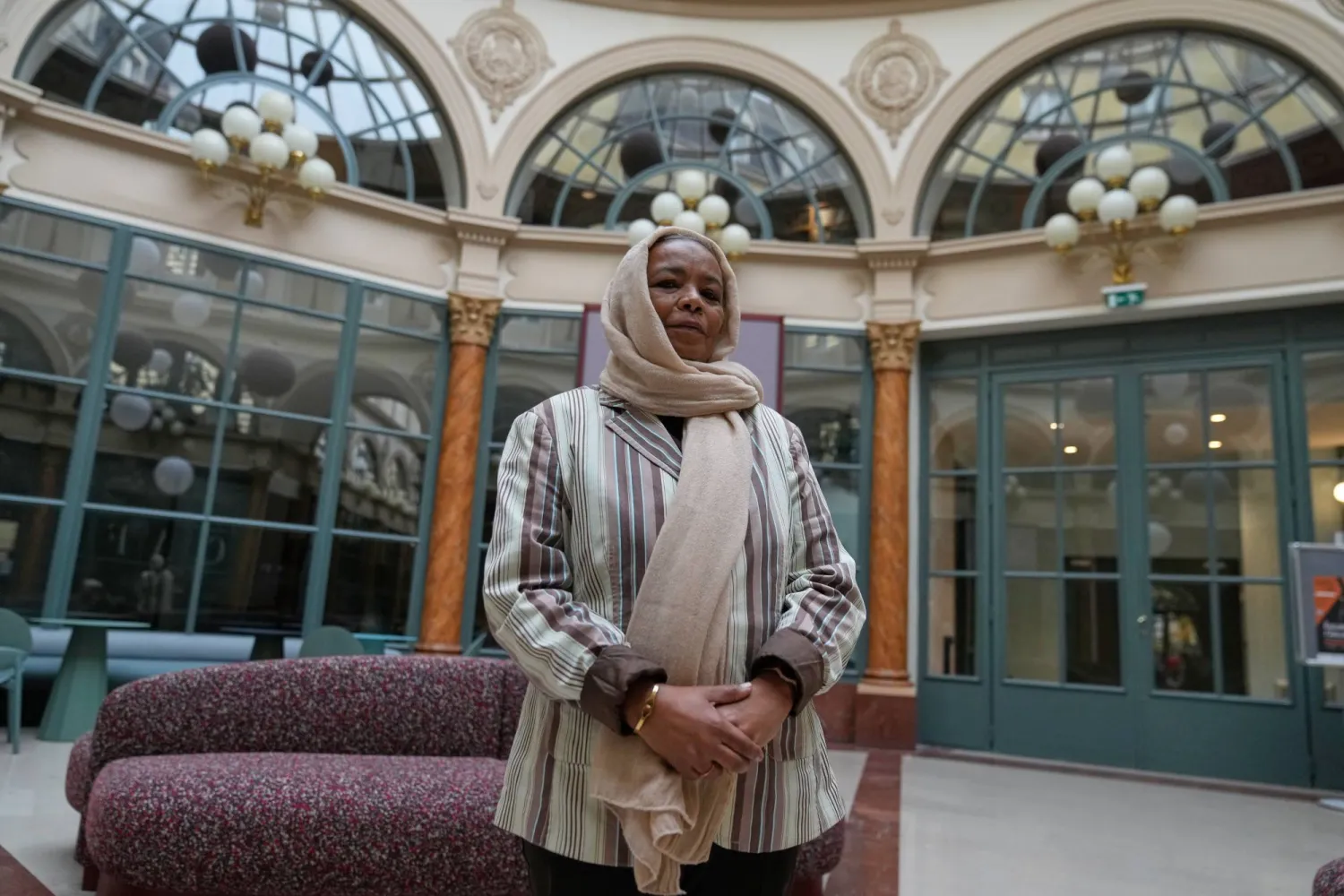
Archaeologist from Sudan's National Museum Dr Shadia Abdrabo, poses in the hall of the French National Institute for Art History (INHA) in Paris, Wednesday, Oct. 29, 2025. (AP Photo/Michel Euler)
TT

An Archaeologist is Racing to Preserve Sudan's Heritage as War Threatens to Erase Its Cultural Past

Archaeologist from Sudan's National Museum Dr Shadia Abdrabo, poses in the hall of the French National Institute for Art History (INHA) in Paris, Wednesday, Oct. 29, 2025. (AP Photo/Michel Euler)

In a dimly lit office in a corner of the French National Institute for Art History, Sudanese archaeologist Shadia Abdrabo studies a photograph of pottery made in her country around 7,000 B.C. She carefully types a description of the Neolithic artifact into a spreadsheet.

As the war between the Rapid Support Forces (RSF) and the Sudanese Armed Forces (SAF) rages on, the curator from Sudan’s National Corporation for Antiquities and Museums (NCAM) is on a yearlong research grant in France with one mission: to build an online database of the African nation’s archaeological sites, museum collections and historical archives.

Soon after the war in Sudan started, in April 2023, museums were looted and destroyed. It’s unclear what exactly went missing, but Abdrabo says her task is to find out — and time is of the essence.

“We have to work fast to secure our collections. We’ve already lost two museums and we don’t want to lose more,” Abdrabo told The Associated Press.

She says two regional museums in El Geneina and Nyala were almost completely destroyed, while in Khartoum, the National Museum — which held an estimated 100,000 objects before the war — was ransacked by militias who posted videos online of their fighters inside the storeroom.

The National Museum had pieces dating back to prehistoric times, including from the Kerma Kingdom and the Napatan era when Kushite kings ruled the region as well as from the Meroitic civilization that built Sudan’s pyramids. Other galleries displayed later Christian and Islamic objects.

Among its most valuable items were mummies dating back to 2,500 B.C., some of the oldest and most archaeologically significant in the world as well as royal Kushite treasures.

‘Entire archives vanished’ UNESCO raised the alarm on reports of plundering saying the “threat to culture appears to have reached an unprecedented level.”

“My heart was broken, you know? It’s not just objects that we lost. We lost research, we lost studies, we lost many things,” Abdrabo said.

Last month, hundreds of people were left dead and more than 80,000 others forced into displacement after the capture of North Darfur’s capital, El Fasher, by the RSF. For Abdrabo the work is deeply personal.

“I’m from Nubia, from the north, an area filled with monuments, archaeological sites and ancient life,” she said. The region was home to some of the world’s earliest kingdoms that rivaled ancient Egypt in power and wealth.

She was working at the national museum in the capital Khartoum when the war started.

“We thought it would finish soon ... but then life started getting really difficult: not just the bombing, but there was no electricity, no water,” she said. With her three sisters, she fled north — first to Atbara, then to Abri, and eventually to Port Sudan.

During that time, Abdrabo and her NCAM colleagues worked tirelessly to try and protect Sudan’s 11 museums and sites — some designated with UNESCO World Heritage status — moving pieces to safe rooms and secret locations.

But efforts to protect Sudan’s art were too slow, said Ali Nour, a Sudanese cultural heritage advocate.

“While applications were being drafted, sites were being emptied. While risk assessments were reviewed, entire archives vanished,” Nour wrote in an article for the UK-based International Institute for Conservation of Historic and Artistic Works.

Urgent recovery efforts UNESCO said it carried out inventories, trained police and customs officers to recognize stolen antiquities, while appealing to collectors “to refrain from acquiring or taking part in the import, export or transfer of ownership of cultural property from Sudan.”

But, unlike similar cultural emergencies that followed wars in Afghanistan and Iraq, "Sudan has not benefited from strong media coverage denouncing the degradation and plundering of its cultural heritage,'' according to researcher Meryam Amarir. ‘’This lack of visibility has reduced the international response.”

Ancient Sudan was connected, through trade and military activity, with Egypt, the Mediterranean world and Mesopotamia, and was the source of much of the gold available in the region, according to Geoff Emberling of the Kelsey Museum of Archaeology at the University of Michigan.

“If we’re interested in these ancient cultures, then we have to be interested in Sudan,” said Emberling, who is involved with the recently established Sudan Cultural Emergency Recovery Fund.

The task force, requested by NCAM, aims to unite institutions, scholars, and donors around the urgent recovery efforts of Sudan’s heritage.

“What Shadia Abdrabo is doing is urgently essential — establishing what’s missing,” Emberling told the AP. “And with a team of about 15 Sudanese now working in the museum in Khartoum to clean and restore what has been damaged, they will soon be able to compare what remains there now.”

‘I cry when I talk about this’ Abdrabo has funding until April 2026 to finish compiling the data and building a platform, but she worries it won’t be enough time.

The work is painstaking. Some datasets arrive as spreadsheets, others as handwritten inventories or photographs taken decades ago. Colleagues at the Louvre, the British Museum and others lend support but she works mostly alone.

“I’m trying to finish this database but it’s a lot. I’ve done about 20% of the work. Just for the national museums, I’ve recorded 1,080 objects so far ... and then I have to do other museums, sites, archives... I need to add pictures, ID numbers, coordinates ...”

As the winter settles over Paris, the crisis in Sudan drives Abdrabo.

“We are working on tracking what has been looted,” she said. “I cry when I talk about this. My only goal and message is to bring back as much as possible, to do as much as I can for Sudan, but it’s not easy for us.”

It’s not just the war itself, but the consequences of it that could affect the country’s heritage: “militias, people displaced... it’s not safe for the art to be in unsecure locations,” she added.

“Until the war finishes we just don’t know what is going to happen.”


Riyadh Art Brings Monumental Works by Saudi Artist Mohammed Al Saleem to its Permanent Collection of Public Art

Created by Saudi-based architecture and engineering consultancy Omrania, the Western Metro Station reinterprets desert sand dunes through earth-colored forms that define entrances - SPA
TT

Riyadh Art Brings Monumental Works by Saudi Artist Mohammed Al Saleem to its Permanent Collection of Public Art

Created by Saudi-based architecture and engineering consultancy Omrania, the Western Metro Station reinterprets desert sand dunes through earth-colored forms that define entrances - SPA

Riyadh Art announced the addition of seven monumental sculptures by pioneering Saudi artist Mohammed Al Saleem to the Riyadh Art permanent collection. Six works have been installed at Western Metro Station on Line 3 (Orange Line) in Riyadh, with the seventh scheduled for installation at a later date.

The sculptures bring an important part of Al Saleem's artistic practice into the city for which they were originally conceived.

Created in 1985 for a Riyadh Municipality public art competition but never installed, the seven works remained in Al Saleem's workshop for decades. In 2022, the Royal Commission for Riyadh City acquired the sculptures and undertook their restoration and conservation, supervised by his daughter, Najla Mohammed Al Saleem, and Al Saleem's foundation, Dar Al-Funoon Al-Sa'udiyyah, to preserve the artist's original vision, SPA reported.

The seven works are Al Showkah Al Khumasiyah (The Pentagon Thorn), Shurfa (Parapet Merlon), Al Kurah (The Ball), Al Mouthalathat (The Triangles), Bur'aum Al Zahrah (The Flower Bud), and Al Ahilla (The Crescents), all installed this August, with Al Nafourah Al Halazouniyah (The Spiral Fountain) due to be installed at a later date. Drawing on desert landscapes, Najdi architecture, geometric forms, and celestial references, the sculptures reflect Al Saleem's distinctive approach to abstraction and the influence of Riyadh and Najd on his practice.

Created by Saudi-based architecture and engineering consultancy Omrania, the Western Metro Station reinterprets desert sand dunes through earth-colored forms that define entrances, allow natural light, and provide shade for pedestrians. Located within Western Station's outdoor plaza, the works bring these references into a contemporary public setting shaped by movement and connection.

"Mohammed Al Saleem holds an important place in the history of modern Saudi art, and his work is deeply connected to Riyadh and the landscape and architecture of Najd," said Senior Director of Riyadh Art Bader AlShenaifi. "Bringing these works into the Riyadh Art permanent collection preserves an important part of Saudi Arabia's artistic heritage while giving Al Saleem's work a lasting presence in the public life of the city that inspired so much of his practice."

The works join the Riyadh Art permanent collection, a citywide collection of public artworks installed across neighborhoods, public spaces, and major transport corridors throughout the capital. The Riyadh Art permanent collection now comprises 82 artworks across the capital.


Paris’ Louvre and Other Top Museums to Close on Saturday Over Concern about Protest Violence

Visitors wait outside as protesters block the entrance to the Louvre Museum to express their support for the high school students' movement in Paris, France, 19 October 2026, two days after demonstrations and riots took place alongside nationwide cost-of-living protests. (EPA)
TT

Paris’ Louvre and Other Top Museums to Close on Saturday Over Concern about Protest Violence

Visitors wait outside as protesters block the entrance to the Louvre Museum to express their support for the high school students' movement in Paris, France, 19 October 2026, two days after demonstrations and riots took place alongside nationwide cost-of-living protests. (EPA)

The Louvre and several other major Paris museums will be closed on Saturday over concerns about potential violence during planned protests, France’s culture ministry said.

In a statement to The Associated Press, the ministry said the Orsay and Picasso museums were also among those that will close.

Protests last Saturday devolved into mayhem, with rioters setting fires, smashing shop windows, looting and clashing with police. The ministry called on all institutions under its authority to adopt any necessary measures to ensure “visitor safety, staff protection and the preservation of artworks,” according to the statement.

Others are taking the same tack. After two days when admission was invite-only, Art Basel Paris opened to the public on Friday — but only for the day, with the threat of unrest prompting organizers on Thursday to cancel the weekend program.

Paris’ Grand Palais is hosting 211 international galleries and their exhibitions for Art Basel, considered one of the world’s most prestigious contemporary art fairs.

“It’s kind of like the art Olympics,” New York-based artist Drake Carr, who is showing his work with Mariposa Gallery, said in an interview.

However, timing proved unfortunate, with the French capital gripped by social tension. The clashes and widespread looting over the weekend marked France’s most violent unrest in years.

A protest on Thursday afternoon in Paris was peaceful, and Art Basel's organizers announced the decision to close for the weekend around the same time. The protest planned for Saturday is expected to be much larger.

"This decision has not been taken lightly, and the safety of everyone involved in the fair remains our utmost priority," organizers said in a statement. Its website posted a similar announcement and said weekend ticketholders would be contacted.

Saloni Doshi, an art collector who travelled to Paris from India for the fair, grew worried last Saturday as she saw the fires and panicked people, and she received phone calls from friends asking whether Paris was safe. She agreed with the organizers' rationale to close.

“It's hard that something like this has to happen, but state activities and people's freedom have to continue,” she told the AP. “I cannot imagine that a bunch of elite, privileged people getting inconvenienced because of this should have a voice.”

Antoine Donzeaud and Elisa Rigoulet, the owners of the gallery exo exo, felt the same.

“We understand this decision, which we consider reasonable and consistent with the urgency of the social demands currently unfolding in France,” they said in a text message.


Twice a Year, a Golden Sunbeam Illuminates a 3,000-Year-Old Pharaonic Temple

 Tourists crowd to film the sun as it sends a beam of light into the Great Temple of Ramses II's dark inner chamber in Abu Simbel, 870 kilometers (540 miles) south of Cairo, Egypt, Thursday, Oct. 22, 2026, a rare 3,200-year-old astronomical ceremony that happens twice a year. (AP)
Tourists crowd to film the sun as it sends a beam of light into the Great Temple of Ramses II's dark inner chamber in Abu Simbel, 870 kilometers (540 miles) south of Cairo, Egypt, Thursday, Oct. 22, 2026, a rare 3,200-year-old astronomical ceremony that happens twice a year. (AP)
TT

Twice a Year, a Golden Sunbeam Illuminates a 3,000-Year-Old Pharaonic Temple

 Tourists crowd to film the sun as it sends a beam of light into the Great Temple of Ramses II's dark inner chamber in Abu Simbel, 870 kilometers (540 miles) south of Cairo, Egypt, Thursday, Oct. 22, 2026, a rare 3,200-year-old astronomical ceremony that happens twice a year. (AP)
Tourists crowd to film the sun as it sends a beam of light into the Great Temple of Ramses II's dark inner chamber in Abu Simbel, 870 kilometers (540 miles) south of Cairo, Egypt, Thursday, Oct. 22, 2026, a rare 3,200-year-old astronomical ceremony that happens twice a year. (AP)

Hundreds of tourists from around the world and locals gathered at dawn Thursday at a temple in southern Egypt, with some sleeping outside it overnight to witness a solar phenomenon that has taken place here for millennia.

Twice a year, on Oct. 22 and Feb. 22 — dates believed to mark the ascension of Ramesses II to the throne and his birthday — the sun sends a beam of light into the Great Temple of Ramses II’s dark inner chamber to illuminate the statues of the pharaoh and two gods beside him.

The illumination, a result of the temple's alignment with the sun, lasts about 20 minutes.

“Today is a very special day, as you can see. It’s a celebration and a historic holiday," Hisham Khela, a local tour guide for Italian tourists, told The Associated Press.

Egyptology enthusiasts and other visitors stood in a messy single-file line with phone cameras in hand, some with selfie sticks and most with bags under their eyes from waking up so early. Although huge crowds turned up, they looked tiny beside the giant statues lining the temple, which overlooks the Nile.

To mark the phenomenon, colorfully dressed performers scattered in front of the temple smiled and danced in unison to meditative chimes, the percussion of the tabla and the distinct sound of mizmars, an ancient Egyptian trumpet.

Inside the temple, visitors huddled tightly in near-total darkness in front of the statues of Ramesses II and the gods Amun-Ra and Ra-Horakhty, lit by a beam of sunlight that traveled about 60 meters (200 feet) into the temple, according to the National Research Institute of Astronomy and Geophysics.

For first-timers, ancient history created modern memories.

Janice Souudi, who traveled from Atlanta, Georgia, said it was her first time in Egypt, and she said it won’t be her last.

“I came here today for the huge temple statues and how well preserved they are. But I was most impressed with the colors of the carvings and hieroglyphics and imagery," she said. "Beautiful, stunning, worth it!”

In the 1960s, archaeologists carried out a massive project to dismantle and relocate the temple, moving it out of the path of rising waters created by the Aswan High Dam.

Engineers took care to preserve the temple’s alignment with the sun, so that more than 3,000 years after it was built, the light still finds its way inside.