

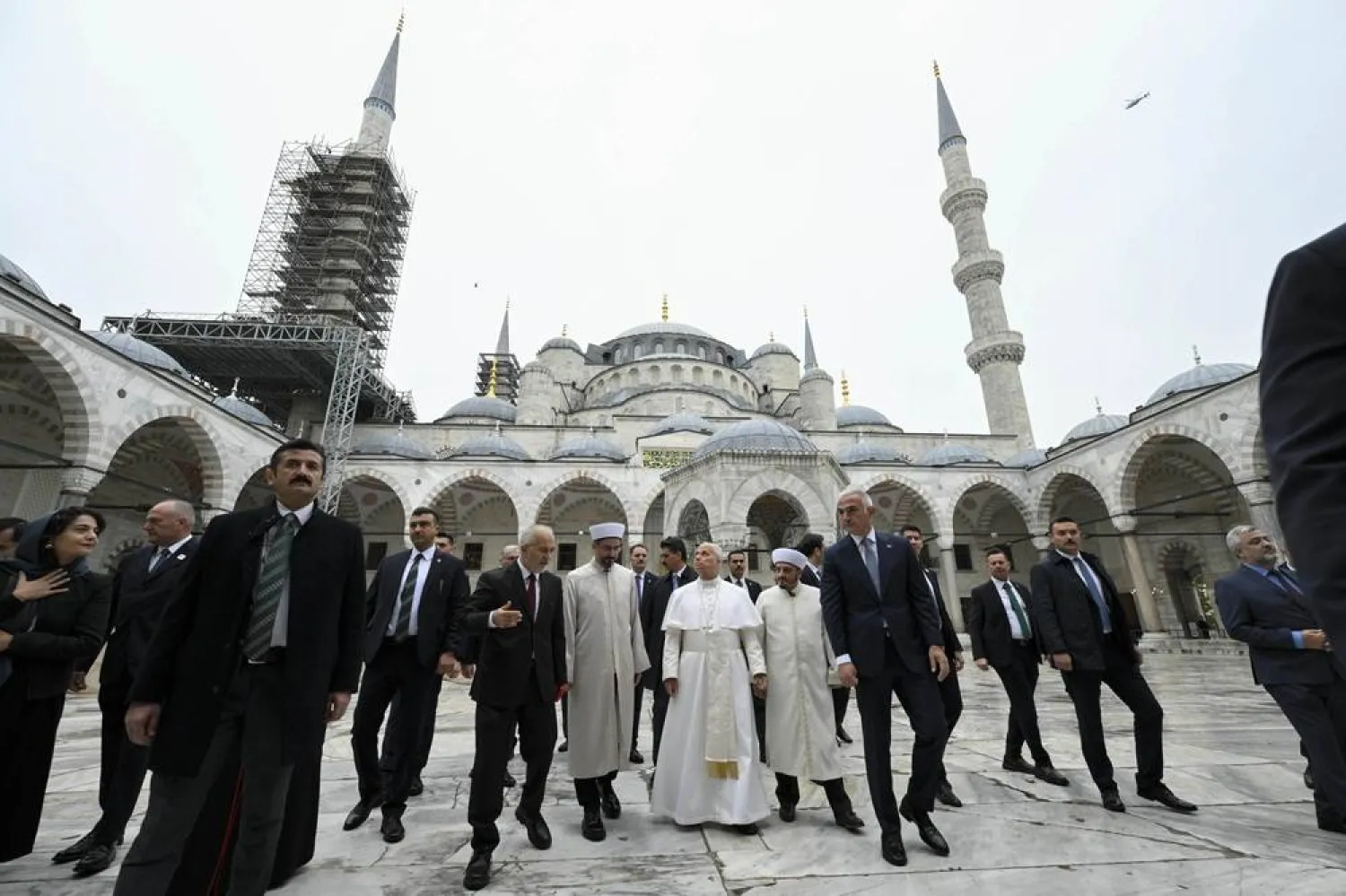

Pope Visits Istanbul’s Blue Mosque at Start of Day of Meetings with Türkiye's Religious Leaders

A handout picture provided by the Vatican Media shows Pope Leo XIV (C) during a visit to the Sultan Ahmed Mosque (The Blue Mosque) in Istanbul, Türkiye, 29 November 2025. (EPA/Vatican Media)
TT

Pope Visits Istanbul’s Blue Mosque at Start of Day of Meetings with Türkiye's Religious Leaders

A handout picture provided by the Vatican Media shows Pope Leo XIV (C) during a visit to the Sultan Ahmed Mosque (The Blue Mosque) in Istanbul, Türkiye, 29 November 2025. (EPA/Vatican Media)

Pope Leo XIV visited Istanbul’s Blue Mosque on Saturday but didn't stop to pray, as he opened an intense day of meetings and liturgies with Türkiye's religious leaders and a Mass for the country's tiny Catholic community.

The head of Türkiye's Diyanet religious affairs directorate showed Leo the soaring tiled domes of the 17th-century mosque and the Arabic inscriptions on its columns, as Leo nodded in understanding.

The Vatican had said Leo would observe a “brief minute of silent prayer” there, but it didn't appear that he had. The imam of the mosque, Asgin Tunca, said he had invited Leo to pray, since the mosque was “Allah's house,” but the pope declined.

Speaking to reporters after the visit, Tunca said he had told the pope: "It’s not my house, not your house, (it’s the) house of Allah,” he said. He said he told Leo: “'If you want, you can worship here,’ I said. But he said, ‘That’s OK.’”

“He wanted to see the mosque, wanted to feel (the) atmosphere of the mosque, I think. And was very pleased,” he said.

Later, Vatican spokesman Matteo Bruni said: “The pope experienced his visit to the mosque in silence, in a spirit of contemplation and listening, with deep respect for the place and the faith of those who gather there in prayer.”

Leo, history's first American pope, was following in the footsteps of his recent predecessors, who all made high-profile visits to the Sultan Ahmed Mosque, as it is officially known, in a gesture of respect to Türkiye's Muslim majority. Leo removed his shoes and walked through the carpeted mosque in his white socks.

But the visits have always raised questions about whether the pope would pray in the Muslim house of worship, or at the very least pause to gather thoughts in a meditative silence.

There were no doubts in 2014 when Pope Francis visited: He stood for two minutes of silent prayer facing east, his head bowed, eyes closed and hands clasped in front of him. The Grand Mufti of Istanbul, Rahmi Yaran, told the pope afterwards, “May God accept it.”

When Pope Benedict XVI visited Türkiye in 2006, tensions were high because Benedict had offended many in the Muslim world a few months earlier with a speech in Regensburg, Germany that was widely interpreted as linking Islam and violence.

The Vatican added a visit to the Blue Mosque at the last minute in a bid to reach out to Muslims, and Benedict was warmly welcomed. He observed a moment of silent prayer, head bowed, as the imam prayed next to him, facing east.

Benedict later thanked him “for this moment of prayer" for what was only the second time a pope had visited a mosque, after St. John Paul II visited one briefly in Syria in 2001.

Hagia Sophia left off itinerary

Past popes have also visited the nearby Hagia Sophia landmark, once one of the most important historic cathedrals in Christianity and a United Nations-designated world heritage site.

But Leo left that visit off his itinerary on his first trip as pope. In July 2020, Türkiye converted Hagia Sophia from a museum back into a mosque, a move that drew widespread international criticism, including from the Vatican.

After the mosque visit, Leo held a private meeting with Türkiye's Christian leaders at the Syriac Orthodox Church of Mor Ephrem. In the afternoon, he was expected to pray with the spiritual leader of the world’s Orthodox Christians, Patriarch Bartholomew, at the patriarchal church of Saint George.

He will end the day with a Catholic Mass in Istanbul's Volkswagen Arena for the country's Catholic community, who number 33,000 in a country of more than 85 million people, most of whom are Sunni Muslim.

Leo had prayed with these Christian leaders on Friday in Iznik, at the site of the A.D. 325 Council of Nicaea, the highlight of his trip. The occasion was to mark the 1,700th anniversary of the council, the unprecedented meeting of bishops that produced the creed, or statement of faith, that is still recited by millions of Christians today.

Standing over the ruins of the site, the men recited the creed. Leo urged them “to overcome the scandal of the divisions that unfortunately still exist and to nurture the desire for unity.”

Such unity, he said, was of particular importance at a time “marked by many tragic signs, in which people are subjected to countless threats to their very dignity.”

The Nicaea gathering took place at a time when the Eastern and Western churches were still united. They split in the Great Schism of 1054, a divide precipitated largely by disagreements over the primacy of the pope, and then in other splintering divisions. But even today, Catholic, Orthodox and most historic Protestant groups accept the Nicaean Creed, making it a point of agreement and the most widely accepted creed in Christendom.

As a result, celebrating its origins at the site of its creation with the spiritual leaders of the Catholic and Orthodox churches and other Christian representatives marked a historic moment in the centuries-old quest to reunite all Christians.



Russia: Man Suspected of Shooting Top General Detained in Dubai

An investigator works outside a residential building where the assassination attempt on Russian Lieutenant General Vladimir Alexeyev took place in Moscow, Russia February 6, 2026. REUTERS/Anastasia Barashkova
TT

Russia: Man Suspected of Shooting Top General Detained in Dubai

An investigator works outside a residential building where the assassination attempt on Russian Lieutenant General Vladimir Alexeyev took place in Moscow, Russia February 6, 2026. REUTERS/Anastasia Barashkova

Russia's Federal Security Service (FSB) said on Sunday that the man suspected of shooting top Russian military intelligence officer Vladimir Alexeyev in Moscow has been detained in Dubai and handed over to Russia.

Lieutenant General Vladimir Alexeyev, deputy head of the GRU, ⁠Russia's military intelligence arm, was shot several times in an apartment block in Moscow on Friday, investigators said. He underwent surgery after the shooting, Russian media ⁠said.

The FSB said a Russian citizen named Lyubomir Korba was detained in Dubai on suspicion of carrying out the shooting.

Russian Foreign Minister Sergei Lavrov accused Ukraine of being behind the assassination attempt, which he said was designed to sabotage peace talks. ⁠Ukraine said it had nothing to do with the shooting.

Alexeyev's boss, Admiral Igor Kostyukov, the head of the GRU, has been leading Russia's delegation in negotiations with Ukraine in Abu Dhabi on security-related aspects of a potential peace deal.


Factory Explosion Kills 8 in Northern China

Employees work on an electric vehicle (EV) production line at the Volkswagen Anhui factory in Hefei, Anhui province, China, February 4, 2026. REUTERS/Florence Lo
TT

Factory Explosion Kills 8 in Northern China

Employees work on an electric vehicle (EV) production line at the Volkswagen Anhui factory in Hefei, Anhui province, China, February 4, 2026. REUTERS/Florence Lo

An explosion at a biotech factory in northern China has killed eight people, Chinese state media reported Sunday, increasing the total number of fatalities by one.

State news agency Xinhua had previously reported that seven people died and one person was missing after the Saturday morning explosion at the Jiapeng biotech company in Shanxi province, citing local authorities.

Later, Xinhua said eight were dead, adding that the firm's legal representative had been taken into custody.

The company is located in Shanyin County, about 400 kilometers west of Beijing, AFP reported.

Xinhua said clean-up operations were ongoing, noting that reporters observed dark yellow smoke emanating from the site of the explosion.

Authorities have established a team to investigate the cause of the blast, the report added.

Industrial accidents are common in China due to lax safety standards.
In late January, an explosion at a steel factory in the neighboring province of Inner Mongolia left at least nine people dead.


Iran Warns Will Not Give Up Enrichment Despite US War Threat

Traffic moves through a street in Tehran on February 7, 2026. (Photo by ATTA KENARE / AFP)
TT

Iran Warns Will Not Give Up Enrichment Despite US War Threat

Traffic moves through a street in Tehran on February 7, 2026. (Photo by ATTA KENARE / AFP)

Iran will never surrender the right to enrich uranium, even if war "is imposed on us,” its foreign minister said Sunday, defying pressure from Washington.

"Iran has paid a very heavy price for its peaceful nuclear program and for uranium enrichment," Abbas Araghchi told a forum in Tehran.

"Why do we insist so much on enrichment and refuse to give it up even if a war is imposed on us? Because no one has the right to dictate our behavior," he said, two days after he met US envoy Steve Witkoff in Oman.

The foreign minister also declared that his country was not intimidated by the US naval deployment in the Gulf.

"Their military deployment in the region does not scare us," Araghchi said.