


Black Friday Consumers Go Online, Rather Than Stand in Line

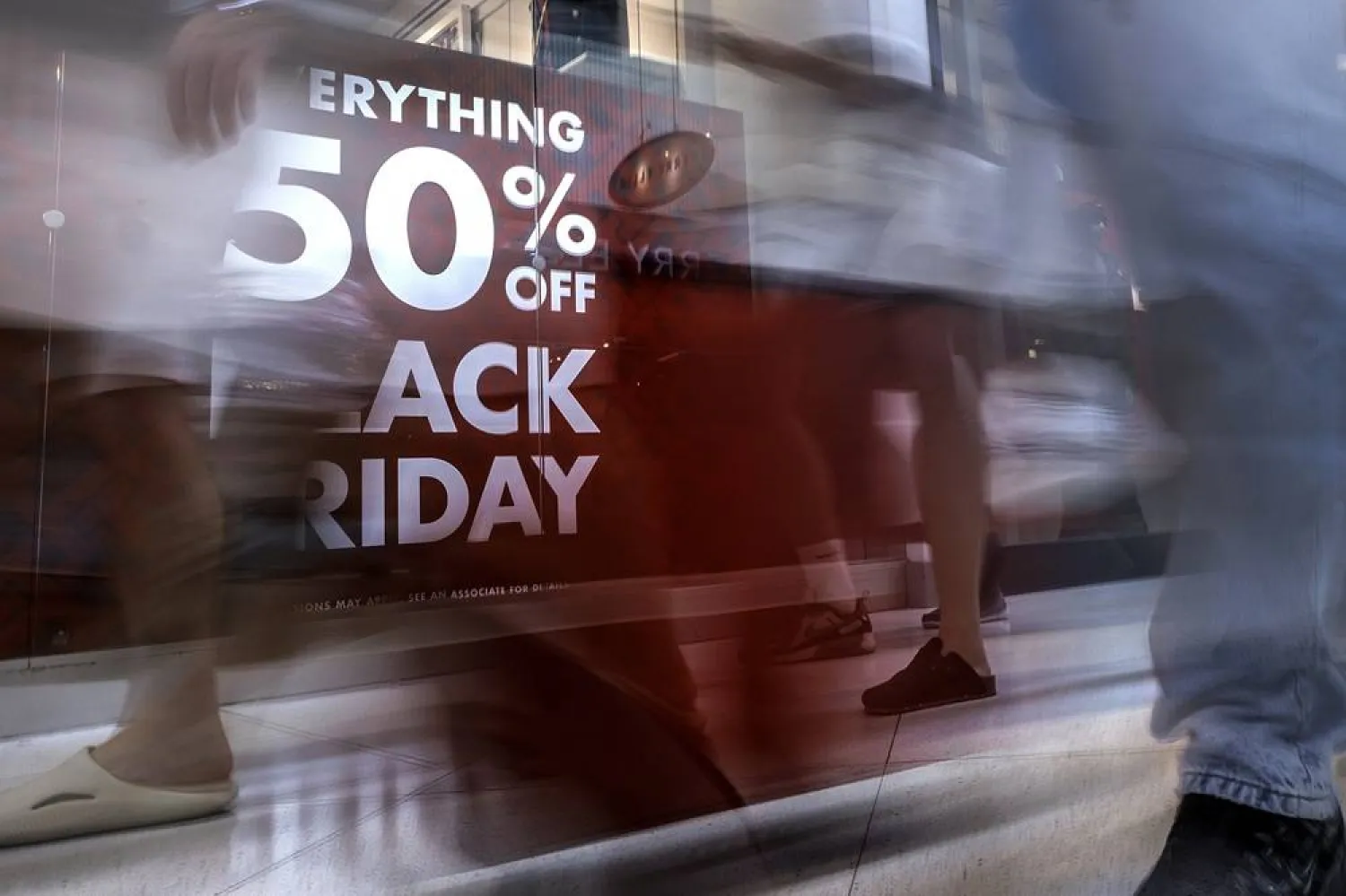
Shoppers browse stores at the Dolphin Mall during Black Friday in Miami, Florida, USA, 28 November 2025. (EPA)
TT

Black Friday Consumers Go Online, Rather Than Stand in Line

Shoppers browse stores at the Dolphin Mall during Black Friday in Miami, Florida, USA, 28 November 2025. (EPA)

Bargain-hunting Americans clicked their way through Thanksgiving, spending $8.6 billion online so far on Black Friday, as more consumers turned to laptops and phones instead of braving brisk weather to snap up deals over the crucial shopping weekend.

Adobe Analytics, which vets e-commerce transactions online, covering over 1 trillion visits to US retail sites, expects US shoppers will spend between $11.7 billion and $11.9 billion online on Black Friday.

While early online sales figures showed a promising trend for spending, at major retailers - a bulk of Black Friday shopping has happened between 10 a.m. and 2 p.m. ET (1900 GMT), according to data from Adobe Analytics, with another surge expected in the evening. Many of those who ventured out said they were on a budget, fearful of overspending at a time when inflation remains above-trend and the labor market is softening.

“I’m being much more careful,” said Grace Curbelo, 67, of New Rochelle, New York, who was at the Woodbury Common outlet center in Central Valley, New York, on Friday morning. “I’m not sure how the economy will turn, and I don’t want to put myself in debt.”

CAUTIOUS CONSUMERS, HIGHER PRICES

Strong Black Friday spending has been driven by deeper-than-expected discounts, Adobe said. Online shopping has diluted Black Friday's significance, with promotions geared towards the event spread across weeks. Adobe Analytics expects Cyber Monday to drive $14.2 billion in online sales, up 6.3% from last year, making it the biggest online shopping day of the year.

Shoppers are leaning heavily on promotional codes found online through social media influencers to squeeze out extra discounts during Cyber Week, said Vivek Pandya, director of Adobe Digital Insights at Adobe Analytics.

The specter of higher prices hovered over the day. US retail sales increased less than expected in September, in part due to elevated prices, and President Donald Trump's tariffs have contributed to this trend, adding roughly 4.9 percentage points to retail prices, according to the non-profit Tax Foundation.

Software firm Salesforce said its early data showed prices in the United States rising faster than worldwide. The average online selling price for goods was 8% higher than last year, compared with 5% globally, a sign of both the effect of tariffs and spending from affluent households, who have continued to shop while most income groups say their consumer confidence is low.

"This is the only market where we're seeing such high increases in average selling price. So there absolutely is a component of retailers trying to save margins because of the impact of the tariffs," said Caila Schwartz, director of consumer insights at Salesforce.

With unemployment near a four-year high, shoppers have also become more selective. US consumer confidence sagged to a seven-month low in November, according to economic research group The Conference Board, with fewer households planning to buy motor vehicles, houses and other big-ticket items over the next six months, or to make vacation plans.

The richest 10% of Americans - those earning at least $250,000 annually - accounted for about 48% of all consumer spending in the second quarter of 2025, a steady increase from around 35% of spending in the mid-1990s, according to Moody's Analytics.

"Higher income consumers are a little more resilient, and that's why we're seeing strong growth in categories like furniture and luxury," said Schwartz.

Heather Cheatham, 50, of Lynchburg, Virginia, started her Black Friday shopping by sampling scents and hunting for Armani eye tints in LVMH's Sephora at Crabtree Valley Mall in Raleigh, North Carolina. Cheatham did not give herself a budget, and she has already purchased gifts for her daughter at apparel company American Eagle Outfitters' Aerie, stereo equipment for her son and a golf putter for her other son.

QUIET AT SUNUP

Black Friday looked different this year, according to Marshal Cohen, chief retail adviser at Circana, who spent the morning visiting stores and malls across New York and New Jersey. Gone were the early-morning rushes and long lines outside retailers.

Among the retailers Cohen visited, Target "won the morning," he said, because it handed out swag bags to the first 100 customers. Walmart gained momentum later in the day as traffic picked up.

About an hour before sunup in freezing temperatures, Quantavius Shorter, 40, a diesel engine mechanic from Atlanta, was one of the first of only a dozen people waiting in line at 5:59 a.m. at the local Walmart in Atlanta's Gresham Park neighborhood.

Shorter bought a Roku flat-screen smart TV for $298, a perfect discount for his smaller Christmas budget.

"This is usually $500," said Shorter. "I'm here early because I expected it to sell out."

In Europe, the shopping day was marked by strikes at Amazon warehouses in Germany, with separate protests also planned outside Zara stores in Spain. Meanwhile, Starbucks' workers union also said they were escalating their ongoing indefinite strike to 26 more stores in the US on Black Friday.



Egypt Plans $1 Billion Red Sea Marina, Hotel Development

This picture shows a partial view of Egypt's Red Sea city of Sharm el-Sheikh, October 7, 2025. (AFP)
TT

Egypt Plans $1 Billion Red Sea Marina, Hotel Development

This picture shows a partial view of Egypt's Red Sea city of Sharm el-Sheikh, October 7, 2025. (AFP)

Egypt announced plans on Monday for a new $1 billion marina, hotel and housing development on the Red Sea in a bid to boost the region's tourist industry.

Construction on the "Monte Galala Towers and Marina" project would ‌start in ‌the second ‌half ⁠of the ‌year and run for seven years, Ahmed Shalaby, managing director of the main developer, Tatweer Misr, said.

The 10-tower development - a partnership with the ⁠housing ministry and other state bodies ‌including the armed ‍forces' engineering authority - ‍would cost about 50 ‍billion Egyptian pounds ($1.07 billion), he added.

The project, also announced by the cabinet, will cover 470,000 square meters on the Gulf of Suez, about ⁠35 km south of Ain Sokhna, Shalaby said.

Egypt aims to boost total tourist arrivals to around 30 million by 2030, from around 19 million recorded by the tourism ministry in 2025.


Saudi-Polish Investment Forum Explores Prospects for Economic and Investment Cooperation

The forum brought together government officials, business leaders, and investors from both countries with the aim of enhancing economic cooperation - SPA
TT

Saudi-Polish Investment Forum Explores Prospects for Economic and Investment Cooperation

The forum brought together government officials, business leaders, and investors from both countries with the aim of enhancing economic cooperation - SPA

The Saudi-Polish Investment Forum was held today at the headquarters of the Federation of Saudi Chambers in Riyadh, with the participation of Minister of Investment Khalid Al-Falih, Minister of Finance of the Republic of Poland Andrzej Domański, and Vice President of the Federation of Saudi Chambers Emad Al-Fakhri.

The forum brought together government officials, business leaders, and investors from both countries with the aim of enhancing economic cooperation, expanding investment partnerships in priority sectors, and exploring high-quality investment opportunities that support sustainable growth in Saudi Arabia and Poland.

During a dedicated session, the forum reviewed economic and investment prospects in both countries through presentations highlighting promising opportunities, investment enablers, and supportive legislative environments.

Several specialized roundtables addressed strategic themes, including the development of the digital economy, with a focus on information and communication technologies (ICT), financial technologies (fintech), and artificial intelligence-driven innovation, SPA reported.

Discussions also covered the development of agricultural value chains from production to market access through advanced technologies, food processing, and agricultural machinery. In addition, participants examined ways to enhance the construction sector by developing systems and materials, improving execution efficiency, and accelerating delivery timelines. Energy security issues and the role of industrial sectors in supporting economic transformation and sustainability were also discussed.

The forum witnessed the announcement of two major investment agreements. The first aims to establish a framework for joint cooperation in supporting investment, exchanging information and expertise, and organizing joint business events to strengthen institutional partnerships.

The second agreement focuses on supporting reciprocal investments through the development of financing and insurance tools and the stimulation of joint ventures to boost investment flows.

The forum concluded by emphasizing the importance of continued coordination and dialogue between the public and private sectors in both countries to deepen Saudi-Polish economic relations and advance shared interests.


Gold Rises as Dollar Slips, Focus Turns to US Jobs Data

FILE PHOTO: An employee places ingots of 99.99 percent pure gold in a workroom at the Novosibirsk precious metals refining and manufacturing plant in the Siberian city of Novosibirsk, Russia, September 15, 2023. REUTERS/Alexander Manzyuk/File Photo
TT

Gold Rises as Dollar Slips, Focus Turns to US Jobs Data

FILE PHOTO: An employee places ingots of 99.99 percent pure gold in a workroom at the Novosibirsk precious metals refining and manufacturing plant in the Siberian city of Novosibirsk, Russia, September 15, 2023. REUTERS/Alexander Manzyuk/File Photo

Gold prices rose on Monday, buoyed by a softer dollar as investors braced for a week packed with US economic data that could offer more clues on the US Federal Reserve's monetary policy.

Spot gold rose 1.2% to $5,018.56 per ounce by 9:30 a.m. ET (1430 GMT), extending a 4% rally from Friday.

US gold futures for April delivery also gained 1.3% to $5,042.20 per ounce.

The US dollar fell 0.8% to a more than one-week low, making greenback-priced bullion cheaper for overseas buyers.

"The big mover today (in gold prices) is the US dollar," said Bart Melek, global head of commodity strategy at TD Securities, adding that expectations are growing for weak economic data, particularly on the labor front, Reuters reported.

Investors are closely watching this week's release of US nonfarm payrolls, consumer prices and initial jobless claims for fresh signals on monetary policy, with markets already pricing in at least two rate cuts of 25 basis points in 2026.

US nonfarm payrolls are expected to have risen by 70,000 in January, according to a Reuters poll.

Lower interest rates tend to support gold by reducing the opportunity cost of holding the non-yielding asset.

Meanwhile, China's central bank extended its gold buying spree for a 15th month in January, data from the People's Bank of China showed on Saturday.

"The debasement trade continues, with ongoing geopolitical risks driving people into gold," Melek said, adding that China's purchases have had a psychological impact on the market.

Spot silver climbed 2.9% to $80.22 per ounce after a near 10% gain in the previous session. It hit an all-time high of $121.64 on January 29.

Spot platinum was down 0.2% at $2,092.95 per ounce, while palladium was steady at $1,707.25.

"A slowdown in EV sales hasn't really materialized despite all the policy softening, so I do see that platinum and palladium will possibly slow down," after a bullish run in 2025, WisdomTree commodities strategist Nitesh Shah said.