
Dinosaur Tartare and Holograms: Dubai’s AI Chef Concept Draws Major Attention

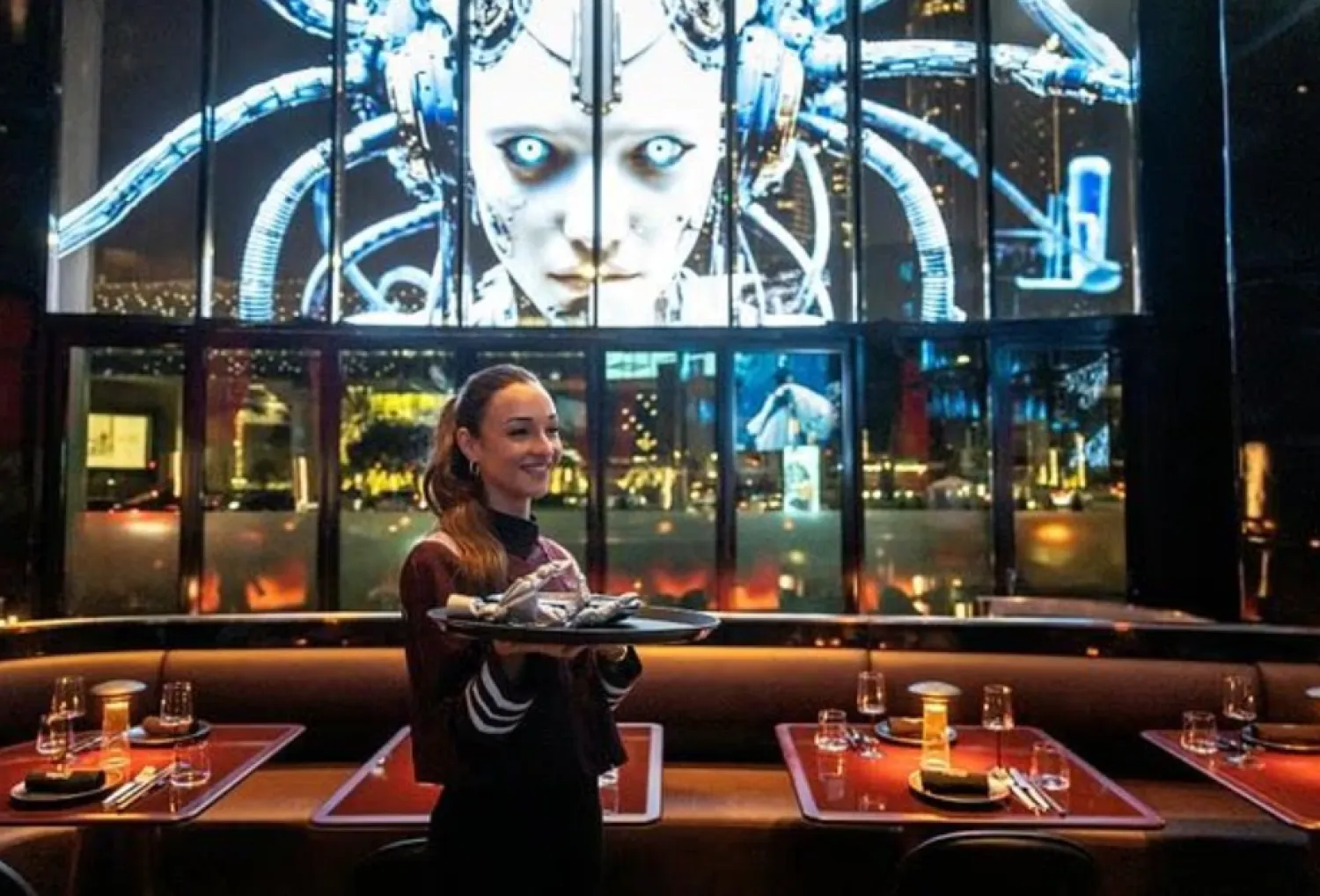
At Woohoo, the brains behind the menu is not a person but an AI program -- known as chef Aiman -- trained on thousands of recipes and decades of culinary research - AFP
TT

Dinosaur Tartare and Holograms: Dubai’s AI Chef Concept Draws Major Attention

At Woohoo, the brains behind the menu is not a person but an AI program -- known as chef Aiman -- trained on thousands of recipes and decades of culinary research - AFP

A Dubai restaurant has opened that features what it calls the world's "first AI chef", introducing new technology in a city focused on the future.

The Emirati city is widely recognized for its growing culinary scene, with thousands of restaurants on offer from luxurious Michelin-starred eateries to street food from across the Middle East and Asia.

At Woohoo, the creator of the menu is an AI program -- known as chef Aiman -- trained on thousands of recipes and decades of culinary research and molecular gastronomy.

Chef Aiman can also optimize menus and balance flavors, according to the establishment.

The real work of preparing and serving the food remains in human hands, for now.

"AI is going to create better dishes than humans maybe in the future," said the restaurant's Turkish co-founder Ahmet Oytun Cakir, AFP reported.

While Woohoo's menu is largely international fusion dishes, some AI creations stand out.

This includes a "dinosaur tartare" created using DNA mapping.

Priced at roughly 50 euros ($58), the dish tastes like a combination of raw meats and is served on a pulsating plate to appear as if it were breathing.

"It was a total surprise. It was so delicious," said customer Efe Urgunlu.

Along with AI-generated holograms and sci-fi animation, the venue features a giant cylindrical computer presented as the digital mainframe powering the restaurant's effects.

Woohoo's Turkish chef Serhat Karanfil oversees the cooking and final presentation and adjusts the flavors when needed. "If I taste it, for example, and it is too spicy, I talk to chef Aiman again. After we discuss, we find the right balance," he said.

Cakir has high hopes that chef Aiman will one day become "the next Gordon Ramsay -- but AI".

For Michelin-starred chef Mohamad Orfali, "there is no such thing as an AI chef". His Orfali Bros restaurant earned a Michelin star last year, after Dubai became the first Middle Eastern city to join the prestigious guide in 2022.

Cooking requires "nafas", or soul, Orfali explained, using the Arabic term that describes a cook's personal flair for food and their ability to create exceptional meals.

"Artificial intelligence lacks feelings and memories; in short, it has no nafas... It can't imbue it into food."

Orfali said he limited the use of AI in his own establishment to administrative tasks such as setting the kitchen schedule and providing additional research. "We use it as a kitchen assistant, but ultimately, it won't cook," he said.

"Everyone is supporting these ideas here in Dubai," said Cakir.

The restaurant has also created a social media buzz, with an Instagram account dedicated to the AI Chef that features chef Aiman's avatar in videos sharing tips and recipes.

Dio, a customer who didn't give her last name, said she visited the restaurant after seeing the excitement around it.

"It is such a creative concept, so I thought I must experience it myself," she said.

"The dishes were extraordinary."


Germany Approves New Rescue Bid for Stranded Whale

People stand close to a stranded humpback whale in the Wismarer Bucht bay of the Baltic Sea off the island of Poel, northern Germany, close to the village of Faehrdorf-Hof, on April 28, 2026. (AFP)
TT

Germany Approves New Rescue Bid for Stranded Whale

People stand close to a stranded humpback whale in the Wismarer Bucht bay of the Baltic Sea off the island of Poel, northern Germany, close to the village of Faehrdorf-Hof, on April 28, 2026. (AFP)

German officials Tuesday gave the green light for a fresh rescue attempt for a humpback whale which has been stranded off the country's Baltic Sea coast for over a month.

The 13-metre (over 40 foot) whale and its struggle for survival have gripped Germany since the sea mammal beached on a sandbank near the city of Luebeck, far from its natural habitat.

After several initial attempts failed, two entrepreneurs came forward to finance a new rescue bid which will involve loading the cetacean onto a special barge and carrying it out to deeper waters.

Till Backhaus, environment minister for the state of Mecklenburg-Western Pomerania, said that two vets had examined the whale and believed it was "fit to be transported."

After his announcement, rescuers in diving suits could be seen next to the whale, standing in shallow waters near the island of Poel, with the barge close by.

The creature, dubbed "Timmy" by some of the German press, was first spotted stuck on a sandbank on March 23 near Luebeck before freeing itself and then becoming stuck again several times.

At the start of April officials gave up on the animal, saying they believed it could not be saved.

But this triggered an outcry and authorities were persuaded to let the entrepreneurs come up with a rescue plan.

Some scientists have strongly criticized the decision to allow further rescue bids, believing they will be too risky for the whale and estimating the chances of success as low.

Backhaus however insisted it was his "absolute priority" that the mammal be rescued alive, and he was trying to "do everything possible to help" the creature.

The saga has sparked a media frenzy -- with non-stop coverage from TV channels, online outlets and social media influencers -- but has also led to angry spats and conspiracy theories.


New Treatment Brings Hope to Children with Cancer

Researchers have developed a new targeted cancer therapy that can precisely seek out and destroy tumor cells. (UBC)
TT

New Treatment Brings Hope to Children with Cancer

Researchers have developed a new targeted cancer therapy that can precisely seek out and destroy tumor cells. (UBC)

Researchers at the University of British Columbia (UBC) Faculty of Medicine in Canada have developed a new targeted cancer therapy that can precisely seek out and destroy tumor cells, showing strong results in preclinical studies that bring the breakthrough closer to human clinical trials.

The findings were published last Monday in the Cancer Discovery Journal.

The therapy targets a protein called IL1RAP, which is found on the surface of certain cancer cells, but is largely absent from normal tissues.

By linking a cancer-killing drug to an antibody that recognizes this protein, the team created an antibody-drug conjugate that delivers treatment directly to cancer cells while sparing healthy tissues.

In multiple models of Ewing sarcoma — a rare and aggressive cancer affecting children and young adults — the treatment eliminated established tumors and dramatically reduced the spread of cancer.

Similar effects were seen in other cancers, including lymphoma and tumors driven by specific genetic alterations (NTRK fusions).

“This is exactly the kind of target we look for, something that’s present on cancer cells but largely absent from normal tissues,” said senior author Dr Poul Sorensen, professor of pathology and laboratory medicine at UBC’s Faculty of Medicine and a distinguished scientist at BC Cancer. “It allows us to deliver treatment with a high degree of precision.”

“This isn’t a distant possibility,” said Sorensen, who also holds the Johal Endowed Chair in Childhood Cancer Research. “The data position this for clinical trials in the very near future, pending the next steps in development and regulatory approval.”

The approach builds on earlier work by Sorensen and his team, including first author Dr Haifeng Zhang from the Sorensen laboratory, which identified IL1RAP as a key protein that helps cancer cells survive in the bloodstream and spread to other parts of the body.

When cancer cells break away from a primary tumor, they must endure a hostile environment in the circulatory system before establishing new tumors elsewhere. IL1RAP appears to help them adapt and survive during this process.

Metastatic disease, which occurs when cancer spreads throughout the body, is the single most powerful predictor of poor outcome for cancer patients of all ages and has been a difficult process for researchers to study or for clinicians to target.

“We think of this protein almost like a protective shield,” said Zhang, a scientist in the Sorensen Lab. “It helps cancer cells withstand the stresses of travelling through the body and forming metastases. What we’ve done here is turn that shield into a target, using it to deliver a drug directly into those cells.”

Crucially, the therapy demonstrated a strong safety profile in preclinical testing, supporting its readiness for clinical development — an important step toward human trials.

The findings highlight a promising new strategy for targeting cancers driven by specific genetic alterations that expresses the IL1RAP protein, potentially opening the door to more precise, effective treatments for both pediatric and adult patients.


Saudi Arabia, Russia Mark 100 Years of Diplomatic Ties with Historical Photo Exhibition in Moscow

The event was hosted at the Russian Ministry of Foreign Affairs in the presence of Russian Deputy Foreign Minister Borisenko Georgy Evgenievich and Saudi Arabia's Ambassador to the Russian Federation Sami Al-Sadhan. (SPA)
TT

Saudi Arabia, Russia Mark 100 Years of Diplomatic Ties with Historical Photo Exhibition in Moscow

The event was hosted at the Russian Ministry of Foreign Affairs in the presence of Russian Deputy Foreign Minister Borisenko Georgy Evgenievich and Saudi Arabia's Ambassador to the Russian Federation Sami Al-Sadhan. (SPA)

The Russian Ministry of Foreign Affairs, in cooperation with the King Abdulaziz Foundation for Research and Archives (Darah), held an exhibition of historical photographs on Monday in Moscow, marking 100 years since the establishment of diplomatic relations between Saudi Arabia and Russia.

The event was hosted at the ministry in the presence of Russian Deputy Foreign Minister Borisenko Georgy Evgenievich and Saudi Arabia's Ambassador to the Russian Federation Sami Al-Sadhan.

Al-Sadhan underlined the importance of the exhibition in showcasing key milestones in the history of relations between the two countries through a collection of historical photographs and documents.

“The exhibition, featuring carefully selected historical photographs and documents, serves to revive a historical memory filled with achievements, initiatives, and strategic partnerships between two pivotal states that hold significant weight and standing on the international stage,” he said.

Saudi Arabia and Russia are commemorating the centenary of their diplomatic relations this year through a series of celebrations and events across various fields, most notably in the economic, cultural, tourism, and sports sectors, he added.

Saudi-Russian relations, which date back to February 1926, are witnessing rapid growth across various sectors, he stressed. This turns the centenary into a unique occasion to revive a diplomatic legacy rich in ambitious projects and pave the way for a new phase of strategic partnership, the ambassador said, wishing continued progress and prosperity for the two countries and their peoples.

For his part, Evgenievich highlighted the growing momentum in air travel between the two countries, noting that Russian flights to Saudi Arabia increased by 42% in 2025, while Saudi flights to Russia rose by more than 35%.

He noted that the mutual visa exemption agreement for Saudi and Russian citizens will come into effect on May 11, stressing that joint efforts have made relations between Moscow and Riyadh more constructive and diversified.