


The Polish 'Magicians of Glass' Who Create Christmas Baubles for Clients Worldwide

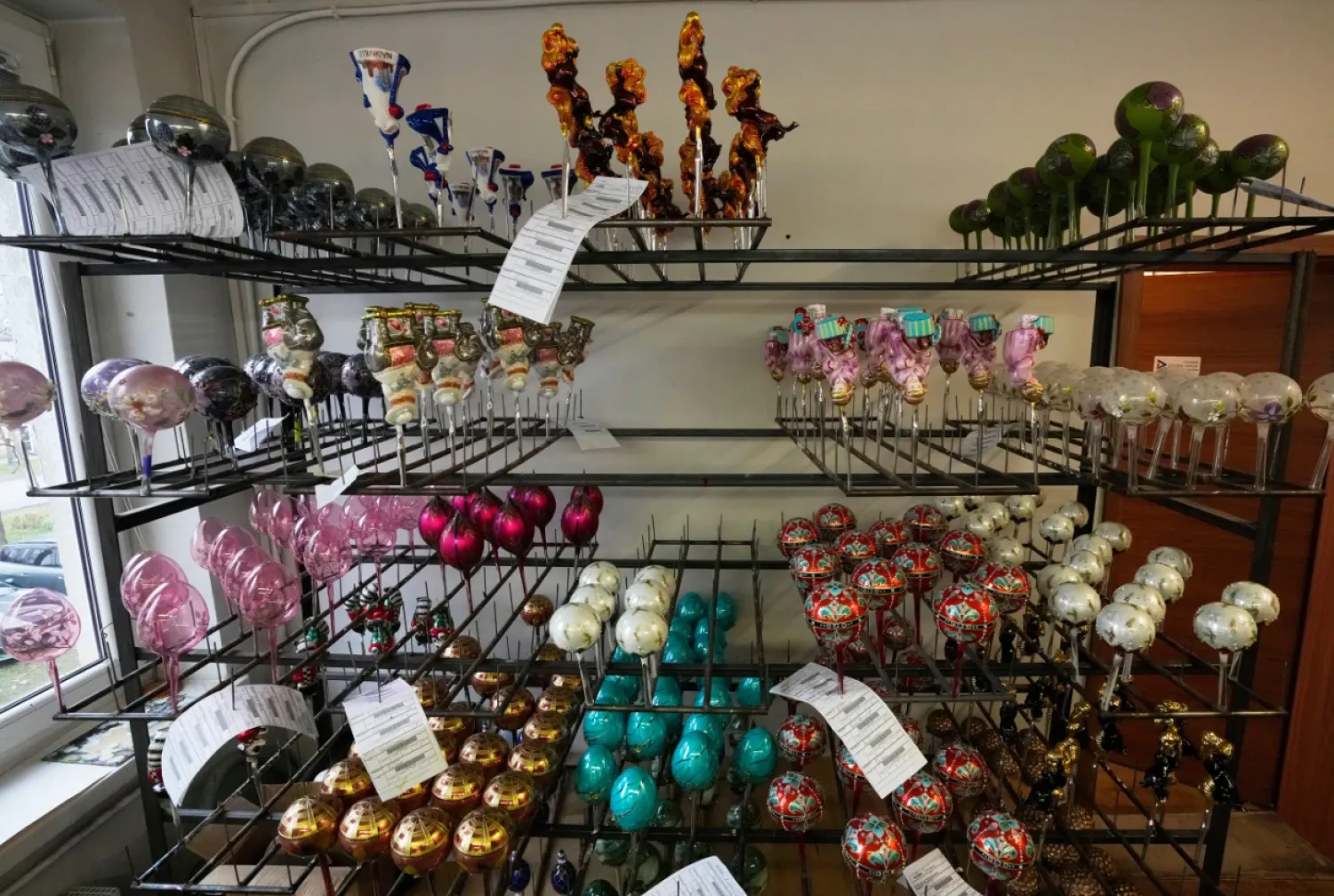
The hand-made Christmas baubles are prepared at GlitterLab in Czestochowa, southern Poland, on Nov. 21, 2025. (AP Photo/Czarek Sokolowski)
TT

The Polish 'Magicians of Glass' Who Create Christmas Baubles for Clients Worldwide

The hand-made Christmas baubles are prepared at GlitterLab in Czestochowa, southern Poland, on Nov. 21, 2025. (AP Photo/Czarek Sokolowski)

If you could design a bauble for your own Christmas tree, what would it be — a teddy bear dressed as a ballerina, a hummingbird, or a crimson phoenix?

The workers at GlitterLab, a company producing Christmas decorations in southern Poland, vow to turn those fantasies into reality.

Calling themselves “the magicians of glass,” their clients have included Swarovski, the French chain Galeries Lafayette, and Harrods, the iconic London department store, The AP news reported.

“We have the ability to create shapes and designs that glass will not normally take,” the company promises on its website.

And the whole production process, “our closely guarded trade secret,” is manual, making each product unique, it says.

“In an age when you can buy anything anywhere for next to nothing, something made from scratch here in a European country, with honest work and thoughtfulness, is truly valued by customers,” company owner Barbara Mostowska told The Associated Press.

‘In our DNA’ Despite its modest appearance, GlitterLab’s workshop has been operating for more than 80 years in Częstochowa, a town of 200,000 in southern Poland.

It was founded by Mostowska’s grandparents in the aftermath of World War II, making her the third generation in the family to manage the business.

“They produced glass cigarette holders, then ‘eprouvettes’ — I think that’s the word — tiny bottles for cake flavors,” Barbara Mostowska said, fondly reminiscing about how the workshop operated when she was a child.

“And then tiny baubles, then slow-blown baubles, the ones we all know from childhood, some swans, mushrooms, pine cones, that sort of thing,” she recalled.

When the company accessed the U.S. market, it started producing more molded ornaments, such as angels or Santa Claus.

On its website, the firm also draws from the history of the town, where a local monastery holds the icon of the Black Madonna, an important object of Catholic devotion since the 14th century. Pilgrims visiting the icon would come back home with souvenirs made by local artisans.

“We are their heirs,” the owners of GlitterLab claim. “The techniques we’re using can’t simply be learned. They need to run in your DNA.”

The company’s mix of artisanal methods, new technologies and savvy marketing is very lucrative. One of their exclusive designs for Harrods, the “Yellow Floral Bauble,” is priced at 125 pounds (around $168).

It is Mostowska's dream that the ornaments won't just be displayed on the Christmas, but instead “our customers have them in their homes, whether on hangers or in display cases, year-round.”

The company’s products are “jewelry for the home,” she said.

Happy work To create a unique design, GlitterLab workers take a client’s drawing on paper and turn it at first into a soft clay sculpture, which can be modified until the client’s vision is accurately represented.

Only then do they choose the unique combination of materials that transforms a particular shape into a bauble.

Mariola Koła, the company’s most seasoned designer, has been working for 42 years at GlitterLab. She says the most satisfying moment in her day comes when a client approves a design with “no corrections.”

“It means I’ve met their expectations, their taste,” she says. “That’s the greatest joy for me. I couldn’t ask for a greater reward.”

The designers work not only with glass but with materials like resin, wood, crystals, and metal, enabling them to craft shapes that go beyond conventional baubles.

But the products also tell a story, often invoking childhood nostalgia.

“Hungry for sweets and play,” says the description of a teddy bear holding a gulf club, part of a series of similar figures in different poses. “These Teddy Bears are a time machine to a happy childhood when nothing tasted as sweet as candy floss licked straight from sticky fingers.”

Amid a heavy reality, a return to childhood and the joy of play may be precisely what Christmas calls for.

“The customers are nice, because how can people get upset and be angry or mean when we’re talking about Christmas baubles?” Magdalena Kucharska, the company’s customer service representative, wonders.

“The fact that we produce a product that brings happiness means these customers are nice too, and it’s a very pleasant job.”



Somalia Welcomes Its First Bowling Alley as the Middle Class and Diaspora Returnees Grow

 People bowl at the Feynuus Bowling Center in Mogadishu, Somalia, on Jan. 15, 2026. (AP)
People bowl at the Feynuus Bowling Center in Mogadishu, Somalia, on Jan. 15, 2026. (AP)
TT

Somalia Welcomes Its First Bowling Alley as the Middle Class and Diaspora Returnees Grow

 People bowl at the Feynuus Bowling Center in Mogadishu, Somalia, on Jan. 15, 2026. (AP)
People bowl at the Feynuus Bowling Center in Mogadishu, Somalia, on Jan. 15, 2026. (AP)

In a city long defined by conflict, Somalia ’s capital of Mogadishu now echoes with the crash of pins at the country's first modern bowling alley.

It's the latest sign of revival in the once-thriving Indian Ocean port shaped by 35 years of civil war and militant bombings. Millions of people were forced to flee what became one of the world’s most dangerous cities. Those who remained avoided public spaces as the al-Qaeda-linked group al-Shabab waged an insurgency against the Somali state.

In recent years, improved security measures against al-Shabab, an expanded government presence and growing private investment have allowed daily life to re-emerge. Cafes line newly reopened streets, beaches draw evening crowds and traffic congestion, once unimaginable, now clogs key intersections.

The Feynuus Bowling Center opened last year and draws many locals and Somalis returning from the diaspora, who bring investment and business ideas after years of sending billions of dollars in remittances from abroad.

On a recent evening, young Somalis gathered in groups, laughing and filming each other on their phones while music played. Many from the diaspora are visiting Mogadishu for the first time in years, or the first time ever.

“I couldn’t believe Mogadishu has this place,” said Hudoon Abdi, a Somali-Canadian on holiday, as she prepared to take her turn to bowl.

“I’m enjoying it. Mogadishu is actually safe,” she said, urging others to visit.

Mogadishu remains vulnerable to militant attacks, however, with security measures like checkpoints and heavily guarded zones part of daily life. Non-Somalis remain largely confined to a compound at the international airport.

But residents say the ability to gather for recreation signals an important psychological shift. Such venues provide a welcoming environment for a younger generation eager for safe spaces to socialize.

Abukar Hajji returned from the United Kingdom on holiday after many years away and found the difference between what he imagined and what he experienced eye-opening.

“When I was flying from the UK, I believed it was a scary place, like a war-torn country,” he said. “Everyone told me, ‘Good luck,’ but when I came and saw it with my own eyes, I didn’t want to leave.”

Sadaq Abdurahman, the manager of the bowling center, said the idea for the business emerged from a growing demand among young people for recreational facilities.

“It has created employment opportunities for at least 40 youths,” he said.

According to the Somali National Bureau of Statistics, Somalia’s unemployment rate stands at 21.4%.

The bowling alley has private security guards, bag checks and surveillance cameras, reflecting the precautions common at public venues in Mogadishu.

Urban planners and economists say businesses like the bowling alley signal a broader shift in Mogadishu’s recovery, as private sector growth increasingly complements international aid and government-led rebuilding efforts.

Ahmed Khadar Abdi Jama, a lecturer in economics at the University of Somalia, said innovative businesses are responding to the needs of diaspora returnees and the growing middle class, “which in turn adds to the expected increase in Somalia’s GDP.”

Outside the bowling alley, traffic hummed and neon signs flickered, other reminders of Mogadishu’s fragile transformation.


Benefit of Taking Magnesium Does Not Get Enough Attention

Nutrition experts recommended trying to get more of magnesium in our diet from food first (Harvard University)
TT

Benefit of Taking Magnesium Does Not Get Enough Attention

Nutrition experts recommended trying to get more of magnesium in our diet from food first (Harvard University)

Nutrition experts revealed that magnesium is often not given the same attention as other vitamins and minerals, although it plays a pivotal role in supporting the overall health of our body, especially improving blood sugar management and supporting neuro-psychological balance.

According to the US National Institutes of Health (NIH), magnesium is an abundant mineral in our body and it’s naturally present in many foods.

The mineral is required in more than 300 different reactions in our body, including those that regulate muscle and nerve function, blood sugar levels, and blood pressure.

“Magnesium plays a role in how our body handles sugar,” Scott Keatley, RD, co-owner of Keatley Medical Nutrition Therapy told Prevention magazine.

“It helps with the action of insulin, the hormone that controls blood sugar levels.” When you have enough magnesium in your body, insulin can work better and your body can manage blood sugar more effectively, Keatley said.

Also, stress can cause our body to use more magnesium than usual, which can limit our body’s ability to do other tasks with the nutrient, Keatley said.

“In addition, magnesium can help reduce the release of stress hormones like cortisol,” he said. “It’s like a natural chill pill that can help keep our body’s stress response in check.”

Magnesium helps regulate brain function and mood. It plays a role in releasing and using neurotransmitters, which are chemicals in our brain that affect our mood and emotions.

The mineral may help improve bone density and decrease fracture risk.
“Magnesium is stored in bones and is an important part of bone health,” said Deborah Cohen, DCN, an associate professor in the department of clinical and preventive nutrition sciences at Rutgers University School of Health Professions.

At baseline, magnesium can help to relax and widen your blood vessels, Keatley said. “This makes it easier for blood to flow and can help lower blood pressure,” he added. “It’s like making the highways wider so that traffic can move more smoothly.”

A 2025 review in hypertension found that magnesium seems to be beneficial for lowering blood pressure in people with high blood pressure and magnesium deficiency, but larger studies are needed.

There are a lot of foods that are high in magnesium. Nutrition experts recommended trying to get more of the nutrient in our diet from food first.

These are the most magnesium-rich foods, according to the NIH are: Pumpkin seeds, Chia seeds, almonds, spinach, cashews, peanuts, shredded wheat, soymilk, black beans, edamame, peanut butter, potato with skin, brown rice and plain yogurt.


SpaceX Prioritizes Lunar 'Self-growing City' over Mars Project

FILE - A SpaceX logo is displayed on a building, May 26, 2020, at the Kennedy Space Center in Cape Canaveral, Fla. (AP Photo/David J. Phillip, File)
TT

SpaceX Prioritizes Lunar 'Self-growing City' over Mars Project

FILE - A SpaceX logo is displayed on a building, May 26, 2020, at the Kennedy Space Center in Cape Canaveral, Fla. (AP Photo/David J. Phillip, File)

Elon Musk said on Sunday that SpaceX has shifted its focus to building a "self-growing city" on the moon, which could be achieved in less than 10 years.

SpaceX still intends to start on Musk's long-held ambition of a city on Mars within five to seven years, he wrote on his X social media platform, "but the overriding priority is securing the future of civilization and the Moon is faster."

Musk's comments echo a Wall Street Journal report on Friday, stating that SpaceX has told investors it would prioritize going to the moon and attempt a trip to Mars ⁠at a later time, targeting March 2027 for an uncrewed lunar landing.

As recently as last year, Musk said that he aimed to send an uncrewed mission to Mars by the end of 2026.

The US faces intense competition from China in the race to return humans to the moon this decade. Humans have not visited the lunar surface since the Apollo 17 mission in 1972. Less than a week ago, Musk announced that SpaceX ⁠acquired the artificial intelligence company he also leads, xAI, in a deal that values the rocket and satellite company at $1 trillion and the artificial intelligence outfit at $250 billion.

Proponents of the move view it as a way for SpaceX to bolster its plans for space-based data centers, which Musk sees as more energy efficient than terrestrial facilities as the demand for compute power soars with AI development.

SpaceX is hoping a public offering later this year could raise as much as $50 billion, which could make it the largest public offering in history.

On Monday, Musk said in response to a user on X that NASA will constitute less than 5% of SpaceX's revenue this year. SpaceX is ⁠a core contractor in NASA's Artemis moon program with a $4 billion contract to land astronauts on the lunar surface using Starship.

"Vast majority of SpaceX revenue is the commercial Starlink system," Musk added.

Earlier on Sunday, Musk shared the company's first Super Bowl ad, promoting its Starlink Wi-Fi service.

Even as Musk reorients SpaceX, he is also pushing his publicly traded company, Tesla, in a new direction.

After virtually building the global electric vehicles market, Tesla is now planning to spend $20 billion this year as part of an effort to pivot to autonomous driving and robots.

To speed up the shift, Musk said last month Tesla is ending production of two car models at its California factory to make room for manufacturing its Optimus humanoid robots.