


Militaries Come to Aid of Asia Flood Victims as Toll Nears 1,000

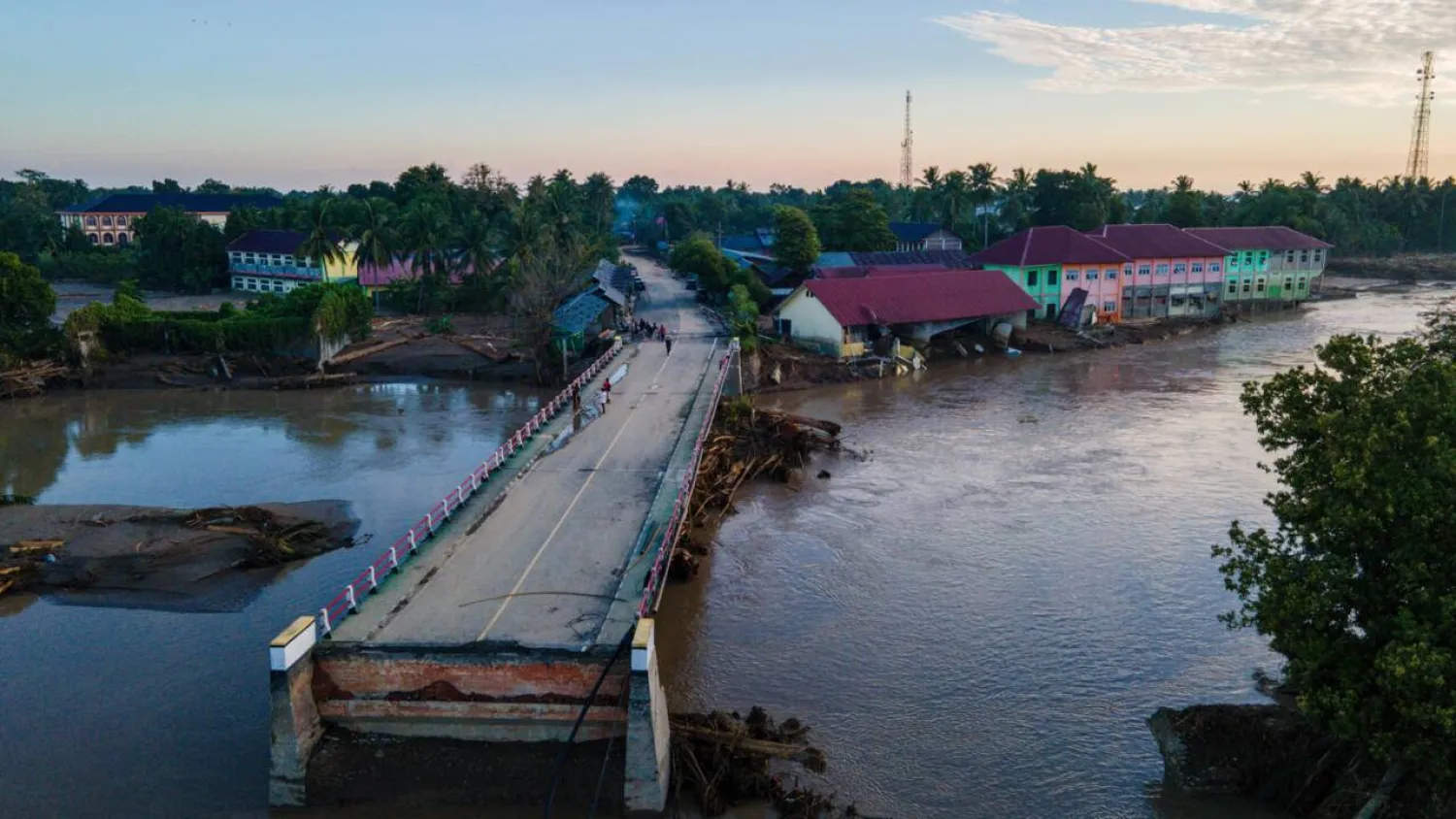
A bridge damaged by flash floods is seen during sunrise in Meureudu, Pidie Jaya district in Indonesia's Aceh province on November 30. CHAIDEER MAHYUDDIN / AFP
TT

Militaries Come to Aid of Asia Flood Victims as Toll Nears 1,000

A bridge damaged by flash floods is seen during sunrise in Meureudu, Pidie Jaya district in Indonesia's Aceh province on November 30. CHAIDEER MAHYUDDIN / AFP

Sri Lanka and Indonesia deployed military personnel on Monday to help victims of devastating flooding that has killed nearly 1,000 people across four countries in Asia in recent days.

Separate weather systems brought torrential, extended rainfall to the entire island of Sri Lanka and large parts of Indonesia's Sumatra, southern Thailand and northern Malaysia last week.

Arriving in North Sumatra on Monday, Indonesia President Prabowo Subianto said "the worst has passed, hopefully".

The government's "priority now is how to immediately send the necessary aid", with particular focus on several isolated villages, he added.

Prabowo has come under increasing pressure to declare a national emergency in response to flooding and landslides that have killed at least 442 people, with hundreds more missing.

Unlike his Sri Lankan counterpart, he has also not publicly called for international assistance, said AFP.

The toll is the deadliest in a natural disaster in Indonesia since a massive 2018 earthquake and subsequent tsunami killed more than 2,000 people in Sulawesi.

The government has sent three warships carrying aid and two hospital ships to some of the worst-hit areas, where many roads remain impassable.

Sri Lanka seeks aid

In Sri Lanka meanwhile, the government called for international aid and used military helicopters to reach people stranded by flooding and landslides triggered by Cyclone Ditwah.

At least 340 people have been killed, Sri Lankan officials said on Monday, with many more still missing.

Floodwaters in the capital Colombo peaked overnight, and with rain now stopped there were hopes that waters would begin receding.

Some shops and offices began to reopen.

Officials said the extent of the damage in the worst-affected central region was only just being revealed as relief workers cleared roads blocked by fallen trees and mudslides.

In Ma Oya, just north of the capital, Hasitha Wijewardena said he was struggling to clean up after the floods.

"The water has gone down, but the house is now full of mud," he told local reporters, appealing for military help to clean up.

President Anura Kumara Dissanayake, who declared a state of emergency to deal with the disaster, vowed to build back.

"We are facing the largest and most challenging natural disaster in our history," he said in an address to the nation.

"Certainly, we will build a better nation than what existed before."

The losses and damage are the worst in Sri Lanka since the devastating 2004 Asian tsunami that killed around 31,000 people there and left more than a million homeless.

Anger in Thailand

By Sunday afternoon, rain had subsided across Sri Lanka but low-lying areas of the capital were flooded and authorities were bracing for a major relief operation.

Military helicopters have been deployed to airlift stranded residents, and deliver food, though one crashed just north of Colombo on Sunday evening.

Selvi, 46, a resident of the Colombo suburb of Wennawatte, left her flooded home on Sunday, carrying four bags of clothes and valuables.

"My house is completely flooded. I don't know where to go, but I hope there is some safe shelter where I can take my family," she told AFP.

Much of Asia is in its annual monsoon season, which often brings heavy rain, triggering landslides and flash floods.

But the flooding that hit Indonesia, Thailand and Malaysia was also exacerbated by a rare tropical storm that dumped heavy rain on Sumatra island in particular.

Climate change has also increased the intensity of storms, and produced more heavy rain events because a warmer atmosphere holds more moisture.

The waves of rain caused flooding that killed at least 176 people in southern Thailand, authorities said Monday, one of the deadliest flood incidents in the country in a decade.

The government has rolled out relief measures, but there has been growing public criticism of the flood response, and two local officials have been suspended over their alleged failures.

Across the border in Malaysia, where heavy rains also inundated large stretches of land in Perlis state, two people were killed.



Israel Presses Washington to Amend War Plan

US President Donald Trump hosts Israeli Prime Minister Benjamin Netanyahu in Florida on Dec. 29, 2025 (Reuters)
TT

Israel Presses Washington to Amend War Plan

US President Donald Trump hosts Israeli Prime Minister Benjamin Netanyahu in Florida on Dec. 29, 2025 (Reuters)

Israeli political sources said the government is pushing back against key elements of a US proposal to end the war with Iran, describing the dispute as fundamental rather than technical.

They said three of the plan’s 15 clauses are at the heart of disagreements with the administration of US President Donald Trump.

Israel’s public broadcaster Kan 11, citing two sources familiar with the proposal, said the sticking points include vague language on the future of Iran’s ballistic missile program, the transfer of enriched uranium to the International Atomic Energy Agency, and sweeping relief from US and European sanctions.

Israel says talks with Washington are ongoing and that revisions to the draft remain possible. A source close to Israeli Prime Minister Benjamin Netanyahu said the government aims to end the war within two weeks.

But Israeli Chief of Staff Eyal Zamir warned the security cabinet of a potential “collapse” of the army as it fights on multiple fronts. Other officials still fear Trump could impose a temporary ceasefire to open talks with Tehran.

Channel 12 quoted senior officials as saying Israel would be notified in advance of any US move toward negotiations, but its influence is currently limited.

A senior Israeli security official said Iran can sustain its current rate of fire for weeks, with enough launch platforms and personnel to stagger attacks over time. Israel’s security establishment has recommended continuing the war until Iran’s national infrastructure is struck.

“If we stop now, we will be close to our goals, but there is still more to complete,” an Israeli source said.

Channel 12 reported no signs of a breakthrough in US-Iran contacts. Instead, it cited indications of US military planning for a major strike on Tehran.

It said prospects for a deal are currently low, prompting the US Department of Defense to prepare options for what it described as a “decisive blow,” potentially involving ground operations and a wide bombing campaign if diplomacy stalls and the Strait of Hormuz remains closed.

Yedioth Ahronoth said Trump is offering incentives to draw Iran into talks while preparing for a powerful strike, describing the mixed messaging as a complex wartime deception.

An Israeli source confirmed reports by Axios and Channel 12, citing informed US officials, that Washington is weighing scenarios including taking control of Kharg Island, Iran’s main oil export hub, targeting Larak Island, reinforcing control over the Strait of Hormuz, seizing Abu Musa and other Gulf islands, or intercepting Iranian oil shipments east of the strait.

The sources said the US military has also prepared plans for ground operations inside Iran to secure highly enriched uranium at nuclear facilities, though the scenario is seen as complex and risky. An alternative would be large-scale airstrikes on those sites to deny Iran access to the material.

Israeli media said Zamir warned the cabinet of a possible army “collapse” due to multi-front fighting and shortages in personnel and resources.

At a daily briefing on Thursday, the military spokesperson said the army lacks 15,000 troops, including 8,000 combat soldiers.

Reports added that Zamir raised 10 “red flags” over the army’s condition and warned of escalating “Jewish terrorist attacks” by settlers in the occupied West Bank.

He said another battalion had been deployed there, while the army’s central command believes one more is needed to complete the mission.


Israel Army Confirms Struck Two Nuclear Sites in Iran

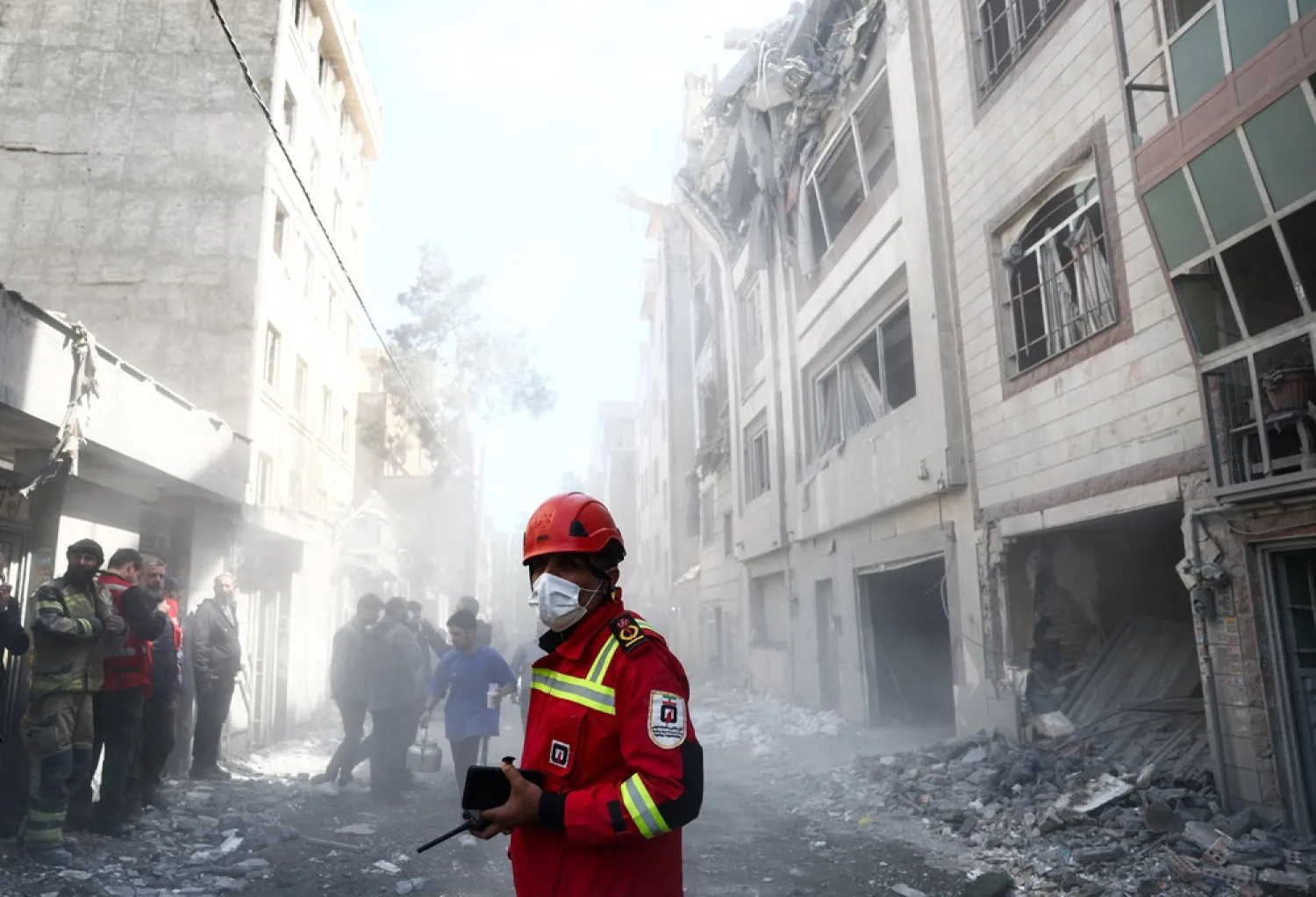
Emergency responders inspect the site of a residential building damaged by a strike, amid the US-Israeli conflict with Iran, in Tehran, Iran, March 27, 2026. Majid Asgaripour/WANA (West Asia News Agency) via Reuters
TT

Israel Army Confirms Struck Two Nuclear Sites in Iran

Emergency responders inspect the site of a residential building damaged by a strike, amid the US-Israeli conflict with Iran, in Tehran, Iran, March 27, 2026. Majid Asgaripour/WANA (West Asia News Agency) via Reuters

The Israeli military confirmed it struck a heavy water reactor and a uranium processing plant in central Iran on Friday, as it targeted nuclear sites in the country.

"A short while ago, the Israeli Air Force... struck the heavy water plant in Arak, central Iran," the military said in a statement, describing the site as a "key plutonium production site for nuclear weapons".

Iranian media had earlier reported that US-Israeli strikes hit the Khondab heavy water complex, saying they caused no casualties or radiation leak from the site.

Work on the reactor on the outskirts of the village of Khondab began in the 2000s, but was halted under the terms of a now-abandoned 2015 nuclear deal struck between Iran and world powers.

The core of the reactor was removed and concrete was poured into it, rendering it inoperative.

The research reactor was officially intended to produce plutonium for medical research and the site includes a production plant for heavy water.

The Israeli military also confirmed it struck a uranium processing site in central Iran's Yazd on Friday, after the country’s atomic energy organization said US-Israeli strikes hit the facility.

"A short while ago, the Israeli Air Force... struck a uranium extraction plant located in Yazd, central Iran," the military said in a statement, describing the site as a "unique facility in Iran used for the production of raw materials required for the uranium enrichment process".

Iran's atomic energy organization said the strike on the plant "did not result in the release of any radioactive material."

Israel and the US accuse Iran of seeking to acquire nuclear weapons, while Tehran maintains that its program is for civilian purposes.

The heavy water plant in Arak was targeted by Israeli strikes during the 12-day war between Iran and Israel last June, during which the US also carried out bombings.

The International Atomic Energy Agency (IAEA) says the site was "damaged" during the attacks and "is assessed not to have been fully operational since that time."

But the agency said it has not had access to the site since May 2025.

The Middle East was plunged into war on February 28 when the US and Israel launched joint strikes on Iran, triggering retaliatory missile and drone attacks targeting Israel and several countries in the region.


US, Israel Unlikely to Achieve ‘Regime Change’ in Iran, Says Merz

 27 March 2026, Hesse, Frankfurt/Main: Germany's Chancellor Friedrich Merz speaks at the "FAZ" Congress. (dpa)
27 March 2026, Hesse, Frankfurt/Main: Germany's Chancellor Friedrich Merz speaks at the "FAZ" Congress. (dpa)
TT

US, Israel Unlikely to Achieve ‘Regime Change’ in Iran, Says Merz

 27 March 2026, Hesse, Frankfurt/Main: Germany's Chancellor Friedrich Merz speaks at the "FAZ" Congress. (dpa)
27 March 2026, Hesse, Frankfurt/Main: Germany's Chancellor Friedrich Merz speaks at the "FAZ" Congress. (dpa)

The US-Israeli war against Iran is unlikely to lead to "regime change", German Chancellor Friedrich Merz said Friday, as the month-long conflict showed no signs of abating.

"Is regime change really the goal?" he said at a forum in Frankfurt organized by the FAZ newspaper.

"If that's the goal, I don't think you'll achieve it. It's mostly gone wrong" in past conflicts, he said, pointing to the Afghanistan war.

"I have serious doubts as to whether there is a strategy and whether that strategy is being successfully implemented," he added. "In that respect, it could take even longer."

Germany has pushed back at US President Donald Trump's criticisms of NATO members for failing to join the attacks on Iran, insisting that it is not their war.

Merz however said Friday he believed that Trump had accepted this stance.

He also said Germany would be open to helping provide military protection in the Strait of Hormuz, a key route for oil and gas, which has been nearly totally blocked, in the event of a ceasefire.

"This requires an international mandate, it requires approval from the German parliament and, prior to that, a cabinet decision. And we are far from that."