


Israel Resumes Spy Activity over Lebanon after Pope’s Departure

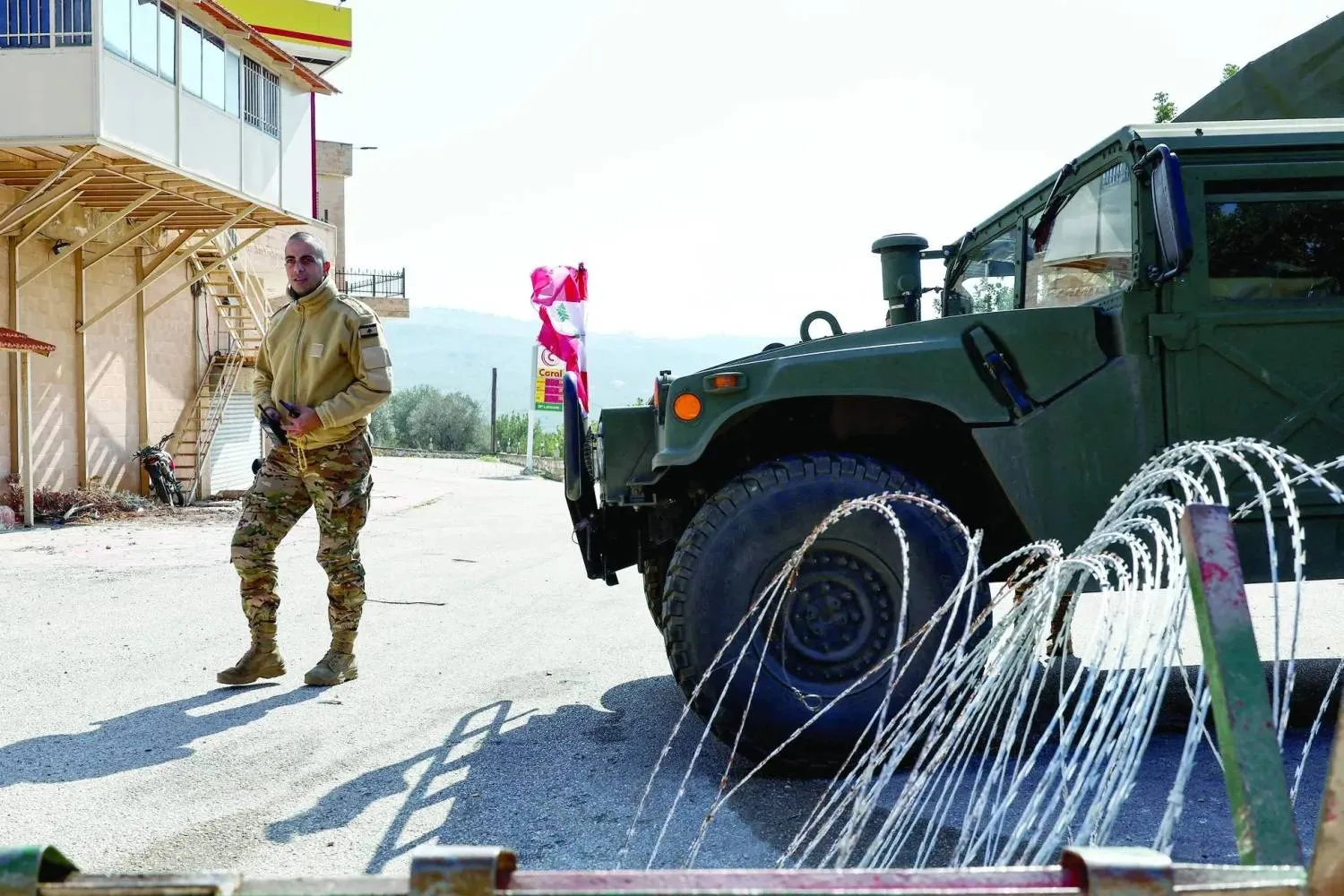
A Lebanese soldier stands beside a military vehicle in the southern town of Deir Mimas (Reuters)
TT

Israel Resumes Spy Activity over Lebanon after Pope’s Departure

A Lebanese soldier stands beside a military vehicle in the southern town of Deir Mimas (Reuters)

Israeli drones swept back into Beirut’s skies shortly after Pope Leo XIV’s plane departed the city, ending a brief and carefully managed calm that had prevailed during his visit.

The resumption of aerial activity underscored that the lull was dictated by diplomatic sensitivities rather than any real shift in Israel’s military posture, as United States and Israeli officials held talks and European governments warned of further volatility on the Lebanese front.

Israel’s public broadcaster said Prime Minister Benjamin Netanyahu and Defense Minister Israel Katz met United States envoy Morgan Ortagus “amid the Israeli threats to Lebanon,” an indication that the northern front featured prominently in their talks.

In parallel, the Yedioth Ahronoth daily quoted a European diplomat as saying there was “a risk of rising tensions on the Lebanese front after the assassination of a Hezbollah commander,” adding that “Israel has the right to act if Hezbollah tries to revive its activity in southern Lebanon.”

These signals aligned with reporting by the Israeli outlet Walla, which said security assessments indicated that “Tel Aviv’s patience is nearing its end,” and that Hezbollah’s rebuilding of its capabilities since late 2024 was unfolding “at a dangerous and rapid pace despite the assassinations and strikes it has faced.”

Return of the drones

Drones had been absent since Sunday, coinciding with the Pope’s arrival in Lebanon, with no Israeli drone activity recorded over Beirut, the southern suburbs or deep in southern Lebanon. Israeli movements were limited to gunfire near military positions and the firing of illumination flares along the border.

That lull did not last. On Tuesday afternoon, Israeli drones were seen flying over the eastern and western Lebanese mountain ranges toward Baalbek, while low-altitude flights were recorded over the southern towns of Adloun and Kfouriya al-Siyad.

Against this shifting backdrop, retired Brig.Gen. Khalil Helou offered a more detailed reading of the current calm and its limits.

He told Asharq Al-Awsat that the slowdown in Israeli attacks in recent days and the absence of drones “does not reflect a change in strategy, but what can be described as the calm before the storm.”

He said the pause was “directly linked to the Pope’s visit, because Israel understands that any major operation during the presence of a figure of this stature would reflect negatively on it in international media, especially Vatican media, which is already not sympathetic to Israel regarding Gaza and Middle East issues.”

Helou added that Israel “also faces domestic pressure in the United States, where protests on university campuses, political tensions in Washington and a rise in congressional criticism make it cautious about any military action that could spark additional controversy in a sensitive election moment.”

He said Israel’s already strained ties with Europe were another reason for suspending major operations for now.

Israel’s objectives

He stressed that “the geostrategic reality has not changed at all,” and that Israel’s goal “remains dismantling Hezbollah’s infrastructure.”

He said Israeli officials believe Resolution 1701 failed to disarm the group in 2006, that the revived understandings collapsed again in 2023 and that Hezbollah “remains capable of reorganizing its ranks.”

He criticized Hezbollah’s statement about resorting to clandestine operations, saying that “announcing an activity that is supposed to be secret is contradictory, and it is used by Israel to justify future strikes.”

He added that international confidence in the Lebanese state’s ability to take clear decisions has sharply eroded, citing the government’s August decision to restrict weapons to state institutions, its reversal a month later and the current shift toward “controlling weapons rather than removing them.”

He said such rhetoric “may serve domestic consumption but does not convince external actors who cannot wait years for Lebanon’s traditional approach to resolve the issue.”

Helou said some believe Israel is not serious and that the situation will pass as before, “but I do not share this view.” In earlier stages, he noted, Europe and the United States played direct roles in restraining Israel. “Today, the circumstances are entirely different.”

He recalled that former United States president Joe Biden refused to expand the war into Lebanon in 2023 because of his negotiations with Iran, while “Trump, now in office, follows a different policy based on striking and escalating, then negotiating, not the other way around.”

Looking ahead, Helou said “the most likely scenario is an intensified Israeli air campaign that had already begun some time ago.”

Read also


Türkiye Calls Israel’s Recognition of Somaliland ‘Illegitimate’

This handout photograph taken and released by the Turkish presidential press service on December 30, 2025, shows Türkiye’s President Recep Tayyip Erdogan (R) and Somalia's President Hassan Sheikh Mohamud (L) shaking hands before their meeting in Istanbul. (Photo by Handout / Turkish Presidential Press Service / AFP)
TT

Türkiye Calls Israel’s Recognition of Somaliland ‘Illegitimate’

This handout photograph taken and released by the Turkish presidential press service on December 30, 2025, shows Türkiye’s President Recep Tayyip Erdogan (R) and Somalia's President Hassan Sheikh Mohamud (L) shaking hands before their meeting in Istanbul. (Photo by Handout / Turkish Presidential Press Service / AFP)

Türkiye’s president on Tuesday called Israel's recognition of Somaliland "illegitimate and unacceptable" as he hosted a visit by his Somali counterpart.

"Preserving the unity and integrity of Somalia in all circumstances holds special importance in our view. Israel's decision to recognize Somaliland is illegitimate and unacceptable," Turkish leader Recep Tayyip Erdogan said in a press conference alongside Somali President Hassan Sheikh Mohamud.

Israel sparked criticism last Friday when it said it was officially recognizing Somaliland -- a breakaway territory in Somalia's north.

The declaration was a first for the territory, which in 1991 had unilaterally declared secession from Somalia.

Israel's move has drawn widespread criticism from the African Union, Egypt and the European Union, which insist on war-torn Somalia's sovereignty.

Türkiye has frequently clashed with Israel over a range of issues, especially over the conflict in Gaza and Israeli obstruction of aid to the Palestinian territory.

Mohamud said Israeli Prime Minister Benjamin Netanyahu's "aggressive position, which also includes Somalia, is unacceptable".

He called Netanyahu's Somaliland declaration "a violation of international law" and "the start of insecurity and instability, especially for Somalia and the African region".


10 Countries Warn of ‘Catastrophic’ Gaza Situation

 Palestinians stand next to a tent set up on the rubble of buildings destroyed during Israeli air and ground operations in the Sheikh Radwan neighborhood, in Gaza City, Tuesday, Dec. 30, 2025. (AP)
Palestinians stand next to a tent set up on the rubble of buildings destroyed during Israeli air and ground operations in the Sheikh Radwan neighborhood, in Gaza City, Tuesday, Dec. 30, 2025. (AP)
TT

10 Countries Warn of ‘Catastrophic’ Gaza Situation

 Palestinians stand next to a tent set up on the rubble of buildings destroyed during Israeli air and ground operations in the Sheikh Radwan neighborhood, in Gaza City, Tuesday, Dec. 30, 2025. (AP)
Palestinians stand next to a tent set up on the rubble of buildings destroyed during Israeli air and ground operations in the Sheikh Radwan neighborhood, in Gaza City, Tuesday, Dec. 30, 2025. (AP)

The foreign ministers of 10 nations on Tuesday expressed "serious concerns" about a "renewed deterioration of the humanitarian situation" in Gaza, saying the situation was "catastrophic". 

"As winter draws in, civilians in Gaza are facing appalling conditions with heavy rainfall and temperatures dropping," the ministers of Britain, Canada, Denmark, Finland, France, Iceland, Japan, Norway, Sweden and Switzerland said in a joint statement released by the UK's Foreign Office. 

"1.3 million people still require urgent shelter support. More than half of health facilities are only partially functional and face shortages of essential medical equipment and supplies. The total collapse of sanitation infrastructure has left 740,000 people vulnerable to toxic flooding," the statement added. 

The ministers said they welcomed the progress that had been made to end the bloodshed in Gaza and secure the release of Israeli hostages. 

"However, we will not lose focus on the plight of civilians in Gaza," they said, calling on the government of Israel to take a string of "urgent and essential" steps. 

These included ensuring that international NGOs could operate in Gaza in a "sustained and predictable" way. 

"As 31 December approaches, many established international NGO partners are at risk of being de-registered because of the government of Israel's restrictive new requirements," the statement said. 

It also called for the UN and its partners to be able to continue their work in Gaza and for the lifting of "unreasonable restricts on imports considered to have a dual use". 

This included medical and shelter equipment. 

The foreign ministers also called for the opening of crossings to boost the flows of humanitarian aid into Gaza. 

While welcoming the partial opening of the Allenby crossing, they said other corridors for moving goods remained closed or severely restricted for humanitarian aid, including Rafah. 

"Bureaucratic customs processes and extensive screenings are causing delays, while commercial cargo is being allowed in more freely," the statement said. 

"The target of 4,200 trucks per week, including an allocation of 250 UN trucks per day, should be a floor not a ceiling. These targets should be lifted so we can be sure the vital supplies are getting in at the vast scale needed," it added. 


UN Condemns Israel's Moves against Agency for Palestinian Refugees

UNRWA center targeted by Israeli shelling in northern Gaza (DPA)
TT

UN Condemns Israel's Moves against Agency for Palestinian Refugees

UNRWA center targeted by Israeli shelling in northern Gaza (DPA)

The United Nations warned Tuesday that recent actions by Israel against the UN agency for Palestinian refugees risked depriving millions of people of basic services such as education and healthcare.

Israel's parliament passed new legislation on Monday formally stripping the United Nations Relief and Works Agency (UNRWA) of diplomatic immunity, and barring Israeli companies from providing water or electricity to the agency's institutions, AFP reported.

According to UNRWA, the legislation also grants the Israeli government the authority to expropriate the agency's properties in East Jerusalem, including its headquarters and main vocational training center.

UNRWA chief Philippe Lazzarini condemned the legislation as "outrageous", decrying it on social media as "part of an ongoing, systematic campaign to discredit UNRWA and thereby obstruct the core role that the agency plays providing human-development assistance and services to Palestine refugees".

Filippo Grandi, the outgoing head of the UN refugee agency, UNHCR, and a former UNRWA chief, also criticised the move as "very unfortunate".

In an interview with AFP, he highlighted that UNRWA, unlike other UN agencies, provides basic public services such as education and healthcare to the millions of registered Palestinian refugees it serves across Gaza and the West Bank, as well as in Lebanon, Jordan and Syria.

"If you deprive those people of those services... then you had better find a substitute," he said, warning: "I think it would be very difficult."

"At the moment, there is a great risk that millions of people will be deprived of basic services if UNRWA is further deprived of space to work, and resources to work."

Israel has been ratcheting up pressure on UNRWA over the past two years.

It has accused the agency of providing cover for Hamas militants, claiming that some UNRWA employees took part in the militant group's October 7, 2023 assault on Israel, which sparked the war in Gaza.

A series of UN-linked internal and external investigations found some "neutrality-related issues" at UNRWA, but stressed Israel had not provided conclusive evidence for its headline allegation.

Grandi criticised the torrent of accusations that have swirled around the agency.

"UNRWA is a very indispensable organization in the Middle East," he said.

"Contrary to much of the frankly baseless rhetoric that we have heard in the past couple of years, UNRWA is a force for peace and stability," he added.

"In a region in which you need every bit of stability and efforts towards peace, it would be really irresponsible to let such an important organization decline further."
