


Gazans Race to Preserve Cultural Heritage Damaged in War

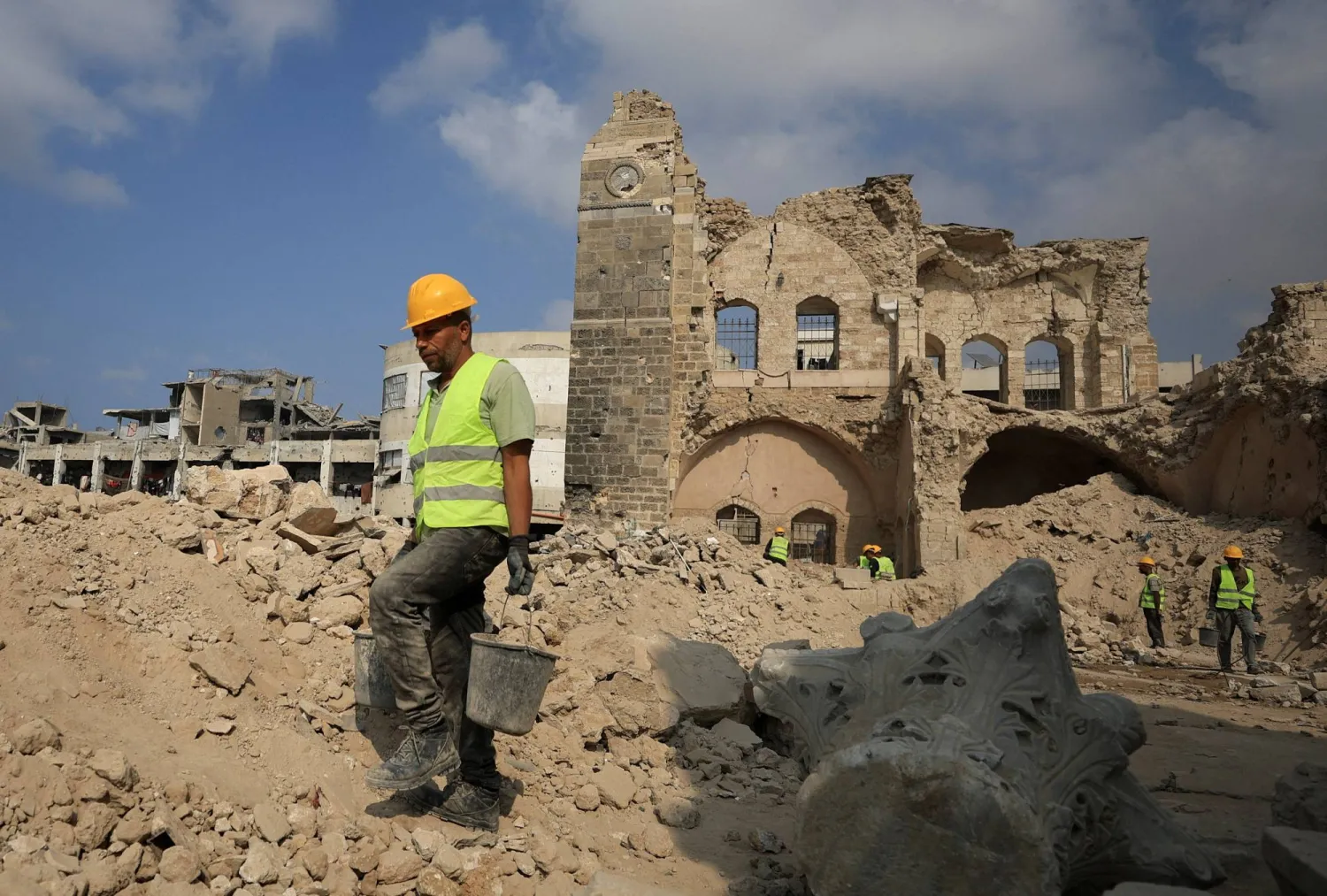
 Workers carry out restoration work at the historical Pasha's Palace, damaged during the war, in Gaza City, November 11, 2025. (Reuters)
Workers carry out restoration work at the historical Pasha's Palace, damaged during the war, in Gaza City, November 11, 2025. (Reuters)
TT

Gazans Race to Preserve Cultural Heritage Damaged in War

 Workers carry out restoration work at the historical Pasha's Palace, damaged during the war, in Gaza City, November 11, 2025. (Reuters)
Workers carry out restoration work at the historical Pasha's Palace, damaged during the war, in Gaza City, November 11, 2025. (Reuters)

With 70,000 dead, countless injured, hundreds of thousands of people homeless and whole districts laid to waste, the task of rebuilding Gaza is almost beyond comprehension.

But at a handful of sites where the enclave's most valuable historical monuments have been severely damaged, workers are already busy with shovels, trying to dig out the few surviving remnants of the past.

Those include Gaza's most important cultural site, the great Omari Mosque in Gaza's Old City, which Israeli forces struck during the war to destroy what they said was a tunnel under its grounds used by fighters.

Palestinians say there is no sign of such a tunnel there, and blame Israel for blasting apart the enclave's religious and cultural heritage.

"If the occupation (Israel) believes that by destroying these buildings it can erase the history of this people, it is mistaken," said Hamuda al-Dahdar, an architect and heritage expert at the Center for Cultural Preservation, which is based in the West Bank city of Bethlehem and is now working inside Gaza to try to rescue sites destroyed in the war.

"These buildings represent the collective memory of an ancient nation, one that must be preserved, and we must unite in our efforts to protect it,” he told Reuters in Gaza.

The Israeli military did not respond to a request for fresh comment on the destruction of Palestinian cultural sites in Gaza.

TIMELESS TALES

In an enclave where most residents are refugees from cities and villages in what is now Israel - and most districts were hastily built in recent decades to house them - the Omari Mosque was Gazans' main link to their own cultural heritage and the rich architectural historical legacy of the wider Middle East.

The site, said by local tradition to be where the biblical Samson brought down a temple on his Philistine captors, housed a Byzantine church before the seventh century Caliph Omar brought Islam to the Mediterranean and reconsecrated it as a mosque.

In the centuries since, it was embellished and restored countless times by Mamluks, Crusaders and Ottomans, renowned throughout the Middle Ages as the area's architectural marvel.

Its minaret was the main landmark of the Gaza skyline. Worshippers would pack its basilica, with vaulted ceilings and cool glazed tile floors, spilling out after prayers through the stately facade, the arched stone courtyard and the compound's gates into the surrounding market streets of the Old City.

The nearby Al Qaisariyya gold market was packed with shops whose owners and neighbors were known for recounting timeless legends of the wedding jewelry of doomed lovers and jealous mothers-in-law. Little is left.

Also lying in ruins is the Pasha's Palace, a landmark partly dating back to the 13th century, which housed a museum whose treasures are now gone.

"When we talk about heritage and culture, we are not merely talking about an old building or ancient stones. Every stone tells a story," said Dahdar.

Palestinian officials and UNESCO are preparing a three-phase recovery plan with initial costs of $133 million for historical sites, said Jehad Yasin, assistant deputy minister at the Palestinian Ministry of Tourism and Antiquities, based in the West Bank.

The first priority will be quickly intervening to support structures that could collapse without support. But there is a shortage of white cement and gypsum. Resources in Gaza are limited and the prices of excavation and restoration materials have skyrocketed, he said.

In Gaza, the loss of cultural landmarks still causes a particular ache, even among families who lost loved ones, homes and livelihoods.

Munzir Abu Assi said he had to comfort his daughter Kenzy after she heard the Great Omari Mosque was damaged.

"She’s really sad. When we heard that the mosque has been hit, we were surprised, why?" said Abu Assi.

"And when they also hit Pasha's Palace, we were certain that this occupation (Israel) wants to wipe out the Palestinian identity and to wipe out any Palestinian monument."



Syrian Culture Minister Applauds Saudi Pavilion at Damascus Book Fair

The 2026 Damascus International Book Fair is held from February 6 to 16 - SPA
TT

Syrian Culture Minister Applauds Saudi Pavilion at Damascus Book Fair

The 2026 Damascus International Book Fair is held from February 6 to 16 - SPA

Syrian Minister of Culture Mohammed Yassin Saleh visited the Kingdom’s pavilion at the 2026 Damascus International Book Fair, held from February 6 to 16, where the Kingdom is serving as the Guest of Honor.

He commended the efforts of the Literature, Publishing and Translation Commission in showcasing the rich diversity of the Saudi cultural and literary scene. The pavilion features exhibitions of manuscripts, a Saudi fashion corner, and archaeological replicas, SPA reported.

The minister reviewed the commission's Tarjim translation initiative and Saudi literature comics.

This participation at the 2026 Damascus International Book Fair showcases Saudi creativity and fosters cultural dialogue, supporting Saudi Vision 2030’s goals of knowledge exchange and cultural leadership.


Saudi Arabia, Syria Underline Depth of their Cultural Ties

Syrian President al-Sharaa receives the Saudi minister of culture and the accompanying delegation at the Conference Palace in Damascus on Thursday. (SPA)
TT

Saudi Arabia, Syria Underline Depth of their Cultural Ties

Syrian President al-Sharaa receives the Saudi minister of culture and the accompanying delegation at the Conference Palace in Damascus on Thursday. (SPA)

Saudi Arabia and Syria underlined the strength of their cultural relationship during high-level meetings held in Damascus on Thursday, on the sidelines of the opening of the Damascus International Book Fair 2026, where the Kingdom is participating as guest of honor.

Syrian President Ahmad al-Sharaa received Saudi Minister of Culture Prince Badr bin Abdullah bin Farhan at the Conference Palace in the capital.

Earlier the same day, Prince Badr met with his Syrian counterpart, Minister of Culture Mohammad Yassin Saleh, during an official visit to attend the fair. T

he Saudi minister congratulated Syria on hosting the exhibition and expressed his wishes for continued prosperity, progress, and stability for the Syrian government and people.

Both meetings highlighted the depth of cultural relations between the two countries, the importance of expanding joint cultural cooperation across various fields, and the alignment of positions on issues of mutual interest in a way that serves both nations.

The Saudi delegation included senior officials and advisers, among them representatives from the Royal Court, the Ministry of Culture, and the King Abdulaziz Public Library, reflecting broad institutional engagement in the visit.

In the evening, Prince Badr attended the opening ceremony of the fair’s special session, held under the patronage and in the presence of al-Sharaa. The event drew wide official and cultural participation, including Arab ministers, political and intellectual figures, and a distinguished group of writers and cultural figures.

In a post on the X platform, Prince Badr thanked “our brothers in Syria for their generous hospitality and their efforts in organizing the Damascus International Book Fair.”

The minister also inaugurated the Kingdom’s pavilion at the fair in the presence of the Syrian minister of culture and the Qatari minister of culture.

Saudi Arabia’s guest-of-honor participation continues until Feb. 16 and reflects its growing prominence and leadership in the Arab and global cultural landscape.

This participation aligns with Saudi Vision 2030, which places culture at the heart of national development, viewing it as a space for dialogue, a bridge for civilizational communication, and a tool for strengthening ties among Arab peoples.

The Saudi Literature, Publishing and Translation Commission is leading the Kingdom’s participation, highlighting the development of the cultural sector and reaffirming the central role of books as carriers of knowledge and awareness.

The Saudi pavilion boasts a comprehensive cultural program featuring intellectual seminars, poetry evenings, a manuscript exhibition, traditional Saudi fashion displays, hospitality corners, archaeological replicas, and performing arts that express the depth of the Kingdom’s cultural heritage.

On the sidelines of the visit, Prince Badr, accompanied by Minister Saleh, toured the National Museum of Damascus, which houses rare artifacts spanning prehistoric eras, ancient Syrian civilizations, classical and Islamic periods, as well as traditional and modern art.


UNESCO Honors Al-Bisht Al-Hasawi as Thousands Flock to Al-Ahsa Festival

Visitors can explore interactive displays, participate in live workshops, and witness the meticulous process of tailoring this iconic symbol of prestige - SPA
TT

UNESCO Honors Al-Bisht Al-Hasawi as Thousands Flock to Al-Ahsa Festival

Visitors can explore interactive displays, participate in live workshops, and witness the meticulous process of tailoring this iconic symbol of prestige - SPA

The third edition of Al-Bisht Al-Hasawi Festival is drawing thousands of regional and international visitors to Ibrahim Palace in historic Al-Hofuf.

Organized by the Heritage Commission, this year’s festival celebrates the inscription of the Bisht on UNESCO’s Representative List of the Intangible Cultural Heritage of Humanity.

The event showcases Al-Ahsa’s centuries-old tradition of hand-weaving and gold embroidery, a craft passed down through generations of local families, SPA reported.

Visitors can explore interactive displays, participate in live workshops, and witness the meticulous process of tailoring this iconic symbol of prestige.

With UNESCO's participation and representatives from six countries, the festival has evolved into a global platform for cultural dialogue, cementing the Bisht’s status as a world-class cultural treasure.