


Yemen Leader Warns against Unilateral Actions Undermining Unity, State Sovereignty

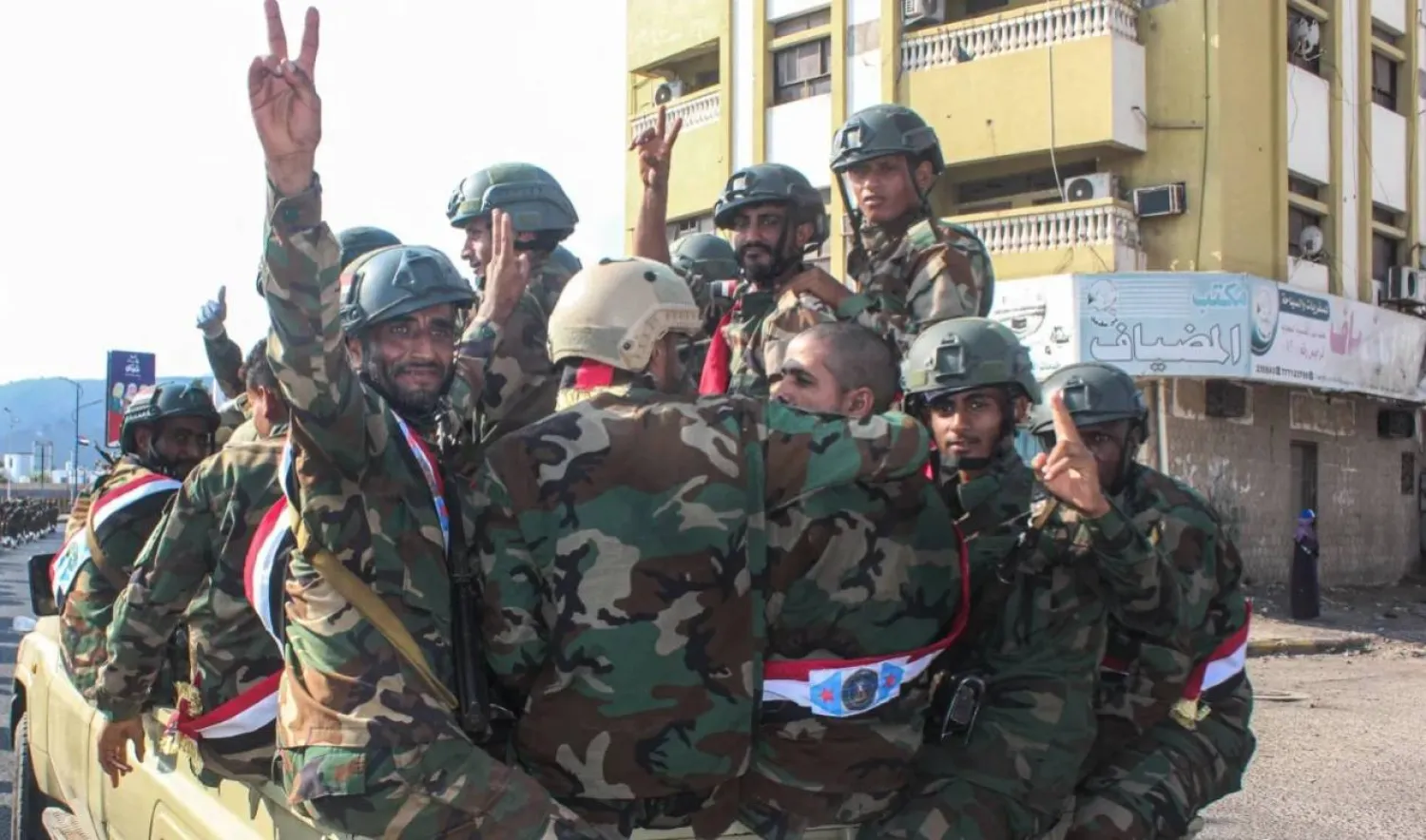
Yemeni armed forces flash the V-sign for victory as they ride in the back of a lorry as they celebrate the 58th anniversary of National Independence Day, in the port city of Aden, November 30, 2025. (Photo by Saleh Al-OBEIDI / AFP)
TT

Yemen Leader Warns against Unilateral Actions Undermining Unity, State Sovereignty

Yemeni armed forces flash the V-sign for victory as they ride in the back of a lorry as they celebrate the 58th anniversary of National Independence Day, in the port city of Aden, November 30, 2025. (Photo by Saleh Al-OBEIDI / AFP)

Yemeni Presidential Leadership Council chief Rashad al-Alimi warned on Friday that unilateral actions and internal disputes within government-controlled areas risk undermining state sovereignty and strengthening the Iran-backed Houthi group.

Al-Alimi made the remarks before leaving the interim capital Aden for Saudi Arabia, where he is set to hold high-level consultations with regional and international partners amid sensitive developments in eastern Yemen, particularly Hadramout.

He reaffirmed the government’s commitment to national partnership and collective responsibility to complete the transitional phase in line with the 2022 power-transfer declaration and the Riyadh Agreement.

“The state alone bears responsibility for protecting its national institutions and safeguarding citizens’ interests,” Al-Alimi said, warning against any measures that would challenge the government’s or local authorities’ exclusive powers, harm security and stability, deepen humanitarian suffering, or undermine economic recovery and international confidence.

The council chief said restoring state institutions, ending Houthi militia control, and pursuing economic reforms would remain top national priorities. He cautioned that any distraction by side conflicts “only serves the Iranian project and its destructive tools,” according to the state-run Saba news agency.

Al-Alimi praised Saudi Arabia for mediating the latest truce agreement in Hadramout and urged full adherence to its terms. He said the deal should serve as a foundation for stability in Hadramout and the wider region, describing the province as “a cornerstone of Yemen’s and the region’s stability.”

He voiced full support for local authorities and tribal leaders seeking to restore calm and enable Hadramout residents to manage their own local affairs in line with the PLC’s pledges and plan to normalize conditions in the province.

Al-Alimi also instructed the local authorities and relevant ministries to form a committee to investigate alleged human rights and humanitarian law violations and damages to public and private property in the province’s Wadi and desert districts, and to ensure victims receive redress.

The Yemeni leader urged all political and social groups to put aside differences, act responsibly, and unite in facing common challenges. He called for rallying behind the government to fulfill its obligations and place citizens’ welfare and dignity above all else.


Strike Blamed on US Kills Four Iran-backed Fighters in Iraq

Iraqi security forces stand guard during a funerary procession for a slain member of Iraq's Hashed al-Shaabi, or the Popular Mobilization Forces (PMF) -- an alliance of factions now integrated into the regular army that also includes powerful Iran-backed groups -- who was killed in a US-Israeli air strike in Mosul the previous evening, in Baghdad on March 8, 2026. (Photo by AHMAD AL-RUBAYE / AFP)
TT

Strike Blamed on US Kills Four Iran-backed Fighters in Iraq

Iraqi security forces stand guard during a funerary procession for a slain member of Iraq's Hashed al-Shaabi, or the Popular Mobilization Forces (PMF) -- an alliance of factions now integrated into the regular army that also includes powerful Iran-backed groups -- who was killed in a US-Israeli air strike in Mosul the previous evening, in Baghdad on March 8, 2026. (Photo by AHMAD AL-RUBAYE / AFP)

Four fighters from the Tehran-backed Kataeb Imam Ali group were killed on Tuesday in air strikes blamed on the US in northern Iraq, the armed faction announced.

The group said its fighters were killed in an "American aggression" on their position in the Debs district in Kirkuk province, Reuters said.


Israeli Strikes Hit South and East Lebanon

A fireball rises from the site of an Israeli air strike in the southern suburbs of the Lebanese capital Beirut on March 9, 2026. (Photo by Ibrahim AMRO / AFP)
TT

Israeli Strikes Hit South and East Lebanon

A fireball rises from the site of an Israeli air strike in the southern suburbs of the Lebanese capital Beirut on March 9, 2026. (Photo by Ibrahim AMRO / AFP)

Israeli strikes hit southern and eastern Lebanon overnight, state media reported on Tuesday, as Israel targets Iran-backed Lebanese group Hezbollah.

"Enemy warplanes launched strikes overnight on the towns of Almajadel, Shaqra, and Srifa," the National News Agency (NNA) reported, adding strikes had also taken place in the Bekaa Valley.

Lebanon was drawn into the Middle East war last week when Iran-backed Hezbollah attacked Israel in response to the killing of Iranian supreme leader Ali Khamenei in US-Israeli strikes.

Lebanese authorities said on Monday that Israel's attacks since March 2 have killed at least 486 people and wounded at least 1,313.

AFP has not been able to carry out a detailed breakdown of the figures.

According to the government, more than 660,000 people have registered as displaced, with 120,000 sleeping at official shelters as of Monday.


Syria Accuses Hezbollah of Firing Shells into Its Territory

Syrian soldiers are deployed near the border with Lebanon. (Reuters)
TT

Syria Accuses Hezbollah of Firing Shells into Its Territory

Syrian soldiers are deployed near the border with Lebanon. (Reuters)

Syria said Iran-backed Hezbollah had fired artillery shells into its territory from Lebanon overnight, state media reported on Tuesday, amid the ongoing conflict between Israel and the Lebanese movement.

Syrian army officials said artillery shells fired from Lebanon landed near the town of Serghaya, west of Damascus, the state news agency SANA reported on Tuesday.

The army accused Hezbollah of targeting Syrian army positions, telling the news agency it observed Hezbollah reinforcements at the Syrian-Lebanese border.

"The Syrian Arab Army will not tolerate any aggression targeting Syria," the army said in a statement to SANA.

Lebanon was drawn into the Middle East war last week when Hezbollah attacked Israel in response to the killing of Iranian supreme leader Ali Khamenei during US-Israeli strikes.

Hezbollah and Israeli forces have clashed in eastern Lebanon in recent days, and Israel has carried out strikes across Lebanon, including on the capital Beirut.

Lebanese President Joseph Aoun accused Hezbollah of working to "collapse" the state, while the head of the group's parliamentary bloc said it had "no other option... than the option of resistance."

Hezbollah provided military support to former Syrian president Bashar al-Assad, who was overthrown in December 2024 by a coalition hostile to the Iran-backed party.

Since then, its supply routes from Syria have been cut off, and Lebanese and Syrian authorities are trying to combat smuggling across the porous border between the two countries.
