

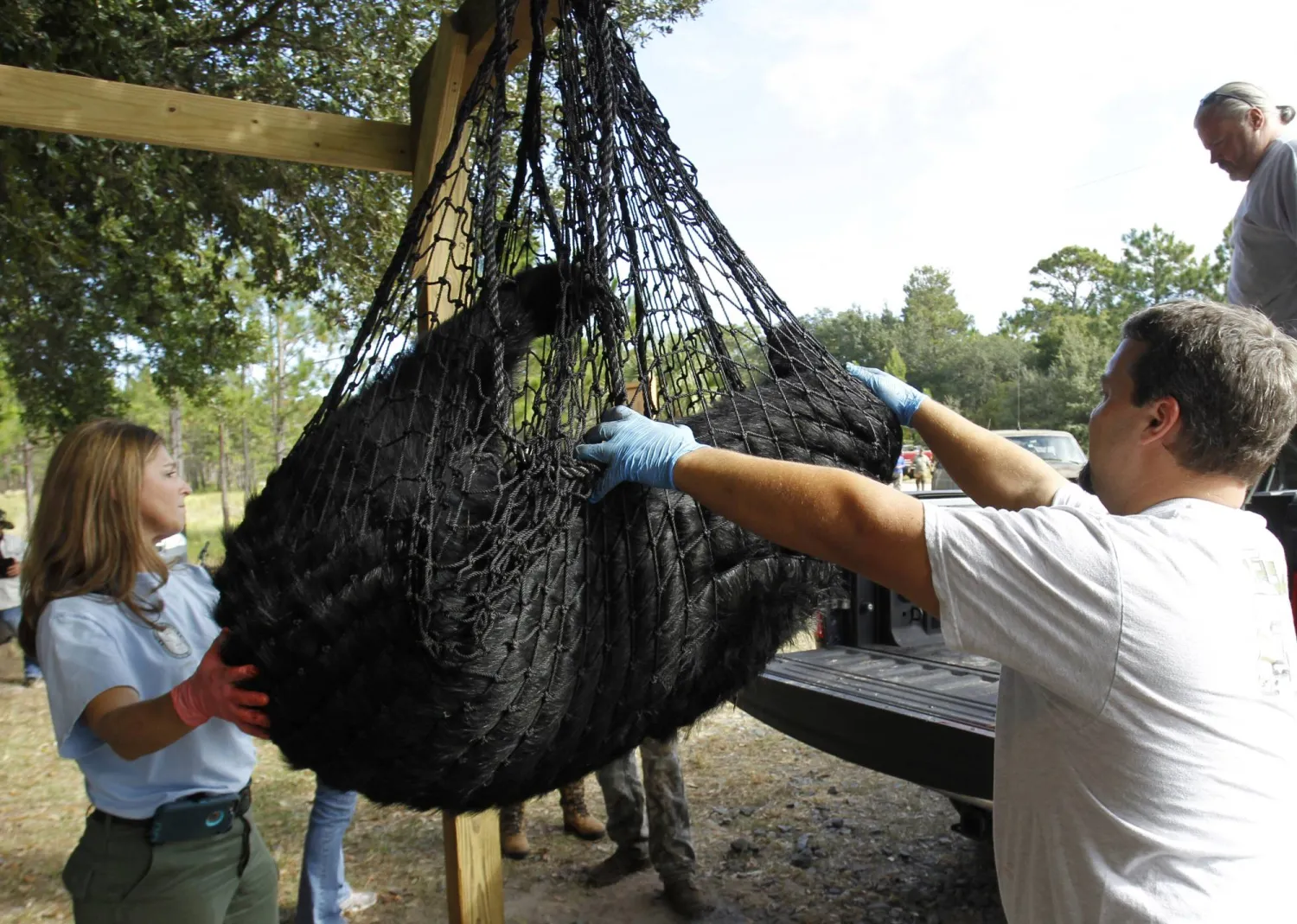

Florida Kicks Off 1st Black Bear Hunt in a Decade, Despite Pushback

FILE - A black bear is weighed by FWC Biologists Alyssa Simmons and Mike Orlando at the Rock Springs Run Wildlife Management Area near Lake Mary, Fla., Oct. 24, 2015. (Luis Santana/Tampa Bay Times via AP, file)
TT

Florida Kicks Off 1st Black Bear Hunt in a Decade, Despite Pushback

FILE - A black bear is weighed by FWC Biologists Alyssa Simmons and Mike Orlando at the Rock Springs Run Wildlife Management Area near Lake Mary, Fla., Oct. 24, 2015. (Luis Santana/Tampa Bay Times via AP, file)

For the first time in a decade, hunters armed with rifles and crossbows are fanning out across Florida's swamps and flatwoods to legally hunt the Florida black bear, over the vocal opposition of critics.

The state-sanctioned hunt began Saturday, after drawing more than 160,000 applications for a far more limited number of hunting permits, including from opponents who are trying to reduce the number of bears killed in this year's hunt, the state's first since 2015, The Associated Press reported.

The Florida Fish and Wildlife Conservation Commission awarded 172 bear hunt permits by random lottery for this year's season, allowing hunters to kill one bear each in areas where the population is deemed large enough. At least 43 of the permits went to opponents of the hunt who never intend to use them, according to the Florida chapter of the Sierra Club, which encouraged critics to apply in the hopes of saving bears.

The Florida black bear population is considered one of the state's conservation success stories, having grown from just several hundred bears in the 1970s to an estimated more than 4,000 today.

Opponents have questioned whether the hunt was necessary, but they were unable to convince the courts to halt it.

Here's what to know.

A limit of one bear per hunter The 172 people who were awarded a permit through a random lottery will be able to kill one bear each during the 2025 season, which runs from Dec. 6 to Dec. 28. The permits are specific to one of the state's four designated bear hunting zones, each of which have a hunting quota set by state officials based on the bear population in each region.

In order to participate, hunters must hold a valid hunting license and a bear harvest permit, which costs $100 for residents and $300 for nonresidents, plus fees. Applications for the permits cost $5 each.

The regulated hunt will help incentivize maintaining healthy bear populations, and help fund the work that is needed, according to Mark Barton of the Florida chapter of Backcountry Hunters and Anglers, an advocacy group that supported the hunt.

Having an annual hunt will help guarantee funding to "keep moving conservation for bears forward,” Barton said.

Hunting as a management tool According to state wildlife officials, the bear population has grown enough to support a regulated hunt and warrant population management. The state agency sees hunting as an effective tool that is used to manage wildlife populations around the world, and allows the state to monetize conservation efforts through permit and application fees.

"While we have enough suitable bear habitat to support our current bear population levels, if the four largest subpopulations continue to grow at current rates, we will not have enough habitat at some point in the future," reads a bear hunting guide published by the state wildlife commission.

Opponents meanwhile have called the hunt cruel, unnecessary and an excuse for hunters to bag a trophy animal when the real issue is the ever-growing human population encroaching on bear habitat.

Stricter regulations than the last hunt This year’s hunting plan has more stringent rules than the 2015 hunt, in which permits were provided to anyone who could pay for them, resulting in more than 3,700 permits issued. That led to a chaotic event that was shut down days early. Of the 304 bears killed, at least 38 were females with cubs, meaning the young bears may have died too.

Ultimately, wildlife officials decided to call off the hunt after its second day after a higher than expected number of bears were killed, though hunters did not exceed the statewide quota.

Doug Moore regularly sees bears on the more than 6,000 acres of timberland that he manages in northeast Florida. The president of a local hunting club, Moore is generally supportive of the new regulations for the bear hunt, even though he and his family members weren't issued a permit this year.

Moore described the management of the 2015 hunt as “fouled up” and “totally wrong" but said, “they’re doing it right this time."

Activists were issued dozens of permits Backers of the hunt have said that growing numbers of bears present a safety problem, with local officials sharing reports of bears on porches, rooting through garbage cans and roaming neighborhoods and playgrounds.

Activists have argued that the state should instead focus on other means of curbing nuisance bears and assuring safety through better trash management.

While opponents failed to convince a judge to stop the hunt, they were issued about a quarter of the overall permits, after activists applied for hunting tags they never intend to use.

“Somewhere out there a bear will be walking the grounds of the Panhandle, and I gave them a stay of execution,” said Joel Cleveland, an opponent of the hunt who was issued one of the permits.



US Astronaut to Take her 3-year-old's Cuddly Rabbit Into Space

FILE PHOTO: An evening launch of a SpaceX Falcon 9 rocket carrying 20 Starlink V2 Mini satellites, from Space Launch Complex at Vandenberg Space Force Base is seen over the Pacific Ocean from Encinitas, California, US, June 23, 2024. REUTERS/Mike Blake/File Photo
TT

US Astronaut to Take her 3-year-old's Cuddly Rabbit Into Space

FILE PHOTO: An evening launch of a SpaceX Falcon 9 rocket carrying 20 Starlink V2 Mini satellites, from Space Launch Complex at Vandenberg Space Force Base is seen over the Pacific Ocean from Encinitas, California, US, June 23, 2024. REUTERS/Mike Blake/File Photo

When the next mission to the International Space Station blasts off from Florida next week, a special keepsake will be hitching a ride: a small stuffed rabbit.

American astronaut and mother, Jessica Meir, one of the four-member crew, revealed Sunday that she'll take with her the cuddly toy that belongs to her three-year-old daughter.

It's customary for astronauts to go to the ISS, which orbits 250 miles (400 kilometers) above Earth, to take small personal items to keep close during their months-long stint in space.

"I do have a small stuffed rabbit that belongs to my three-year-old daughter, and she actually has two of these because one was given as a gift," Meir, 48, told an online news conference.

"So one will stay down here with her, and one will be there with us, having adventures all the time, so that we'll keep sending those photos back and forth to my family," AFP quoted her as saying.

US space agency NASA says SpaceX Crew-12 will lift off on a SpaceX Falcon 9 rocket from Cape Canaveral in Florida to the orbiting scientific laboratory early Wednesday.

The mission will be replacing Crew-11, which returned to Earth in January, a month earlier than planned, during the first medical evacuation in the space station's history.

Meir, a marine biologist and physiologist, served as flight engineer on a 2019-2020 expedition to the space station and participated in the first all-female spacewalks.

Since then, she's given birth to her daughter. She reflected Sunday on the challenges of being a parent and what is due to be an eight-month separation from her child.

"It does make it a lot difficult in preparing to leave and thinking about being away from her for that long, especially when she's so young, it's really a large chunk of her life," Meir said.

"But I hope that one day, she will really realize that this absence was a meaningful one, because it was an adventure that she got to share into and that she'll have memories about, and hopefully it will inspire her and other people around the world," Meir added.

When the astronauts finally get on board the ISS, they will be one of the last crews to live on board the football field-sized space station.

Continuously inhabited for the last quarter century, the aging ISS is scheduled to be pushed into Earth's orbit before crashing into an isolated spot in the Pacific Ocean in 2030.

The other Crew-12 astronauts are Jack Hathaway of NASA, European Space Agency astronaut Sophie Adenot, and Russian cosmonaut Andrey Fedyaev.


iRead Marathon Records over 6.5 Million Pages Read

Participants agreed that the number of pages read was not merely a numerical milestone - SPA
TT

iRead Marathon Records over 6.5 Million Pages Read

Participants agreed that the number of pages read was not merely a numerical milestone - SPA

The fifth edition of the iRead Marathon achieved a remarkable milestone, surpassing 6.5 million pages read over three consecutive days, in a cultural setting that reaffirmed reading as a collective practice with impact beyond the moment.

Hosted at the Library of the King Abdulaziz Center for World Culture (Ithra) and held in parallel with 52 libraries across 13 Arab countries, including digital libraries participating for the first time, the marathon reflected the transformation of libraries into open, inclusive spaces that transcend physical boundaries and accommodate diverse readers and formats.

Participants agreed that the number of pages read was not merely a numerical milestone, but a reflection of growing engagement and a deepening belief in reading as a daily, shared activity accessible to all, free from elitism or narrow specialization.

Pages were read in multiple languages and formats, united by a common conviction that reading remains a powerful way to build genuine connections and foster knowledge-based bonds across geographically distant yet intellectually aligned communities, SPA reported.

The marathon also underscored its humanitarian and environmental dimension, as every 100 pages read is linked to the planting of one tree, translating this edition’s outcome into a pledge of more than 65,000 trees. This simple equation connects knowledge with sustainability, turning reading into a tangible, real-world contribution.

The involvement of digital libraries marked a notable development, expanding access, strengthening engagement, and reinforcing the library’s ability to adapt to technological change without compromising its cultural role. Integrating print and digital reading added a contemporary dimension to the marathon while preserving its core spirit of gathering around the book.

With the conclusion of the iRead Marathon, the experience proved to be more than a temporary event, becoming a cultural moment that raised fundamental questions about reading’s role in shaping awareness and the capacity of cultural initiatives to create lasting impact. Three days confirmed that reading, when practiced collectively, can serve as a meeting point and the start of a longer cultural journey.


Imam Turki bin Abdullah Royal Reserve Launches Fifth Beekeeping Season

Jazan’s Annual Honey Festival - File Photo/SPA
TT

Imam Turki bin Abdullah Royal Reserve Launches Fifth Beekeeping Season

Jazan’s Annual Honey Festival - File Photo/SPA

The Imam Turki bin Abdullah Royal Nature Reserve Development Authority launched the fifth annual beekeeping season for 2026 as part of its programs to empower the local community and regulate beekeeping activities within the reserve.

The launch aligns with the authority's objectives of biodiversity conservation, the promotion of sustainable environmental practices, and the generation of economic returns for beekeepers, SPA reported.

The authority explained that this year’s beekeeping season comprises three main periods associated with spring flowers, acacia, and Sidr, with the start date of each period serving as the official deadline for submitting participation applications.

The authority encouraged all interested beekeepers to review the season details and attend the scheduled virtual meetings to ensure organized participation in accordance with the approved regulations and the specified dates for each season.