


UN Security Council Delegation Visits South Lebanon, Urges All Sides to Stick to Truce

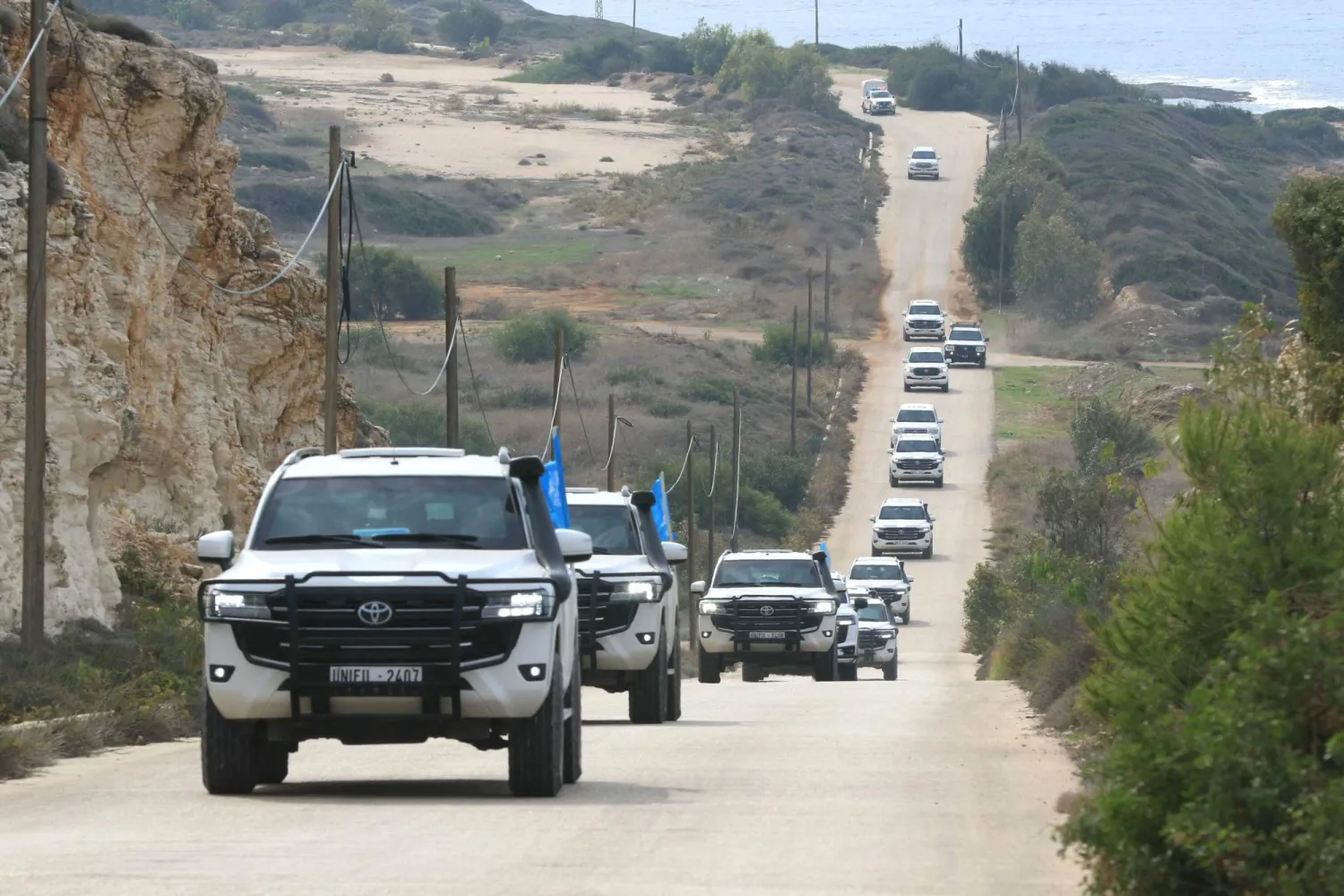
A convoy carrying a UN Security Council delegation, tours the border with Israel close to the southern Lebanese area of Naqura on December 6, 2025. (Photo by Mahmoud ZAYYAT / AFP)
TT

UN Security Council Delegation Visits South Lebanon, Urges All Sides to Stick to Truce

A convoy carrying a UN Security Council delegation, tours the border with Israel close to the southern Lebanese area of Naqura on December 6, 2025. (Photo by Mahmoud ZAYYAT / AFP)

A United Nations Security Council delegation on Saturday urged all parties to uphold a year-old ceasefire between Israel and Hezbollah, expressing support for a state weapons monopoly at the end of a Lebanon visit.

"We came to Beirut at a pivotal time for the implementation of... the cessation of hostilities agreement of November of last year," Slovenian UN ambassador Samuel Zbogar, whose country holds the rotating presidency of the UN body, told reporters.

"All parties must uphold the November 2024 cessation of hostilities agreement, and we recognize progress achieved by Lebanon this year," he said.

"We reaffirm the council's support for Lebanon's territorial integrity, sovereignty and political independence."

"We also reaffirm commitment to the full implementation of Resolution 1701 in support of Lebanon's -- as well as regional -- security and stability," he added, referring to a 2006 Security Council decision that forms the basis of the current truce.

The November 2024 ceasefire was supposed to end more than a year of hostilities between Israel and Hezbollah, but Israel has kept up strikes on Lebanon.

Israel has mainly said it is targeting the group, and has maintained troops in five south Lebanon areas it deems strategic.

The Lebanese government has committed to disarming Hezbollah, and the army is set to dismantle the group's military infrastructure near the border by year end before tackling the rest of the country.

"We support the Lebanese government's decision to ensure the state's monopoly of arms," Zbogar said, also urging "intensified international support" for Lebanon's army.

The delegation met senior officials including President Joseph Aoun, and on Saturday went to south Lebanon near the Israeli border, visiting UNIFIL peacekeepers.

In August, the Security Council voted to extend UNIFIL's mandate until the end of 2026 and then withdraw the force from Lebanon by the end of the following year.

The visit was a chance to "examine options for the implementation of Resolution 1701 following UNIFIL's departure from Lebanon", Zbogar said, adding that "this is a topic that will deserve a thorough conversation during 2026".

Zbogar also emphasized that the "safety of peacekeepers must be respected and that they must never be targeted", after Lebanon's army said it arrested six people following an attack by gunmen on UNIFIL personnel this week.


Iran, Hezbollah ‘Parallel Missile War’: Tactic to Confuse Israel or War of Attrition?

A damaged building in Beirut’s southern suburbs after an Israeli strike on the area, with a large portrait of Iran’s late Supreme Leader Ali Khamenei displayed on it (Reuters)
TT

Iran, Hezbollah ‘Parallel Missile War’: Tactic to Confuse Israel or War of Attrition?

A damaged building in Beirut’s southern suburbs after an Israeli strike on the area, with a large portrait of Iran’s late Supreme Leader Ali Khamenei displayed on it (Reuters)

The war in the region is showing a striking military shift, with Iran and Hezbollah launching missiles simultaneously toward Israel, signaling a move from sporadic attacks to coordinated fire across two fronts.

The step reflects an effort to impose new military equations and generate simultaneous pressure across multiple arenas.

Experts say the confrontation is effectively being run as a single front led by Tehran, with the Lebanese front appearing as a direct extension of the battle Iran is fighting.

Hezbollah underscored that when it said its missile attacks were in retaliation for the killing of Iran’s late Supreme Leader Ali Khamenei, while Iran’s Islamic Revolutionary Guard Corps said in a statement Wednesday evening that it had joined Hezbollah in what was called “Operation Al-Asf Al-Makoul.”

Lebanese government summons Iranian embassy official

The Iranian statement triggered a response in Lebanon. The cabinet decided to summon the Iranian embassy’s charge d’affaires, linking the move to a recent decision banning any activity by Iran’s Revolutionary Guards in Lebanon.

Information Minister Paul Morcos said that after the Revolutionary Guards’ statement referring to a joint operation with Hezbollah, Prime Minister Nawaf Salam asked Foreign Minister Youssef Rajji to “summon the appropriate official from the Iranian embassy.”

Rajji subsequently summoned the Iranian charge d’affaires and tasked the secretary-general of the Foreign Ministry with meeting him on Friday morning to convey Lebanon’s position rejecting any Iranian interference in the country’s internal affairs.

One front managed between Tehran and Beirut

Since the start of the US-Iran war, near-daily barrages have been launched from Iranian territory toward Israel’s interior, alongside dozens of rockets fired from southern Lebanon toward northern Israel.

The synchronized attacks deliver both a political and military message. Air raid sirens have sounded across wide areas from northern to central Israel during the barrages.

The latest operation was what Hezbollah called “Operation Al-Asf Al-Makoul,” which the Revolutionary Guards also said it had joined alongside the group.

Israeli military spokesperson Nadav Shoshani said Thursday that Hezbollah, in coordination with Iran, launched an overnight attack involving missiles and drones targeting cities and communities across Israel.

About 200 rockets and 20 drones were fired, he said, in addition to ballistic missiles launched from Iran at the same time.

Shoshani described it as the largest barrage Hezbollah has fired since the start of the war, but said Israeli air defenses and a rapid response limited the damage.

A security source told Asharq Al-Awsat the parallel strikes leave “no room for doubt that the military order comes from the same source,” adding that Iran views the war as “one front, not two,” managed from Tehran and Beirut alike.

The source said that view is also reflected in Israeli assassinations targeting Revolutionary Guard commanders, adding that those carrying out operations tied to that source “must execute the orders.”

Tactic aimed at Israeli air defenses

Retired Brigadier General Yaroob Sakher said the parallel launches reflect a tactic aimed primarily at confusing Israel’s air defense systems.

He said barrages fired by Hezbollah from southern Lebanon, given the group’s geographic proximity to Israel, serve to occupy defense systems and disperse their ability to respond to threats, opening a time window for long-range Iranian missiles attempting to penetrate those defenses.

Hezbollah as an ‘attrition front’

Sakher said the approach relies on synchronized barrages: closer-range rockets serve as a defensive distraction, while missiles launched farther away aim to exploit the resulting confusion.

But he said the tactic’s results remain limited, succeeding at times but failing often because of the density and sophistication of Israeli air defenses.

Sakher places the approach within what he describes as a broader Iranian strategy. In his view, Tehran sees the war as a major confrontation that could threaten its future and is therefore deploying all available tools.

That includes expanding regional tension while activating its regional allies, foremost Hezbollah, which forms the front closest to Israel.

However, he said Hezbollah no longer possesses all its previous capabilities after the blows it has sustained, leaving its role closer to a front of attrition or distraction than a decisive battlefield.

Israel strikes across multiple fronts

Sakher said Israel, in turn, is pursuing a parallel strategy by spreading its strikes across multiple fronts.

As Iran operates simultaneously from Tehran and Beirut, Israel is balancing its attacks between Iran and Hezbollah, backed by significant military and logistical capabilities, along with a US military presence in the region and the continued arrival of cargo aircraft carrying weapons to Israel.

He said the ongoing strikes have begun to affect Iran’s missile capabilities by targeting production sites and storage facilities above and below ground, gradually reducing its ballistic missile stockpile.

Hezbollah’s missile arsenal, he added, is also being depleted under sustained Israeli strikes.

In Sakher’s assessment, the balance of power clearly favors the United States and Israel because of the wide gap in military technology.

Iran, he said, relies on less advanced capabilities than those of the opposing side, including technologies based on artificial intelligence.

“In the short term, the battle does not appear to be moving in Tehran’s favor,” Sakher said, pointing to the continuing strikes on Iran’s missile capabilities.

He added that this could accelerate the confrontation's resolution, unless new political or military developments emerge.


Strike Kills 2 Academics at Lebanese University as Israel Bombs Central Beirut

People stand amid debris in front of damaged buildings in the aftermath of a reported Israeli strike in Zuqaq al-Blat, central Beirut, Lebanon March 12, 2026. REUTERS/Mohamed Azakir
TT

Strike Kills 2 Academics at Lebanese University as Israel Bombs Central Beirut

People stand amid debris in front of damaged buildings in the aftermath of a reported Israeli strike in Zuqaq al-Blat, central Beirut, Lebanon March 12, 2026. REUTERS/Mohamed Azakir

An Israeli strike that hit in the vicinity of Lebanon’s only public university killed the director of the faculty of sciences Hussein Bazzi and professor Mortada Srour.

The campus is in Hadath, on the outskirts of Beirut’s southern suburbs, which Israel had warned last week should be evacuated.

It was not clear whether the campus was directly targeted, but smoke could be seen rising near the building’s courtyard in the aftermath.

Lebanese President Joseph Aoun condemned the bombing, which he said targeted the campus, as a crime and a “violation of international laws and norms that prohibit attacks on educational institutions and civilians.”

Israel’s military said Thursday night it had begun another wave of strikes on Lebanon’s capital, saying it was targeting Hezbollah sites.

Israeli strikes hit two buildings in busy residential and commercial districts near central Beirut.


How Israel Crippled Gaza's Fishing

A Palestinian man stands on the door of a refrigerator that he uses as a makeshift rowing boat, as he throws his fishing basket into the sea at the port of Gaza City on March 9, 2025. (Photo by BASHAR TALEB / AFP)
TT

How Israel Crippled Gaza's Fishing

A Palestinian man stands on the door of a refrigerator that he uses as a makeshift rowing boat, as he throws his fishing basket into the sea at the port of Gaza City on March 9, 2025. (Photo by BASHAR TALEB / AFP)

Fishermen in Gaza say they are facing their toughest conditions since the start of the Israeli war, with Israeli forces preventing them from accessing the sea to earn a living and exposing them to gunfire or arrest, both during periods of truce and even after the ceasefire reached last October.

Israeli forces target Gaza fishermen with live ammunition or detain some for allegedly violating bans on fishing or even diving. Restrictions imposed on Gaza residents also leave them largely unable to swim.

Nafez Jarbou, 53, a fisherman from the Beach refugee camp west of Gaza City, told Asharq Al-Awsat that Israeli naval boats destroyed his fishing vessel during the war. He supports a family of 16, including four relatives who worked with him in fishing, all of whom lost their livelihoods.

“When the first truce began in January 2025, we tried to return to fishing using another boat belonging to neighbors whose sons, also fishermen, were killed by Israeli forces,” Jarbou said. “But we were surprised to find we were still barred from fishing.”

Hope briefly returned after the ceasefire was announced. But Jarbou said that, like thousands of other fishermen, he encountered “severe restrictions.” He later tried to resume fishing with his sons within less than one nautical mile from Gaza City’s shoreline.

Israeli naval boats continued to pursue them, opening fire or attempting to arrest them and confiscate their boats, he said.

Diving replaces fishing

With traditional fishing routes effectively closed despite the ceasefire, Gaza’s fishing activity has sharply declined. Even fishing within a one-nautical-mile range has become increasingly restricted.

Faced with these limits, fishermen have turned to diving with simple, rudimentary equipment to avoid being pursued or targeted.

But Jarbou said diving prevents them from catching most types of fish.

“All we can catch now is small sardines, which are not in high demand,” he said.

According to the Gaza Fishermen’s Union, more than 5,000 fishermen worked in the sector before the war.

At least 235 have been killed during Israeli military operations, most in airstrikes that hit their homes or the homes of relatives.

Another 40 fishermen were killed, and dozens were wounded while working at sea at extremely short distances from shore, sometimes less than 500 meters, and in some cases just 200 meters. Israeli forces have also arrested around 43 fishermen.

Mohammed al-Habil, 31, from the Beach refugee camp, was recently released after being detained off Gaza City’s coast.

“We went through a long ordeal in prison after I was arrested with two of my relatives while working at sea to make a living,” he told Asharq Al-Awsat.

Al-Habil said interrogators did not focus on his fishing work but instead sought “information about Hamas members in my area.”

He added that Israeli forces have long targeted fishermen, even before the latest war, attempting to arrest them and recruit them as informants.

“Words cannot describe our living conditions,” he said. “We have joined the large army of unemployed in Gaza.”

He questioned the role of mediators overseeing the ceasefire in ensuring safety for fishermen and allowing them to work at least within two or three nautical miles, an area he said “would not pose any security threat to Israel.”

“Starvation policy”

Zakaria Bakr, head of the Union of Workers in Gaza’s fishing sector, said Israel is “deliberately depriving fishermen of work at sea to starve them,” describing the move as part of a collective punishment policy against the enclave.

Preventing fishing, even within limited distances, despite the ceasefire shows the main goal is to destroy what remains of the fishing sector, which has already suffered heavy damage since the war began, he said.

“What is happening is the destruction of fishermen by depriving them of their livelihoods,” Bakr told Asharq Al-Awsat.

Each fisherman supports at least four family members who depend on the fish they sell, fish that are now largely unavailable under current restrictions imposed by Israel, he said.

The Gaza Center for Human Rights said Israel has imposed strict restrictions aimed at the comprehensive destruction of the fishing sector’s infrastructure and deepening a policy of starvation affecting thousands of fishermen’s families.

The group said Israeli forces destroyed trawlers and large fishing vessels, the backbone of Gaza’s fish production, inside the main Gaza port and the harbors of Khan Younis and Rafah, putting them permanently out of service.

More than 95% of small boats and more than 100 larger vessels have been destroyed, along with fishing equipment and boat-building workshops, it said.
