
‘It’s All Over’: How Iran Abandoned Assad to His Fate Days Before Fall

 Iran was a staunch backer of Bashar al-Assad but quickly withdrew its forces once as opposition forces took over Syria. (AFP)
Iran was a staunch backer of Bashar al-Assad but quickly withdrew its forces once as opposition forces took over Syria. (AFP)
TT

‘It’s All Over’: How Iran Abandoned Assad to His Fate Days Before Fall

 Iran was a staunch backer of Bashar al-Assad but quickly withdrew its forces once as opposition forces took over Syria. (AFP)
Iran was a staunch backer of Bashar al-Assad but quickly withdrew its forces once as opposition forces took over Syria. (AFP)

As city after city fell to a lightning opposition offensive in Syria last December, Iranian forces and diplomats supporting Bashar al-Assad saw the writing on the wall, abandoning the longtime ruler days before his ousting, sources told AFP.

During Syria's civil war, which erupted in 2011 following the government's brutal repression of pro-democracy protests, Iran was one of Damascus's biggest backers, sending Assad military advisers and forces from its Revolutionary Guards.

Iranian and allied regional fighters -- mainly from Lebanon's Hezbollah, but also from Iraq and Afghanistan -- had held key locations and helped prop up Assad, only to melt away in the face of opposition forces' headlong rush towards the capital.

Syrian officers and soldiers served under the Iranian Guards, whose influence grew during the conflict as Assad's power waned.

A former Syrian officer assigned to one of the Guards' security headquarters in Damascus said that on December 5 last year, his Iranian superior summoned him to an operations center in the Mazzeh district the following day to discuss an "important matter".

The former officer, requesting anonymity due to fears for his safety, said his superior, known as Hajj Abu Ibrahim, made a bombshell announcement to around 20 Syrian officers and soldiers gathered for the meeting.

"From today, there will be no more Iranian Revolutionary Guards in Syria. We're leaving," they were told.

"It's all over. From today, we are no longer responsible for you."

He said they were ordered to burn or otherwise destroy sensitive documents and remove hard drives from computers.

- Border bottleneck -

The announcement came as the opposition forces were making huge gains, but it still took the Syrian soldiers by surprise, he said.

"We knew things hadn't been going well, but not to that extent."

They received one month's salary in advance and went home.

Two days later the opposition forces captured Damascus without a fight after Assad fled to Russia.

Two Syrian employees of Iran's consulate in Damascus, requesting anonymity for security reasons, also described a hasty Iranian exit.

The consulate was empty by the evening of December 5 as Iranian diplomats scarpered across the border to Beirut, they told AFP.

Several Syrian employees "who held Iranian nationality left with them, accompanied by senior Revolutionary Guards officers", according to one of the former employees.

At Jdeidet Yabus, Syria's main border crossing with Lebanon, taxi drivers and former staff reported a massive bottleneck on December 5 and 6, with an eight-hour wait to clear the frontier.

Both of the former consulate employees said the Iranians told their Syrian personnel to stay home and paid them three months' salary.

The embassy, consulate and all Iranian security positions were deserted by the morning of December 6, they said.

- Russian base -

During the war, forces under Iranian command were concentrated in sensitive areas inside Damascus and its suburbs, particularly the Sayyida Zeinab area, home to an important Shiite shrine, and around Damascus airport, as well as near the Lebanese and Iraqi borders.

Parts of the northern city of Aleppo and locations elsewhere in the province were also major staging areas for personnel and fighters.

At a site that used to be a key military base for Iranian forces south of Aleppo, Colonel Mohammad Dibo said that when the city fell early in the opposition campaign, "Iran stopped fighting".

Iranian forces "had to withdraw suddenly after the quick collapse" of Assad's military, said Dibo, who took part in the opposition offensive and now serves in Syria's new army.

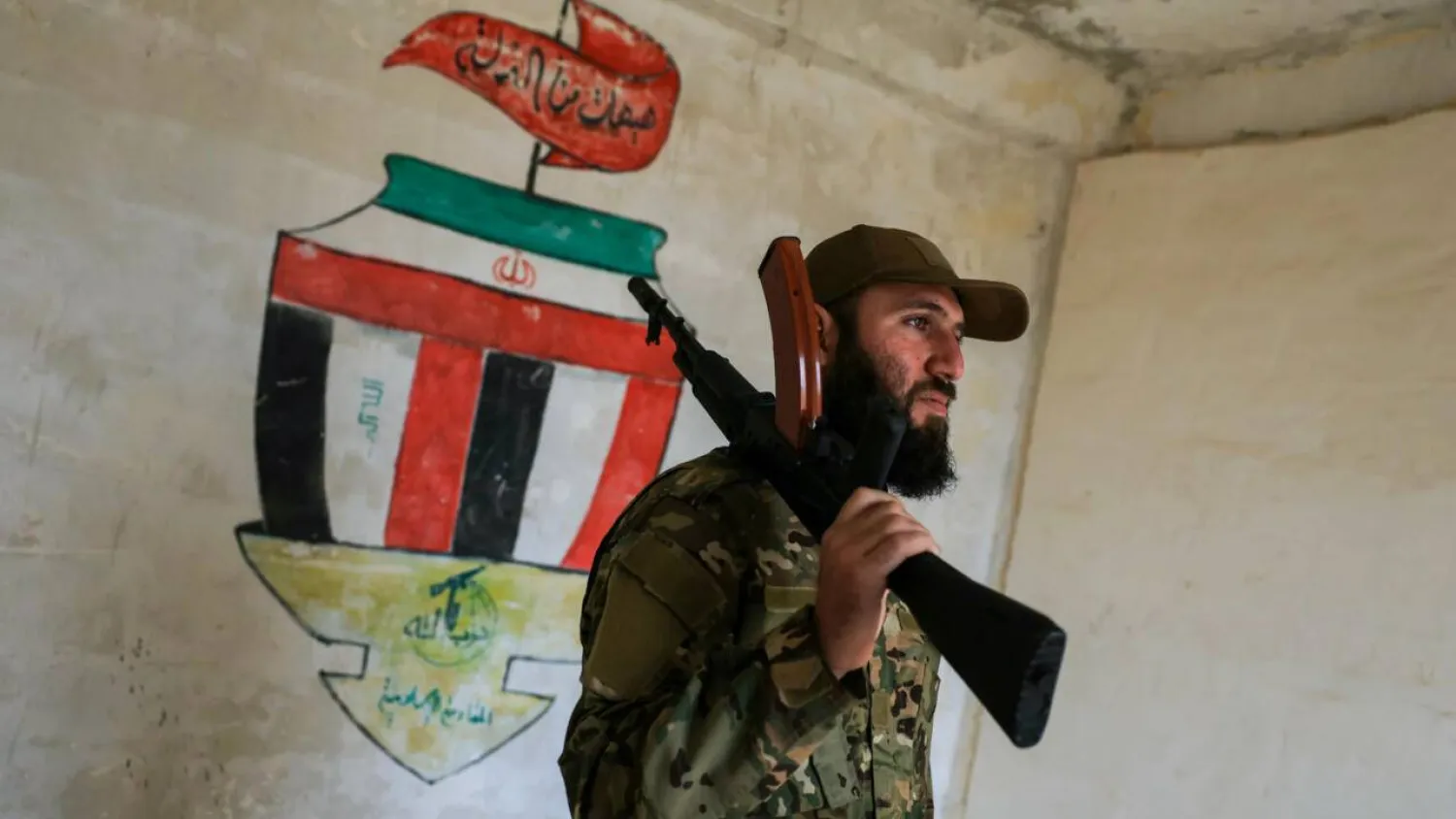
On the heavily damaged walls of the abandoned base, an AFP journalist saw Iranian and Hezbollah slogans, and a painting of a sword tearing through an Israeli flag.

Tehran's foe Israel had launched hundreds of strikes on Syria over the course of the war, mainly saying it was targeting Assad's army and Iran-backed groups.

The former Syrian army officer who requested anonymity said that on December 5, a senior Iranian military official known as Hajj Jawad and several Iranian soldiers and officers were evacuated to Russia's Hmeimim base on the Mediterranean coast, then flown back to Tehran.

At the abandoned site near Aleppo, Dibo said that after the city's fall, "some 4,000 Iranian military personnel were evacuated via Russia's Hmeimim base" where they had taken refuge.

Others fled overland through Iraq or Lebanon, he said.

Their exit was so rushed that "when we entered their bases" in Aleppo province, "we found passports and identity documents belonging to Iranian officers who didn't even have time to retrieve them."


Four Iranian Narratives on the Collapse of the ‘Resistance’ in Syria  

Iran's General Qassem Soleimani makes a phone call near the historic Citadel of Aleppo, winter 2016. (Fars)
TT

Four Iranian Narratives on the Collapse of the ‘Resistance’ in Syria  

Iran's General Qassem Soleimani makes a phone call near the historic Citadel of Aleppo, winter 2016. (Fars)

One hundred and ninety-two days separated the last meeting between Iran’s Supreme Leader Ali Khamenei and Syria’s ousted President Bashar al-Assad in Tehran from the moment the Syrian regime fell to the opposition in December 2024.

That interval was no footnote in the Syrian war. It became a sharp mirror inside Tehran, reflecting the magnitude of the wager Iran’s leadership had placed on Assad, and the limits of its ability to anticipate the trajectory of the conflict and shifts in the regional balance of power.

At that meeting, Khamenei laid out the essence of his “Syrian doctrine” amid changing realities across the “Axis of Resistance.” Syria, he argued, was no ordinary state but one with a “special place” because its identity, in his view, stemmed from its role in this axis.

Since “resistance is Syria’s defining identity and must be preserved,” he addressed Assad not as a political ally but as a partner in that identity. He praised Assad for once saying that “the cost of resistance is lower than the cost of compromise” and that “whenever we retreat, the other side advances.” Thus, Khamenei reaffirmed his full - if belated – gamble on the regime’s survival, even as signs of collapse were unmistakable on the ground.

Less than seven months later, the regime would fall. Assad’s collapse would yield several Iranian narratives: the Supreme Leader’s, the Revolutionary Guard’s, the diplomatic narrative, and a fourth voiced from within the system itself, one that raised blunt questions about the price of Iran’s Syrian gamble.

Khamenei’s narrative

In his first speech after Assad’s fall, Khamenei offered a hard-edged explanation: the event, he said, was the product of a “joint American-Zionist plot,” aided by neighboring states. He spoke of factors that he claimed prevented Iran from providing the necessary support, including Israeli and US strikes inside Syria and the closure of air and land corridors to Iranian supplies.

He concluded that the decisive flaw lay within Syria itself, where the “spirit of resistance” had eroded in state institutions.

He stressed that the regime’s fall did not mean the fall of the idea of “resistance,” predicting that “patriotic Syrian youth” would one day revive it in a new form.

This narrative rejects the notion of strategic defeat: for Khamenei, what happened is not the end of the struggle, but a harsh phase in a longer one.

Revolutionary Guard’s narrative

The Islamic Revolutionary Guard Corps (IRGC) adopted a language closer to national security logic than pure ideology, though it drew from the same lexicon. In 2013, cleric Mehdi Taeb, head of the IRGC’s Ammar Headquarters think tank, framed the equation starkly: “Syria is our 35th province... If the enemy attacks Syria or Khuzestan, our priority is to keep Syria.”

With that shocking sentence, Syria was elevated to the level of Iranian strategic geography, sometimes above parts of Iran itself.

Late General Qassem Soleimani, then commander of the Quds Force, became the chief architect of this approach: confronting threats abroad by building multinational militia networks and using the “protection of shrines” as a mobilizing slogan that fused ideology with national security calculations.

A month after Assad’s fall, at a memorial for Soleimani, Khamenei reaffirmed this school of thought, linking the defense of shrines in Damascus and Iraq to the defense of “Iran as a sanctuary,” aiming to bind various fronts into a single cross-border security-sectarian struggle.

After the Syrian regime’s collapse, this narrative preserved its core: success or failure is not defined by who sits in Damascus, but by whether the IRGC’s influence networks remain intact and whether Iran still has access to Syrian depth.

Full withdrawal would amount, in this logic, to admitting that the “35th province” had slipped from the map, so the IRGC will continue to search for any possible foothold.

Diplomatic narrative

Iran’s diplomatic apparatus sought to tell a softer story. Weeks before the fall, Khamenei dispatched his adviser Ali Larijani to Damascus and Beirut with reassuring messages for Assad and other allies, publicly asserting that events in Syria and Lebanon “directly concern Iran’s national security.”

Days later, Foreign Minister Abbas Araghchi visited Damascus just six days before the collapse, even posing with shawarma in a downtown restaurant to signal “normalcy” and dismiss talk of impending downfall as “psychological warfare.”

It was the peak of the gap between diplomatic messaging and a disintegrating reality.

Afterward, the Foreign Ministry adopted a defensive formula: Iran had “responded to the request of an allied government”, but “cannot decide on behalf of peoples.” Thus, responsibility was shifted toward Syrian internal failures and the external “conspiracy” often invoked by Khamenei.

This narrative treats Syria as one file among many, not an existential arena as seen by the IRGC and the Leader.

‘Open account’ narrative

The fourth narrative emerged, unexpectedly, from within the establishment itself. For the first time, semi-public acknowledgments surfaced that the economic return on Iran’s Syrian adventure was nearly nil and that the political-security “investment” had resulted in something resembling a net loss.

In 2020, former member of the Iranian parliamentary national security and foreign policy committee, Heshmatollah Falahatpisheh revealed that Tehran had spent “$20-30 billion” in Syria, insisting: “This is the people’s money and must be recovered.”

Five years later, he returned with a more bitter charge: Syria’s debts to Iran were effectively settled through “land without oil, cow farms without cows, and empty promises.”

This view is no outlier. Over a decade, Iranian protest slogans increasingly linked “Gaza, Lebanon, Syria” with bread, fuel, and economic hardship at home.

With Assad gone, critics more easily argue that Iran spent tens of billions and paid a human cost among its fighters and proxies, only to end up with almost no influence in Damascus.

For decision-makers, this narrative becomes domestic pressure against any large-scale return to Syria.

Four scenarios for Tehran

Taken together, these narratives reveal a deep contradiction: the IRGC and Khamenei refuse to concede that Iran “lost Syria,” treating the episode as one phase in a longer struggle. Meanwhile, the diplomatic and economic narratives acknowledge, implicitly, that the previous intervention model is no longer sustainable.

Four broad scenarios emerge. The first is a return through proxies, closest to the IRGC’s logic: Iran would rebuild influence from the ground up through militias - old or newly recruited - to pressure any future authority in Damascus.

The second is regional repositioning without Syria, in which Iran shifts resources to arenas where it still holds leverage, including Lebanon, Iraq, Yemen and Gaza, while limiting its role in Syria to preventing hostile entrenchment.

The third is a “gray” re-entry: a gradual, negotiated, non-confrontational return through localized deals or modest economic and security projects, allowing Tehran to claim continued presence without the cost of backing a single ruler.

The fourth is institutionalizing the loss: Iran accepts Syria’s departure from its strategic depth, but repackages the outcome within a narrative of “conspiracy and steadfastness,” using it to tighten internal control while maintaining symbolic presence through shrine rhetoric and minimal diplomacy.

Across all scenarios, one fact remains. Syria, which was once described as more vital than Khuzestan and the “distinct identity of resistance”, is no longer what it was before December 8, 2024 when the regime collapsed.

Tehran can invoke time, the IRGC can search for openings, diplomats can polish their statements, and critics can lament “land without oil.” But one question looms over every debate in Iran: Can Tehran afford a second Syrian-sized gamble after emerging from the first still trying to convince itself that the “resistance factor” remains standing, even as its Syrian pillar has broken?


A Year After Assad’s Fall, Families of Missing Detainees Languish without Answers 

Amina Beqai holds a photo of her husband, who went missing after he was arrested by security forces under the rule of ousted President Bashar al-Assad, in Damascus, Syria, November 23, 2025. (Reuters)
TT

A Year After Assad’s Fall, Families of Missing Detainees Languish without Answers 

Amina Beqai holds a photo of her husband, who went missing after he was arrested by security forces under the rule of ousted President Bashar al-Assad, in Damascus, Syria, November 23, 2025. (Reuters)

A year after dictator Bashar al-Assad's ouster in Syria, little has changed in Amina Beqai's desperate quest. She types her missing husband's name yet again into an internet search box, hoping for answers to a 13-year-old question. In vain.

Beqai has nowhere else to turn.

A National Commission for Missing Persons established in May has been gathering evidence of enforced disappearances under Assad, but has yet to offer families any clues on the estimated 150,000 people who vanished in his notorious prisons.

They include Beqai's husband Mahmoud, arrested by Syria's security forces at their home near Damascus on April 17, 2012, and her brother Ahmed, detained in August that year.

Assad's overthrow initially stirred hope that prison records could tell families if, when and how their loved ones died. Mass graves dug by Assad's forces across Syria could be exhumed. Victims could be properly buried.

None of that has transpired.

"It's been a year. They didn't do anything ... Is it thinkable that they didn't even get the documents for these men? Showing us the truth is what we want," Beqai told Reuters.

FADING HOPES

As opposition fighters swept through Syrian towns last year on the way to capturing Damascus, they rushed first to the jails, flinging doors open to free thousands of bewildered prisoners.

On December 8, 2024, hours after Assad fled to Russia, the fighters freed dozens of prisoners from Sednaya, dubbed "the human slaughterhouse" by Amnesty International for the industrial-scale torture and executions undertaken there.

The emerging detainees did not include Beqai's loved ones.

"When the prisons were open, and they didn't come back – that was the shock. That was when the hope ended, it really died," Beqai said. But she demands to know how, when and where her husband and brother may have died.

With no updates from the national commission, Beqai said she had become "obsessed" with her online hunt, scouring pictures of dead detainees and scans of prison documents published by Syrian news outlets who entered jails and security branches after Assad's fall.

"All there is left to do is sit and search," she said.

Such documents have revealed crucial information.

Sarah al-Khattab last saw her husband heading into a police station in Syria's south on February 9, 2019 to reconcile with Assad's government after years holed up with insurgents.

She has had no news of him since.

A spreadsheet of dead Sednaya prisoners seen by Reuters after Assad's fall included his name, Ali Mohsen al-Baridi, dating his death as October 22, 2019 from "stopped pulse and breathing" with orders that the body not be given to his family.

Reuters passed its finding to the Syrian Justice and Accountability Center, an advocacy group working with families of the missing, who informed Khattab.

COMMISSION SEEKS HELP, OVERSIGHT

The national commission was established by new President Ahmed al-Sharaa. The commission's media adviser, Zeina Shahla, told Reuters its mandate includes any missing Syrian, no matter the circumstances.

"When it comes to the pain of the families, maybe we really are being slow. But this file needs progress to come carefully, in a way that is scientific and systemic and not rushed," she said.

Next year, the commission hopes to launch a database of all the missing using documents from prisons and other locations. Exhuming mass graves requires more technical expertise and probably won't happen until 2027, Shahla said.

The commission has met with Syrian advocacy groups and some families. In November, it signed a cooperation agreement with the Geneva-based International Committee of the Red Cross and the International Commission on Missing Persons, which have global expertise on the issue.

Syria's commission hopes that will lead to more training for its personnel and access to equipment in short supply in Syria, including DNA testing labs for exhumed remains.

"We welcome any kind of cooperation and support we can receive, as long as the issue remains under (our commission's) authority,” Shahla said.

RELATIVES, ACTIVISTS DEMAND BETTER

The government's approach has upset organizations who developed expertise on enforced disappearances while in exile during the Assad era, six rights groups told Reuters.

Many were excited to apply that knowledge on the ground with Assad gone, but say the government's centralized approach has excluded them, slowed progress and left families in limbo.

"When you have as many as a quarter of a million people missing, you can't do that. You break up the work," said Ahmad Helmi, a Syrian activist who leads Ta'afi, an initiative focused on missing detainees and prison survivors.

Activists also accuse the commission of "monopolizing" detention-related documents.

In September, Syrian authorities briefly detained Amer Matar, an activist who founded a virtual museum to preserve detainees' experiences, accusing him of illegally accessing official documents for personal purposes.

In November, the commission urged families not to believe any detention-related documents shared on unofficial online platforms, like the ones Beqai has been searching, and threatened legal action against those outlets.

"The commission wants to monopolize the file, but it lacks the tools, the competence and the transparency. It demands the trust of families but delivers no results," Matar said.

Shahla said the commission is "the central, official body authorized to reveal the fate" of missing people and that families needed one place to go to for accurate answers.

Agnes Callamard, head of Amnesty International, said the commission should issue regular updates about its progress and consider granting financial aid to relatives of missing people.

"The most important thing ... the national commission can do at the moment is ensuring that families feel they are being heard and being supported," she told Reuters.

As Syria marks a year since Assad's downfall, many people remain exhausted by the same burden that plagued them under his rule: the lack of closure.

Alia Darraji last saw her son Yazan on November 1, 2014, as he left home to meet friends near Damascus. He never returned.

In the last year, the elderly woman has spent time in "truth tents" - sit-ins demanding information on disappeared Syrians that were unthinkable under Assad. While solidarity has helped, it hasn't given her what her heart aches for.

"We were hoping to find their bodies, to bury them, or to find out where they are," Darraji said.


Former Spy Chief and Assad’s Cousin Plot Syrian Uprisings from Russia

A member of Hayat Tahrir al-Sham stands guard near an image of Syria's Bashar al-Assad at the fourth division headquarters in Damascus, Syria, January 23, 2025 (Reuters)
TT

Former Spy Chief and Assad’s Cousin Plot Syrian Uprisings from Russia

A member of Hayat Tahrir al-Sham stands guard near an image of Syria's Bashar al-Assad at the fourth division headquarters in Damascus, Syria, January 23, 2025 (Reuters)

Two former loyalists to Bashar al-Assad who fled Syria after his fall are funneling millions of dollars to tens of thousands of potential fighters, hoping to stir uprisings against the new government and reclaim some of their lost influence, a Reuters investigation has found.

Assad, who escaped to Russia last December, is largely resigned to exile in Moscow, say four people close to the family. But other senior figures from his inner circle, including his brother, have not come to terms with losing power.

Reuters found that two of the men once closest to Assad, Maj. Gen. Kamal Hassan and billionaire Rami Makhlouf, are competing to form militias in coastal Syria and Lebanon made up of members of their minority Alawite sect, long associated with the Assad family.

All told, the two men and other factions jostling for power are financing more than 50,000 fighters in hope of winning their loyalty.

Assad’s brother, Maher, who is also in Moscow and still controls thousands of former soldiers, has yet to give money or orders, said the four people close to the Assads.

One prize for Hassan and Makhlouf is control of a network of 14 underground command rooms built around coastal Syria toward the end of Assad’s rule, as well as weapons caches.

Two officers and a Syrian regional governor confirmed the existence of these concealed rooms, details of which appear in photos seen by Reuters.

Hassan, who was Bashar’s military intelligence chief, has been tirelessly making calls and sending voice messages to commanders and advisors. In them, he seethes about his lost influence and outlines grandiose visions of how he would rule coastal Syria, home to the majority of Syria’s Alawite population and Assad’s former powerbase.

Makhlouf, a cousin of the Assads, once used his business empire to fund the ousted President during the civil war, only to run afoul of his more powerful relatives and wind up under years of house arrest. He now portrays himself in conversations and messages as a messianic figure who will return to power after ushering in an apocalyptic final battle.

Hassan and Makhlouf did not respond to requests for comment for this report. Bashar and Maher Assad couldn’t be reached. Reuters also sought comment from the Assad brothers through intermediaries, who didn’t reply.

From their exiles in Moscow, Hassan and Makhlouf envision a fractured Syria, and each wants control of the Alawite-majority areas.

Both have spent millions of dollars in competing efforts to build forces, Reuters found. Their deputies are located in several countries.

To counter the plotters, Syria’s new government is deploying another former Assad loyalist – a childhood friend of new President Ahmed al-Sharaa who became a paramilitary leader for Assad and then switched sides mid-war after the ousted President turned against him. The task of that man, Khaled al-Ahmad, is to persuade Alawite ex-soldiers and civilians that their future lies with the new Syria.

Details of the scheming are based on interviews with 48 people with direct knowledge of the competing plans. All spoke on condition of anonymity.

Reuters also reviewed financial records, operational documents, and exchanges of voice and text messages.

The governor of the coastal region of Tartous, Ahmed al-Shami, said Syrian authorities are aware of the outlines of the plans and ready to combat them. He confirmed the existence of the command-room network as well, but said it has been weakened.

“We are certain they cannot do anything effective, given their lack of strong tools on the ground and their weak capabilities,” al-Shami told Reuters in response to questions about the plotting.

The Lebanese Interior Ministry and the Russian Foreign Ministry did not respond to requests for comment. A UAE official said its government is committed to preventing the use of its territory for “all forms of illicit financial flows.”

For now, the prospects of a successful uprising seem low.

Chief plotters Hassan and Makhlouf are virulently at odds with one another.

Their hopes are fading to win backing from Russia, once Assad’s most powerful political and military supporter. Many Alawites in Syria, who also suffered under Assad, mistrust the pair. And the new government is working to stymie their plans.

In a brief statement in response to the Reuters findings, the government’s Alawite point man al-Ahmad said the “work of healing – of uprooting sectarian hatred and honoring the dead – remains the only path toward a Syria that can live with itself again.”

Hassan claims control of 12,000 fighters, while Makhlouf claims control of at least 54,000, according to their factions’ internal documents. Commanders on the ground said fighters are paid a pittance and taking money from both sides.

The exiles don't appear to have mobilized any forces yet. Reuters could not confirm the fighter figures or determine specific action plans. Tartous governor Al-Shami said potential fighters numbered in the tens of thousands.

In interviews, the people closest to the plotters said they’re aware that tens of thousands of Syrian Alawites could face violent retribution if they implement their plans against the new leadership.

In March, nearly 1,500 civilians were killed across the Mediterranean coast by government-affiliated forces after a failed uprising in an Alawite town.

Both Hassan and Makhlouf promise to protect Syria’s Alawites from the insecurity that has continued since March, including near-daily killings and kidnappings.

Neither Makhlouf nor Hassan were behind the protests, but rather a cleric who opposes both men and publicly called on people to demonstrate peacefully.

Makhlouf attacked the cleric the next day in a social media post, saying, “all these movements will only bring calamity, for the time is not yet right.”
One of Hassan’s top military coordinators told Reuters that fighting is the only way to restore Alawite dignity.

“We are lucky that only this number of our people have died so far,” said the coordinator, a former Assad-era military intelligence officer who is now in Lebanon. “Perhaps thousands more will die, but the sect must offer up sacrificial lambs” to defend the community.

According to January 2025 documents seen by Reuters, Assadist forces drew up initial plans to build a paramilitary force of 5,780 fighters and supply them from the subterranean command rooms. These are essentially large storerooms equipped with arms, solar power, internet, GPS units and walkie-talkies.

Nothing came of that early plan, and the command rooms – along a spine in coastal Syria about 180 kilometers from north to south – remain operational but essentially idle, according to two people with knowledge of them and photos seen by Reuters.

One photo showed a room with five stacked crates, three of which were open to reveal a collection of AK-47s, ammunition and hand grenades. The room also held three desktop computers, two tablets, a set of walkie-talkies, and a power bank. In the center was a wooden table topped with a large map.

For the plotters, “this network is Treasure Island, and they are all boats trying to reach it,” said one of the people, a commander who monitors the readiness of the rooms.

Al-Shami, the Tartous governor, said the network is real but poses little danger.

As senior military officials and ranking government figures escaped abroad in December 2024, many mid-level commanders remained in Syria. Most fled to the coastal regions dominated by Alawites, a Muslim minority that makes up a little over 10% of Syria’s population.

Those officers started recruiting fighters, according to a retired commander involved in the effort.

“The most fertile ground was the military,” the retired commander said. “Thousands of young men from the sect had been conscripted into the army, which was dissolved in December, and they suddenly found themselves exposed.”

Then came the failed uprising on March 6. An Alawite unit operating independently ambushed security forces from the new Syrian government in rural Latakia, killing 12 men and capturing more than 150, according to a brigadier general who was involved with the ambush and has since left for Lebanon.

The new Syrian government says hundreds of its security forces died in the fighting that followed – a claim largely echoed by the pro-Assad fighters.

The brigadier general said 128 pro-Assad forces died in the uprising, which was quelled by the new government. The insurgency sparked reprisals that killed nearly 1,500 Alawites.

The Assadist exiles neither started nor commanded the uprising, according to the officers who were there, but those days marked a turning point. They began to organize.

An Assad Family Feud
It was on March 9 that Makhlouf started calling himself “The Coast Boy,” declaring in a statement that he had been entrusted with a divine mission to help Alawites. “I’m back, and blessed be the return,” the statement read. It did not mention that he was in Moscow.

Makhlouf dominated Syria’s economy for more than two decades, with holdings estimated by the British government at well over a billion dollars in industries as varied as telecoms, construction and tourism. He used his money to fund Syrian army units and allied militias during the civil war, which broke out in 2011.

When Assad’s victory seemed assured in 2019, Makhlouf publicly claimed credit. Soon after, Assad seized Makhlouf’s businesses, ostensibly because they were indebted to the state, and put him under years of house arrest.

Makhlouf escaped to Lebanon in an ambulance the night of December 8, 2024, as Damascus fell to Sharaa’s rebels.

Makhlouf’s brother Ehab also tried to flee that night in his Maserati, but was shot to death near the border and robbed of millions of dollars he was carrying in cash, according to four close associates of the family and a customs officer with direct knowledge of the events. Reuters could not independently verify the events of that night.

Makhlouf now lives on a private floor in a luxurious Radisson hotel in Moscow under tight security, according to nine aides and relatives.

The Radisson in Moscow and group headquarters in Brussels did not respond to a request for comment.

According to Makhlouf’s Facebook posts and WhatsApp messages to associates, he believes God gave him money and influence so he can play a messianic role in a prophecy involving the battle of Armageddon in Damascus.
In his interpretation, the apocalypse will arrive after the end of US President Donald Trump’s term.

Using trusted business administrators three countries, Makhlouf is transferring money to Alawite officers for salaries and equipment, according to a financial manager and receipts and payroll tables seen by Reuters.

The documents show the money is funneled through two prominent Syrian officers who reunited with Makhlouf in Moscow: Suhail Hassan and Qahtan Khalil, who both held the rank of major general. Hassan and Khalil claimed to have created a force for Makhlouf totaling what they said were 54,053 willing fighters, including 18,000 officers, organized into 80 battalions and groups in and around the cities of Homs, Hama, Tartous and Latakia.

Many rank-and-file soldiers conscripted under Assad, however, gave up fighting when his government fell.

Hassan and Khalil didn’t reply to requests for comment about their role in transferring money.

An UAE official said the government maintains strict oversight over its economic sectors and fully “supports Syria’s efforts to safeguard its security, stability, and sovereignty over all territories.’

One of his financial managers told Reuters that Makhlouf has spent at least $6 million on salaries. Payroll tables and salary receipts created by financial aides to Makhlouf in Lebanon claimed he spent $976,705 in May, and that one group of 5,000 fighters received $150,000 in August.

The total force numbers are real, according to five leaders of military groups in Syria who are on Makhlouf’s payroll and lead about a fifth of his following. But Makhlouf’s funding falls short of their needs, amounting to just $20 to $30 a month per fighter.

In addition, Makhlouf’s staff has sought to provide weapons. They have mapped the possible location of dozens of caches hidden during the Assad era totaling a few thousand firearms, according to schematics Reuters viewed.

These stockpiles are separate from the hidden command rooms.

They have also been in discussions with smugglers in Syria for new weapons.

People familiar with the discussions said they didn’t know if new weapons were actually purchased or delivered.

Altogether, the five local military leaders said they command about 12,000 men in various stages of readiness. One of them told Reuters the time wasn’t yet right for action.

Another of the five commanders derided Makhlouf as trying to buy loyalty with “crumbs of money.”

All five said they had accepted money from both Makhlouf and Hassan, the spy chief. They saw no issue with overlapping paymasters.

Mass Grave and Hiding Atrocities
Hassan ran the Assad dictatorship’s military detention system, which was notorious for extorting money at scale from prisoners’ families, according to a 2024 United Nations report about the system.

A Reuters investigation this year found it was Hassan who proposed moving a mass grave containing thousands of bodies in 2018 to the Dhumair desert outside Damascus to hide the scope of the Assad government atrocities.

With Assad’s fall, Hassan took refuge in the Russian embassy in December 2024 for nearly two weeks.

He was infuriated at what he perceived as ill-treatment by his hosts, who provided a single room with just one hard chair to sit on, according to two people close to him.

“Kamal Hassan is not one to sit on a wooden chair for days!” he said in one WhatsApp voice message to his inner circle from this spring, reviewed by Reuters.

Hassan ultimately took up residence in a three-story villa in suburban Moscow, according to an officer who met him over the summer.

Since then, he has seen Maher al-Assad once and maintains close ties with Bashar’s Russian protectors, according to the two people aware of Hassan’s movements.

According to Hassan’s operations coordinator in Lebanon, Hassan has spent $1.5 million since March on 12,000 fighters in Syria and Lebanon.

“Be patient, my people, and don’t surrender your arms. I am the one who will restore your dignity,” he said in another WhatsApp voice message from April that appeared aimed at commanders. Two recipients confirmed the message was from him.

In mid-year, a charity called the “Development of Western Syria” announced its creation and said it was funded by “the Syrian citizen Maj. Gen. Kamal Hassan,” according to one of its initial Facebook posts.

Three officers linked to Hassan and a manager in the organization described it as a humanitarian cover so Hassan could build influence among Alawites.

In August, the charity paid $80,000 to shelter 40 Syrian Alawite families, according to an announcement of its first action. That same month, Hassan sent $200,000 in cash to 80 officers in Lebanon, according to a payroll document seen by Reuters.