

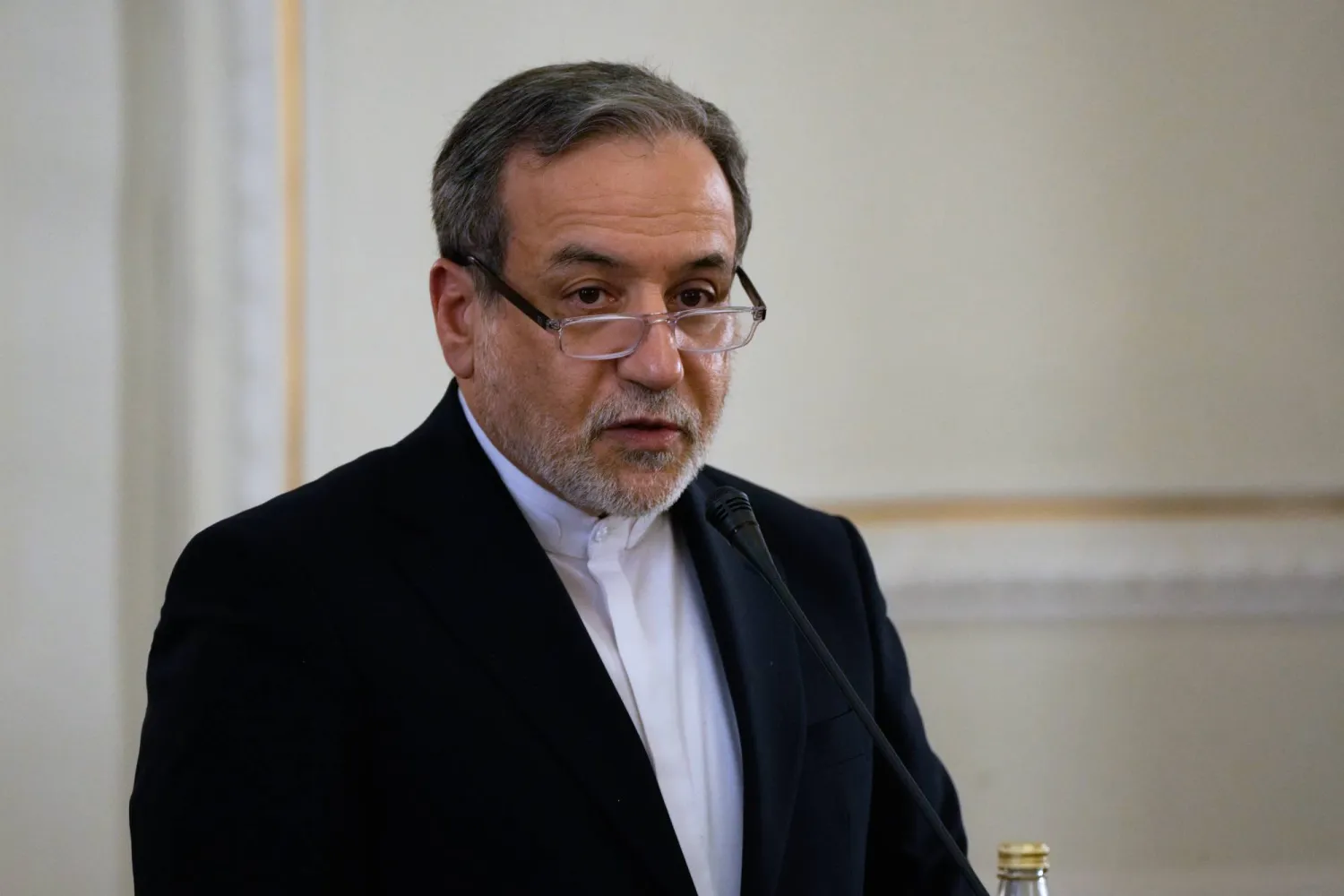

Araghchi: Iran Ready for Serious Nuclear Talks with Washington

Iranian Foreign Minister Abbas Araghchi (AP) 
TT

Araghchi: Iran Ready for Serious Nuclear Talks with Washington

Iranian Foreign Minister Abbas Araghchi (AP) 

Iranian Foreign Minister Abbas Araghchi said on Saturday Tehran is not convinced Washington was ready for real and serious negotiations.

But, the FM added, “If they change their approach and are prepared for a fair and mutually beneficial negotiation, we are prepared as well.”

In an exclusive interview with Japan’s Kyodo News, Araghchi called for Japan to share its expertise with past atomic disasters and help Iran secure facilities severely damaged by recent Israeli and US strikes.

“I have no doubt that Japan has good knowledge on how to improve the safety of nuclear facilities, and that knowledge can be shared with Iran,” he said, citing extensive work on environmental, medical and technical safety measures in the aftermath of nuclear crises.

Also, Araghchi emphasized that potential cooperation would pertain to technical safety, not to inspections, which is an IAEA mandate. “On the technical aspects of these safety challenges, cooperation with Japan can be very useful.”

The Iranian FM then noted that the Israeli strikes on Iran's nuclear sites were “perhaps the biggest violation of international law” ever committed against a safeguarded nuclear facility under the monitoring of the International Atomic Energy Agency.

Fair and Balanced Negotiations

Touching on the prospects for stalled nuclear talks, Araghchi said Iran is open to diplomacy but only under conditions that guarantee a “fair and balanced” outcome. “It depends on the United States,” he said.

The minister said Tehran remains skeptical about the outcomes of future nuclear talks, due to Washington’s withdrawal from the 2015 nuclear accord and its support for the recent Israeli attacks on Iran.

“If they change their approach and are prepared for a fair and mutually beneficial negotiation, we are prepared as well. But negotiation is different from dictation. For the time being, we are not convinced they are ready for a real, serious negotiation,” he said.

Araghchi explained that the main disagreement remains Washington's refusal to acknowledge Iran's right to peaceful nuclear technology, including uranium enrichment, under the Nuclear Non-Proliferation Treaty, of which Japan is a member.

“Tehran is prepared to accept limits on levels of enrichment and centrifuge types,” he said, adding that negotiations could proceed quickly once the US takes a reciprocal approach by allowing Iran's peaceful nuclear program and lifting sanctions.

Araghchi then said Iran faces a complex mix of safety and security threats that it has never seen before, citing structural damage and potential radiation leaks after the June strikes.

As there is “no precedent of a peaceful nuclear facility being bombarded,” the foreign chief said, “the strikes exposed a critical procedural gap within the IAEA, in terms of how to inspect such a facility.”

Earlier this year, Iran and the IAEA reached a framework of cooperation during talks in Cairo to define a workable mechanism for inspecting and stabilizing sites damaged by military action.

However, Araghchi said, the agreement was undermined when the United States and the three European parties to the 2015 nuclear deal sought to restore past UN Security Council sanctions.


Trump Says Zelenskyy 'Isn't Ready' Yet to Accept US-authored Proposal to End Russia-Ukraine War

US President Donald Trump poses on the red carpet for the 2025 Kennedy Center Honors at the John F. Kennedy Center for the Performing Arts in Washington, D.C., US, December 7, 2025. REUTERS/Jeenah Moon
TT

Trump Says Zelenskyy 'Isn't Ready' Yet to Accept US-authored Proposal to End Russia-Ukraine War

US President Donald Trump poses on the red carpet for the 2025 Kennedy Center Honors at the John F. Kennedy Center for the Performing Arts in Washington, D.C., US, December 7, 2025. REUTERS/Jeenah Moon

President Donald Trump on Sunday claimed Ukrainian President Volodymyr Zelenskyy “isn't ready” to sign off on a US-authored peace proposal aimed at ending the Russia-Ukraine war.

Trump was critical of Zelenskyy after US and Ukrainian negotiators completed three days of talks on Saturday aimed at trying to narrow differences on the US administration's proposal. But in an exchange with reporters on Sunday night, Trump suggested that the Ukrainian leader is holding up the talks from moving forward.

“I’m a little bit disappointed that President Zelenskyy hasn’t yet read the proposal, that was as of a few hours ago. His people love it, but he hasn’t,” Trump claimed in an exchange with reporters before taking part in the Kennedy Center Honors. The president added, "Russia is, I believe, fine with it, but I’m not sure that Zelenskyy’s fine with it. His people love it. But he isn’t ready.”

To be certain, Russian President Vladimir Putin hasn't publicly expressed approval for the White House plan. In fact, Putin last week had said that aspects of Trump's proposal were unworkable, even though the original draft heavily favored Moscow.

Trump has had a hot-and-cold relationship with Zelenskyy since riding into a second White House term insisting that the war was a waste of US taxpayer money. Trump has also repeatedly urged the Ukrainians to cede land to Russia to bring an end to a now nearly four-year conflict he says has cost far too many lives.

Zelenskyy said Saturday he had a “substantive phone call” with the American officials engaged in the talks with a Ukrainian delegation in Florida. He said he had been given an update over the phone by US and Ukrainian officials at the talks.

“Ukraine is determined to keep working in good faith with the American side to genuinely achieve peace,” Zelenskyy wrote on social media.

Trump's criticism of Zelenskyy came as Russia on Sunday welcomed the Trump administration’s new national security strategy in comments by the Kremlin spokesman published by Russia’s Tass news agency.

Dmitry Peskov said the updated strategic document, which spells out the administration's core foreign policy interests, was largely in line with Moscow’s vision.

“There are statements there against confrontation and in favor of dialogue and building good relations,” he said, adding that Russia hopes this would lead to “further constructive cooperation with Washington on the Ukrainian settlement.”

The document released Friday by the White House said the US wants to improve its relationship with Russia after years of Moscow being treated as a global pariah and that ending the war is a core US interest to “reestablish strategic stability with Russia.”

Speaking on Saturday at the Reagan National Defense Forum, Trump’s outgoing Ukraine envoy, Keith Kellogg, said efforts to end the war were in “the last 10 meters.”

He said a deal depended on the two outstanding issues of “terrain, primarily the Donbas,” and the Zaporizhzhia Nuclear Power Plant.

Russia controls most of Donbas, its name for the Donetsk and neighboring Luhansk regions, which, along with two southern regions, it illegally annexed three years ago. The Zaporizhzhia Nuclear Power Plant is in an area that has been under Russian control since early in Moscow’s invasion of Ukraine and is not in service. It needs reliable power to cool its six shutdown reactors and spent fuel, to avoid any catastrophic nuclear incidents.

Kellogg, who is due to leave his post in January, was not present at the talks in Florida.

Separately, officials said the leaders of the United Kingdom, France and Germany would participate in a meeting with Zelenskyy in London on Monday.

As the three days of talks wrapped up, Russian missile, drone and shelling attacks overnight and Sunday killed at least four people in Ukraine.

A man was killed in a drone attack on Ukraine’s northern Chernihiv region Saturday night, local officials said, while a combined missile and drone attack on infrastructure in the central city of Kremenchuk caused power and water outages. Kremenchuk is home to one of Ukraine’s biggest oil refineries and is an industrial hub.

Kyiv and its Western allies say Russia is trying to cripple the Ukrainian power grid and deny civilians access to heat, light and running water for a fourth consecutive winter, in what Ukrainian officials call “weaponizing” the cold.

Three people were killed and 10 others wounded Sunday in shelling by Russian troops in Ukraine’s Kharkiv region, according to the regional prosecutor’s office.


Thailand Launches Airstrikes Along Border with Cambodia as Tensions Reignite 

Thai residents who fled homes following clashes between Thai and Cambodian soldiers rest at an evacuation center in Buriram province, Thailand, Monday, Dec. 8, 2025. (AP)
TT

Thailand Launches Airstrikes Along Border with Cambodia as Tensions Reignite 

Thai residents who fled homes following clashes between Thai and Cambodian soldiers rest at an evacuation center in Buriram province, Thailand, Monday, Dec. 8, 2025. (AP)

Thailand launched airstrikes along the disputed border with Cambodia on Monday as both sides accused the other of breaking a ceasefire that halted fighting earlier this year.

Longstanding border disputes erupted into five days of combat in July that killed dozens of soldiers and civilians. US President Donald Trump pushed the Southeast Asian neighbors to sign a truce agreement in October, but tensions have continued to simmer.

The Thai ministry of defense said that more than 35,000 people have left areas near the border for shelters and more are believed to have fled to stay with relatives elsewhere, while Cambodia's Information Minister Neth Pheaktra said that residents of several villages near the border have been evacuated.

Thai Prime Minister Anutin Charnvirakul said in a televised speech that military operations would be carried out as necessary to defend the country and protect public safety.

“Thailand has never wished for violence. I'd like to reiterate that Thailand has never initiated a fight or an invasion, but will never tolerate a violation of its sovereignty,” he said.

The ceasefire was strained in early November after Thai troops were injured by land mines, leading Thailand to announce that it would indefinitely suspend implementation of the agreement. Both sides continue to trade accusations over responsibility, even as they are supposed to be cooperating in getting rid of the mines.

Trump said in mid-November that he’d intervened to preserve the ceasefire as tensions simmered between the two countries.

But another brief episode of fighting took place along the border on Sunday, after which both sides said the other fired first. The Thai army said Cambodian fire injured two Thai soldiers and Thai troops retaliated, resulting in an exchange of fire that lasted around 20 minutes. Cambodia said that the Thai side fired first and that its own troops did not retaliate.

On Monday, Thai army spokesperson Maj. Gen. Winthai Suvaree said the Cambodian troops fired first into Thai territory in multiple areas. He said one Thai soldier was killed and four other soldiers were wounded, and civilians were being evacuated from the affected areas.

Thailand used aircraft “to strike military targets in several areas to suppress Cambodian supporting fire attacks,” he said.

Cambodian Defense Ministry spokesperson Maly Socheata said the Thai military attacked the Cambodian troops first on Monday, and that Cambodia did not retaliate during the initial attacks.

“Cambodia urges that Thailand immediately stop all hostile activities that threaten peace and stability in the region,” she said.

The prime minister of regional neighbor Malaysia, Anwar Ibrahim, called for restraint in a statement posted to social media and said that his country is ready to supports efforts to avert further fighting.

“Our region cannot afford to see long-standing disputes slip into cycles of confrontation,” he wrote.

Centuries of rivalry lie beneath territorial dispute Thailand and Cambodia have a history of enmity going back centuries, when they were warring empires.

Their modern territorial claims stem largely from a 1907 map drawn when Cambodia was under French colonial rule, which Thailand has argued is inaccurate.

The International Court of Justice in 1962 awarded sovereignty to Cambodia over an area that included the 1,000-year-old Preah Vihear temple, which still rankles many Thais.

The ceasefire does not spell out a path to resolve the underlying basis of the dispute, the longstanding differences over where the border should run.


A Second Flight of Iranian Deportees, Carrying 55, Has Left the US, Iran Says

Iran's and US' flags are seen printed on paper in this illustration taken January 27, 2022. REUTERS/Dado Ruvic/Illustration/File Photo
TT

A Second Flight of Iranian Deportees, Carrying 55, Has Left the US, Iran Says

Iran's and US' flags are seen printed on paper in this illustration taken January 27, 2022. REUTERS/Dado Ruvic/Illustration/File Photo

A second flight carrying Iranians deported from the United States has left America, Iranian officials said, as Washington reportedly planned to send hundreds of prisoners back to the Iranian Republic.

The deportations come as tensions remain high between Iran and the US after America bombed Iranian nuclear sites during Tehran's 12-day war with Israel in June. Activists abroad also have expressed concern about deportees returning to Iran, whose theocracy has been cracking down on intellectuals and executing prisoners at a rate unseen in decades.

A report published Monday by the Mizan news agency, the official mouthpiece of the Iran's judiciary, quoted Iranian Foreign Ministry official Mojtaba Shasti Karimi acknowledging the deportation of 55 Iranians.

“These individuals announced their willingness for return following continuation of anti-immigration and discriminative policy against foreign nationals particularly Iranians by the United States,” Karimi reportedly said.

Iranian Foreign Ministry spokesperson Esmail Baghaei also said Sunday there were plans for 55 Iranians to return to their country.

Based on the US claims, “the Iranians were repatriated because of legal reasons and breach of immigration regulations," Baghaei said.

The US government did not immediately acknowledge the deportation flight and it wasn't clear whether the plane had arrived yet in Tehran. The US Department of Homeland Security and State Department did not immediately respond to requests for comment from The Associated Press early Monday.

The deportations represent a collision of a top priority of President Donald Trump — targeting illegal immigration — against a decades-long practice by the US of welcoming Iranian dissidents, exiles and others since the 1979 Iranian Revolution.

In September, Iranian officials acknowledged as many as 400 Iranians could be returned under the Trump administration policy. That month, the first such flight arrived in Tehran.

In the lead up to and after the 1979 revolution, a large number of Iranians fled to the US. In the decades since, the US had been sensitive in allowing those fleeing from Iran over religious, sexual or political persecution to seek residency. Iran has maintained only those facing criminal charges face prosecution, while others can travel freely. However, Tehran has detained Westerns and others with ties abroad in the past to be exchanged in prisoner swaps.

Iran has criticized Washington for hosting dissidents and others in the past. US federal prosecutors have accused Iran of hiring hitmen to target dissidents as well in America.
