


Four Iranian Narratives on the Collapse of the ‘Resistance’ in Syria  

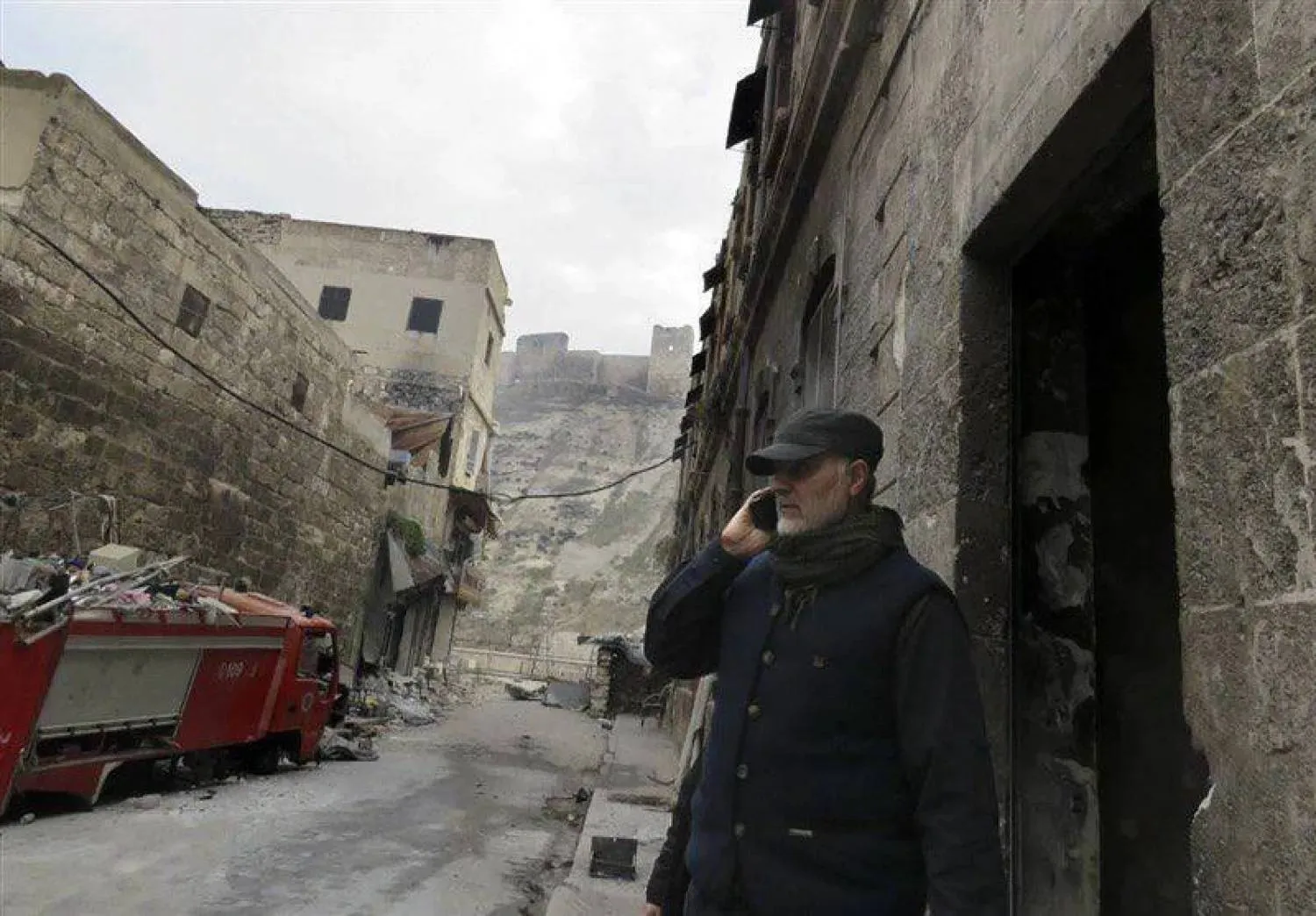
Iran's General Qassem Soleimani makes a phone call near the historic Citadel of Aleppo, winter 2016. (Fars)
TT

Four Iranian Narratives on the Collapse of the ‘Resistance’ in Syria  

Iran's General Qassem Soleimani makes a phone call near the historic Citadel of Aleppo, winter 2016. (Fars)

One hundred and ninety-two days separated the last meeting between Iran’s Supreme Leader Ali Khamenei and Syria’s ousted President Bashar al-Assad in Tehran from the moment the Syrian regime fell to the opposition in December 2024.

That interval was no footnote in the Syrian war. It became a sharp mirror inside Tehran, reflecting the magnitude of the wager Iran’s leadership had placed on Assad, and the limits of its ability to anticipate the trajectory of the conflict and shifts in the regional balance of power.

At that meeting, Khamenei laid out the essence of his “Syrian doctrine” amid changing realities across the “Axis of Resistance.” Syria, he argued, was no ordinary state but one with a “special place” because its identity, in his view, stemmed from its role in this axis.

Since “resistance is Syria’s defining identity and must be preserved,” he addressed Assad not as a political ally but as a partner in that identity. He praised Assad for once saying that “the cost of resistance is lower than the cost of compromise” and that “whenever we retreat, the other side advances.” Thus, Khamenei reaffirmed his full - if belated – gamble on the regime’s survival, even as signs of collapse were unmistakable on the ground.

Less than seven months later, the regime would fall. Assad’s collapse would yield several Iranian narratives: the Supreme Leader’s, the Revolutionary Guard’s, the diplomatic narrative, and a fourth voiced from within the system itself, one that raised blunt questions about the price of Iran’s Syrian gamble.

Khamenei’s narrative

In his first speech after Assad’s fall, Khamenei offered a hard-edged explanation: the event, he said, was the product of a “joint American-Zionist plot,” aided by neighboring states. He spoke of factors that he claimed prevented Iran from providing the necessary support, including Israeli and US strikes inside Syria and the closure of air and land corridors to Iranian supplies.

He concluded that the decisive flaw lay within Syria itself, where the “spirit of resistance” had eroded in state institutions.

He stressed that the regime’s fall did not mean the fall of the idea of “resistance,” predicting that “patriotic Syrian youth” would one day revive it in a new form.

This narrative rejects the notion of strategic defeat: for Khamenei, what happened is not the end of the struggle, but a harsh phase in a longer one.

Revolutionary Guard’s narrative

The Islamic Revolutionary Guard Corps (IRGC) adopted a language closer to national security logic than pure ideology, though it drew from the same lexicon. In 2013, cleric Mehdi Taeb, head of the IRGC’s Ammar Headquarters think tank, framed the equation starkly: “Syria is our 35th province... If the enemy attacks Syria or Khuzestan, our priority is to keep Syria.”

With that shocking sentence, Syria was elevated to the level of Iranian strategic geography, sometimes above parts of Iran itself.

Late General Qassem Soleimani, then commander of the Quds Force, became the chief architect of this approach: confronting threats abroad by building multinational militia networks and using the “protection of shrines” as a mobilizing slogan that fused ideology with national security calculations.

A month after Assad’s fall, at a memorial for Soleimani, Khamenei reaffirmed this school of thought, linking the defense of shrines in Damascus and Iraq to the defense of “Iran as a sanctuary,” aiming to bind various fronts into a single cross-border security-sectarian struggle.

After the Syrian regime’s collapse, this narrative preserved its core: success or failure is not defined by who sits in Damascus, but by whether the IRGC’s influence networks remain intact and whether Iran still has access to Syrian depth.

Full withdrawal would amount, in this logic, to admitting that the “35th province” had slipped from the map, so the IRGC will continue to search for any possible foothold.

Diplomatic narrative

Iran’s diplomatic apparatus sought to tell a softer story. Weeks before the fall, Khamenei dispatched his adviser Ali Larijani to Damascus and Beirut with reassuring messages for Assad and other allies, publicly asserting that events in Syria and Lebanon “directly concern Iran’s national security.”

Days later, Foreign Minister Abbas Araghchi visited Damascus just six days before the collapse, even posing with shawarma in a downtown restaurant to signal “normalcy” and dismiss talk of impending downfall as “psychological warfare.”

It was the peak of the gap between diplomatic messaging and a disintegrating reality.

Afterward, the Foreign Ministry adopted a defensive formula: Iran had “responded to the request of an allied government”, but “cannot decide on behalf of peoples.” Thus, responsibility was shifted toward Syrian internal failures and the external “conspiracy” often invoked by Khamenei.

This narrative treats Syria as one file among many, not an existential arena as seen by the IRGC and the Leader.

‘Open account’ narrative

The fourth narrative emerged, unexpectedly, from within the establishment itself. For the first time, semi-public acknowledgments surfaced that the economic return on Iran’s Syrian adventure was nearly nil and that the political-security “investment” had resulted in something resembling a net loss.

In 2020, former member of the Iranian parliamentary national security and foreign policy committee, Heshmatollah Falahatpisheh revealed that Tehran had spent “$20-30 billion” in Syria, insisting: “This is the people’s money and must be recovered.”

Five years later, he returned with a more bitter charge: Syria’s debts to Iran were effectively settled through “land without oil, cow farms without cows, and empty promises.”

This view is no outlier. Over a decade, Iranian protest slogans increasingly linked “Gaza, Lebanon, Syria” with bread, fuel, and economic hardship at home.

With Assad gone, critics more easily argue that Iran spent tens of billions and paid a human cost among its fighters and proxies, only to end up with almost no influence in Damascus.

For decision-makers, this narrative becomes domestic pressure against any large-scale return to Syria.

Four scenarios for Tehran

Taken together, these narratives reveal a deep contradiction: the IRGC and Khamenei refuse to concede that Iran “lost Syria,” treating the episode as one phase in a longer struggle. Meanwhile, the diplomatic and economic narratives acknowledge, implicitly, that the previous intervention model is no longer sustainable.

Four broad scenarios emerge. The first is a return through proxies, closest to the IRGC’s logic: Iran would rebuild influence from the ground up through militias - old or newly recruited - to pressure any future authority in Damascus.

The second is regional repositioning without Syria, in which Iran shifts resources to arenas where it still holds leverage, including Lebanon, Iraq, Yemen and Gaza, while limiting its role in Syria to preventing hostile entrenchment.

The third is a “gray” re-entry: a gradual, negotiated, non-confrontational return through localized deals or modest economic and security projects, allowing Tehran to claim continued presence without the cost of backing a single ruler.

The fourth is institutionalizing the loss: Iran accepts Syria’s departure from its strategic depth, but repackages the outcome within a narrative of “conspiracy and steadfastness,” using it to tighten internal control while maintaining symbolic presence through shrine rhetoric and minimal diplomacy.

Across all scenarios, one fact remains. Syria, which was once described as more vital than Khuzestan and the “distinct identity of resistance”, is no longer what it was before December 8, 2024 when the regime collapsed.

Tehran can invoke time, the IRGC can search for openings, diplomats can polish their statements, and critics can lament “land without oil.” But one question looms over every debate in Iran: Can Tehran afford a second Syrian-sized gamble after emerging from the first still trying to convince itself that the “resistance factor” remains standing, even as its Syrian pillar has broken?



Why Greenland Is Strategically Important to Arctic Security

Houses covered by snow are seen on the coast of a sea inlet of Nuuk, Greenland, on March 7, 2025. (AP Photo/Evgeniy Maloletka, File)
TT

Why Greenland Is Strategically Important to Arctic Security

Houses covered by snow are seen on the coast of a sea inlet of Nuuk, Greenland, on March 7, 2025. (AP Photo/Evgeniy Maloletka, File)

Location, location, location: Greenland’s position above the Arctic Circle makes the world’s largest island a key part of security strategy.

Increasing international tensions, global warming and the changing world economy have put Greenland at the heart of the debate over global trade and security, and US President Donald Trump wants to make sure his country controls the mineral-rich island that guards the Arctic and North Atlantic approaches to North America.

Greenland is a self-governing territory of Denmark, a longtime US ally that has rejected Trump’s overtures. Greenland’s own government also opposes US designs on the island, saying the people of Greenland will decide their own future.

The island, 80% of which lies above the Arctic Circle, is home to about 56,000 mostly Inuit people who until now have been largely ignored by the rest of the world.

Here’s why Greenland is strategically important to Arctic security:

Greenland’s location is key

Greenland sits off the northeastern coast of Canada, with more than two-thirds of its territory lying within the Arctic Circle. That has made it crucial to the defense of North America since World War II, when the US occupied Greenland to ensure it didn’t fall into the hands of Nazi Germany and to protect crucial North Atlantic shipping lanes.

Following the Cold War, the Arctic was largely an area of international cooperation. But climate change is thinning the Arctic ice, promising to create a northwest passage for international trade and reigniting competition with Russia, China and other countries over access to the region’s mineral resources.

Security threats

In 2018, China declared itself a “near-Arctic state” in an effort to gain more influence in the region. China has also announced plans to build a “Polar Silk Road” as part of its global Belt and Road Initiative, which has created economic links with countries around the world.

Then US Secretary of State Mike Pompeo rejected China’s move, saying: “Do we want the Arctic Ocean to transform into a new South China Sea, fraught with militarization and competing territorial claims?”

Meanwhile, Russia has sought to assert its influence over wide areas of the Arctic in competition with the US, Canada, Denmark and Norway. Moscow has also sought to boost its military presence in the polar region, home to its Northern Fleet and a site where the Soviet Union tested nuclear weapons. Russian military officials have said that the site is ready for resuming the tests, if necessary.

Russia's military has been restoring old Soviet infrastructure in the Arctic and building new facilities. Since 2014, the Russian military has opened several military bases in the Arctic and worked on reconstructing airfields.

European leaders’ concerns have been heightened since Russia launched a war in Ukraine on Feb. 24, 2022.

Last year, Russian President Vladimir Putin noted that Moscow is worried about NATO’s activities in the Arctic and will respond by strengthening the capability of its armed forces there. But he said that Moscow was holding the door open to broader international cooperation in the region.

US military presence

The US Department of Defense operates the remote Pituffik Space Base in northwestern Greenland, which was built after the US and Denmark signed the Defense of Greenland Treaty in 1951. It supports missile warning, missile defense and space surveillance operations for the US and NATO.

Greenland also guards part of what is known as the GIUK (Greenland, Iceland, United Kingdom) Gap, where NATO monitors Russian naval movements in the North Atlantic.

Thomas Crosbie, an associate professor of military operations at the Royal Danish Defense College, said that an American takeover wouldn't improve upon Washington’s current security strategy.

“The United States will gain no advantage if its flag is flying in Nuuk (Greenland's capital) versus the Greenlandic flag,” he told The Associated Press. “There’s no benefits to them because they already enjoy all of the advantages they want.

"If there’s any specific security access that they want to improve American security, they’ll be given it as a matter of course, as a trusted ally. So this has nothing to do with improving national security for the United States.”

Denmark’s parliament approved a bill last June to allow US military bases on Danish soil. It widened a previous military agreement, made in 2023 with the Biden administration, where US troops had broad access to Danish air bases in the Scandinavian country.

Danish Foreign Minister Lars Løkke Rasmussen, in a response to lawmakers’ questions, wrote over the summer that Denmark would be able to terminate the agreement if the US tries to annex all or part of Greenland.

Danish armed forces in Greenland

Denmark is moving to strengthen its military presence around Greenland and in the wider North Atlantic. Last year, the government announced a roughly 14.6 billion-kroner ($2.3 billion) agreement with parties including the governments of Greenland and the Faroe Islands, another self-governing territory of Denmark, to “improve capabilities for surveillance and maintaining sovereignty in the region.”

The plan includes three new Arctic naval vessels, two additional long-range surveillance drones and satellite capacity.

Denmark’s Joint Arctic Command is headquartered in Nuuk, and tasked with the “surveillance, assertion of sovereignty and military defense of Greenland and the Faroe Islands,” according to its website. It has smaller satellite stations across the island.

The Sirius Dog Sled Patrol, an elite Danish naval unit that conducts long-range reconnaissance and enforces Danish sovereignty in the Arctic wilderness, is also stationed in Greenland.

Mineral wealth

Greenland is also a rich source of the so-called rare earth minerals that are a key component of cellphones, computers, batteries and other high-tech gadgets that are expected to power the world’s economy in the coming decades.

That has attracted the interest of the US and other Western powers as they try to ease China’s dominance of the market for these critical minerals.

Development of Greenland’s mineral resources is challenging because of the island’s harsh climate, while strict environmental controls have proved an additional hurdle for potential investors.


Protest-Hit Iran Warily Watches the US After its Raid on Venezuela

Iranians protest a 22-year-old woman Mahsa Amini's death after she was detained by the morality police, in Tehran, Sept. 20, 2022, in this photo taken by an individual not employed by the Associated Press and obtained by the AP outside Iran. (AP Photo/ File)
TT

Protest-Hit Iran Warily Watches the US After its Raid on Venezuela

Iranians protest a 22-year-old woman Mahsa Amini's death after she was detained by the morality police, in Tehran, Sept. 20, 2022, in this photo taken by an individual not employed by the Associated Press and obtained by the AP outside Iran. (AP Photo/ File)

Iran faces a new round of protests challenging the country's theocracy, but it seems like the only thing people there want to talk about is half a world away: Venezuela.

Since the US military seized Venezuelan President Nicolas Maduro, a longtime ally of Tehran, over the weekend, Iranian state media headlines and officials have condemned the operation. In the streets and even in some official conversations, however, there's a growing question over whether a similar mission could target the country's top officials including the supreme leader, 86-year-old Ali Khamenei.

The paranoia feeds into wider worries among Iranians. Many fear that close US ally Israel will target Iran again as it did during the 12-day war it launched against Tehran in June. Israel killed a slew of top military officials and nuclear scientists, and the US bombed Iranian nuclear enrichment sites. Khamenei is believed to have gone into hiding for his protection.

“God bless our leader, we should be careful too," said Saeed Seyyedi, a 57-year-old teacher in Tehran, worried the US could act as it did in Venezuela.

"The US has always been after plots against Iran, especially when issues like oil, Israel are part of the case. In addition, it can be complicated when it is mixed with the Russia-Ukraine war, the Lebanese (group) Hezbollah and drug accusations.”

The US long has accused the Iranian-backed Hezbollah of running drug-smuggling operations to fund its operations, including in Latin America, which the group denies.

‘Please pray’

Immediately after Maduro’s seizure, an analyst on Iranian state television claimed, without offering evidence, that the US and Israel had plans during the war last year to kidnap Iranian officials with a team of dual-national Iranians. Even for conspiracy-minded Iranian television, airing such a claim is unusual.

Then on Sunday night, the prominent cleric Mohammad Ali Javedan warned an audience at prayers in Tehran University that Khamenei's life was in danger.

“Someone said he had a bad dream that the leader’s life is in danger," Javedan said, without elaborating. "Please pray.”

However, Iran is roughly twice the size of Venezuela and has what analysts consider to be a much stronger military and robust security forces. The memory of Operation Eagle Claw, a failed US special forces mission to rescue hostages held after the 1979 US Embassy takeover in Tehran, also haunts Washington.

Then there's the political situation in Iran, with its theocracy protected by hard-liners within the paramilitary Revolutionary Guard, who answer only to Khamenei.

They could launch assassinations, cyberattacks and assaults on shipping in the Middle East, warned Farzin Nadimi, senior fellow at the Washington Institute for Near East Policy who studies Iran’s military.

And crucially, Iran also still has fissile nuclear material.

“In the grand-strategy scheme of things, they need to think about the day after,” Nadimi said of anyone considering a Venezuela-style raid. “Iran is a much more complex political situation. They have to calculate the costs and benefits.”

Not just the Iranians

Others wonder what part of the world the US might take interest in next, while critics have warned about setting a dangerous precedent.

“The regime in Iran should pay close attention to what is happening in Venezuela,” Israeli opposition leader Yair Lapid posted on social media on Saturday.

Israeli Prime Minister Benjamin Netanyahu did not directly link Maduro's detention to Iran but acknowledged the protests sweeping Tehran and other cities, saying: “It is very possible that we are standing at the moment when the Iranian people are taking their fate into their own hands.”

Hours before the US action in Venezuela, US President Donald Trump warned Iran that if Tehran “violently kills peaceful protesters” the US “will come to their rescue.”

On Monday, Iranian Foreign Ministry spokesman Esmail Baghaei denounced the comments by Trump and Netanyahu as an “incitement to violence, terrorism and killing.”

US Rep. Marjorie Taylor Greene, a Republican who had been close to Trump but resigned Monday after a falling-out with the president, directly linked the Venezuela operation to Iran.

“The next obvious observation is that by removing Maduro this is a clear move for control over Venezuelan oil supplies that will ensure stability for the next obvious regime change war in Iran," Greene wrote on social media.

‘Make Iran Great Again’

US Sen. Lindsey Graham, a Republican, put on a “Make Iran Great Again” hat during a Sunday segment on Fox News. He later posted an image showing him and Trump smiling after the president autographed a similar-looking hat.

“I pray and hope that 2026 will be the year that we make Iran great again," Graham said.


Iran at a Critical Crossroads Testing the Survival of its Regime

Burning debris lies in the middle of a street during protests in Hamedan, western Iran, Jan. 1, 2026. (AFP/Getty Images)
TT

Iran at a Critical Crossroads Testing the Survival of its Regime

Burning debris lies in the middle of a street during protests in Hamedan, western Iran, Jan. 1, 2026. (AFP/Getty Images)

Iran is confronting one of the most consequential junctures since the founding of the republic in 1979. The pressures bearing down on the system are no longer confined to economic sanctions or familiar forms of external coercion, but now cut to the heart of the governing formula itself: how to ensure the regime’s survival without accelerating the very forces that threaten to undermine it.

At the center of this moment lies a stark existential dilemma. A permissive response to internal unrest risks allowing protests to spread and harden into a protracted campaign of political attrition, while a sweeping security crackdown would heighten external dangers, at a time of mounting international hostility and unprecedented US warnings.

Caught between these two paths, Tehran finds its room for maneuver shrinking to levels it has rarely faced before.

Passing protests or structural shift?

The evolution of the current protests raises a central question about their nature: are they a containable social wave, or a deeper expression of a shift in public mood? The spread of demonstrations to small and medium-sized cities, and the widening of their social base, reflect an advanced level of discontent, even if it has not yet reached the threshold of a comprehensive explosion.

Farzin Nadimi, a senior Iran analyst at the Washington Institute for Near East Policy, argues that this wave differs from previous ones.

He told Asharq Al-Awsat that the latest protests, unlike earlier waves led by university students or low-income workers in major cities, are now driven by young people in smaller towns and supported by university students nationwide.

He described them as “more entrenched and widespread,” though not yet as large as some previous protests, noting the absence of government employees and oil workers, alongside a strong female presence once again.

This assessment aligns with the reading of Michael Rubin, a scholar at the American Enterprise Institute, who pointed to three key differences defining this wave: the nature of the participating forces, the symbolism of its launch from Tehran’s bazaar, and the impact of Israeli strikes that have punctured the aura surrounding Iran.

By contrast, Michael O’Hanlon, a senior fellow at the Brookings Institution, cautions against overestimating the street’s ability to bring about rapid change, noting that the Iranian system is highly organized and does not hesitate to use violence to control society.

‘Political fuel’

Iran’s economic crisis is no longer a technical issue that can be separated from politics. The collapse of the currency, the erosion of purchasing power, and declining trust in institutions have turned the economy into a direct driver of protest.

With each new round of pressure or sanctions, the sense deepens that the system is incapable of delivering real solutions without making political concessions.

Alex Vatanka, a Senior Fellow at the Middle East Institute in Washington, argues that what is unfolding goes beyond anger over prices or living conditions.

He told Asharq Al-Awsat that the protests reflect a deeper shift in public opinion, in which opposition is no longer directed at specific policies but at the model of governance itself. This shift, he said, confronts the system with a difficult question: can the economy be saved without rethinking the structure of power?

The security establishment: cohesion or fatigue?

Security institutions, from the Revolutionary Guards and their Basij mobilization arm to the intelligence services, form the backbone of the system’s ability to endure. Historically, these institutions have been the primary guarantor of internal stability, but mounting pressures now raise questions about their moral and ideological cohesion.

Rubin said that cracks are widening, pointing to rumors that Tehran has turned to deploying forces from Iraq’s Popular Mobilization Forces and Afghanistan’s Fatemiyoun Brigade due to declining confidence in some Revolutionary Guard units’ willingness to carry out orders.

Vatanka, for his part, acknowledged that these institutions remain cohesive for now, but warned that this cohesion is under growing strain from economic and social exhaustion, which over time could erode morale and produce partial fractures, even if open defections remain unlikely in the foreseeable future.

From deterrence to breaking taboos

If internal challenges are pressing on the structure of power, the external environment multiplies the risks. US-Israeli escalation, coupled with the waning weight of regional allies, places Iran before a radically different strategic landscape.

Threats by US President Donald Trump to support Iranian protesters signal a qualitative shift in US rhetoric, in which the focus is no longer confined to the nuclear program, but now includes Iran’s internal dynamics as part of the pressure equation.

Nadimi said that the developments in Venezuela and the arrest of Nicolas Maduro as carrying troubling implications for Tehran, while stressing the differences between the two cases, arguing that Iran is larger and more complex, and that Washington does not believe its system can be easily overthrown without a clear internal alternative.

Vatanka, however, sees a significant psychological impact from that precedent, saying it has weakened the assumption that leaders are immune from personal targeting.

The regional network: asset or burden?

Israeli strikes in June that targeted military leaders and sovereign symbols inside Iran reflect a shift in Israel’s security doctrine, from containment to direct confrontation.

O’Hanlon said that this pattern, following events in Venezuela and attacks on figures linked to Iran’s nuclear program, has become more likely under Trump, reflecting a willingness to break taboos that once held.

At the same time, questions are resurfacing over the effectiveness of Iran’s regional network. According to Vatanka, these arms are no longer a real deterrent, but have become, given their rising costs, a strategic burden.

Rubin agreed, adding that they have drained the state treasury, although he does not rule out the system turning to them if the crisis intensifies on the domestic front.

Amid this complex entanglement between internal and external pressures, the Iranian system’s options are narrowing as never before.

Between those who see this weakness as an opportunity to rebalance the region and those who fear widespread chaos, the core question remains: Is Tehran facing a manageable crisis of governance or an existential crisis that could shape Iran and the region for decades to come?