


Powerful 7.6-Magnitude Earthquake Strikes Japan’s Northeast

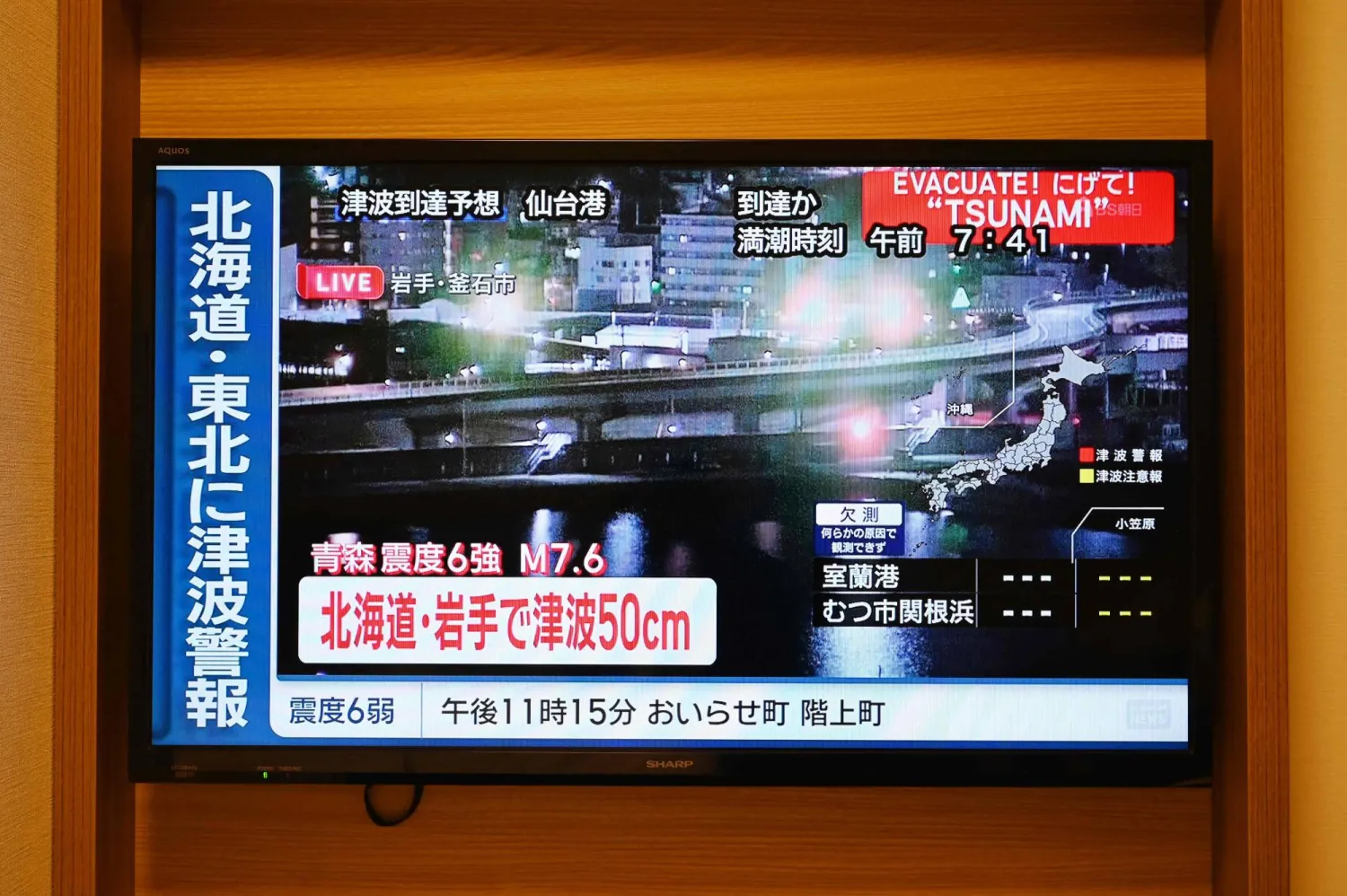
A tsunami warning flashes over live footage of a waterfront area, on a television screen in Sapporo, in Japan's northern Hokkaido prefecture on December 9, 2025. (AFP)
TT

Powerful 7.6-Magnitude Earthquake Strikes Japan’s Northeast

A tsunami warning flashes over live footage of a waterfront area, on a television screen in Sapporo, in Japan's northern Hokkaido prefecture on December 9, 2025. (AFP)

A powerful 7.6-magnitude earthquake shook northeastern Japan late on Monday, prompting tsunami warnings and orders for about 90,000 residents to evacuate. 

The Japan Meteorological Agency said a tsunami as high as 3 meters (10 feet) could hit Japan's northeastern coast after the earthquake struck off the coast at 11:15 p.m. (1415 GMT). 

Tsunami warnings were issued for the prefectures of Hokkaido, Aomori and Iwate, and tsunamis from 20 to 70 cm (7 to 27 inches) high were observed at several ports, JMA said. 

The epicenter of the quake was 80 km (50 miles) off the coast of Aomori prefecture, at a depth of 50 km, the agency added. 

On Japan's 1-7 scale of seismic intensity, the tremor registered as an "upper 6" in Aomori prefecture -- a quake strong enough to make it impossible to keep standing or move without crawling. In such tremors, most heavy furniture can collapse and wall tiles and windowpanes are damaged in many buildings. 

East Japan Railway suspended some services in the area, which was also hit by the massive 9.0-magnitude quake in March 2011. As of 1600 GMT, there was little information of major damage from public broadcaster NHK. 

"There is a possibility that further powerful and stronger earthquakes could occur over the next several days," a JMA official said at a briefing. 

No irregularities were reported at nuclear power plants in the region run by Tohoku Electric Power and Hokkaido Electric Power, the utilities said. Tohoku Electric initially said thousands of households had lost power but later lowered that number to the hundreds. 

The yen weakened against major currencies after news of the tremor, before regaining some ground. The dollar touched a session high and was trading at around 155.81 yen around 1533 GMT, while the euro also hit a session high. 

Japan is one of the world's most earthquake-prone countries, with a tremor occurring at least every five minutes. Located in the "Ring of Fire" of volcanoes and oceanic trenches partly encircling the Pacific Basin, Japan accounts for about 20% of the world's earthquakes of magnitude 6.0 or greater.  

The northeastern region suffered one of the country's deadliest earthquakes on March 11, 2011, when a 9.0-magnitude tremor struck under the ocean off the coast of the northern city of Sendai.  

It was the most powerful ever recorded in Japan and set off a series of massive tsunami that devastated a wide swathe of the Pacific coastline and killed nearly 20,000 people. 

The 2011 tsunami also damaged the Fukushima Daiichi nuclear plant, leading to a series of explosions and meltdowns in the world's worst nuclear disaster for 25 years. 


US Braces for Potential Iranian Retaliatory Operations within its Borders

US President Donald Trump speaks with the media as Defense Secretary Pete Hegseth (R) and special envoy Steve Witkoff (C) look on aboard Air Force One during a flight from Dover, Delaware, to Miami, Florida, on March 7, 2026. (AFP)
TT

US Braces for Potential Iranian Retaliatory Operations within its Borders

US President Donald Trump speaks with the media as Defense Secretary Pete Hegseth (R) and special envoy Steve Witkoff (C) look on aboard Air Force One during a flight from Dover, Delaware, to Miami, Florida, on March 7, 2026. (AFP)

Fears have grown in the US that Tehran could activate “sleeper cells” or carry out unconventional retaliatory attacks on American soil as Washington and Tel Aviv continue their war against Iran.

President Donald Trump warned on Wednesday that his administration knows where the Iranian sleeper cells are and is monitoring all of their members. The statement appeared aimed both at reassuring the public and sending a warning to Iran.

Still, the tone contrasts with more cautious assessments from US security agencies, which say the threat remains potential rather than imminent or specific.

Security agencies on alert

Trump’s remarks followed earlier comments in which he said the situation was “under control” and that authorities were “watching everyone” of the suspected sleeper cells.

While the president sought to link the issue to immigration, security agencies have adopted a more measured approach. A US intelligence assessment issued after the killing of Iran’s Supreme Leader Ali Khamenei warned that Iran and its proxies could resort to selective attacks inside the United States, though large-scale assaults are considered less likely.

Officials see a higher probability of cyberattacks or smaller operations carried out by limited networks or sympathetic individuals.

The Department of Homeland Security has similarly assessed that Iran and its proxies could pose a threat through targeted attacks inside the United States.

Against that backdrop, Kash Patel, director of the Federal Bureau of Investigation, announced on Feb. 28 that the bureau had placed its counterterrorism and intelligence teams on “maximum alert.”

The move included mobilizing additional security resources and emphasizing that the FBI’s Joint Terrorism Task Forces nationwide are working around the clock to detect and disrupt potential threats. Such measures typically involve heightened surveillance of high-priority suspects, expanded use of confidential sources, reviews of technical intelligence tools and closer coordination between federal and local authorities.

Drone concerns in California

One development that drew attention in recent days was the disclosure of a confidential FBI bulletin circulated through the Los Angeles Joint Regional Intelligence Center before the outbreak of the war.

The notice warned that Iran might attempt to retaliate for US attacks by launching drones from ships at sea targeting California.

According to a security bulletin reviewed by Reuters, the FBI distributed the warning last month to law enforcement agencies, citing information collected in late February suggesting Iran could plan a surprise drone attack launched from a vessel offshore if Washington carried out strikes against it.

The bulletin, however, contained no specific information on timing or targets and described the scenario more as a potential ambition than a confirmed operational plan. It also said no further details were available regarding how such an attack might be carried out or who might be involved.

Details of the bulletin emerged publicly as the war, which began with US and Israeli strikes on Iran on Feb. 28, entered its twelfth day.

Vigilance but no imminent threat

California authorities sought to balance caution with reassurance. Governor Gavin Newsom said the state was aware of the warning and was coordinating closely with federal and local agencies while preparing for worst-case scenarios. He stressed that no credible or imminent threats had been identified.

Los Angeles Mayor Karen Bass and San Francisco Mayor Daniel Lurie delivered similar messages, saying no specific threat had been detected but that coordination with federal authorities was ongoing.

Local police departments across the state said they had been informed of a higher risk environment and urged residents to report suspicious activity.

Past incidents

Previous cases have heightened US concerns. In July 2021, the Justice Department revealed a plot linked to an Iranian intelligence network to kidnap journalist and activist Masih Alinejad from New York and forcibly take her to Iran.

In March 2025, a federal court convicted two leaders of an Eastern European organized crime network in a murder-for-hire scheme targeting Alinejad on behalf of actors linked to Iran’s Revolutionary Guard Corps.

They were sentenced in October that year to 25 years in prison each. Another defendant involved in surveilling Alinejad and planning her killing in New York was sentenced in January 2026 to 15 years in prison.


Turkish-Owned Ship Allowed to Pass Through Strait of Hormuz, Minister Says

A man walks along the shore as oil tankers and cargo ships line up in the Strait of Hormuz, seen from Khor Fakkan, United Arab Emirates, Wednesday, March 11, 2026. (AP)
TT

Turkish-Owned Ship Allowed to Pass Through Strait of Hormuz, Minister Says

A man walks along the shore as oil tankers and cargo ships line up in the Strait of Hormuz, seen from Khor Fakkan, United Arab Emirates, Wednesday, March 11, 2026. (AP)

A Turkish-owned ship that had been waiting near Iran was allowed to pass through the Strait of Hormuz after authorities received permission from Tehran, Turkish Transport Minister Abdulkadir ‌Uraloglu was reported ‌as saying by ‌local ⁠media.

Ankara was continuing ⁠contacts with Iranian officials regarding the situation of the remaining 14 Turkish-owned vessels there, Uraloglu told reporters ⁠late on Thursday, ‌news website ‌Haberturk said.

"Fifteen ships (with Turkish ‌owners) were there; we ‌obtained permission from the Iranian authorities for one of them, which had used ‌an Iranian port, and it passed," Uraloglu ⁠was ⁠quoted as saying.

The US-Israeli war on Iran has effectively shut the Strait of Hormuz, leaving tankers and other ships stranded, which has stoked concerns about global energy supply.


US Wants to 'Divide Europe', EU's Kallas Tells FT

European Union foreign policy chief Kaja Kallas arrives for a meeting of EU foreign ministers and representatives of the Gulf Cooperation Council at the European Council building in Brussels, Belgium, Thursday, March 5, 2026. (AP Photo/Virginia Mayo)
TT

US Wants to 'Divide Europe', EU's Kallas Tells FT

European Union foreign policy chief Kaja Kallas arrives for a meeting of EU foreign ministers and representatives of the Gulf Cooperation Council at the European Council building in Brussels, Belgium, Thursday, March 5, 2026. (AP Photo/Virginia Mayo)

European Union foreign policy chief Kaja Kallas said the US wants to "divide Europe" and doesn't "like the European Union" in an interview published by the Financial Times on Friday, after more than a year of turmoil in transatlantic relations.

"What I think is actually important for everybody to understand is that the US has been very clear that they ‌want to divide ‌Europe. They don't like the ‌European ⁠Union," Kallas told the ⁠FT.

US President Donald Trump has repeatedly targeted the European Union in his second term, imposing tariffs on member countries and others and talking about annexing Greenland - a move that could effectively end the NATO alliance.

This week, Trump's administration ⁠launched trade investigations into the EU and ‌other countries, including ‌China, India, Japan, South Korea and Mexico, over what ‌it said were unfair trade practices. Under the ‌investigation, the countries could face new tariffs by this summer, after the US Supreme Court tore down much of Trump's tariff program last month.

Kallas said ‌the United States' approach to the EU echoed tactics used by the bloc's ⁠adversaries, ⁠according to the FT.

EU countries should not be looking to deal with Trump bilaterally, she said, and instead should deal with him together, "because we are equal powers when we are together," the FT reported.

On defense, however, Kallas said the bloc needed "to buy from America because we don't have the assets or the possibilities or the capabilities that we need," adding that Europe needed to invest in its own defense industry.
