


16,000 Fossil Footprints in Central Bolivia Reveal Dinosaur Behavior 

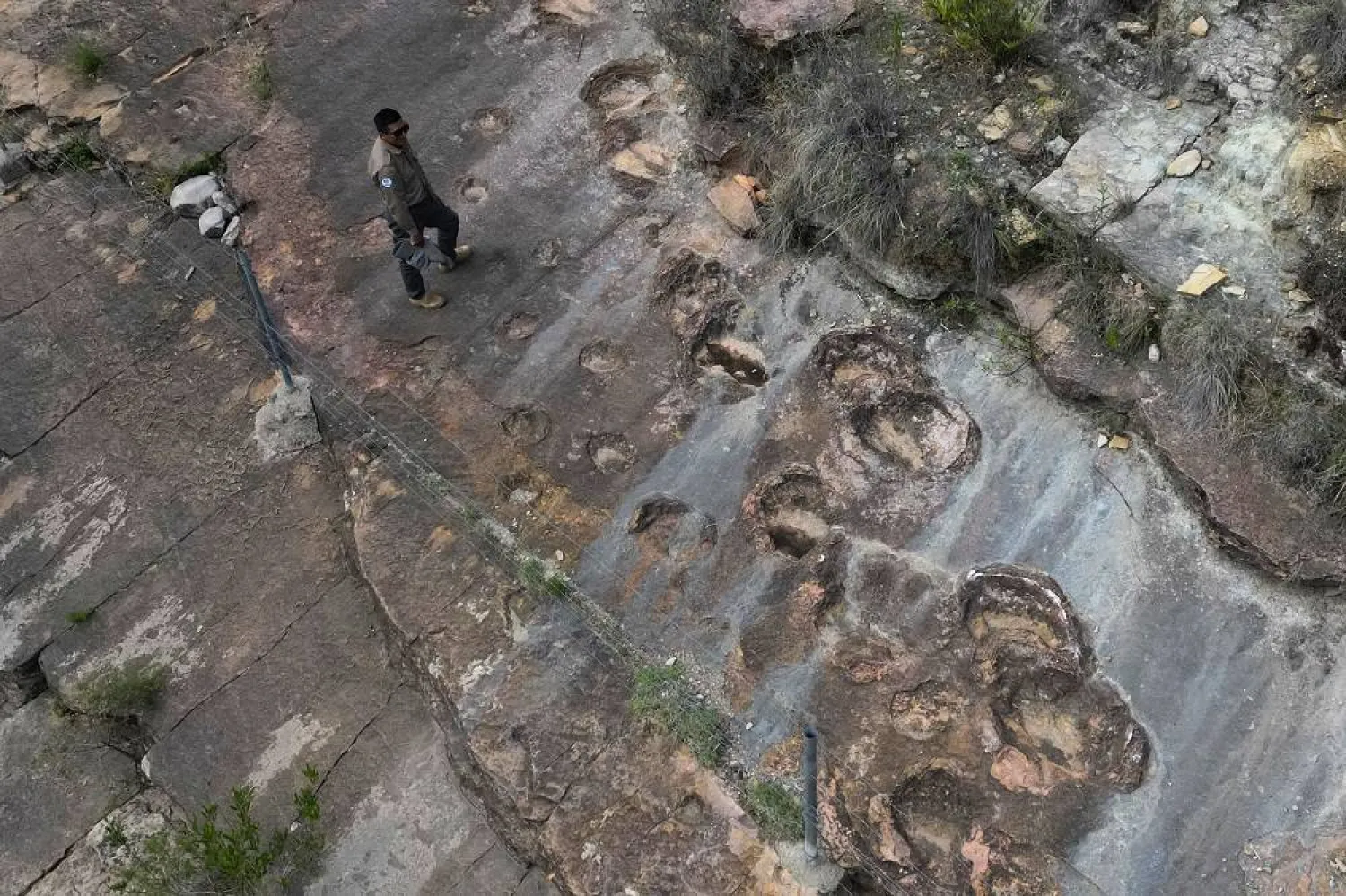
Park ranger José Vallejos stands next to petrified dinosaurs footprints in Carreras Pampa in Toro Toro National Park, north of Potosi, Bolivia, Saturday, Dec. 6, 2025. (AP) 
TT

16,000 Fossil Footprints in Central Bolivia Reveal Dinosaur Behavior 

Park ranger José Vallejos stands next to petrified dinosaurs footprints in Carreras Pampa in Toro Toro National Park, north of Potosi, Bolivia, Saturday, Dec. 6, 2025. (AP) 

Legend once had it that the huge, three-toed footprints scattered across the central highlands of Bolivia came from supernaturally strong monsters — capable of sinking their claws even into solid stone.

Then scientists came here in the 1960s and dispelled children's fears, determining that the strange footprints in fact belonged to gigantic, two-legged dinosaurs that stomped and splashed over 60 million years ago, in the ancient waterways of what is now Toro Toro, a village and popular national park in the Bolivian Andes.

Now, a team of paleontologists, mostly from California’s Loma Linda University, have discovered and meticulously documented 16,600 such footprints left by theropods, the dinosaur group that includes the Tyrannosaurus rex. Their study, based on six years of regular field visits and published last Wednesday in the peer-reviewed journal PLOS One, reports that this finding represents the highest number of theropod footprints recorded anywhere in the world.

“There’s no place in the world where you have such a big abundance of (theropod) footprints,” said Roberto Biaggi, a co-author of the study led by Spanish paleontologist Raúl Esperante. “We have all these world records at this particular site.”

The dinosaurs that ruled the earth and roamed this region also made awkward attempts to swim here, according to the study, scratching at what was squishy lake-bottom sediment to leave another 1,378 traces.

They pressed their claws into the mud just before water levels rose and sealed their tracks, protecting them from centuries of erosion, scientists said.

“The preservation of many of the tracks is excellent,” said Richard Butler, a paleontologist at the University of Birmingham who was not involved in the research. He said that, to his knowledge, the number of footprints and trackways found in Toro Toro had no precedent.

“This is a remarkable window into the lives and behaviors of dinosaurs at the end of the Cretaceous,” Butler added, referring to the period around 66 million years ago at the end of which an asteroid impact abruptly extinguished all dinosaurs and 75% of living species along with them, according to scientists.

Footprints face preservation threats

Although they've survived for millions of years, human life has threatened these traces. For decades, farmers threshed corn and wheat on the footprint-covered plateaus. Nearby quarry workers didn’t think much of the formations as they blasted rock layers for limestone. And just two years ago, researchers said, highway crews tunneling through hillsides nearly wiped out a major site of dinosaur tracks before the national park intervened.

Such disturbances may have something to do with the area's striking absence of dinosaur bones, teeth and eggs, experts say. For all of the footprints and swim traces found across Bolivia’s Toro Toro, there are virtually no skeletal remains of the sort that litter the peaks and valleys of Argentine Patagonia and Campanha in Brazil.

But the lack of bones could have natural causes, too. The team said the quantity and pattern of tracks — and the fact they were all found in the same sediment layer — suggest that dinosaurs didn’t settle in what is now Bolivia as much as trudge along an ancient coastal superhighway stretching from southern Peru into northwest Argentina.

The range in footprint sizes indicated that giant creatures roughly 10 meters (33 feet) tall moved in a herd with tiny theropods the size of a chicken, 32 centimeters (1 foot) tall at the hip.

In presenting a snapshot of everyday behavior footprints “reveal what skeletons cannot,” said Anthony Romilio, a paleontologist at the University of Queensland in Australia who also did not participate in the study. Just from footprints, researchers can tell when dinosaurs strolled or sped up, stopped or turned around.

But the reason they flocked in droves to this wind-swept plateau remains a mystery.

“It may have been that they were all regular visitors to a large, ancient, freshwater lake, frequenting its expansive muddy shoreline,” offered Romilio.

Biaggi suggested that they were “running away from something or searching for somewhere to settle.”

What's certain is that research into this treasure trove of a dinosaur tracksite will continue.

“I suspect that this will keep going over the years and many more footprints will be found right there at the edges of what’s already uncovered,” Biaggi said.



Louvre Thieves Escaped With 30 Seconds to Spare, Probe Reveals

The daring robbery at the Louvre took place in broad daylight © Dimitar DILKOFF / AFP
TT

Louvre Thieves Escaped With 30 Seconds to Spare, Probe Reveals

The daring robbery at the Louvre took place in broad daylight © Dimitar DILKOFF / AFP

The thieves who stole priceless crown jewels from the Louvre in October escaped with just 30 seconds to spare due to avoidable security failures at the Paris museum, a damning investigation revealed on Wednesday.

The probe, ordered by the culture ministry after the embarrassing daylight heist, revealed that only one of two security cameras was working near the site where the thieves broke in on the morning of Sunday October 19, according to AFP.

Agents in the security headquarters also did not have enough screens to follow the images in real-time, while a lack of coordination meant police were initially sent to the wrong place once the alarm was raised, the report unveiled at the French Senate's Culture Commission, stated.

"It highlights an overall failure of the museum, as well as its supervisory authority, to address security issues," the head of the commission, Laurent Lafon, said at the start of a hearing.

One of the most startling revelations was that the robbers left only 30 seconds before police and private security guards arrived on the scene.

"Give or take 30 seconds, the Securitas (private security) guards or the police officers in a car could have prevented the thieves from escaping," the head of the investigation, Noel Corbin, told senators.

He said that measures such as a modern security camera system, more resistant glass in the door cut open with angle grinders, or better internal coordination could have prevented the loss of the crown jewels -- worth an estimated $102 million -- which have still not been found.

Security risks were highlighted in several reports commissioned by management of the Louvre, including a 2019 audit by the jewellery company Van Cleef & Arpels.

The evaluation said the balcony used by the thieves was a weak point in security and could be reached by using an extendable ladder -- exactly what transpired in the heist.

Corbin confirmed that under-fire Louvre boss Laurence des Cars had been unaware of the audit which was carried out by her predecessor, Jean-Luc Martinez.

"The recommendations were not acted on and they would have enabled us to avoid this robbery," Corbin said, adding that there had been a lack of coordination between the two state-appointed administrators.

Police believe they have arrested all four thieves, who escaped on powerful motorbikes, having carried out the heist in the Apollo Gallery in around 10 minutes in total.

The revelations on Wednesday are likely to pile more pressure on des Cars, who was already facing calls to resign.


Prince Mohammed bin Salman Royal Reserve Launches Live Turtle Tracking Program

This data will fill a critical regional knowledge gap and drive unified, cross-border conservation strategies for these globally endangered species - SPA
TT

Prince Mohammed bin Salman Royal Reserve Launches Live Turtle Tracking Program

This data will fill a critical regional knowledge gap and drive unified, cross-border conservation strategies for these globally endangered species - SPA

In a milestone for marine conservation, Prince Mohammed bin Salman Royal Reserve has launched a live satellite tracking program for hawksbill and green turtles, including the first known tagging of a pre-nesting, egg-carrying green turtle in the Red Sea, SPA reported.

This data will fill a critical regional knowledge gap and drive unified, cross-border conservation strategies for these globally endangered species.

The team, led by Senior Marine Ecologist at Prince Mohammed bin Salman Royal Reserve Dr. Ahmed Mohammed and KAUST Beacon Development’s Senior Marine Megafauna Specialist Dr. Hector Barrios-Garrido, successfully in-water captured and tagged three critically endangered (IUCN) hawksbill turtles and seven green turtles. The tags transmit real-time movement data identifying foraging grounds, migratory corridors, and most crucially the nesting site of the egg-carrying green turtle, ensuring the appropriate protection and management is in place. The program continues the reserve’s long-term commitment to marine conservation, expanding its turtle nest monitoring and protection program in operation since 2023.

The reserve protects 4,000km² of Red Sea waters, 1.8% of the Kingdom’s marine area, and a coastline of 170km, the longest coastline under management by a single entity in the Kingdom. Linking NEOM and Red Sea Global, this forms an 800km corridor of protected Red Sea coastline. It is a refuge for five of the world’s seven turtle species and a breeding ground for green and hawksbill turtles. The reserve’s ranger teams monitor turtle activity both on shore and at sea, protecting nesting sites critical to natal homing, the biological instinct that drives turtles to return to the same beaches where they were born.

‘’Critically endangered hawksbill turtles face an extremely high risk of extinction in the wild within our lifetime. With fewer than 200 breeding-age females remaining in the Red Sea, their survival depends on closing vital knowledge gaps to enable their effective conservation,” said CEO of Prince Mohammed bin Salman Royal Reserve Andrew Zaloumis.

He added, “Hawksbill turtles hatching on the reserve’s protected beaches range across 438,000 km² of open sea bordered by eight MENA countries, before returning some three decades later to the same sandy beach to lay their eggs. Our satellite tagging and tracking program is a game-changer, providing the real-time data needed to identify their critical staging, foraging, and rookery areas across the Red Sea. The data will support national and regional conservation efforts to drive forward a much-needed unified ecosystem-wide turtle conservation management plan.’’

The reserve’s ongoing turtle conservation supports Saudi Arabia’s commitments under the UNEP Convention on Migratory Species and the IOSEA Marine Turtle Memorandum of Understanding by strengthening habitat protection and regional cooperation through scientific knowledge-sharing across the Red Sea.

Senior Marine Ecologist at the reserve Dr. Ahmed Mohammed stated, ‘’These state-of-the-art, lightweight tags are designed to operate for at least 12 months, providing continuous data that will enable detailed analysis of seasonal patterns, developmental habitats, and contribute valuable insights to regional and global sea turtle research. Additionally, depth sensors will reveal sea grass meadows, essential foraging grounds for green turtles and critical blue carbon sinks."

Despite the recent global reclassification of green turtles by the IUCN, regionally, they are still regarded as vulnerable and conservation dependent. All five marine turtle species resident in the Red Sea are listed under the Convention on Migratory Species (CMS), to which Saudi Arabia became a party in 1979. Turtles remain at risk from entanglement in fishing nets, habitat degradation, and illegal poaching. While these threats are absent within the reserve’s protected waters, ecosystem-wide management strategies that span political boundaries are necessary and the reserve continues to share data with the wider conservation and scientific community and partner with SHAMS on local and regional conservation strategies.

One of eight Royal Reserves, the 24,500 km² Prince Mohammed bin Salman Royal Reserve stretches from the lava plains of the Harrats to the deep Red Sea in the west, connecting NEOM, Red Sea Global, and AlUla. It is home to the Public Investment Fund's (PIF) Wadi Al Disah project and Red Sea Global’s Destination AMAALA.

The reserve encompasses 15 distinct ecosystems. At just 1% of the Kingdom’s terrestrial area and 1.8% of its marine area, it boasts over 50% of the Kingdom’s species, making it one of the most biodiverse protected areas in the Middle East.

Prince Mohammed bin Salman Royal Reserve is one of eight royal reserves established by royal decree and overseen by the Royal Reserves Council chaired by His Royal Highness Prince Mohammed bin Salman bin Abdulaziz Al Saud, Crown Prince and Prime Minister. The reserve’s program is integrated with Saudi Arabia’s wider sustainability and conservation programs, including the Saudi Green and Middle East Green Initiatives.


National Greening Program to Plant 400,000 Seedlings in North Riyadh Geopark

The projects falls in line with the objectives of the Kingdom’s Vision 2030 - SPA
TT

National Greening Program to Plant 400,000 Seedlings in North Riyadh Geopark

The projects falls in line with the objectives of the Kingdom’s Vision 2030 - SPA

The National Greening Program, affiliated with the National Center for Vegetation Cover Development and Combating Desertification (NCVC), has launched its first afforestation project in the North Riyadh Geopark, located in Thadiq Governorate.

The project aims to plant 400,000 seedlings by 2030 as part of the program’s efforts to help rehabilitate environmentally degraded sites, in line with the objectives of the Kingdom’s Vision 2030, SPA reported.

Representatives from government agencies, environmental associations, and some students and staff from the local schools participated in the first phase of the afforestation project.