Sudan’s RSF Advances Could Trigger New Refugee Exodus, UNHCR Chief Warns 

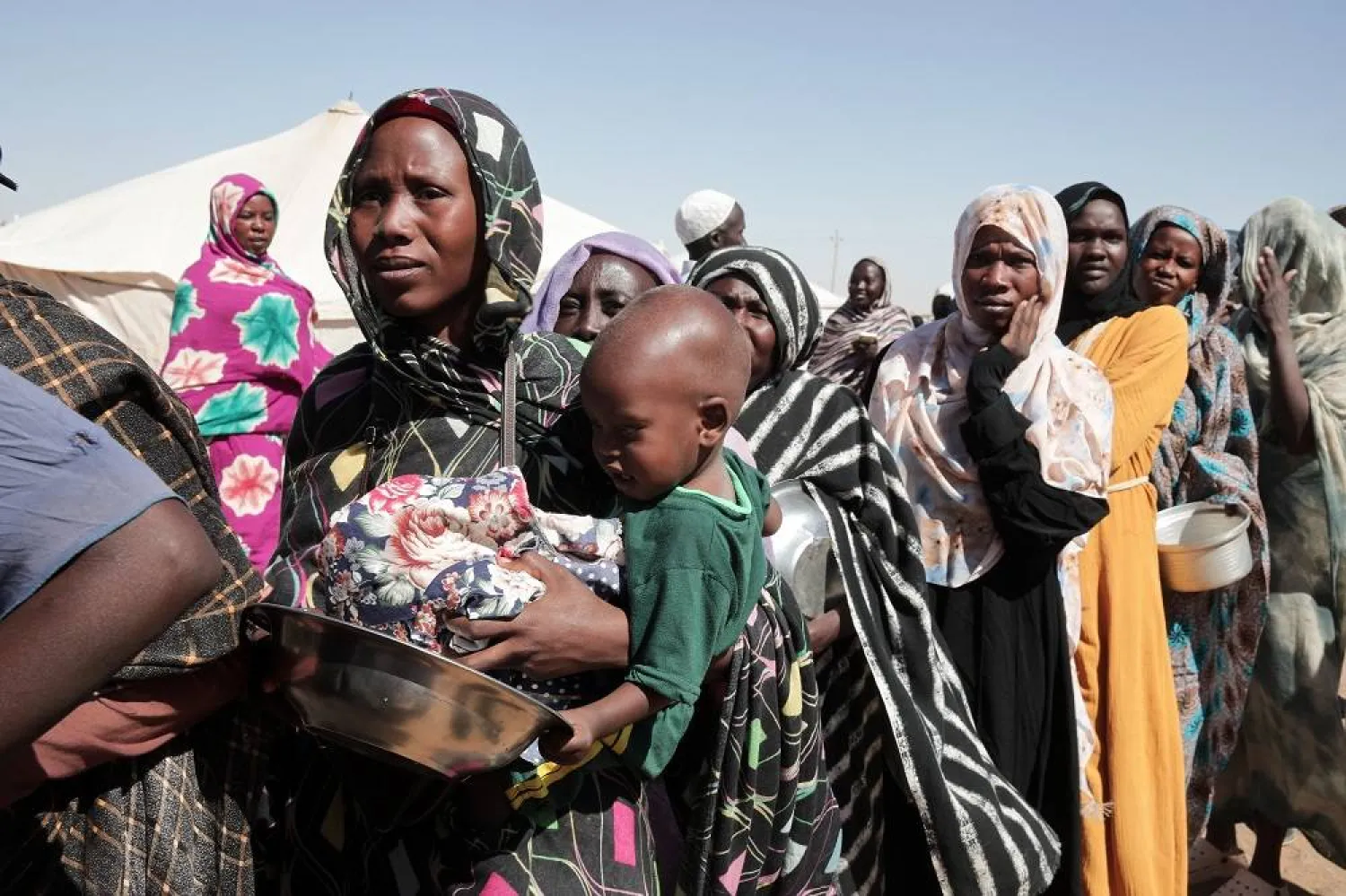
Women displaced from el-Fasher stand in line to receive food aid at the newly established El-Afadh camp in al-Dabba, in Sudan's Northern State, Nov. 16, 2025. (AP)
TT

Sudan’s RSF Advances Could Trigger New Refugee Exodus, UNHCR Chief Warns 

Women displaced from el-Fasher stand in line to receive food aid at the newly established El-Afadh camp in al-Dabba, in Sudan's Northern State, Nov. 16, 2025. (AP)

Advances by paramilitary Rapid Support Forces in Sudan could trigger another exodus across the country's borders, UN High Commissioner for Refugees, Filippo Grandi, told Reuters.

The RSF took over Darfur's city of el-Fasher in late October in one of its biggest gains of the 2-1/2-year war with Sudan's army. This month, advances have continued eastward into the Kordofan region and they seized the country's biggest oil field.

Most of the estimated 40,000 people that the United Nations says have been displaced by the latest violence in Kordofan - a region comprised of three states in central and southern Sudan - have sought refuge within the country, Grandi said, but that could change if violence spreads to a large city like El Obeid.

"If that were to be - not necessarily taken - but engulfed by the war, I am pretty sure we would see more exodus," said Grandi in an interview from Port Sudan late on Monday.

"We have to remain...very alert in neighboring countries in case this happens," he said.

MILLIONS HOMELESS

Already, the war has uprooted nearly 12 million people, including 4.3 million who have fled across borders to Chad, South Sudan and elsewhere, in the world's biggest displacement crisis. However, some have returned to the capital Khartoum, which is now back in Sudanese army control.

Humanitarian workers lack resources to help those fleeing, many of whom have been raped, robbed or bereaved by the violence, said Grandi, who met with survivors who fled mass killings in el-Fasher.

"We are barely responding," said Grandi, referring to a Sudan response plan, which is just a third funded largely due to Western donor cuts. UNHCR lacks resources to relocate Sudanese refugees from an unstable area along Chad's border, he said.

FAMILIES TORN APART BY CONFLICT

Most of those who trekked hundreds of kilometers from el-Fasher and Kordofan to Sudan’s al-Dabba camp on the banks of the Nile north of Khartoum, which Grandi visited last week, are women and children. Their husbands and sons were killed or conscripted along the way.

Some mothers said they disguised their sons as girls to protect them from being abducted by fighters, Grandi said.

"Even fleeing is difficult because people are continuously stopped by the militias," he said.

Grandi began his UNHCR career in Khartoum in the 1980s, when Sudan sheltered refugees from other African wars. He is on his last trip as UNHCR chief before his term ends this month. A successor has yet to be named from over a dozen candidates.


Syria: Ceasefire Holds as Kurds Withdraw to Kobani

Syrian government forces inspect al-Aqtan prison in Raqqa after the SDF withdrew from the facility on Friday, Jan. 23 (AP). 
TT

Syria: Ceasefire Holds as Kurds Withdraw to Kobani

Syrian government forces inspect al-Aqtan prison in Raqqa after the SDF withdrew from the facility on Friday, Jan. 23 (AP). 

Hundreds of fighters from the Syrian Democratic Forces (SDF) arrived on Friday in the city of Kobani (Ain al-Arab) in eastern Aleppo province, after the Syrian army facilitated their withdrawal from Raqqa to the Kurdish city on the Turkish border.

The development comes amid continued adherence to a ceasefire between the two sides, following the Syrian government’s takeover of large areas previously controlled by the SDF’s autonomous administration in Aleppo, Raqqa, Hasakah and Deir Ezzor provinces in northern and eastern Syria.

Syria’s Interior Ministry announced on Friday that it had taken control of al-Aqtan prison in Raqqa after SDF forces withdrew from the facility.

The state news agency SANA quoted the ministry as saying that specialized units from the counterterrorism department and other relevant authorities had been deployed to secure the prison and maintain order inside it.

The Syrian army’s operations command said its units had begun transferring SDF elements from al-Aqtan prison and its surroundings to Kobani, escorting the withdrawing fighters to the city’s outskirts.

Kurdish news outlets later published images showing hundreds of SDF fighters and their vehicles arriving in snow-covered Kobani, where they were welcomed by large crowds of residents.

Al-Aqtan prison holds detainees linked to the ISIS group and had witnessed clashes in its vicinity between government forces and the SDF days earlier. The number of remaining detainees in the facility remains unclear.

Meanwhile, US Central Command announced on Wednesday the launch of a new mission to transfer up to 7,000 ISIS detainees to Iraq to ensure their continued detention in secure facilities.

It said 150 detainees had already been transferred from a prison in Hasakah to Iraq. Iraqi security officials told AFP that the first group included senior ISIS leaders of various nationalities, including Europeans, Asians and Arabs.

Under a comprehensive integration agreement reached on Sunday between Damascus and the SDF, responsibility for prisons holding ISIS detainees is expected to be transferred to the Syrian government.

Separately, the UN refugee agency said the volatile security situation at al-Hol camp, home to families of ISIS fighters, has hindered access to the site. The camp hosts about 24,000 people, including thousands of Syrians and foreign women and children from dozens of countries.


Southern Yemeni Forces Rally in Riyadh Ahead of Key Saudi-Sponsored Dialogue

Southern leaders received in Riyadh by Abdullah Bawazeer, a member of Yemen’s Presidential Leadership Council (X).
TT

Southern Yemeni Forces Rally in Riyadh Ahead of Key Saudi-Sponsored Dialogue

Southern leaders received in Riyadh by Abdullah Bawazeer, a member of Yemen’s Presidential Leadership Council (X).

Riyadh has witnessed, since the beginning of January, an unprecedented wave of political activity involving southern Yemeni leaders and factions.

These consultations and discussions among key actors and influential figures are aimed at preparing for the convening of the Southern Dialogue Conference, sponsored by Saudi Arabia at the request of Rashad al-Alimi, Chairman of Yemen’s Presidential Leadership Council.

Al-Alimi had formally requested Saudi sponsorship of the conference against the backdrop of military and political developments that followed unilateral military actions by Aidarous al-Zubaidi, head of what was formerly known as the Southern Transitional Council (STC), and the subsequent intervention of the Coalition to Support Legitimacy in Yemen to protect civilians in Hadhramaut and Al-Mahra.

As coalition-backed government forces regained control of Hadhramaut and Al-Mahra and deployed across other southern governorates, the Presidential Leadership Council decided to remove Aidarous al-Zubaidi and Faraj al-Bahsani from its membership.

Al-Zubaidi fled Aden by sea to Somalia and then by air to Abu Dhabi, which Yemeni authorities accuse of committing widespread violations in Hadhramaut before ending its military presence there in recent weeks.

Broad Political Mobilization

Amid this momentum, southern figures held a consultative meeting days ago, during which they agreed to abide by the outcomes of the upcoming dialogue, according to a statement read by Abdulrahman al-Muharrami, a member of the Presidential Leadership Council.

In the statement, participants called on the international community to support the dialogue and respect the aspirations of the southern people, stressing that Saudi Arabia guarantees the inclusion of all southern parties and encourages partnership and responsible representation.

Meanwhile, political and social figures in Hadhramaut are mobilizing to unify their vision at the dialogue conference, under the leadership of Salem al-Khanbashi, a member of the Presidential Leadership Council and Governor of Hadhramaut.

Parallel efforts are being led by Abdullah al-Alimi, another member of the Presidential Leadership Council, who has been holding meetings with various southern groups and figures, including those from Shabwa Governorate, alongside representatives from other governorates such as Al-Mahra, Abyan, and Socotra.

This intensive political activity is taking place under direct Saudi sponsorship, in preparation for the launch of the Comprehensive Southern Dialogue Conference, which is expected to constitute a cornerstone in shaping Yemen’s final transitional phase.

Saudi Arabia’s role is no longer confined to traditional mediation but has evolved into what participants describe as “engineering consensus.” Current meetings aim to bridge differences among the various southern components, particularly leaders of what was formerly known as the Southern Transitional Council prior to its dissolution, in addition to other influential southern figures.

Analysts believe that the upcoming conference will not be a mere symbolic event, but rather a defining moment in the history of the “Southern Cause” and Yemen more broadly.

Emphasis on Partnership

Against this political backdrop, converging positions have emerged from Presidential Leadership Council members Abdullah al-Alimi Bawazeer and Abdulrahman al-Muharrami, who stressed the need to entrench the principle of partnership, reject exclusion, and unify the southern front through an inclusive dialogue under Saudi sponsorship.

These positions were articulated during southern meetings held in Riyadh, with the participation of prominent political and military leaders, as part of ongoing preparations for the upcoming dialogue conference.


Lebanon PM Says IMF Wants Rescue Plan Changes as Crisis Deepens

A photograph released by the Lebanese Government Press Office on December 26, 2025, show Lebanon's Prime Minister Nawaf Salam speaking during a press conference following a cabinet session in Beirut on December 26, 2025. (Photo by Handout / Lebanese Government Press Office / AFP)
TT

Lebanon PM Says IMF Wants Rescue Plan Changes as Crisis Deepens

A photograph released by the Lebanese Government Press Office on December 26, 2025, show Lebanon's Prime Minister Nawaf Salam speaking during a press conference following a cabinet session in Beirut on December 26, 2025. (Photo by Handout / Lebanese Government Press Office / AFP)

The International Monetary Fund has demanded amendments to a draft rescue law aimed at hauling Lebanon out of its worst financial crisis on record and giving depositors access to savings frozen for six years, Prime Minister Nawaf Salam said.

The "financial gap" law is part of a series of reform measures required by the IMF in order to access its funding and aims to allocate the losses from Lebanon's 2019 crash between the state, the central bank, commercial banks and depositors.

Salam told Reuters the IMF wants clearer provisions in the hierarchy of claims, which is a core element of the draft legislation designed to determine how losses are allocated.

"We want to engage with the IMF. We want to improve. This is a draft law," ‌Salam said in ‌an interview at the World Economic Forum annual meeting ‌in ⁠the Swiss mountain ‌resort of Davos.

"They wanted the hierarchy of claims to be clearer. The talks are all positive," Salam added.

In 2022, the government put losses from the financial crisis at about $70 billion, a figure that analysts and economists forecast is now likely to be higher.

Salam stressed that Lebanon is still pushing for a long-delayed IMF program, but warned the clock is ticking as the country has already been placed on a financial 'grey list' and risks falling onto the 'black ⁠list' if reforms stall further.

"We want an IMF program and we want to continue our discussions until we get ‌there," he said, adding: "International pressure is real ... The longer we ‍delay, the more people's money will evaporate".

The ‍draft law, which was passed by Salam's government in December, is under parliamentary ‍review. It aims to give depositors a guaranteed path to recovering their funds, restart bank lending, and end a financial crisis that has left nearly a million accounts frozen and confidence in the system shattered.

The roadmap would repay depositors up to $100,000 over four years, starting with smaller accounts, while launching forensic audits to determine losses and responsibility.

Lebanon's Finance Minister Yassine Jaber, who is driving the reform push with Salam, told Reuters it was ⁠essential to salvage a hollowed-out banking system, and to stop the country from sliding deeper into its cash-only, paralyzed economy.

The aim, Jaber said, is to give depositors clarity after years of uncertainty and to end a system that has crippled Lebanon's international standing.

He framed the law as part of a broader reckoning: the first time a Lebanese government has confronted a combined collapse of the banking sector, the central bank and the state treasury.

Financial reforms have been repeatedly derailed by political and private vested interests over the last six years and Jaber said the responsibility now lies with lawmakers.

Failure to act, he said, would leave Lebanon trapped in "a deep, dark tunnel" with no way back to a functioning system.

"Lebanon ‌has become a cash economy, and the real question is whether we want to stay on the grey list, or sleepwalk into a black list," Jaber added.