


Scientists Discover Secrets of Ancient Roman Concrete at Pompeii

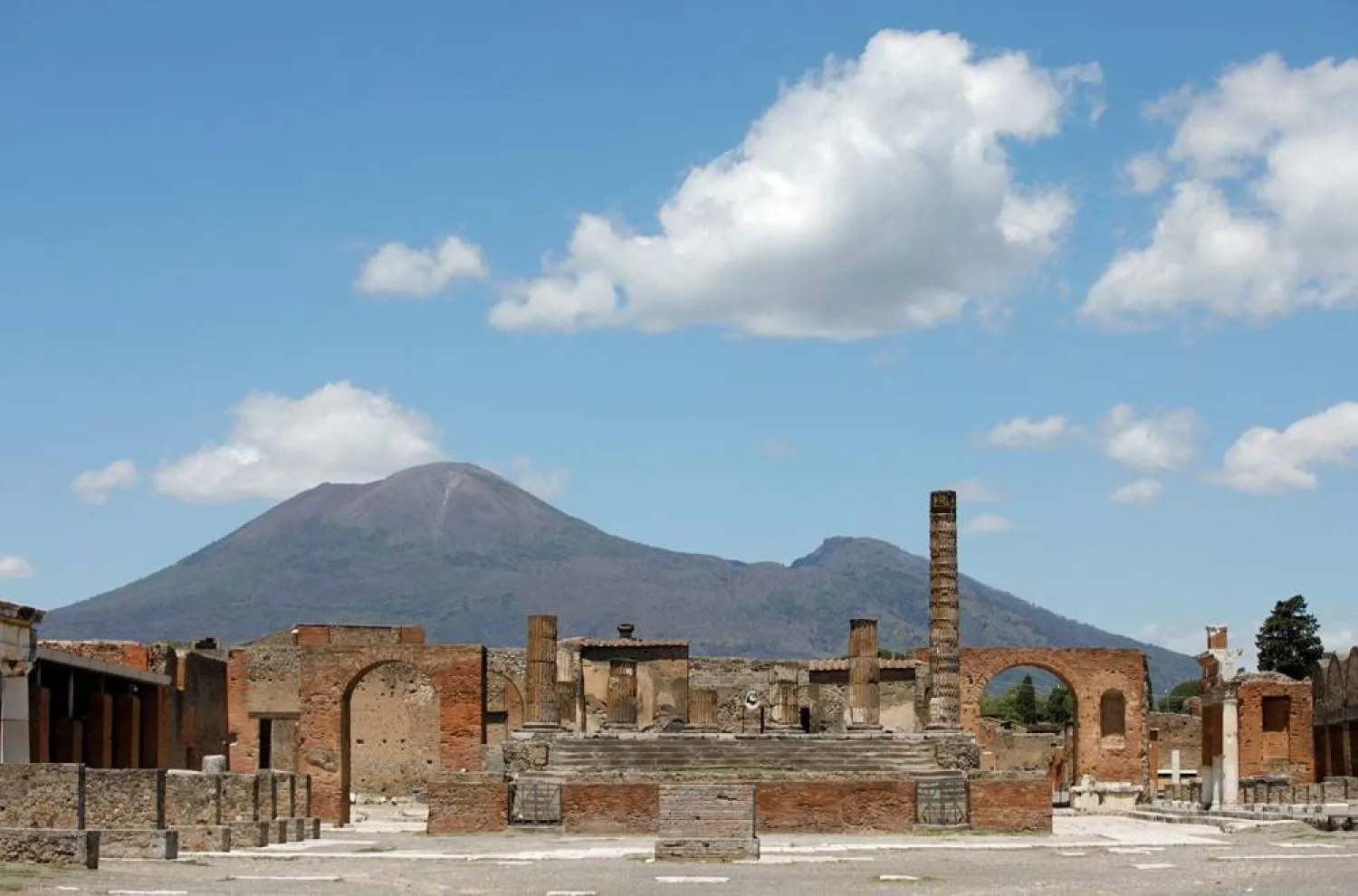
The archaeological site of the ancient Roman city of Pompeii is seen in Pompeii, Italy, May 26, 2020. (Reuters)
TT

Scientists Discover Secrets of Ancient Roman Concrete at Pompeii

The archaeological site of the ancient Roman city of Pompeii is seen in Pompeii, Italy, May 26, 2020. (Reuters)

Scientists excavating the ruins of Pompeii have discovered a construction site left frozen in time by the eruption of Italy's Mount Vesuvius volcano in 79 AD, clarifying the ingredients and methods behind the durable self-healing concrete the ancient Romans used to revolutionize architecture.

The site represents a building project that was underway when the eruption buried Pompeii under volcanic ash and rock. The researchers came across rooms where the walls were unfinished and piles of premixed dry material and tools for weighing and measuring were in place for preparing concrete.

"Studying it truly felt as if I had traveled back in time and was standing beside the workers as they mixed and placed their concrete," said Admir Masic, a Massachusetts Institute of Technology professor of civil and environmental engineering and leader of the study published on Tuesday in the journal Nature Communications.

An indispensable building material, concrete helped the Romans erect structures including stadiums like the Colosseum, domed temples like the Pantheon, public baths and other big buildings, aqueducts and bridges unlike any fashioned to that point in history. Because the concrete could harden underwater, it also was vital for constructing harbors and breakwaters.

The precise method they used to make their concrete has been a matter of debate, with recent archaeological discoveries appearing to contradict accounts given in a 1st century BC treatise by Roman architect and engineer Vitruvius.

The Pompeii discovery showed the Romans used a technique called "hot mixing" in which a material called quicklime - dry limestone that was previously heated - is combined directly with water and a blend of volcanic rock and ash, producing a chemical reaction that naturally heats the mixture. That differs from the method described by Vitruvius, who wrote about a century earlier.

"Pompeii preserves buildings, materials and even work in progress in the precise state they were in when the eruption occurred. Unlike finished structures that have undergone centuries of repair or weathering, this site captures construction processes as they happened," Masic said.

"For studying ancient technologies, there is simply no parallel," Masic said. "Its exceptional preservation offers a true 'snapshot' of Roman building practice in action."

The building under construction combined domestic rooms with a working bakery with ovens, grain-washing basins and storage. The evidence there indicated that the technique outlined by Vitruvius, known as slaked lime, was not used for building walls.

That method may have been outdated by the time of the project in Pompeii.

"Imagine what 100 years of difference could mean for the building technology. A good analogy could be the early telephones. In the 1920s-30s: rotary dialing, long-distance copper lines. In the 2020s: smartphones using packet-switched digital signals and wireless networks," Masic said.

The hot-mixing technique contributed to the self-healing properties of the concrete, chemically repairing cracks. The concrete contains white remnants of the lime used to make it, called "lime clasts," which can dissolve and recrystallize, healing cracks that may form with the infiltration of water.

The Romans industrialized concrete, beginning in the 1st centuries BC and AD.

"This allowed builders to construct massive monolithic structures, complex vaults and domes, and harbors with concrete that cured underwater. Concrete fundamentally expanded what could be built and how cities and infrastructures were conceived," Masic said.

The new understanding of Roman concrete may have relevance for modern architects.

"Modern concretes generally lack intrinsic self-healing capability, which is increasingly important as we seek longer-lasting, lower-maintenance infrastructure," Masic said. "So while the ancient process itself is not a direct replacement for modern standards, the principles revealed can inform the design of next-generation durable, low-carbon concretes."



Saudi Cultural Development Fund to Support 5 Enterprises Worth over SAR63 Million

The agreements were concluded during the Development Finance Conference MOMENTUM 2025. SPA
TT

Saudi Cultural Development Fund to Support 5 Enterprises Worth over SAR63 Million

The agreements were concluded during the Development Finance Conference MOMENTUM 2025. SPA

Saudi Arabia’s Cultural Development Fund (CDF) signed five credit facility agreements under its Cultural Financing Program, with a total value exceeding SAR63 million, to finance cultural projects.

The agreements were concluded during the Development Finance Conference MOMENTUM 2025, organized by the National Development Fund (NDF) at the King Abdulaziz International Conference Center in Riyadh, held under the patronage of Prince Mohammed bin Salman bin Abdulaziz Al Saud, Saudi Crown Prince and Prime Minister.

The credit facilities aim to support the growth of a select group of cultural projects targeting four cultural sub-sectors: architecture and design arts, theater and performing arts, music, and visual arts.

The projects focus on several areas, including strengthening cultural sector infrastructure by establishing a music institute and developing a creative complex, in addition to providing supporting services for the sector and developing national talents and capabilities.


Cultural Fund Hosts 'Film Future Reception' during Red Sea International Film Festival

CDF signed credit facility agreements under the Cultural Financing Program, totaling more than SAR60 million - SPA
TT

Cultural Fund Hosts 'Film Future Reception' during Red Sea International Film Festival

CDF signed credit facility agreements under the Cultural Financing Program, totaling more than SAR60 million - SPA

The Cultural Development Fund (CDF) hosted the “Film Future Reception” during the fifth edition of the Red Sea International Film Festival.

The event brought together entrepreneurs, investors, and leading filmmakers from the Kingdom and around the world to highlight financial solutions and investment opportunities that support the growth of the sector and its cinematic productions.

During the gathering, CDF signed credit facility agreements under the Cultural Financing Program, totaling more than SAR60 million, to finance six major projects in the film sector. These projects target several areas, including feature film production and infrastructure development supporting the industry, SPA reported.

The gathering was organized in collaboration with the Red Sea International Film Festival and BSF Capital. During the event, the fund reviewed future investment trends in the film sector and the funds in which it serves as a principal investor, including the Riviera Content Fund— the first of its kind in the Kingdom— in addition to a second investment fund in the film sector, whose establishment agreement was signed last September and is managed by BSF Capital. Each of these funds has a capital size of SAR375 million.


Visual Arts Commission Announces Art and Ideas Riyadh Initiative

Visual Arts Commission Announces Art and Ideas Riyadh Initiative
TT

Visual Arts Commission Announces Art and Ideas Riyadh Initiative

Visual Arts Commission Announces Art and Ideas Riyadh Initiative

The Visual Arts Commission announced the upcoming edition of its Art and Ideas initiative, taking place 14–15 December 2025 at Prince Mohammad bin Salman City “Misk City”.

After the success of its Paris and Seoul iterations, Art and Ideas initiative launches a new edition in Riyadh to bookend the year with an exciting new program. This annual initiative takes its new mission line as a launchpad to present ideas that will shape the visual arts' future, SPA reported.

According to a press release issued by the commission today, the title, "Art and Ideas: in Action," emphasizes the relationship between theory and practice, intention and execution. Each session gathers distinguished practitioners from various creative fields such as curation, media and technology to present perspectives that broaden audience’s understanding of the arts landscape and highlight the ideas that are shaping our present moment. Framing the visual arts as a record of the times in which they are conceived and presented, "Art and Ideas: in Action" stresses the Visual Arts Commission's commitment to supporting an ever-evolving art landscape.

CEO of the Visual Arts Commission Dina Amin said that “the initiative launched this year as a cross-city dialogue, traveling between Seoul and Paris. Today, it returns to its home—Riyadh under the theme ‘Art and Ideas: In Action.’ Riyadh now stands as a global platform for cultural exchange, collective exploration, and the building of lasting bridges between artistic communities, aligned with the commission’s vision to foster dialogue and to establish a thriving and sustainable artistic ecosystem.”

The release added that the two-day program features four panel discussions and two keynote presentations, hosting distinguished speakers from Saudi Arabia and around the world. These sessions explore the intersections of visual arts with technology, learning, gaming, and contemporary thought, in addition to discussions on building a future-ready art ecosystem and fostering community-driven initiatives.

Driven by the Kingdom’s ambition to create a profound and lasting movement in the fields of arts and culture, the initiative dedicates its efforts to supporting diversity, encouraging experimentation, and strengthening global connectivity. It continues to expand its role by creating spaces that bring together artists, curators, innovators, and cultural thinkers, enabling the exchange of knowledge and perspectives and fostering creative dialogue. Through this convergence of practitioners and experts, the initiative sheds light on current issues and lived experiences that shape the contemporary art landscape and contribute to defining the legacy of Saudi visual art in an ever-changing world.

This edition of Art and Ideas is held in Misk City, which is a destination that fosters arts and innovation within a broader cultural and knowledge-driven ecosystem. Its innovative spaces attract artists and creators, offering platforms for dialogue and artistic exploration. Its presence in this context reflects a vision that places people and creativity at the heart of urban development, aligning with national efforts to support distinctive initiatives such as Zawaya and Afkar.