


Italian Cooking and Its Rituals Get UN Designation as World Heritage 

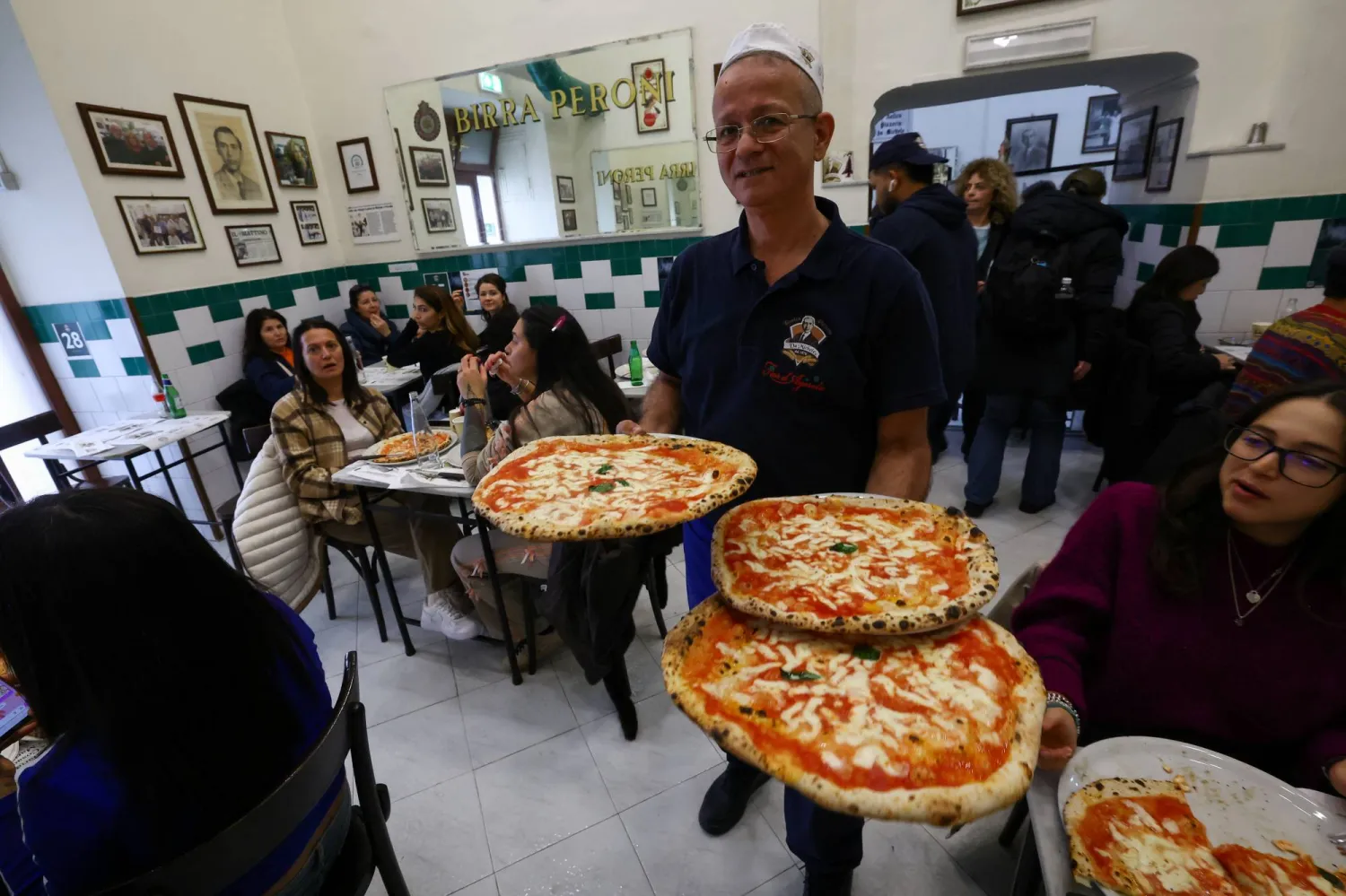
A waiter carries pizzas at L'antica Pizzeria da Michele as Italian cuisine awaits a crucial UNESCO decision that could recognize it as an Intangible Cultural Heritage of Humanity in Naples, Italy, December 5, 2025. (Reuters)
TT

Italian Cooking and Its Rituals Get UN Designation as World Heritage 

A waiter carries pizzas at L'antica Pizzeria da Michele as Italian cuisine awaits a crucial UNESCO decision that could recognize it as an Intangible Cultural Heritage of Humanity in Naples, Italy, December 5, 2025. (Reuters)

Italian food is known and loved around the world for its fresh ingredients and palate-pleasing tastes. On Wednesday, the UN's cultural agency gave foodies another reason to celebrate their pizza, pasta and tiramisu by listing Italian cooking as part of the world’s “intangible” cultural heritage.

UNESCO added the rituals surrounding Italian food preparation and consumption to its list of the world’s traditional practices and expressions. It's a designation celebrated alongside the more well-known UNESCO list of world heritage sites, on which Italy is well represented with locations like the Rome's Colosseum and the ancient city of Pompeii.

The citation didn’t mention specific dishes, recipes or regional specialties, but highlighted the cultural importance Italians place on the rituals of cooking and eating: the Sunday family lunch, the tradition of grandmothers teaching grandchildren how to fold tortellini dough just so, even the act of coming together to share a meal.

“Cooking is a gesture of love, a way in which we tell something about ourselves to others and how we take care of others,” said Pier Luigi Petrillo, a member of the Italian UNESCO campaign and professor of comparative law at Rome’s La Sapienza University.

“This tradition of being at the table, of stopping for a while at lunch, a bit longer at dinner, and even longer for big occasions, it’s not very common around the world,” he said.

Premier Giorgia Meloni celebrated the designation, which she said honored Italians and their national identity.

“Because for us Italians, cuisine is not just food or a collection of recipes. It is much more: it is culture, tradition, work, wealth,” she said in a statement.

Many gastronomic cultures get recognition It’s by no means the first time a country’s cuisine has been recognized as a cultural expression: In 2010, UNESCO listed the “gastronomic meal of the French” as part of the world’s intangible heritage, highlighting the French custom of celebrating important moments with food.

Other national cuisines and cultural practices surrounding them have also been added in recent years: the “cider culture” of Spain’s Asturian region, the Ceebu Jen culinary tradition of Senegal, the traditional way of making cheese in Minas Gerais, Brazil.

UNESCO meets every year to consider adding new cultural practices or expressions onto its lists of so-called “intangible heritage.” There are three types: One is a representative list, another is a list of practices that are in “urgent” need of safeguarding and the third is a list of good safeguarding practices.

This year, the committee meeting in New Delhi considered 53 nominations for the representative list, which already had 788 items. Other nominees included the Swiss yodelling, the handloom weaving technique used to make Bangladesh’s Tangail sarees, and Chile’s family circuses.

In its submission, Italy emphasized the “sustainability and biocultural diversity” of its food. Its campaign noted how Italy’s simple cuisine valued seasonality, fresh produce and limiting waste, while its variety highlighted its regional culinary differences and influences from migrants and others.

“For me, Italian cuisine is the best, top of the range. Number one. Nothing comes close,” said Francesco Lenzi, a pasta maker at Rome’s Osteria da Fortunata restaurant, near the Piazza Navona. “There are people who say ‘No, spaghetti comes from China.’ Okay, fine, but here we have turned noodles into a global phenomenon. Today, wherever you go in the world, everyone knows the word spaghetti. Everyone knows pizza.”

Lenzi credited his passion to his grandmother, the “queen of this big house by the sea” in Camogli, a small village on the Ligurian coast where he grew up. “I remember that on Sundays she would make ravioli with a rolling pin.”

“This stayed with me for many years,” he said in the restaurant's kitchen.

Mirella Pozzoli, a tourist visiting Rome’s Pantheon from the Lombardy region in northern Italy, said the mere act of dining together was special to Italians:

“Sitting at the table with family or friends is something that we Italians cherish and care about deeply. It’s a tradition of conviviality that you won’t find anywhere else in the world.”

Italy already well-represented on list Italy already has 13 other cultural items on the UNESCO intangible list, including Sicilian puppet theater, Cremona’s violin craftsmanship and the practice moving of livestock along seasonal migratory routes known as transhumance.

Italy appeared in two previous food-related listings: a 2013 citation for the “Mediterranean diet” that included Italy and half a dozen other countries, and the 2017 recognition of Naples’ pizza makers.

Petrillo, the Italian campaign member, said after 2017, the number of accredited schools to train Neapolitan pizza makers increased by more than 400%.

“After the UNESCO recognition, there were significant economic effects, both on tourism and the sales of products and on education and training,” he said.

Syrian Culture Minister Applauds Saudi Pavilion at Damascus Book Fair

The 2026 Damascus International Book Fair is held from February 6 to 16 - SPA
TT

Syrian Culture Minister Applauds Saudi Pavilion at Damascus Book Fair

The 2026 Damascus International Book Fair is held from February 6 to 16 - SPA

Syrian Minister of Culture Mohammed Yassin Saleh visited the Kingdom’s pavilion at the 2026 Damascus International Book Fair, held from February 6 to 16, where the Kingdom is serving as the Guest of Honor.

He commended the efforts of the Literature, Publishing and Translation Commission in showcasing the rich diversity of the Saudi cultural and literary scene. The pavilion features exhibitions of manuscripts, a Saudi fashion corner, and archaeological replicas, SPA reported.

The minister reviewed the commission's Tarjim translation initiative and Saudi literature comics.

This participation at the 2026 Damascus International Book Fair showcases Saudi creativity and fosters cultural dialogue, supporting Saudi Vision 2030’s goals of knowledge exchange and cultural leadership.


Saudi Arabia, Syria Underline Depth of their Cultural Ties

Syrian President al-Sharaa receives the Saudi minister of culture and the accompanying delegation at the Conference Palace in Damascus on Thursday. (SPA)
TT

Saudi Arabia, Syria Underline Depth of their Cultural Ties

Syrian President al-Sharaa receives the Saudi minister of culture and the accompanying delegation at the Conference Palace in Damascus on Thursday. (SPA)

Saudi Arabia and Syria underlined the strength of their cultural relationship during high-level meetings held in Damascus on Thursday, on the sidelines of the opening of the Damascus International Book Fair 2026, where the Kingdom is participating as guest of honor.

Syrian President Ahmad al-Sharaa received Saudi Minister of Culture Prince Badr bin Abdullah bin Farhan at the Conference Palace in the capital.

Earlier the same day, Prince Badr met with his Syrian counterpart, Minister of Culture Mohammad Yassin Saleh, during an official visit to attend the fair. T

he Saudi minister congratulated Syria on hosting the exhibition and expressed his wishes for continued prosperity, progress, and stability for the Syrian government and people.

Both meetings highlighted the depth of cultural relations between the two countries, the importance of expanding joint cultural cooperation across various fields, and the alignment of positions on issues of mutual interest in a way that serves both nations.

The Saudi delegation included senior officials and advisers, among them representatives from the Royal Court, the Ministry of Culture, and the King Abdulaziz Public Library, reflecting broad institutional engagement in the visit.

In the evening, Prince Badr attended the opening ceremony of the fair’s special session, held under the patronage and in the presence of al-Sharaa. The event drew wide official and cultural participation, including Arab ministers, political and intellectual figures, and a distinguished group of writers and cultural figures.

In a post on the X platform, Prince Badr thanked “our brothers in Syria for their generous hospitality and their efforts in organizing the Damascus International Book Fair.”

The minister also inaugurated the Kingdom’s pavilion at the fair in the presence of the Syrian minister of culture and the Qatari minister of culture.

Saudi Arabia’s guest-of-honor participation continues until Feb. 16 and reflects its growing prominence and leadership in the Arab and global cultural landscape.

This participation aligns with Saudi Vision 2030, which places culture at the heart of national development, viewing it as a space for dialogue, a bridge for civilizational communication, and a tool for strengthening ties among Arab peoples.

The Saudi Literature, Publishing and Translation Commission is leading the Kingdom’s participation, highlighting the development of the cultural sector and reaffirming the central role of books as carriers of knowledge and awareness.

The Saudi pavilion boasts a comprehensive cultural program featuring intellectual seminars, poetry evenings, a manuscript exhibition, traditional Saudi fashion displays, hospitality corners, archaeological replicas, and performing arts that express the depth of the Kingdom’s cultural heritage.

On the sidelines of the visit, Prince Badr, accompanied by Minister Saleh, toured the National Museum of Damascus, which houses rare artifacts spanning prehistoric eras, ancient Syrian civilizations, classical and Islamic periods, as well as traditional and modern art.


UNESCO Honors Al-Bisht Al-Hasawi as Thousands Flock to Al-Ahsa Festival

Visitors can explore interactive displays, participate in live workshops, and witness the meticulous process of tailoring this iconic symbol of prestige - SPA
TT

UNESCO Honors Al-Bisht Al-Hasawi as Thousands Flock to Al-Ahsa Festival

Visitors can explore interactive displays, participate in live workshops, and witness the meticulous process of tailoring this iconic symbol of prestige - SPA

The third edition of Al-Bisht Al-Hasawi Festival is drawing thousands of regional and international visitors to Ibrahim Palace in historic Al-Hofuf.

Organized by the Heritage Commission, this year’s festival celebrates the inscription of the Bisht on UNESCO’s Representative List of the Intangible Cultural Heritage of Humanity.

The event showcases Al-Ahsa’s centuries-old tradition of hand-weaving and gold embroidery, a craft passed down through generations of local families, SPA reported.

Visitors can explore interactive displays, participate in live workshops, and witness the meticulous process of tailoring this iconic symbol of prestige.

With UNESCO's participation and representatives from six countries, the festival has evolved into a global platform for cultural dialogue, cementing the Bisht’s status as a world-class cultural treasure.