


Trump Says the US Has Seized an Oil Tanker off the Coast of Venezuela

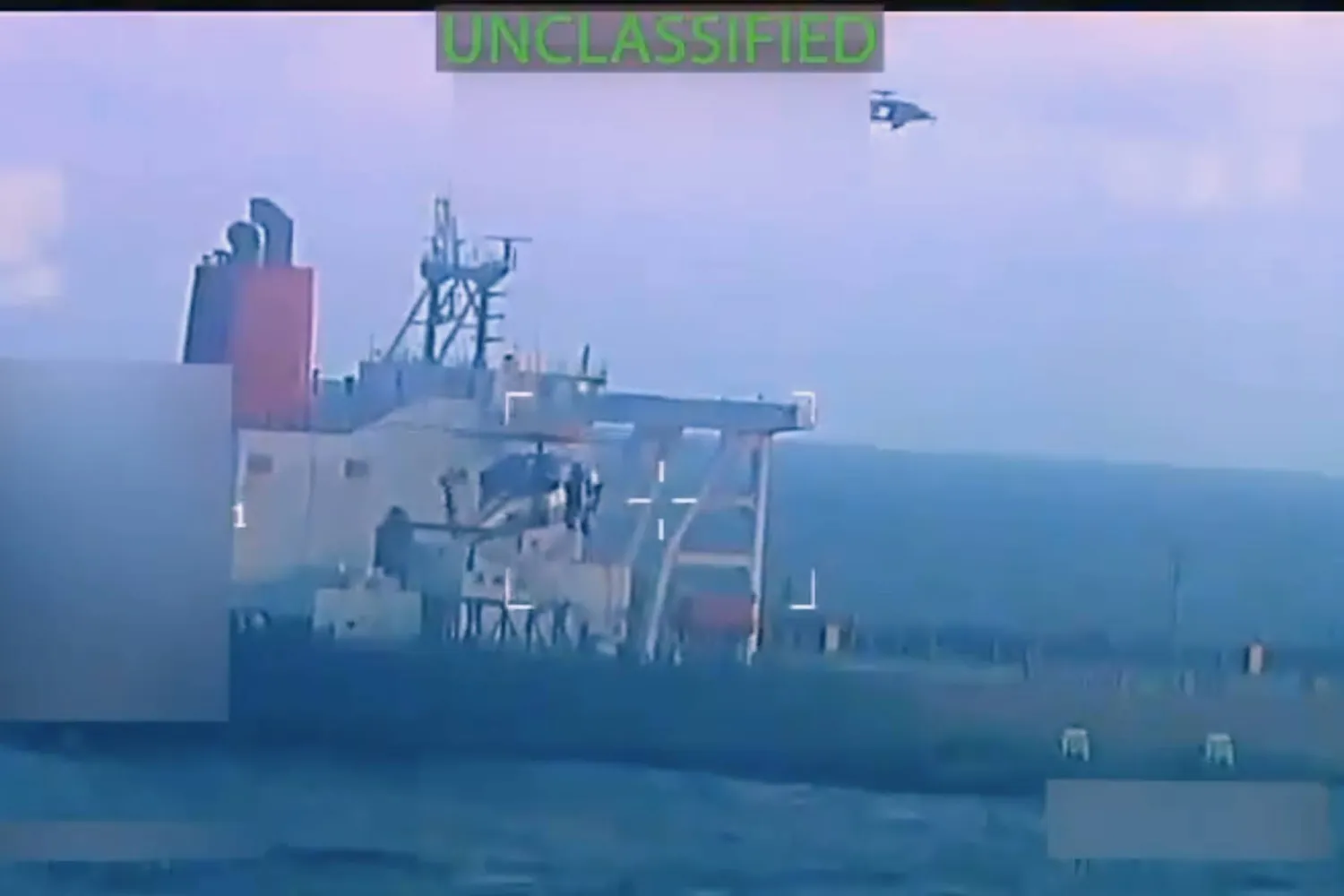
This image from video posted on Attorney General Pam Bondi's X account, and partially redacted by the source, shows an oil tanker being seized by US forces off the coast of Venezuela, Wednesday, Dec. 10, 2025. (US Attorney General's Office/X via AP)
TT

Trump Says the US Has Seized an Oil Tanker off the Coast of Venezuela

This image from video posted on Attorney General Pam Bondi's X account, and partially redacted by the source, shows an oil tanker being seized by US forces off the coast of Venezuela, Wednesday, Dec. 10, 2025. (US Attorney General's Office/X via AP)

President Donald Trump said Wednesday that the United States has seized an oil tanker off the coast of Venezuela as tensions mount with the government of President Nicolás Maduro.

Using US forces to take control of a merchant ship is incredibly unusual and marks the Trump administration’s latest push to increase pressure on Maduro, who has been charged with narcoterrorism in the United States. The US has built up the largest military presence in the region in decades and launched a series of deadly strikes on alleged drug-smuggling boats in the Caribbean Sea and eastern Pacific Ocean. The campaign is facing growing scrutiny from Congress.

“We’ve just seized a tanker on the coast of Venezuela, a large tanker, very large, largest one ever seized, actually,” Trump told reporters at the White House, later adding that "it was seized for a very good reason.”

Trump did not offer additional details. When asked what would happen to the oil aboard the tanker, Trump said, “Well, we keep it, I guess", The Associated Press reported.

The seizure was led by the US Coast Guard and supported by the Navy, according to a US official who was not authorized to comment publicly and spoke on the condition of anonymity. The official added that it was conducted under U.S. law enforcement authority.

Storming the oil tanker

The Coast Guard members were taken to the oil tanker by helicopter from the aircraft carrier USS Gerald R. Ford, the official said. The Ford is in the Caribbean Sea after arriving last month in a major show of force, joining a fleet of other warships.

Video posted to social media by Attorney General Pam Bondi shows people fast-roping from one of the helicopters involved in the operation as it hovers just feet from the deck.

The Coast Guard members can be seen later in the video moving throughout the superstructure of the ship with their weapons drawn.

Bondi wrote that “for multiple years, the oil tanker has been sanctioned by the United States due to its involvement in an illicit oil shipping network supporting foreign terrorist organizations.”

Venezuela’s government said in a statement that the seizure “constitutes a blatant theft and an act of international piracy.”

“Under these circumstances, the true reasons for the prolonged aggression against Venezuela have finally been revealed. ... It has always been about our natural resources, our oil, our energy, the resources that belong exclusively to the Venezuelan people,” the statement said.

Half of ship's oil is tied to Cuban importer The US official identified the seized tanker as the Skipper.

The ship departed Venezuela around Dec. 2 with about 2 million barrels of heavy crude, roughly half of it belonging to a Cuban state-run oil importer, according to documents from the state-owned company Petróleos de Venezuela S.A., commonly known as PDVSA, that were provided on the condition of anonymity because the person did not have permission to share them.

The Skipper was previously known as the M/T Adisa, according to ship tracking data. The Adisa was sanctioned by the US in 2022 over accusations of belonging to a sophisticated network of shadow tankers that smuggled crude oil on behalf of Iran’s Revolutionary Guard and Lebanon's Hezbollah militant group.

The network was reportedly run by a Switzerland-based Ukrainian oil trader, the US Treasury Department said at the time.

Hitting Venezuela's sanctioned oil business Venezuela has the world’s largest proven oil reserves and produces about 1 million barrels a day.

PDVSA is the backbone of the country’s economy. Its reliance on intermediaries increased in 2020, when the first Trump administration expanded its maximum-pressure campaign on Venezuela with sanctions that threaten to lock out of the US economy any individual or company that does business with Maduro’s government. Longtime allies Russia and Iran, both also sanctioned, have helped Venezuela skirt restrictions.

The transactions usually involve a complex network of shadowy intermediaries. Many are shell companies, registered in jurisdictions known for secrecy. The buyers deploy so-called ghost tankers that hide their location and hand off their valuable cargoes in the middle of the ocean before they reach their final destination.

Maduro did not address the seizure during a speech before a ruling-party organized demonstration in Caracas, Venezuela’s capital. But he told supporters that the country is “prepared to break the teeth of the North American empire if necessary.”

Maduro has insisted the real purpose of the US military operations is to force him from office.

Democrat says the move is about ‘regime change’

Sen. Chris Van Hollen, D-Md., a member of the Senate Foreign Relations Committee, said the US seizing the oil tanker cast doubt on the administration’s stated reasons for the military buildup and boat strikes.

“This shows that their whole cover story — that this is about interdicting drugs — is a big lie,” the senator said. “This is just one more piece of evidence that this is really about regime change — by force.”

Vincent P. O’Hara, a naval historian and author of “The Greatest Naval War Ever Fought,” called the seizure “very unusual” and "provocative." Noting that the action will probably deter other ships from the Venezuela coastline, he said, "If you have no maritime traffic or access to that, then you have no economy.”

The seizure comes a day after the US military flew a pair of fighter jets over the Gulf of Venezuela in what appeared to be the closest that warplanes had come to the South American country’s airspace. Trump has said land attacks are coming soon but has not offered more details.

The Trump administration is facing increasing scrutiny from lawmakers over the boat strike campaign, which has killed at least 87 people in 22 known strikes since early September, including a follow-up strike that killed two survivors clinging to the wreckage of a boat after the first hit.

Some legal experts and Democrats say that action may have violated the laws governing the use of deadly military force.

Lawmakers are demanding to get unedited video from the strikes, but Defense Secretary Pete Hegseth told congressional leaders at a classified briefing Tuesday that he was still weighing whether to release it.

The Coast Guard referred a request for comment about the tanker seizure to the White House.


Macron Says it is Unrealistic to Open Hormuz Strait by Force

FILE PHOTO: A cargo ship in the Gulf, near the Strait of Hormuz, as seen from northern Ras al-Khaimah, near the border with Oman’s Musandam governance- REUTERS/Stringer/File Photo
TT

Macron Says it is Unrealistic to Open Hormuz Strait by Force

FILE PHOTO: A cargo ship in the Gulf, near the Strait of Hormuz, as seen from northern Ras al-Khaimah, near the border with Oman’s Musandam governance- REUTERS/Stringer/File Photo

French President Emmanuel Macron said on Thursday it would be unrealistic to launch a military operation to force open the Strait of Hormuz, after US President Donald Trump challenged US allies to work towards reopening it.

Thousands of people have been killed across the Middle East since February 28, when the US and Israel struck Iran, triggering Iranian attacks on Israel, US bases and the Gulf states, and Tehran effectively closing the waterway that carries about a fifth of global oil and liquefied natural gas supplies.

"Some people defend the idea of freeing the Strait of Hormuz by force via a military operation, a position sometimes expressed by the United States, although it has varied," Macron told reporters during a trip to South Korea.

"This was never the option we have supported because it is unrealistic," he said. "It would take forever, and would expose all those who go through the Strait to risks from the guardians of the revolution but also ballistic missiles," he said.

Macron, who has worked with European and other allies to build a coalition to guarantee free passage through Hormuz once hostilities have stopped, said this could only be done by talking to Iran.

"What we say from the beginning is that this strait must be reopened because it is strategic for energy flows, fertilisers and international trade, but that it can only be done in consultation with Iran," he said.

Asked about Trump's criticism of NATO allies and threats to pull the US out of the alliance, Macron said: "I don't want to provide a running commentary of an operation the Americans have decided on their own with Israel. They can deplore the fact they're not being helped, but that's not our operation. We want peace as soon as possible."

Macron also said that Trump's comments mocking him and his wife Brigitte were "neither elegant, nor commensurate" with the moment.


Strike Hits Bridge Near Tehran Again

Smoke rises from the site of an airstrike on Tehran (File/AFP)
TT

Strike Hits Bridge Near Tehran Again

Smoke rises from the site of an airstrike on Tehran (File/AFP)

US-Israeli strikes hit a bridge near Tehran on Thursday, which had already been hit around an hour earlier, Iranian state TV reported.

"A few minutes ago, the American-Zionist enemy once again targeted the B1 bridge in Karaj," a city west of Tehran, state TV said, adding that the first strike had caused two civilian casualties, AFP reported.

It said the later attack took place as emergency teams were deployed to the site to help victims of the first strike.


Argentina Expels Iran's Charge D'affaires

Argentine flag flutters in front of the presidential palace, Casa Rosada, as Argentina's government expects the International Monetary Fund board will approve a $20 billion loan, in Buenos Aires, Argentina April 11, 2025. REUTERS/Irina Dambrauskas
TT

Argentina Expels Iran's Charge D'affaires

Argentine flag flutters in front of the presidential palace, Casa Rosada, as Argentina's government expects the International Monetary Fund board will approve a $20 billion loan, in Buenos Aires, Argentina April 11, 2025. REUTERS/Irina Dambrauskas

Argentina's government declared Iran's charge d'affaires, Mohsen Tehrani, "persona non grata" and expelled him from the country, Argentina's Foreign Minister said in a statement on Thursday.

The measure orders Tehrani to leave the country within 48 hours.

The decision comes in response to a statement released on Wednesday by Iran's Ministry of Foreign Affairs, which accused Argentina's president Javier Milei, an ally of US president Donald Trump, and his foreign minister Pablo Quirno, of being complicit in military attacks on its territory, Reuters reported.

Argentina's Foreign Minister said Iran's claims "contain false, offensive, and unfounded accusations against the Argentine Republic and its highest authorities."

Earlier this week, the Milei government had designated the Iranian Revolutionary Guard Corps (IRGC) a terrorist organization.
