

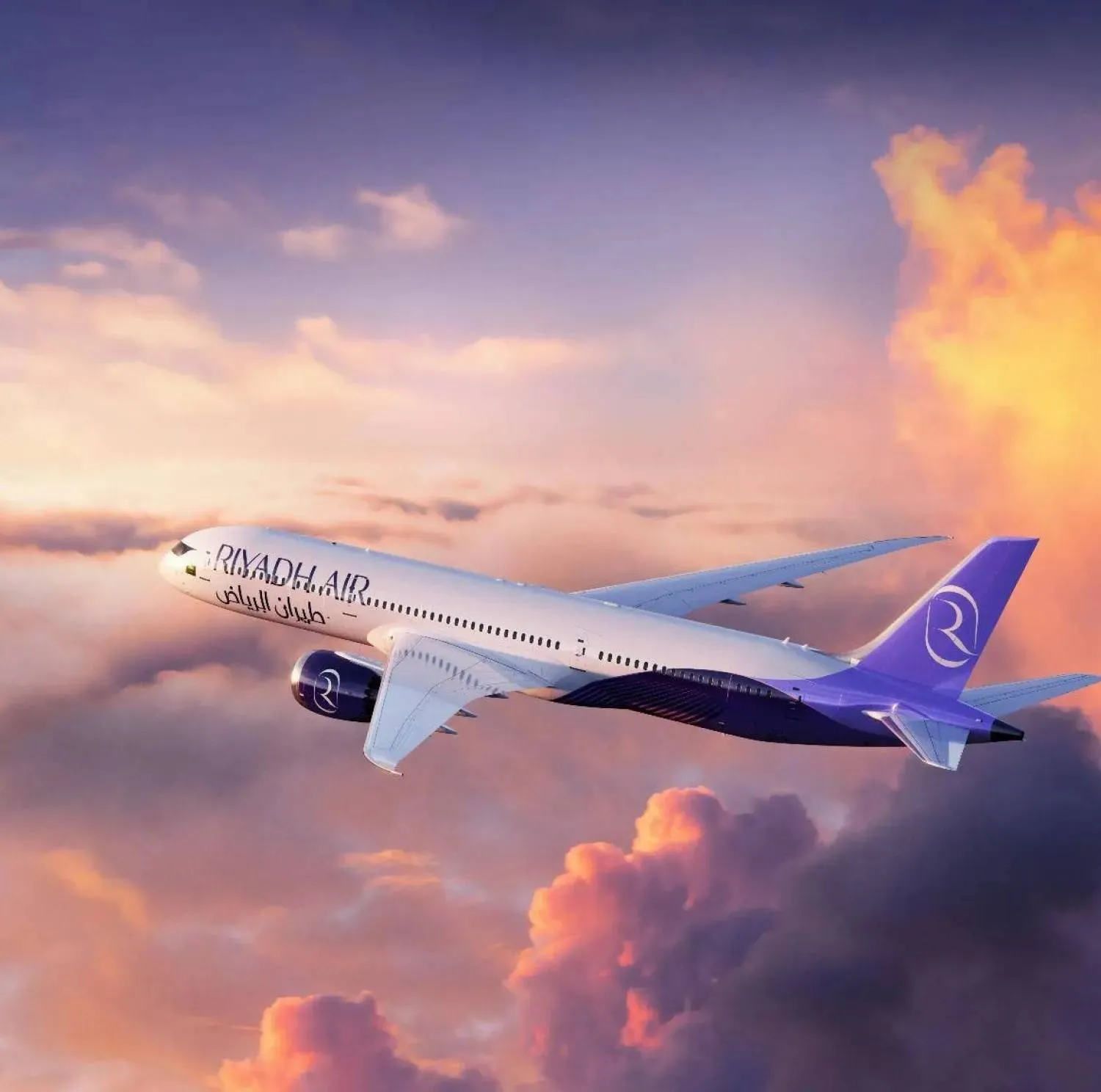

Riyadh Air, IBM Build the World’s First Airline Founded on AI

A Riyadh Air aircraft (The company’s website)
TT

Riyadh Air, IBM Build the World’s First Airline Founded on AI

A Riyadh Air aircraft (The company’s website)

The Middle East’s aviation sector has undergone rapid transformation in recent years, driven by network expansion, advanced digital technologies, and growing reliance on smart analytics to enhance passenger experience and improve operational efficiency.

As competition intensifies among regional and international carriers, digital innovation has become central to differentiation and customer appeal.

Aligned with Saudi Arabia’s Vision 2030, which is focused on strengthening air connectivity, diversifying the economy, and leveraging modern technology, the Kingdom has paved the way for innovations such as service automation, workforce digitalization, and real-time data analytics for smarter operational decision-making.

In this context, Riyadh Air - one of the Public Investment Fund’s aviation companies -announced, in partnership with IBM Middle East and North Africa, the creation of the world’s first national airline built entirely on artificial intelligence from day one.

The initiative represents a new model for the airline of the future, going beyond traditional digital transformation to establish an operating and management structure free from legacy systems.

Through a collaboration involving more than 60 technology partners across 59 workstreams, Riyadh Air aims to set a global benchmark not only for AI-driven operational efficiency, using generative AI and the watsonx Orchestrate platform, but also for highly personalized experiences for passengers and employees.

The airline is preparing for the launch of its first commercial flights in early 2026, with a goal of connecting the Kingdom to more than 100 international destinations by 2030.

Riyadh Air Chief Financial Officer Adam Boukadida told Asharq Al-Awsat that the objective was to build a fully modern national airline.

“We started from scratch so Riyadh Air could become the first airline built on AI platforms that define the sector’s future, while preserving the human touch for both employees and guests,” he said.

He added that the biggest challenge was developing all systems anew and coordinating dozens of partners to ensure seamless integration while embedding AI across every operational layer.

The digital infrastructure provides employees with a unified workspace that simplifies tasks and strengthens data-driven decision-making. AI empowers crew to deliver customized, proactive services, from booking to arrival and beyond. This includes a virtual assistant offering tailored suggestions such as car rentals and reservations for events or restaurants.

Boukadida noted that real-time analysis of operational, financial, and commercial data will boost efficiency, profitability, and cost management, while elevating Saudi Arabia’s global air connectivity.

Mohamad Ali, Senior Vice President of IBM Consulting, said integrating AI into the airline’s core operations makes Riyadh Air “a model of adaptability, where technology and human hospitality converge on every journey.” IBM platforms provide unified, real-time data to enhance performance for both staff and travelers.

He highlighted watsonx Orchestrate as a key component enabling personalized digital workplaces, seamless access to HR tools, and instant insights for crew, such as alerts to offer fast-track services to late-arriving passengers.

For travelers, the platform will power an AI virtual assistant offering customized add-on services and curated experiences.

Riyadh Air plans to serve over 100 global destinations by 2030 with a fleet of long-range aircraft. Boukadida said Saudi talent has been integral to building the airline, reflecting the Kingdom’s commitment to developing digital expertise and creating high-value jobs in aviation.



UK Economy Unexpectedly Shrinks in October

People exit the London Underground station at Bank, outside the Bank of England (L) and the Royal Exchange building (back R) in central London on December 12, 2025. (Photo by HENRY NICHOLLS / AFP)
TT

UK Economy Unexpectedly Shrinks in October

People exit the London Underground station at Bank, outside the Bank of England (L) and the Royal Exchange building (back R) in central London on December 12, 2025. (Photo by HENRY NICHOLLS / AFP)

Britain's economy unexpectedly contracted again in October, official data showed Friday, dealing a blow to the Labour government's hopes of reviving economic growth.

Gross domestic product fell 0.1 percent in October following a contraction of 0.1 percent in September, the Office for National Statistics said in a statement.

Analysts had forecast growth of 0.1 percent.

Manufacturing rebounded in the month as carmaker Jaguar Land Rover resumed operations after a cyberattack that had weighed on the UK economy in September, AFP reported.

But analysts noted that businesses and consumers reined in spending ahead of Britain's highly-expected annual budget.

"Business and consumers were braced for tax hikes and the endless speculation and leaks have once again put a brake on the UK economy," said Lindsay James, investment manager at Quilter.

Prime Minister Keir Starmer's Labour party raised taxes in last month's budget to slash state debt and fund public services.

At the same time, Britain's economic growth was downgraded from next year until the end of 2029, according to data released alongside the budget.

Finance Minister Rachel Reeves raised taxes on businesses in her inaugural budget last year -- a decision widely blamed for causing weak UK economic growth and rising unemployment.

She returned in November with fresh hikes, this time hitting workers.
Analysts said that Friday's data strengthened expectations that the Bank of England would cut interest rates next week.


Gold Hits Seven-week High on Safe-haven Demand; Silver Notches Peak

FILE PHOTO: A goldsmith works on a gold necklace at a workshop in Ahmedabad, India, October 8, 2025. REUTERS/Amit Dave/File Photo
TT

Gold Hits Seven-week High on Safe-haven Demand; Silver Notches Peak

FILE PHOTO: A goldsmith works on a gold necklace at a workshop in Ahmedabad, India, October 8, 2025. REUTERS/Amit Dave/File Photo

Gold prices rose to a seven-week high on Friday, bolstered by a soft dollar, expectations of interest rate cuts and safe-haven demand prompted by geopolitical turbulence, while silver hit a record high.

Spot gold rose 0.7% to $4,311.73 per ounce by 0945 GMT, its highest level since October 21, and set for a 2.7% weekly gain, Reuters reported.

US gold futures gained 0.7% to $4,343.50.

The dollar hovered near a two-month low, and was on track for a third straight weekly drop, making bullion more affordable for overseas buyers.

Additionally, "the sharp rise in US weekly jobless claims as well as US-Venezuela tensions are underpinning gold and keeping haven demand strong," said Zain Vawda, analyst at MarketPulse by OANDA.

US jobless claims rose by the most in nearly 4-1/2 years last week, reversing the sharp drop seen in the previous week.

The US Federal Reserve trimmed rates by 25 basis points for the third time this year on Wednesday, but indicated caution on additional cuts.

Investors are currently pricing in two rate cuts next year, and next week's US non-farm payrolls report could provide further clues on the Fed's future policy path.

Non-yielding assets such as gold tend to benefit in low-interest-rate environment.

On the geopolitical front, the US is preparing to intercept more ships transporting Venezuelan oil following the seizure of a tanker this week.

Meanwhile, India saw widening gold discounts this week as demand remained subdued despite the wedding season, while high spot prices also dented demand in China.

Spot silver rose 0.5% to $63.87 per ounce, after hitting a new record high of $64.32/oz, and is headed for a 9.5% weekly gain.

Prices have more than doubled this year, supported by strong industrial demand, dwindling inventories and its inclusion on the US critical minerals list.

"Silver is supported by industrial demand amid fears of shortages, a continued tight market, and the speculative frenzy, mostly from retail investors which has helped drive inflows to Silver ETFs," said Ole Hansen, head of commodity strategy at Saxo Bank.

Elsewhere, platinum was up 0.8% at $1,708.11, while palladium climbed 2.2% to $1,516.95. Both were headed for a weekly rise.


IATA: Middle East Will Lead the World in Airline Profitability in 2026

International Air Transport Association (IATA) flags
TT

IATA: Middle East Will Lead the World in Airline Profitability in 2026

International Air Transport Association (IATA) flags

The International Air Transport Association (IATA) has said the Middle East will lead the world in airline profitability next year.

According to its outlook for the region as part of its 2026 global industry forecast, which it released on Thursday, Middle East carriers are expected to deliver the highest net profit margin globally (9.3%) and the highest profit per passenger ($28.6)—well above the global averages of 3.9% and $7.9 respectively.

“The Middle East’s position as the most profitable region in 2026, in terms of profit margin and profit per passenger, underscores the benefits of strategic investment, supportive policy frameworks, and the region’s role as a global connecting hub,” IATA Regional Vice President, Africa and Middle East Kamil Al-Awadhi said.

“But this success is far from uniform. Several carriers continue to face severe financial pressure due to geopolitical instability, blocked funds, and uneven infrastructure development,” he added.

According to IATA, Middle East airlines are forecast to generate $6.9 billion in net profit in 2026, reflecting the region’s strong fundamentals, including robust long-haul traffic, expanding hub capacity, and continued investment in infrastructure.

By comparison, global industry net profit is projected to reach $41 billion, with a total of 5.2 billion passengers expected to travel worldwide.

Cargo demand is expected to grow 2.6% globally, with Middle East cargo volumes remaining stable.

The regional passenger market is forecast to reach 240 million passengers in 2026, supported by an expected 6.1% growth rate, outpacing the global average of 4.9%.

Despite positive performance, the region faces several structural challenges:

Blocked Funds: Of the $1.2 billion in airline funds blocked globally as of October 2025, 43% ($515 million) is held in the Middle East and North Africa (MENA). Algeria now represents the largest share of blocked funds, driven by new approval requirements that have added administrative delays. Lebanon’s blocked funds remain static, representing legacy balances from 2019–2021.

Geopolitical Instability: Conflicts in Yemen, Syria, Iraq, and Lebanon continue to restrict airspace and disrupt operations. Airlines face longer routings around closed or restricted airspace, increasing fuel burn, emissions, and flight times.

Economic Disparities: Gulf Cooperation Council (GCC) states have made significant progress in building world-class aviation systems. In contrast, lower-income countries such as Yemen, Lebanon, and Syria face outdated infrastructure, under-resourced aviation authorities, and limited investment capacity.

IATA underscored the importance of greater cooperation to unlock aviation’s full potential in the Middle East. Key priorities include:

Advancing toward a more integrated air transport market to improve connectivity and reduce market fragmentation.

Ensuring fair and proportionate consumer protection by aligning national regulations with ICAO principles and global best practices.

Supporting states emerging from sanctions to safely reintegrate into the global aviation system, including access to aircraft, financing, and international standards.

“Greater regional coordination is essential for the Middle East to realize its full aviation potential. An integrated air transport market, fair consumer protection rules, and clearing blocked funds will strengthen connectivity and efficiency across the region,” said Al-Awadhi.