Saudi Industrial Production Jumps 8.9% in October, Driven by Mining Sectorhttps://english.aawsat.com/business/5218320-saudi-industrial-production-jumps-89-october-driven-mining-sector
Saudi Industrial Production Jumps 8.9% in October, Driven by Mining Sector
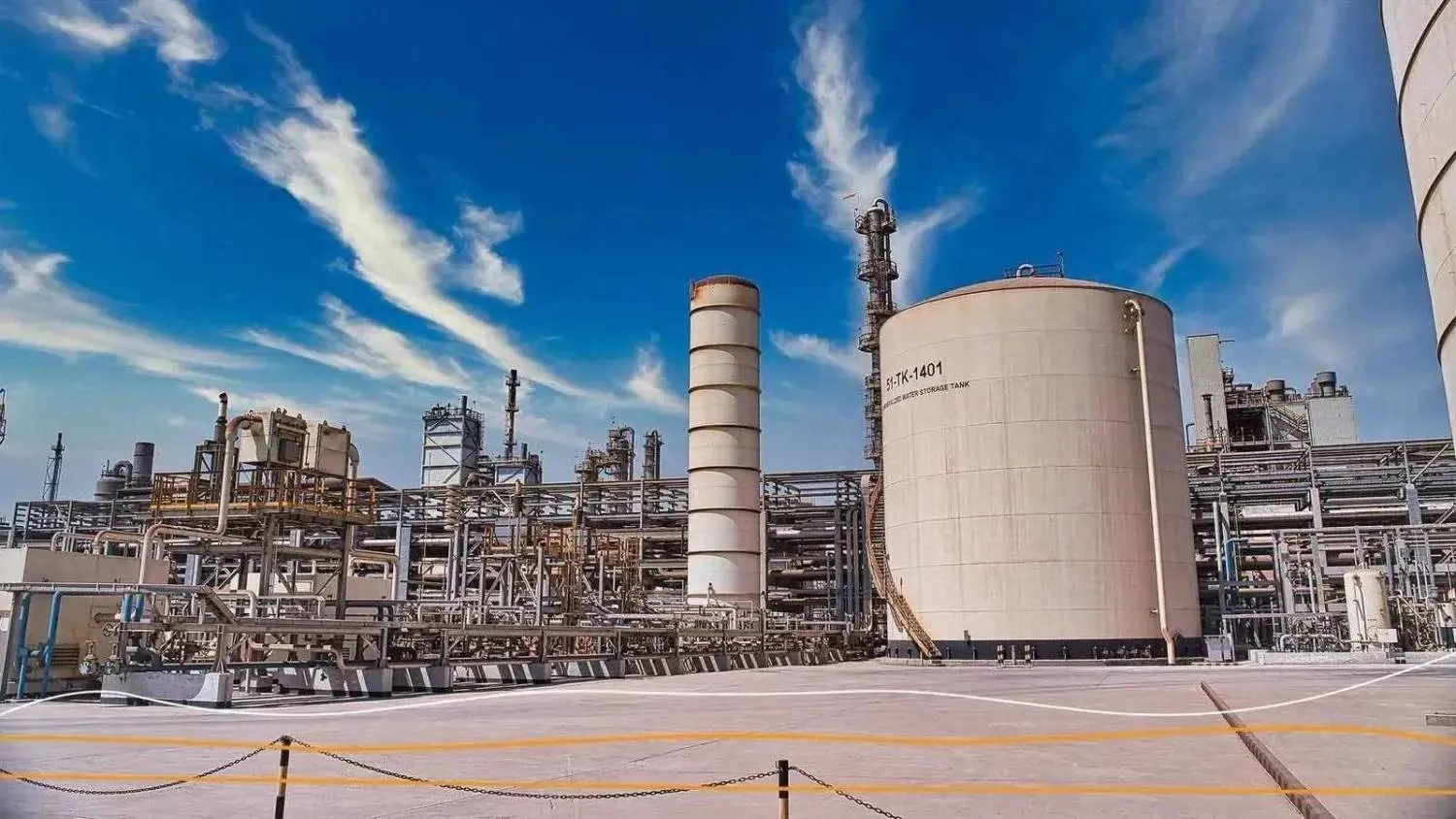
A facility operated by the Saudi International Petrochemical Company (Sipchem) (Photo: the company’s website)
Saudi Arabia’s General Authority for Statistics (GASTAT) released preliminary data for the Industrial Production Index (IPI) for October 2025, reporting a strong 8.9 percent increase compared with the same month last year.
The rise was supported by robust performance across most major economic activities, led by mining and quarrying, manufacturing, and higher output in electricity, gas, water, and wastewater services.
On a monthly basis, the overall index inched up 0.3 percent from September 2025. Mining and quarrying, by far the heaviest-weighted component of the IPI, was the main engine of growth, posting an 11.5 percent annual rise in October. The increase was largely attributed to a sharp boost in Saudi oil production, which reached 10 million barrels per day, up from 8.9 million barrels per day in the same month of 2024.
Month-on-month, the sector continued to strengthen, with its sub-index rising 0.4 percent from September.
The manufacturing sub-index recorded a solid 5.5 percent annual expansion. This performance was driven by coke and refined petroleum products, up 8.0 percent year-on-year, and chemicals and chemical products, which posted 8.1 percent growth.
Monthly data also showed momentum: manufacturing rose 0.9 percent from September, supported by a 2.7 percent increase in chemicals and a 1.5 percent rise in refined petroleum products.
Within manufacturing, most detailed activities registered year-on-year growth. Manufacture of paper and paper products climbed 5.6 percent, while non-metallic mineral products rose 4.4 percent. However, some subsectors diverged: basic metals declined 6.3 percent year-on-year, and food products fell 4.9 percent month-on-month despite recording 1.9 percent annual growth.
In the utilities segment, the electricity, gas, steam, and air conditioning supply index grew 5.1 percent year-on-year. Water supply, wastewater, waste management, and remediation activities posted an even stronger rise of 8.5 percent.
Despite positive annual trends, electricity and gas supply fell 5.8 percent on a monthly basis, whereas water and wastewater services edged up 0.6 percent.
A breakdown by economic activity shows that October’s annual growth was heavily influenced by oil production. The petroleum activities index recorded a 10.8 percent year-on-year increase.
Non-oil industrial activities also expanded, rising 4.4 percent annually. On a monthly basis, petroleum activities grew 0.6 percent, while non-oil activities slipped 0.3 percent compared with September.
Saudi Minister of Energy and Minister of Industry and Mineral Resources Prince Abdulaziz bin Salman bin Abdulaziz (L) at the Riyadh meeting on Monday. (SPA)
Saudi Minister of Energy and Minister of Industry and Mineral Resources Prince Abdulaziz bin Salman bin Abdulaziz (L) at the Riyadh meeting on Monday. (SPA)
Ministers of OPEC and non-OPEC Participating Countries in the Declaration of Cooperation (DoC) met on the sidelines of the 17th IEF ministerial meeting and the 25th WPC Energy Congress in Riyadh on Monday.
The ministers reviewed market conditions and agreed to continue consultation with all OPEC+ countries, through already established mechanisms, including the Joint Ministerial Monitoring Committee (JMMC) and the OPEC and Non-OPEC Ministerial Meetings (ONOMM).
They reaffirmed their commitment to the decisions made on June 7, 2026 (41stONOMM) to achieve and sustain a stable oil market.
The ministers stressed the critical importance of safeguarding the international maritime routes to ensure the uninterrupted flow of energy.
They noted that the current interruption of energy flows has elevated the cost of shipping and insurance, which have reached unprecedented levels of more than one third of the commodity value, impeding the timely and efficient movement of crude oil and products, and placing additional inflationary pressures on the global economy.
These exceptionally elevated costs are ultimately transmitted across the oil value chain, increasing and prolonging the cost burden on producing and consuming countries and impacting global economic growth, they remarked.
The ministers will continue monitoring the situation and will engage with governments, industry stakeholders, and international organizations such as the IEF, IEA, and others to improve global shipping conditions.
Saudi Energy Minister Signs MoUs on Energy Cooperation with Mongolia, Tanzania, Cyprus, and Mauritiushttps://english.aawsat.com/business/5328906-saudi-energy-minister-signs-mous-energy-cooperation-mongolia-tanzania-cyprus-and
Saudi Minister of Energy and Minister of Industry and Mineral Resources Prince Abdulaziz bin Salman bin Abdulaziz and Cyprus’s Minister of Energy, Commerce and Industry Michael Damianos during the signing ceremony in Riyadh on Monday. (SPA)
TT
TT
Saudi Energy Minister Signs MoUs on Energy Cooperation with Mongolia, Tanzania, Cyprus, and Mauritius
Saudi Minister of Energy and Minister of Industry and Mineral Resources Prince Abdulaziz bin Salman bin Abdulaziz and Cyprus’s Minister of Energy, Commerce and Industry Michael Damianos during the signing ceremony in Riyadh on Monday. (SPA)
Saudi Minister of Energy and Minister of Industry and Mineral Resources Prince Abdulaziz bin Salman bin Abdulaziz signed in Riyadh on Monday four memoranda of understanding with ministers from Mongolia, Tanzania, Cyprus and Mauritius to strengthen cooperation across a range of energy fields.
The MoUs were signed on the sidelines of the 25th WPC Energy Congress, hosted by Saudi Arabia through October 15 under the theme “Pathways to an Energy Future for All."
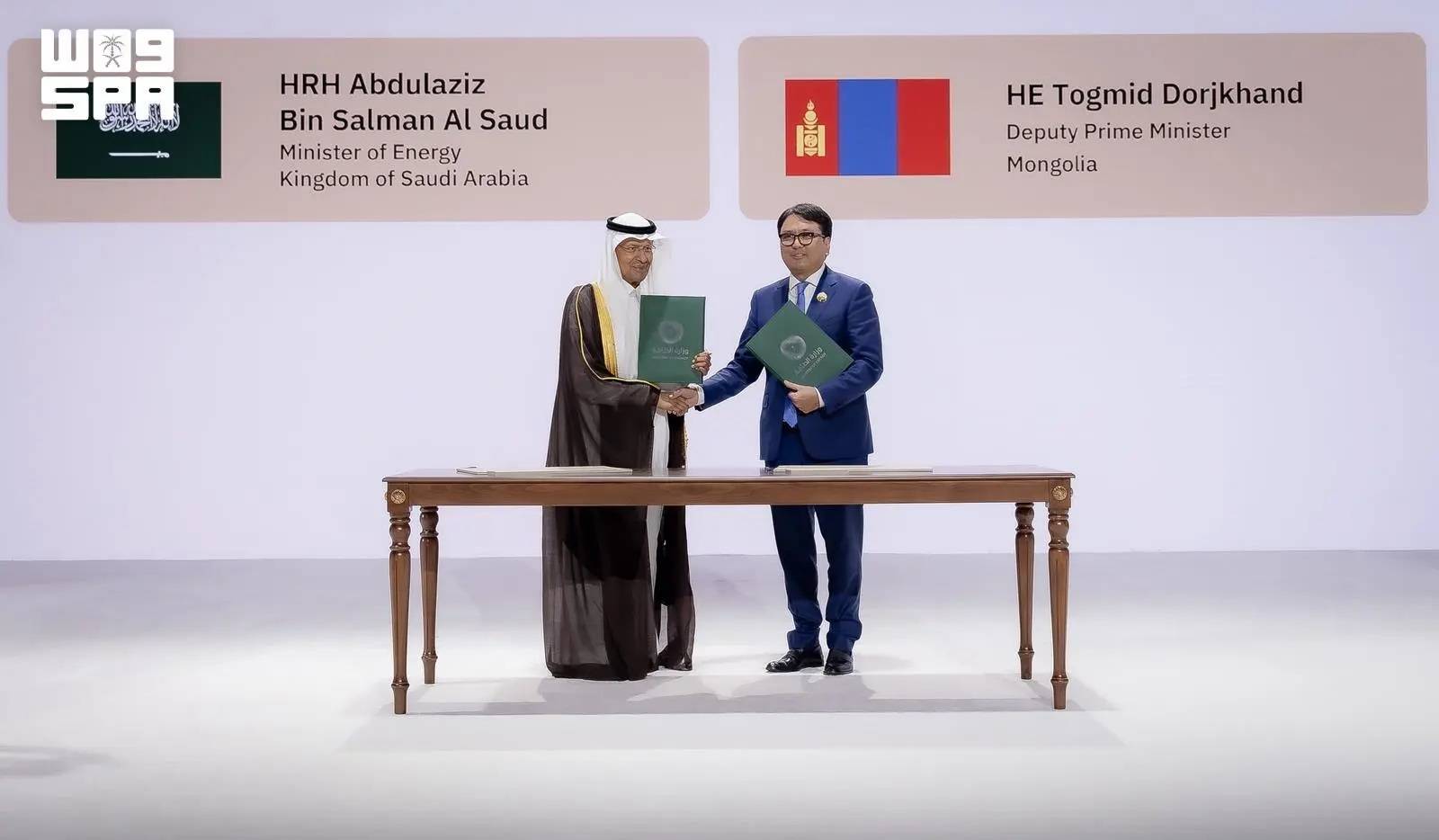
Prince Abdulaziz and Mongolia’s Deputy Prime Minister Togmid Dorjkhand signed an MoU to strengthen cooperation between the two countries in oil and gas and their derivatives, refining, petrochemicals, electricity, power interconnection, renewable energy, energy efficiency, energy storage, and technologies and solutions related to climate change mitigation, including Circular Carbon Economy solutions.
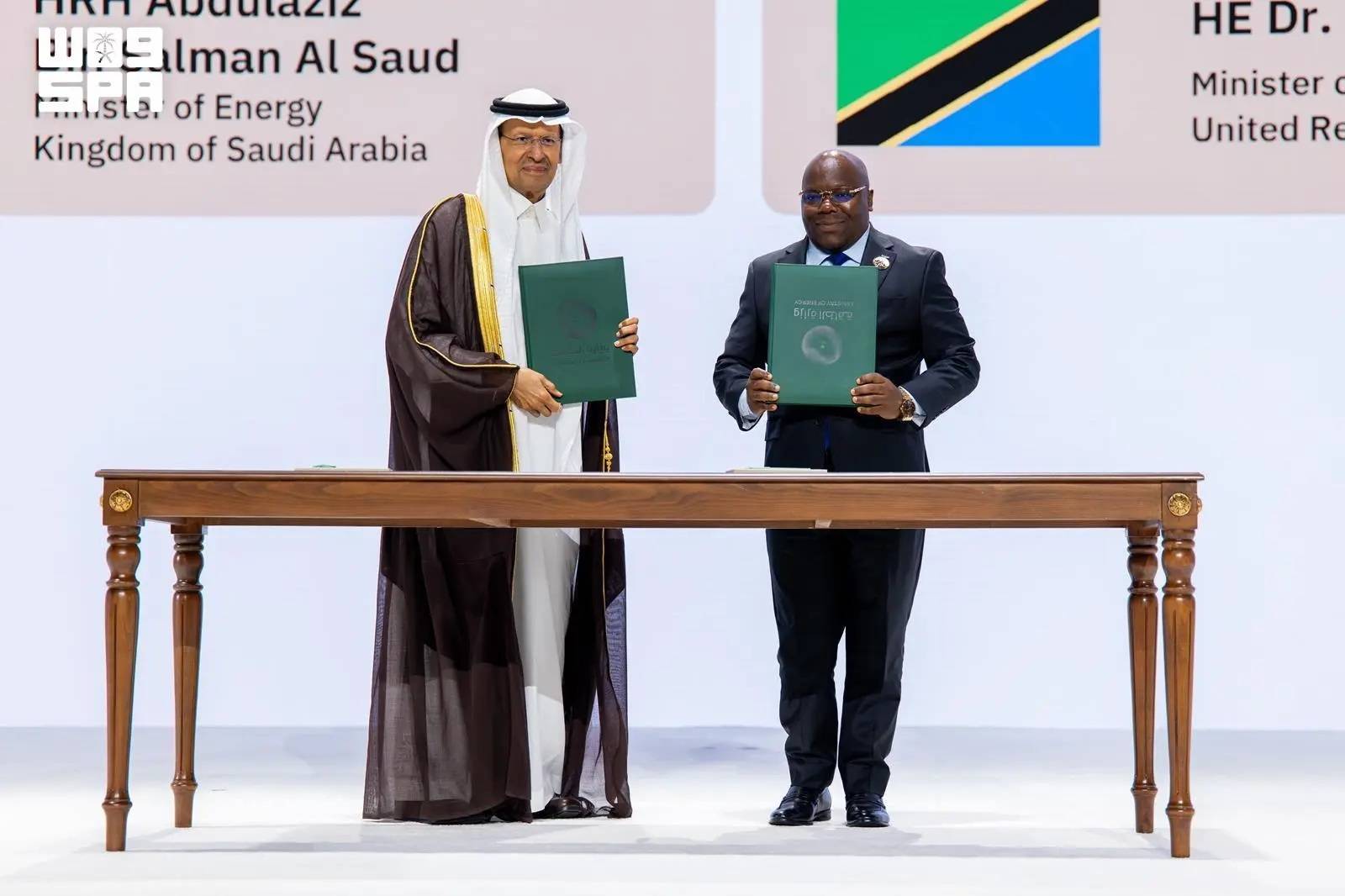
Saudi Minister of Energy and Minister of Industry and Mineral Resources Prince Abdulaziz bin Salman bin Abdulaziz and Tanzania’s Minister for Energy Juma Zuberi Homera during the signing ceremony. (SPA)
The MoU covers cooperation in digital transformation, innovation, cybersecurity applications and artificial intelligence in the energy sector. It seeks to develop strategic partnerships between the two countries to secure materials, products and services across energy sectors and their supply chains and technologies; promote the development and use of sustainable petrochemical materials in construction and other sectors; strengthen cooperation between energy companies; and support them in implementing large-scale electricity projects and harnessing renewable energy in both countries.
Prince Abdulaziz signed an MoU with Tanzania’s Minister for Energy Juma Zuberi Homera to strengthen cooperation between the two countries in the supply of refined petroleum products and explore opportunities related to associated infrastructure, assess opportunities in liquefied natural gas, exchange technical expertise in oil and gas exploration, and explore opportunities in petrochemical production.
The MoU covers electricity, renewable energy, energy efficiency, and the exchange of technologies and solutions related to climate change mitigation, including clean cooking solutions and Circular Carbon Economy technologies and solutions. It further includes exploring opportunities related to the Oil Sustainability Program and transport and fuel infrastructure, as well as cooperation in digital transformation, innovation, cybersecurity applications and artificial intelligence in the energy sector.
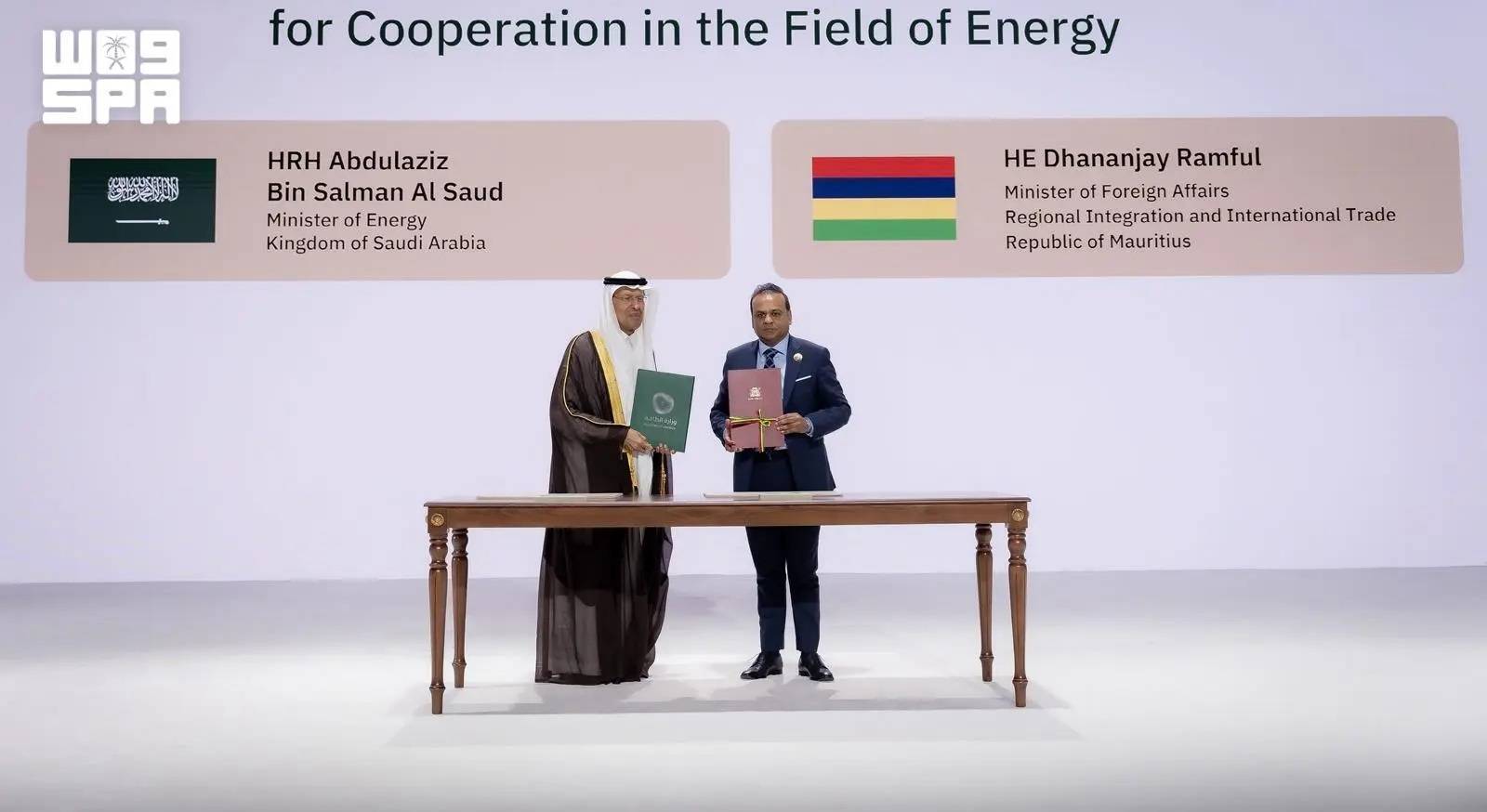
Saudi Minister of Energy and Minister of Industry and Mineral Resources Prince Abdulaziz bin Salman bin Abdulaziz and Mauritius’s Minister of Foreign Affairs, Regional Integration and International Trade Dhananjay Ramful during the signing ceremony. (SPA)
Prince Abdulaziz and Cyprus’s Minister of Energy, Commerce and Industry Michael Damianos signed an MoU establishing a framework for cooperation in oil and gas and their derivatives, refining, petrochemicals, electricity, clean hydrogen and its derivatives, renewable energy, energy efficiency, energy storage, and technologies and solutions related to climate change mitigation, including Circular Carbon Economy technologies and solutions.
The MoU covers cooperation in digital transformation and cybersecurity applications in the energy sector, as well as efforts to advance and support shared international policy priorities through relevant multilateral negotiations, including under the United Nations Framework Convention on Climate Change, the Paris Agreement and the international legally binding instrument on plastic pollution.
It further provides for cooperation on the development and use of sustainable petrochemical materials in construction and other sectors, the development of appropriate infrastructure to expand energy access, and cooperation between companies operating in energy-related fields.
Saudi Minister of Energy and Minister of Industry and Mineral Resources Prince Abdulaziz bin Salman bin Abdulaziz and Mongolia’s Deputy Prime Minister Togmid Dorjkhand. (SPA)
Prince Abdulaziz signed an MoU with Mauritius’s Minister of Foreign Affairs, Regional Integration and International Trade Dhananjay Ramful covering cooperation in oil and gas and their derivatives, refining, petrochemicals, electricity, clean hydrogen and its derivatives, renewable energy, energy efficiency, energy storage, and technologies and solutions related to climate change mitigation, including Circular Carbon Economy technologies and solutions.
The MoU also covers cooperation in digital transformation and cybersecurity applications in the energy sector.
It provides for efforts to advance and support shared international policy priorities through relevant multilateral negotiations, including under the United Nations Framework Convention on Climate Change, the Paris Agreement and the international legally binding instrument on plastic pollution.
It covers cooperation on the development and use of sustainable petrochemical materials in construction and other sectors, as well as the development of appropriate infrastructure to expand energy access.
Minister of Finance Leads Saudi Delegation to 2026 IMF-World Bank Annual Meetingshttps://english.aawsat.com/business/5328905-minister-finance-leads-saudi-delegation-2026-imf-world-bank-annual-meetings
Saudi Minister of Finance Mohammed Aljadaan. (SPA file)
TT
TT
Minister of Finance Leads Saudi Delegation to 2026 IMF-World Bank Annual Meetings
Saudi Minister of Finance Mohammed Aljadaan. (SPA file)
Minister of Finance Mohammed Aljadaan is leading Saudi Arabia's delegation to the 2026 Annual Meetings of the International Monetary Fund (IMF) and World Bank Group (WBG) in Bangkok from October 12-17.
The Saudi delegation includes Governor of the Saudi Central Bank (SAMA) Ayman Alsayari; Deputy Chair of the International Monetary and Financial Committee (IMFC) Dr. Ryadh Alkhareif; Deputy Minister of Finance for International Relations Khalid Bawazier; CEO of the Saudi Fund for Development (SFD) Sultan Almarshad; CEO of the National Debt Management Center (NDMC) Hani Almedaini; and experts from the Ministry of Finance, SAMA, SFD, NDMC, and the Zakat, Tax and Customs Authority (ZATCA).
Aljadaan will participate in the IMF and Gulf Cooperation Council (GCC) High-Level Seminar; the IMF Managing Director's meeting with the Middle East, North Africa, Afghanistan and Pakistan; and the Arab Governors' meeting with the President of the WBG.
Aljadaan and Alsayari will participate in the Third G20 Finance Ministers and Central Bank Governors (FMCBG) Meeting, held under the US Presidency. Discussions will focus on key developments in the global economy, emerging challenges, and ways to strengthen international economic cooperation.
Aljadaan will chair the IMFC meeting, where members will exchange views on developments in the global economy, including growth prospects and emerging risks. Discussions will cover global economic policy priorities and the IMF's role in addressing these challenges through financial assistance, advice, and capacity development for its members.
He will also take part in the WBG Governor's Development Committee meeting to discuss the latest updates in the WBG's development strategies, including its role in helping to create jobs as a key economic driver, enabling the private sector, and supporting countries in reforming policies that attract investments and promote economic growth.
The Annual Meetings serve as a global platform that brings together finance ministers, central bankers, senior officials from international organizations, private sector executives, representatives from civil society organizations, and academics to discuss global issues, including the global economy, sustainable development, poverty eradication, and other economic and financial topics.
لم تشترك بعد
انشئ حساباً خاصاً بك لتحصل على أخبار مخصصة لك ولتتمتع بخاصية حفظ المقالات وتتلقى نشراتنا البريدية المتنوعة