


Israel Insists on Hamas Disarmament, Rejects Freeze Proposal

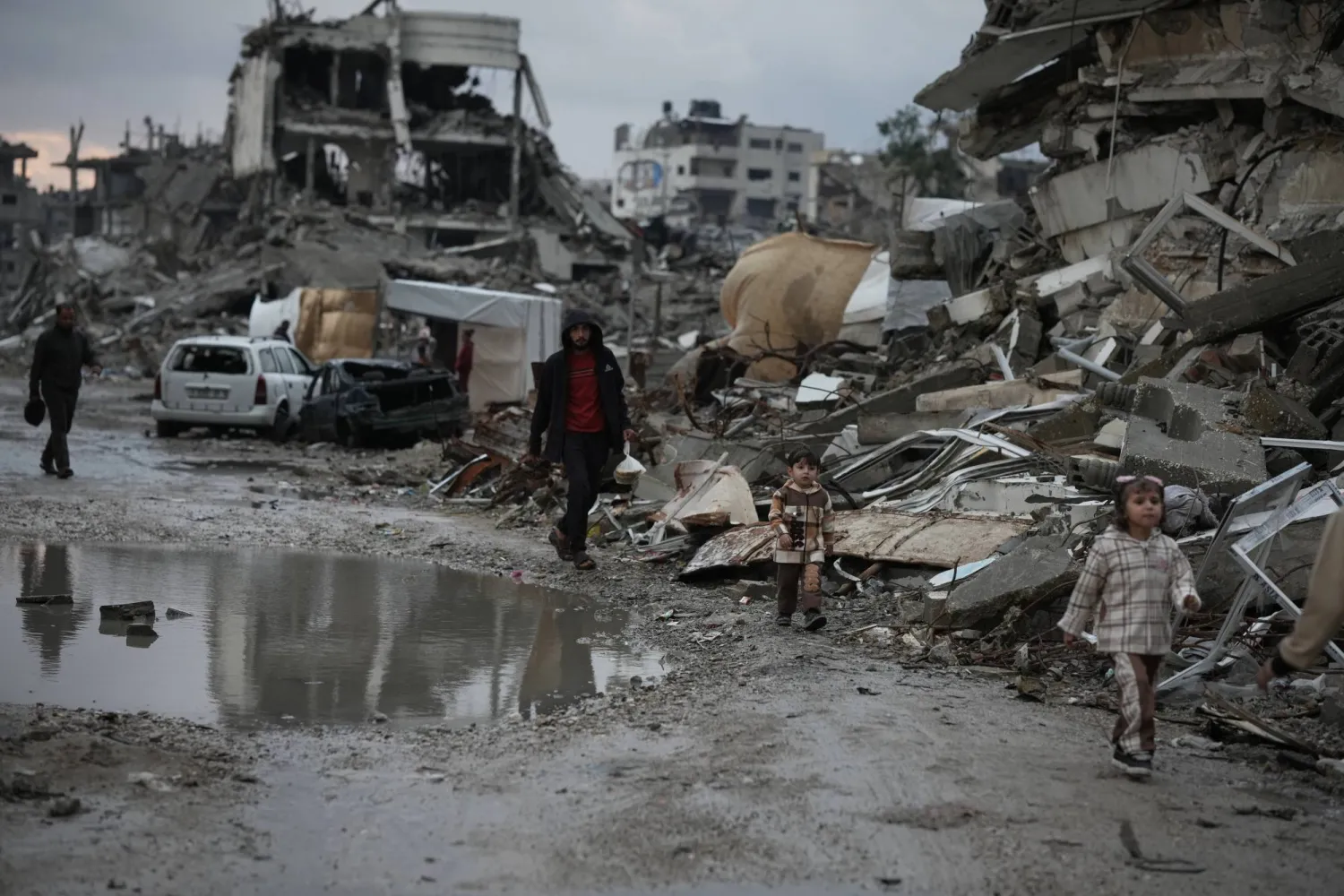
Palestinians walk through the rubble amid stormy weather in Gaza City Thursday, Dec. 11, 2025. (AP Photo/Jehad Alshrafi)
TT

Israel Insists on Hamas Disarmament, Rejects Freeze Proposal

Palestinians walk through the rubble amid stormy weather in Gaza City Thursday, Dec. 11, 2025. (AP Photo/Jehad Alshrafi)

Israel has held firm to demands that Hamas be disarmed as part of President Donald Trump’s ceasefire plan for Gaza, whose first phase began in October. An Israeli official said Tel Aviv has rejected a proposal from the group’s leadership to freeze the use of weapons under a long term truce.

Speaking to Agence France Presse on Thursday, the official said there will be no future for Hamas under the twenty-point plan and the group will be disarmed.

Gaza will be demilitarized, the official added.

The comments came a day after Khaled Meshaal, the head of Hamas’s political bureau abroad, relayed in an interview aired by Al Jazeera on Wednesday that the idea of completely giving up weapons is unacceptable to the resistance.

He said the group had floated the notion of freezing its weapons, adding that the resistance was offering proposals that could guarantee the absence of military escalation from Gaza against Israel.

Israeli Army Radio quoted an official in Tel Aviv on Thursday as saying Israel “remains committed to fully disarming Gaza,” adding that there is ongoing coordination with the United States on this issue.

The ceasefire agreement, which took effect on October 10, stipulates that Hamas and other armed factions in Gaza must be disarmed.

Openness in the Trump administration

A senior Hamas figure believes the Trump administration, which has repeatedly stressed disarmament, “has become more open to ideas being exchanged between Hamas and the mediators on one side and Washington on the other.”

The source told Asharq Al-Awsat that “several ideas were proposed by the movement and developed by the mediators, and other proposals are still being passed around by different parties to help accelerate the transition to the second phase.”

But Hamas’s perceptions seem at odds with recent public statements, most recently from US Ambassador to the United Nations Mike Waltz in his meeting with Israeli President Isaac Herzog on Wednesday. Waltz said Washington would not allow Hamas to rebuild itself.

Sources in the group said contacts with all parties were continuing and that the current talks show greater seriousness to reach understandings on this issue and others.

Hamas appears to be banking on American flexibility that could allow it to retain its weapons or place them in storage under a freeze, or even put them under the custody of an Arab or Islamic party.

One Hamas source said “the mediators are capable of creating broad convergence and understanding with the United States on the weapons issue and other important files such as the deployment of international forces and the governance of the Gaza Strip.”

Meshaal had explained his proposal for freezing, rather than dismantling, the group’s weapons by saying it wants a framework with guarantees that Israel will not return to war against Gaza.

He suggested that weapons can be safeguarded and neither used nor displayed.

Meshaal added that mediators could guarantee that Hamas and other resistance forces in Gaza would prevent any military escalation from the enclave.

A role for the Authority

Israel insists on moving to the second phase of the deal after Hamas hands over the body of the last Israeli hostage in its custody. Prime Minister Benjamin Netanyahu said days ago that the transition to the next phase was near, while noting the difficulties surrounding it such as disarming Hamas and Gaza “whether the easy way or the hard way.”

Amid the dispute between Hamas and Israel, the Palestinian Authority has underscored its position that it must assume full responsibilities in Gaza with exclusive authority over security and law.

President Mahmoud Abbas has held talks in recent days with several Arab, Islamic and European leaders, stressing the Authority’s readiness to take over and its commitment to its reform program, which he said would enable it to carry out its duties and prepare for comprehensive elections.

Hamas does not publicly comment on the Authority’s stance, but a senior source in the group told Asharq Al Awsat, “We have no objection to coordinating with the Palestinian Authority and for it to assume its responsibilities in Gaza, but this requires agreement on a comprehensive national program.”

The source added that “another problem is that Israel refuses to allow any role for the Authority in Gaza and we are working with all parties, with help from international pressure on Tel Aviv, so that the Palestinian Authority can eventually govern the strip.”



Lebanon PM Says Won’t Allow Country to Be Dragged into New Conflict

Smoke and flames rise from a building after an Israeli airstrike in Ain Qana village, in southern Lebanon, 02 February 2026. (EPA)
TT

Lebanon PM Says Won’t Allow Country to Be Dragged into New Conflict

Smoke and flames rise from a building after an Israeli airstrike in Ain Qana village, in southern Lebanon, 02 February 2026. (EPA)

Lebanon's prime minister said Tuesday he will not allow his country to be dragged into a new conflict, after Hezbollah warned any attack on its Iranian backer would be an attack on the group.

"We will never allow anyone to drag the country into another adventure," Nawaf Salam said during the World Governments Summit in Dubai, in response to a question about comments made by Hezbollah chief Sheikh Naim Qassem last week.

Qassem had responded to American threats of military action against Iran, saying: "We will choose at that time how to act... but we are not neutral."

Salam said Hezbollah's decision to enter the Gaza war in support of its ally Hamas had "very big" consequences for Lebanon and that "no one is willing to expose the country to adventures of this kind".


Syria Kurds Impose Curfew in Qamishli Ahead of Govt Forces Entry

02 February 2026, Syria, Saran: Syrian internal security forces are preparing near the village of Saran to enter the Kobane region northeast of Aleppo, following an agreement between the SDF and the Syrian government stipulating the entry of a number of Syrian security forces into the cities of Hasakeh, Qamishli, and Kobane to take over government institutions. (dpa)
TT

Syria Kurds Impose Curfew in Qamishli Ahead of Govt Forces Entry

02 February 2026, Syria, Saran: Syrian internal security forces are preparing near the village of Saran to enter the Kobane region northeast of Aleppo, following an agreement between the SDF and the Syrian government stipulating the entry of a number of Syrian security forces into the cities of Hasakeh, Qamishli, and Kobane to take over government institutions. (dpa)

Kurdish forces imposed a curfew on Kurdish-majority Qamishli in northeastern Syria on Tuesday, ahead of the deployment of government troops to the city, an AFP team reported.

The curfew came after Syrian security personnel entered the mixed Kurdish-Arab city of Hasakeh and the countryside around the Kurdish town of Kobane on Monday, as part of a comprehensive agreement to gradually integrate the Kurds' military and civilian institutions into the state.

The Kurds had ceded territory to advancing government forces in recent weeks.

An AFP correspondent saw Kurdish security forces deployed in Qamishli and found the streets empty of civilians and shops closed after the curfew came into effect early on Tuesday.

It will remain in force until 6:00 am (0300 GMT) on Wednesday.

The government convoy is expected to enter the city later on Tuesday and will include a limited number of forces and vehicles, according to Marwan al-Ali, the Damascus-appointed head of internal security in Hasakeh province.

The integration of Kurdish security forces into the interior ministry's ranks will follow, he added.

Friday's deal "seeks to unify Syrian territory", including Kurdish areas, while also maintaining an ongoing ceasefire and introducing the "gradual integration" of Kurdish forces and administrative institutions, according to the text of the agreement.

It was a blow to the Kurds, who had sought to preserve the de facto autonomy they exercised after seizing vast areas of north and northeast Syria in battles against the ISIS extremist group during the civil war, backed by a US-led coalition.

Mazloum Abdi, head of the Kurdish-led Syrian Democratic Forces (SDF), had previously said the deal would be implemented on the ground from Monday, with both sides to pull forces back from frontline positions in parts of the northeast, and from Kobane in the north.

He added that a "limited internal security force" would enter parts of Hasakeh and Qamishli, but that "no military forces will enter any Kurdish city or town".


Sudan Army Breaks Siege on Key Southern City of Kadugli

A volunteer fills water containers at a free distribution point, due to water outages in Khartoum, Sudan, Friday, Jan. 30, 2026. (AP Photo/Marwan Ali)
TT

Sudan Army Breaks Siege on Key Southern City of Kadugli

A volunteer fills water containers at a free distribution point, due to water outages in Khartoum, Sudan, Friday, Jan. 30, 2026. (AP Photo/Marwan Ali)

Sudanese army forces broke Tuesday a siege by the Rapid Support Forces on the South Kordofan state capital Kadugli, two army sources told AFP.

"Our forces have entered Kadugli and lifted the siege," one said on condition of anonymity because they were not authorized to brief the media.

Famine-hit Kadugli was long besieged by the RSF and their local allies, at war with Sudan's regular army since April 2023.