SME Bank Signs 19 Agreements Worth over SAR3 Billion to Strengthen Finance, Development

The memoranda of understanding aim to establish a unified development-finance model that serves small and medium enterprises (SMEs) across various economic sectors - SPA
TT

SME Bank Signs 19 Agreements Worth over SAR3 Billion to Strengthen Finance, Development

The memoranda of understanding aim to establish a unified development-finance model that serves small and medium enterprises (SMEs) across various economic sectors - SPA

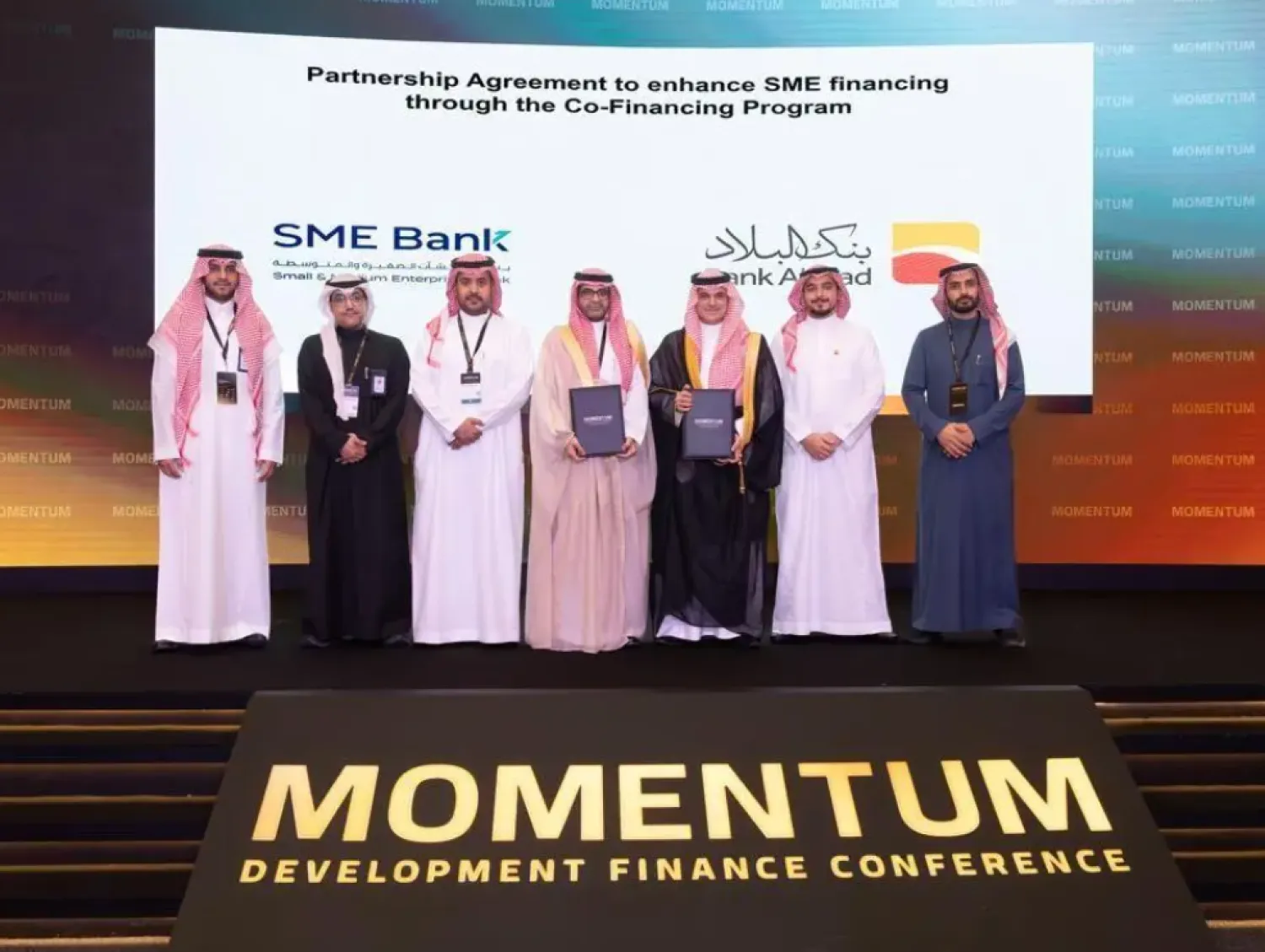
The Small and Medium Enterprises Bank (SME Bank) signed 19 cooperation agreements and memoranda of understanding with entities from both the public and private sectors, with a total value exceeding SAR3 billion, in support of the development finance ecosystem and the empowerment of enterprises as part of the Development Finance Conference MOMENTUM 2025, SPA reported.

The memoranda of understanding aim to establish a unified development-finance model that serves small and medium enterprises (SMEs) across various economic sectors and enhances integration among development entities under the National Development Fund ecosystem, thereby contributing to improving financing efficiency and expanding SMEs’ access to sustainable financing solutions.

The cooperation agreements come as an extension of the bank's commitment to expanding the range of financing options through strategic partnerships that support growth and sustainability, enable entrepreneurs to scale their businesses, and strengthen the role of the private sector in supporting the national economy and increasing its contribution to gross domestic product (GDP).


US Bonds Tumble as Oil Price Surge Rekindles Inflation Fears

Patrick King works on the floor at the New York Stock Exchange in New York, Wednesday, March 4, 2026. (AP Photo/Seth Wenig)
TT

US Bonds Tumble as Oil Price Surge Rekindles Inflation Fears

Patrick King works on the floor at the New York Stock Exchange in New York, Wednesday, March 4, 2026. (AP Photo/Seth Wenig)

A steep selloff ‌in US Treasuries extended into a fourth straight day on Thursday, as investors fretted that surging energy prices from the war in the Middle East could stoke inflation and derail the Federal Reserve's rate outlook.

The benchmark 10-year US Treasury yield jumped as much as 5 basis points in Asia to a three-week high of 4.1310%, extending its rise for the week thus far to nearly 17 bps.

The two-year yield was meanwhile up about 2 bps to ‌3.5640%, having ‌also gained more than 18 bps ‌this ⁠week. Bond prices move ⁠inversely to yields, said Reuters.

Investors have pared back expectations of further easing from the Fed this year on the back of the US-Israel war with Iran, which entered its sixth day as Iran launched a wave of missiles at Israel, sending millions of residents into bomb shelters.

That has ⁠kept oil prices elevated, and with shipping ‌through the key Strait of ‌Hormuz paralyzed, investor focus has quickly shifted to the risk ‌of a resurgence in inflation.

"As of right now, ‌the (US) consumer price index is going to get back to the high (2%) if crude oil costs don't tumble in short order," said Jose Torres, senior economist at Interactive Brokers.

"The reversal in (inflation) ‌progress would likely send Treasuries and stocks further lower, as rate-cut optimism amid decelerating cost ⁠pressures was ⁠what sparked the rallies in fixed income and cyclical benchmarks early in 2026."

Traders are now pricing in just a 34% chance of a Fed cut in June, as compared to a near 46% chance a week ago, according to the CME FedWatch tool.

Fed funds futures point to just over 40 bps worth of easing by the year-end.

The shifting Fed expectations have also come on the back of Wednesday's upbeat US economic data, which showed services sector activity surged to more than a 3-1/2-year high in February amid strong demand.


Could Egypt’s ‘SUMED’ Pipeline Temporarily Replace the Strait of Hormuz?

Egypt’s Petroleum Minister Karim Badawi during an inspection tour of SUMED port (Egyptian Petroleum Ministry)
TT

Could Egypt’s ‘SUMED’ Pipeline Temporarily Replace the Strait of Hormuz?

Egypt’s Petroleum Minister Karim Badawi during an inspection tour of SUMED port (Egyptian Petroleum Ministry)

Amid the ongoing Iran war and Tehran’s announcement of the closure of the Strait of Hormuz, a key artery for global energy supplies, Egypt has begun highlighting the SUMED pipeline linking the Red Sea and the Mediterranean as a potential temporary alternative for oil transport.

The move has raised questions about whether the pipeline, a vital connection between the two seas, could help offset disruptions to the volatile waterway.

Egypt’s Minister of Petroleum and Mineral Resources Karim Badawi addressed the issue during a government press conference on Tuesday, saying Egypt “has sufficient technical and logistical capabilities to support this strategic route.”

He said the SUMED pipeline enhances the flexibility of oil supply flows in the region and confirmed Egypt’s readiness to cooperate with Gulf states to facilitate oil transport from the Red Sea to the Mediterranean through the line.

Energy experts who spoke to Asharq Al-Awsat agreed that the pipeline could help ease the current energy crisis amid the absence of any political solution to end the war, noting the line was originally designed as an alternative route when oil shipments face obstacles passing through the Suez Canal.

SUMED pipeline

The pipeline is owned by the Arab Petroleum Pipelines Company (SUMED), an Arab joint venture led by Egypt, with a 50% stake held by the Egyptian General Petroleum Corporation, alongside partners from Gulf states.

The pipeline runs across Egypt from Ain Sokhna on the Gulf of Suez to Sidi Kerir on the Mediterranean coast, with a capacity of about 2.8 million barrels per day.

According to Egypt’s petroleum ministry, the pipeline transported about 24.9 billion barrels of crude oil and more than 730 million barrels of petroleum products from its launch in 1974 through 2024.

Ahmed Kandil, head of Energy Studies Program at the Al-Ahram Center for Political and Strategic Studies, said the line’s importance lies in easing disruptions to oil trade following Tehran’s declaration that it had closed the Strait of Hormuz.

He told Asharq Al-Awsat that oil shipments could reach the pipeline via tankers transporting crude from Saudi Arabia’s Yanbu port to Egypt’s Ain Sokhna port, from where it would move through the pipeline to the Mediterranean and onward to Europe.

He said coordination with Gulf states is underway to contain concerns over energy supplies, particularly among European consumers.

Kandil added that the arrival of part of Gulf exports to European markets is highly important, helping limit spikes in Brent crude prices, which have already surpassed $80 per barrel.

“The growing importance of the Egyptian pipeline comes amid the absence of a political horizon, which means the current conflict could be prolonged,” he said.

Storage capacity

According to the US Energy Information Administration, the main reason for building the SUMED pipeline at this location is that very large crude carriers — capable of transporting about 2.2 million barrels — cannot pass through the Suez Canal due to their excessive weight and width, which could risk grounding.

Instead, they offload their cargo at Ain Sokhna, where the oil is transported through the pipeline to the other side of Egypt. Smaller vessels then reload the crude at Sidi Kerir and sail to Europe and the United States.

Energy markets expert Ramadan Abu Al-Ala said the Egyptian pipeline serves as an alternative to the Suez Canal and could temporarily ease the crisis caused by the closure of the Strait of Hormuz.

He noted that the pipeline is particularly effective for oil tankers arriving from Saudi Arabia, Oman, Bahrain and the United Arab Emirates, which can unload at Ain Sokhna before the crude is transported to the Mediterranean and European markets.

Abu Al-Ala expects SUMED to become even more important for Gulf oil exports to Europe if the war drags on, increasing reliance on the pipeline. However, he said this would require enhanced security measures for oil tankers operating in the Red Sea.

Energy market experts also highlighted another advantage: the pipeline’s large storage capacity. SUMED operates storage tanks with a total capacity of 40 million barrels of oil.

In February 2019, Saudi Aramco signed two agreements with the company to provide storage capacity for diesel and fuel oil.


Saudi East-West Pipeline Underpins Kingdom’s Energy Security Strategy

The King Fahd Industrial Port in Yanbu. (SPA)
TT

Saudi East-West Pipeline Underpins Kingdom’s Energy Security Strategy

The King Fahd Industrial Port in Yanbu. (SPA)

As regional military tensions escalate and attacks on shipping in the Strait of Hormuz recur, Saudi Arabia’s East-West oil pipeline has re-emerged as a critical safeguard in the global energy system.

With markets closely watching threats to the vital maritime corridor, the Kingdom’s sovereign infrastructure is acting as a strategic shield to keep oil flowing. The moment underscores that Saudi Arabia’s logistical resilience and delivery capacity are as vital as its production strength, reinforcing its reputation as the most reliable supplier in times of turmoil.

In a statement to Asharq Al-Awsat, Saudi Aramco said it had adjusted crude oil shipping operations to prioritize safety and service continuity, and to help ensure reliability, by temporarily redirecting allocated volumes to the Yanbu port as an option for customers unable to access the Arabian Gulf.

“We remain fully committed to supporting and serving our customers and continue to assess the situation in order to resume normal procedures,” the company said.

Reuters earlier cited sources as saying Aramco was seeking to reroute some crude exports to the Red Sea to avoid the Strait of Hormuz, after the risk of attacks brought shipping traffic to a near halt.

The company has also informed some buyers of its Arab Light crude that cargoes would need to be loaded at Yanbu.

Sovereign infrastructure

The pipeline, known as Petroline, is more than a transport project. It is sovereign infrastructure built to protect Saudi crude flows from potential maritime disruptions.

The East-West pipeline carries crude from fields in Saudi Arabia’s Eastern Province to the Red Sea coast, where it is exported through King Fahd Industrial Port in Yanbu. Stretching about 1,200 kilometers across the Kingdom, it runs through several pumping stations capable of moving millions of barrels per day efficiently.

The line began operating in the early 1980s during a period of heightened regional security concerns, when fears were growing over threats to shipping in the Strait of Hormuz, a route that carries about one-fifth of global seaborne oil trade.

The project had three clear aims: to provide an export outlet outside the Arabian Gulf, to strengthen Saudi energy security, and to reassure global markets about the continuity of supply.

Today, the pipeline has a capacity of about five million barrels per day, far above its initial capacity at launch. That scale gives Saudi Arabia significant logistical flexibility to redirect exports quickly in response to geopolitical or operational disruptions.

Operated by Saudi Aramco, the line is managed through advanced monitoring systems that efficiently regulate crude flows, alongside strict technical and security safeguards.

Why it matters now

Financial and economic adviser Dr. Hussein Al-Attas told Asharq Al-Awsat the pipeline linking the Eastern Region to Yanbu is among the most important strategic infrastructure projects in Saudi Arabia’s energy sector.

Its capacity of roughly five million barrels per day provides the kingdom with high logistical flexibility if disruptions occur in the Arabian Gulf or the Strait of Hormuz, he said.

Amid geopolitical tensions, having an export outlet far from maritime chokepoints reduces operational risks and strengthens the Kingdom’s ability to honor long-term supply contracts.

It is impossible to speak of zero disruptions in absolute terms, but the pipeline significantly reduces risks and makes the likelihood of widespread disruption to Saudi exports very low compared with many other producers, Al-Attas said.

He added that Petroline has evolved from a logistics project into a tool of economic national security.

What was once an oil transport project designed to improve export efficiency has become part of the Kingdom’s economic national security architecture, he said.

Aramco now treats it not only as an alternative route but as a strategic option that diversifies export outlets, reduces reliance on sensitive maritime passages, protects oil export revenues and strengthens reliability for customers in Asia and Europe.

Al-Attas stressed that delivery capability is as important as production capacity, noting that the pipeline’s strategic value lies in ensuring supply even under the most difficult conditions.

During wars or regional tensions, markets rapidly price in risk, he said. The presence of an effective alternative route gives Saudi Arabia a competitive edge by helping ease the risk premium on its crude compared with producers reliant on a single export route.

It also reinforces investor confidence in the stability of Aramco’s cash flows and strengthens the Kingdom’s image as a long-term reliable supplier—an important factor in futures markets.

The more Saudi Arabia proves it can maintain supplies even in the toughest circumstances, the more global markets will see it not only as the largest oil exporter but also as the most reliable and stable, Al-Attas said.

He stressed that the East-West pipeline is no longer just crude transport infrastructure. It is now a strategic pillar that protects revenues, supports financial stability and strengthens Saudi Arabia’s geopolitical weight in the global energy security equation.